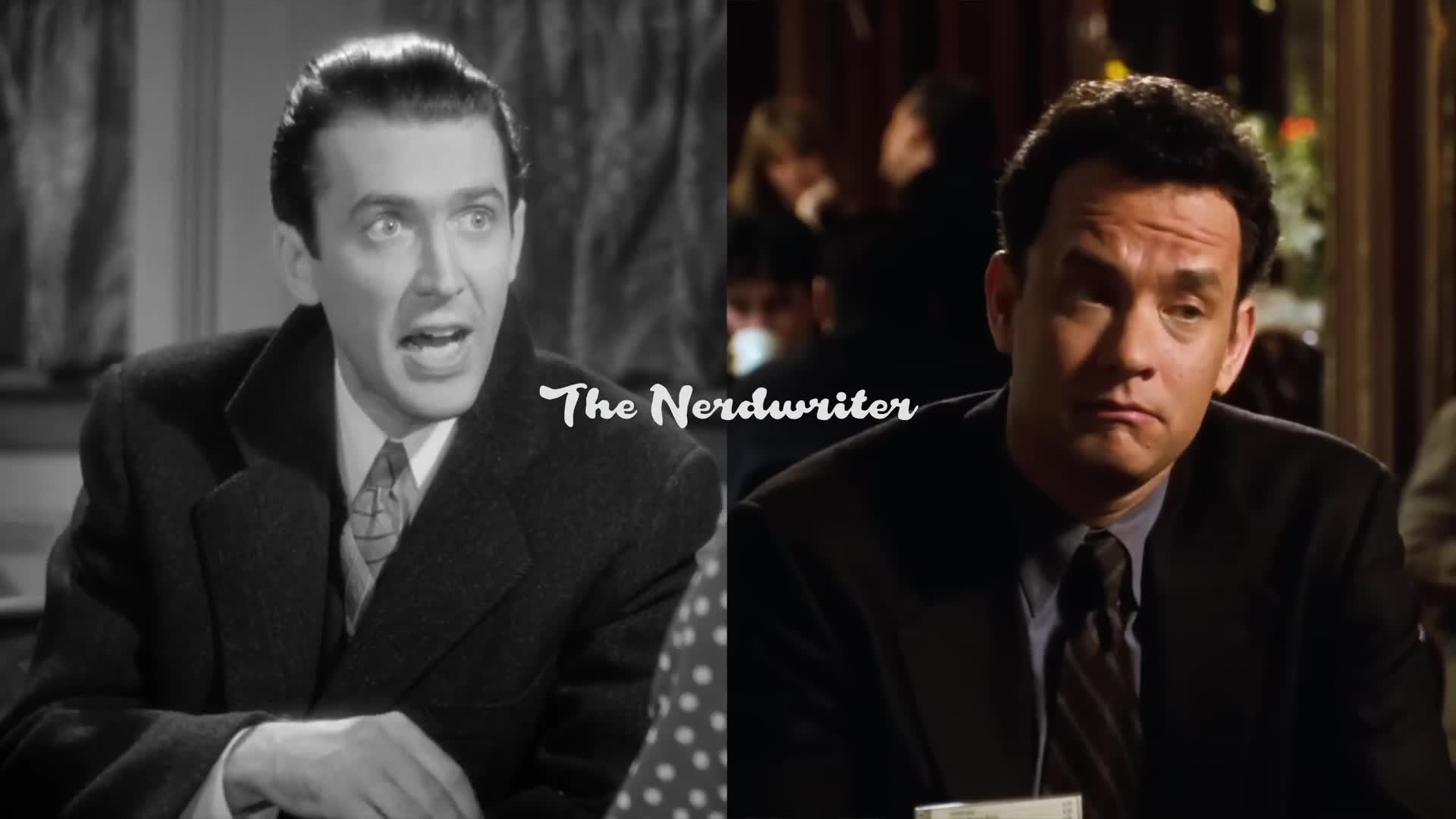
So a little while ago I had a lot of fun making a video comparing two movies filmed 60 years apart that had the same exact scene, as a way to look at how filmmaking has changed over time.
Today, I want to repeat that exercise, but from a different angle.
Let's take two movies that have the same scene, but instead of exploring the differences across time, let's look at the differences across cinematic cultures.
The movie on the left is Wim Wenders' 1987 German film Wings of Desire, and the movie on the right is the 1998 Hollywood remake City of Angels.
There is a decade of difference here, but the real contrast is between Hollywood and European art cinema and what they each prioritize.
Now, the basic plot of both movies is that an angel who wanders the city listening to people's thoughts falls in love with a mortal woman and eventually decides to give up immortality and become human.
Now, the scene I want to look at happens near the beginning of both movies and takes place in a library.
But first, how did we get here?
Wings of Desire spends its first ten minutes with the angel Damiel as he floats through a divided Berlin, listening to various people's inner monologues, which are both poetic and quotidian.
Then we get a five to six minute scene where Damiel and another angel Cassiel, discuss what they observed that day and their roles as witnesses and recorders of humanity.
Damiel expresses his desire to be a feeling being in the world, rather than an immortal invisible, insensate spectator.
Nicht immer nur am geist begeistern, sondern endlich an einer mahlzeit, eine nackenlinie, If that opening is meditative and lyrical, with meandering quality.
City of Angels, on the other hand, starts with an emotional nuclear bomb.
The first thing we see is a little girl dying and an angel, Seth, accompanying her to the afterlife.
It's tragic and sentimental, less a tug than a yank on the heartstrings.
Then, like in the original, we get Seth's conversation with Cassiel not in a car but atop a highway sign in Los Angeles.
The conversation is much shorter than in Wings of Desire just 48 seconds instead of five minutes and this will be a recurring theme.
Wings of Desire has a lot of interests, but City of Angels is dominated by one the love story, which is why we only get two and a half minutes of people's inner monologues, before spending eight minutes with Seth's love interest, Dr Maggie Rice, in another highly emotional scene.
I'm sorry.
After this, the angel Cassiel descends into the role of protagonist's best friend, listening to Seth talk about his crush in yet another scene that becomes highly dramatic and emotional.
Finally, in an emotional scene, Dr Rice talks with her doctor boyfriend who tells her to take a few days off because she's being too emotional.
Okay, so now we've made it to the library scenes.
In both movies, the library is a place where angels congregate to be around contemplative humans.
As we'll see, Wings of Desire has time to explore this space and the people in it, while City of Angels has to keep the plot moving forward.
In Vendor's film, the library scene is six minutes long.
In the Hollywood remake, it's a minute and a half.
Let's start with the latter.
In City of Angels, this scene is just four shots.
They're perfectly nice shots.
The camera moves deftly around Seth as he explores the Los Angeles Public Library.
Except, this isn't the LAPL.
It's the San Francisco Public Library because it looked better.
The first shot swoops behind Seth as he looks over the balcony on a high floor, exulting in what people are thinking and reading.
The second shot shows angels beside humans looking into the camera, presumably this is Seth's POV.
The third shot follows him as he walks around greeting another angel, and the final shot closes in on Seth watching an old man reading Ernest Hemingway's A Movable Feast before running his own hand over the book.
And there you have it, we're in and out of the scene lickety-split.
If you listen closely, you can hear snippets of Emerson Thoreau, Conrad Gabriel Garcia Marquez, Hemingway quotes about solitude divinity loneliness passion, nature.
You could find ways to link these ideas up to the story, but the story doesn't seem that interested in exploring those themes too deeply.
It's interested in a movable feast because it's Seth's gift to Dr. Rice.
It moves the love story plot forward.
In fact, when we revisit the library two more times, the setting becomes little more than a backdrop for their romance.
The first thing you notice about the library scene in Wings of Desire is that it's not hurried.
The first shot is just as long as the whole scene in City of Angels, and it's doing a lot more.
It starts by panning down from the heavens, as it were.
Then we sweep along the stacks, catching glimpses of what people are reading, and these excerpts are deeply connected to the film's themes.
For example, someone's reading Walter Benjamin's comments on Paul Klee's Angelus Novus, in which he describes an angel being swept into the future by a storm of destruction that we call progress.
So much of this movie is about the possibility of reckoning with Germany's past, the destructive storm that brought the country to this divided moment.
Its effects still visible everywhere in the streets.
After we move past the readers, we get a really interesting perspective shift.
So far, the angels have been looking directly into the lens, so we assume that it's a POV shot.
But then the camera pulls back to show Damiel and Cassiol, as if we're uncoupling from their perspective, which can't help but make us aware of our own perspective on this scene.
We become the witnesses.
And yet, we're not separate from what we see.
After all, everyone in this scene is a witness.
The library patrons read, the angels listen, and we, the audience, watch.
We witness and we identify.
Another word for that is empathy, one of the great powers of cinema.
And now that we're in this empathetic space, Vendors really earns what comes next.
We feel every unhurried second of this exaltation with Cassiel.
The next shot does the same thing, but for Damiel, framing him in front of these massive windows as if they're his wings.
Wenders makes great use of this space.
It's not just a backdrop, it's essential to the scene, just as Berlin is essential to the movie.
In Wings of Desire, place is as important as plot.
Switching to another city's prettier library doesn't make sense if you're trying to say something about Berlin.
Now, Berlin's State Library is beautiful, but vendors chose it for what it represents.
Designed in 1964, the library was built on a site flattened by World War II bombing, just steps away from the Berlin Wall which, of course, partitioned the city.
Scharoun designed a large, open, continuously flowing space.
As Alexandra Stara notes, it's impossible to say where one kind of space ends and another begins.
This makes the library something unique in a movie about walls of all kinds the wall between angel and human, between East Berlin and West Berlin, between Germany's present and its past.
The library can be a space that dissolves barriers, like Wenders dissolves the barriers between witnesses in the first shot.
Like this child can see Damiel through the angelic veil.
And yet, even in this holy place, Damiel is reminded of all that he isn't.
He goes to pick up a simple pencil, but all he can grab is its ghostly copy.
He can't touch the real thing.
He sits in a chair, clearly pained by this fact, raising up his hands like wings.
The camera moves right and pans up to Cassiel, who's watching on a higher level.
Wenders is using vertical space to communicate something here that Cassiol is less conflicted than his friend, less troubled by his divine role.
As the camera pans back, Damiel is descending the stairs, moving closer to Earth, foreshadowing his choice later in the movie.
On the stairs, he passes somebody moving in the opposite direction, ascending.
The film identifies this person as the poet Homer.
Now it's interesting that Homer is ascending because in his mind he's lamenting that no one listens to his stories in the way that they used to.
Instead of gathering around the fire as a community, they read in isolation.
We see that in the library.
But remember from the beginning of the scene we've been primed by vendors to think about our role as the audience.
Isn't it true that the people who watch this in a theater or any movie are gathering around to experience a story together?
Maybe Vendors is saying that cinema is a new form of communal storytelling, an empathy machine to quote Roger Ebert that can tear down all sorts of walls.
In Ebert's review of City of Angels, he suggests that it's a little unfair to compare these two films, because Wings of Desire is visionary and original, while City of Angels is aiming squarely for the pop mainstream.
That's definitely true, but I think it's why looking at these films shows us something about what different industries prioritize.
To be honest, I don't hate City of Angels.
I think Nick Cage and Meg Ryan are amazing performers, and I'm definitely nostalgic for a type of movie that we just don't see in theaters anymore.
That said, this remake is clearly using Wings of Desire as high concept wrapping for a formulaic love story.
And, as we've seen, those types of stories tend to have a narrow focus to which other elements are subordinated.
Sometimes you're in the mood for that kind of thing.
And sometimes you're in the mood for a movie that's less focused on plot and sentiment.
A movie that isn't scared of risking confusion or boredom for a greater reward.
A movie that's allowed to let its moments and its ideas breathe.
Hey everybody, thank you so much for watching.
This episode was brought to you by Squarespace, the all-in-one website platform for entrepreneurs to stand out and succeed online.
To get started, you can use Blueprint AI, Squarespace's AI-enhanced website builder, to get a fully customized site in just a few steps, or choose from their library of professionally designed templates that are sleek and engaging.
Every website you make will be optimized for SEO, so you'll show up more often in search results.
And you can do so much within Squarespace, like creating members-only content videos, blogs or courses, creative work that you can monetize via one-time payments or subscriptions.
The bottom line is that Squarespace is going to make a home for your products or your work that looks and feels professional, something that will impress your customers and fans.
Head over to squarespacecom for a free trial and when you're ready to launch, go to squarespacecom.
Slash nerdwriter for 10 off your first purchase.
Thanks guys, I'll see you next time.