Discussion keeps the world turning.
This is Roundtable.
Step into Earth's story with China's newest geoparks, recognized by UNESCO, where ancient landscapes reveal secrets millions of years in the making.
Coming to you live from Beijing, this is Roundtable.
I'm Hea Young. For today's program, I'm joined by Steve Hathorley and Yu Shen in the studio.
First on today's show, imagine walking through a prehistoric land dating back 165 million years where dinosaurs once roamed, or sipping tea in a Tibetan village set against ancient cliffs that hold the secrets of Earth's tectonic shifts.
Not just a cool thought, it's real life in China's newest UNESCO Global Geoparks.
This year two stunning sights, Kambula in Qinghai and Yunyang in Chongqing, have officially joined the elite club of UNESCO Global Geoparks.
From geological wonders to cutting -edge VR experiences, today we dig into why Geoparks Geoparks are more than just pretty rocks.
They are a combination of science, community, and storytelling.
So tell us about what's going on with Geoparks subtly being talked about in China?
Well, that's great news, right?
Huyang, you just mentioned how the Kambula global Geopark and Yuanyang global Geopark is newly designated.
They are, they've been, they've long been Geoparks here in China.
But receiving the title of the UNESCO Global Geoparks actually means something for them.
And speaking of which, I kind of want to mention that with these two new sites joining, China is now home to 49 global geoparks.
And that's more than any other country around the world.
That's pretty cool.
It's like the country is becoming one giant Geopark.
Just some feedbacks here is that UNESCO Global Geoparks, now that we're talking about it, It's a program that initiated by the UNESCO as early as 2001.
And in 2004, there were 17 European and 8 Chinese geo parks that came together as the first batch of UNESCO global geo parks that's announced in Paris.
And also, over the year on 17 November 2015, the 195 member states of UNESCO ratified the creation of a new label which is what we call the UNESCO Global Geoparks during their 38th General Conference.
So, this is relatively a recent title, but up until now there are 229 UNESCO Global Geoparks worldwide and that's spanning over to 50 countries around the world.
Yeah, this is all about expressing governmental recognition of the importance of managing and maintaining these incredible geological sites and then the landscapes and doing it in a holistic manner.
It's all about protecting these sites of geological significance.
Yes, and just to offer a quick explanation, UNESCO stands for the United Nations Educational Scientific and Cultural Organization.
So if you – I'm sure everybody in China have learned about that in our textbooks when we're in elementary school and that's what this this string of alphabet letters means, and it's a big deal.
What does it mean when a park is given this internationally recognized title?
I really enjoy how they described it on the UNESCO website.
That is, this designation of a UNESCO Global Geopark means that this park, this very space that we're talking about is recognized as a single, unified geographical area where sites and landscapes of international geological significance are managed with a holistic concept of protection, education, and sustainable development.
So, my interpretation of that would be it's not just about geology or, say, the natural or nature conservation alone, but more like protecting the whole area in general, including the communities there, the local culture there, and inspiring how the local development can be emerged as part of the general holistic development of the entire park or say, geological region.
So that's the idea.
Region might be a better word for people's general understanding, because I think when we hear park, we think, oh, you pay an entrance fee and you walk around for an hour.
No, these are massive spaces, right.
And these are important because it's more than just geology.
UNESCO Global GeoParks they have to demonstrate geological heritage of international significance and that's a that's a big thing to accomplish even that into its own and then the purpose of a GeoPark is to explore and then develop and then celebrate the links between the geological heritage and then all the other aspects of the areas natural and cultural and intangible heritages.
And that includes the community, oftentimes too.
Yeah, I think we previously touched upon some national parks or national, say, conservation areas here in China, including, say, the giant panda national park or the Northeast China tiger and leopard national park.
Those are national parks that protect the local environment in the purpose of protecting the animals inside, or just the general natural environment inside that area.
But here we're talking about geo -parks that focus more on the say one approach of combining Conservation of the local environment with sustainable development that involves the local people So that's the idea of this title UNESCO Global Geo part.
Right and it's great to have this title Is it for life?
Yeah, no, it's not a lifetime membership.
Yeah, you get it for a period of time actually the evaluation procedure is pretty detailed.
So when you are given this designation of a UNESCO Global Geopark, you get that designation for 4 years.
And then after 4 years, the functioning of the park and the quality of the park will be reexamined quite thoroughly.
And as part of that process, the Geopark under review at that time, then they have to prepare a progress report.
And that's followed with field mission that's undertaken by a couple of evaluators and then they assess the quality of the park and the results are broken down into different categories.
Yeah, it's like a traffic light that we're talking about here.
There's a green card. If you say, manage to fulfill all the criteria based on the field evaluation report, everything is looking good, then this area will continue as a UNESCO Global Geopark for another four years period.
and then there are the yellow card given to those areas that no longer fulfills the criteria and the management body will be informed to just work on your best to take appropriate steps within the two years period.
It's like a warning, right?
Yeah, it's like a warning.
And then of course, there's the red card. If you are not doing a good job and not filling the criteria within two years after receiving yellow card, then you will no longer fit for a UNESCO Global Geopark designation anymore.
All right, so let's talk about these two new members to this elite club of geoparks.
And they've certainly obtained the green card, so to speak.
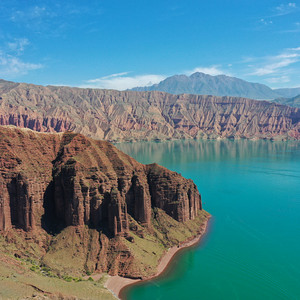
So let's start with the Kambula Geopark in Qinghai.
What's so amazing about this place?
Well, the one highlight of Kambula Geopark is definitely on its geographical research value because Kambula is an exceptional site for studying tectonic evolution and ocean continent transformation process of the Earth.
It's basically an area that's becoming a true witness to that period of time from the the transformation from ocean to land.
So the geo park itself, it contains a total of 162 geological heritage sites and that include two of international significance.
So it is a natural museum for researching massive landslides in the upper reaches of the Yellow River and climate change as well.
So the whole park, geologically speaking, on its own.
It's just an open museum for researchers from all over the world to come and conduct geological research. So that's one highlight of the park.
It's beautiful too, not to mention that.
I watched a video on it earlier today and it was describing the jagged peaks that seem to touch the sky, the mysterious caves, the sparkling emerald lakes but they were saying in the video that it's than just a beautiful area it's also a hot spot for geoscientific research and maybe even more importantly you could argue a classroom for public science education.
Yes an outdoor museum of sorts but also an outdoor school in a sense as well.
And also it's renowned for its diverse cultures and of course the harmonious coexistence of just environmental protection and human activities because Well, this is according to a recent report from China National Radio that the Kambula Geopark boasts a rich heritage of historical and ethnic culture.
And that include two items listed as UNESCO representative works of the intangible cultural heritage of humanity, and that include the Zhuogong Art, which depicts Tibetan Buddhism Through paintings, sculpture and embroidery and also they are very famous for the local Hwang Nan Tibetan Opera as well.
I would really be looking forward to seeing a show or say a performance of that.
And that's something so unique so locally performed that you can't find anywhere else.
So that's another really surprising spot of this Geo Park.
Yup, and it also has four nationally protected cultural relics.
It has 54 nationally recognized traditional villages.
And all of the things that were mentioned so far make it a very rare, very comprehensive geo park too, that integrates a high precision amount of research. It has the diverse and unique, as you mentioned, Yuxuan, cultural experiences and then a plateau of ecological conservation.
There's a lot going on in this particular geo park.
What makes this geo park kind of special for me is that you know, there are still so many people of the Tibetan community live there.
And because with some of the other international geo parks often, you think about rocks, mountains, caves, and beautiful waters possibly.
But this one, you know, you've still got a lot of people living there, although it's a very very spacious land and you know just to know more about how do people conduct their lives in the 21st century in a place like that is fascinating to me.
Yeah and I was so surprised while I was doing research that a lot of people are commenting that wow this is such a beautiful place to visit the Kambula Geopark but it's still not that popular yet because it's such a vast area and in the meantime those people that had already had the advantages of being there introduced that they're actually already just a very complete route, traveling route that's been established locally.
And one agency offers say a one -day bus tour of Kampula's iconic geographical and cultural views with just a label price of 581, and that's roughly $80 per adult.
And also it mentioned that the GeoParks ticket price as far as the latest data release is 254 yuan, which is not entirely a cheap price.
But given that it's such a vast area and they offer bus tours, I think it's pretty good reasonable price.
And also like you mentioned Ho Young, there's interaction between tourists and the local people there.
some mentioned that the travel route also suggests one say try out of having tea with the local Tibetan farmers and that cost about 20 to 50 yuan per serve might be just a delivery meals price for us but for them that's very a relatively high learning for one day I would imagine.
Yeah and you know whether it's expensive or affordable often it is relative, right?
Yeah, yeah. And then the other Geo Park that's made it to the spotlight this time is Yunyang Geo Park in Chongqing.
Dinosaurs! Oh tell me more about that!
Yeah the Yunyang Geo Park is best known for its dinosaur IP.
I mean the Geo Park covers an area of about a hundred and twelve hectares and it's also 112 thousand hectares.
Sorry, a hundred and twelve thousand hectares.
That's what I was saying before what I was saying, these are not little parks, these are not like like urban parks these are massive massive spaces yeah and that 112 ,000 hectares of land is known for its well protected dinosaur fossils and the park features a rich assemble of middle Jurassic dinosaur fossil as its main highlight and that include the 18 .2 kilometer long Great Wall of dinosaur fossils I saw the picture of that side actually it's built like a having a cover on top so it's semi -indoor in order to protect that so -called Great Wall of Fossil Wall and the world's and that's some known
to be the world's largest monolithic Jurassic dinosaur fossil wall.
So that's located in Yun Yang and something about something funny about that is they're trying to develop something that's related to say VR and very immersive tourism like programs to to combine their dinosaur IP with the high technology experiences to just, you know, attract young generation to come and visit as well.
Yeah, going back, pardon me, to the point of being like an outdoor classroom, an opportunity for study for students.
I mean, what better, what more cool a chance to go out and learn about a little bit of history than to go to the Great Wall of Dinosaurs in a geo park?
That's a fun day out of class.
Yes and that's a great way to sell it but also you sometimes get the dim students like He Young when you tell me oh it's educational immediately I want to fall asleep.
But this one you know you can also sell it as you know the real life Jurassic Park.
You know with the VR experience then I'm sure they can make it more exciting.
And the Yun -Yang geo park is located in Chongqing, which is in the south western part of the country.
And it's located in the heather lands of the Three Gorges reservoir area, and that is the world's largest dam, and this has a huge, it's got its own history background here in China.
And it's definitely a really interesting place worth visiting.
And once you get there, you will start to understand how vast and different place to place China is.
The line, sorry to interrupt though.
It has to be discussed, doesn't it?
When we're talking about the opportunities for students to go, the opportunities of ecotourism or for ecotourism, that's wonderful.
but there needs to be a plan in place for those tourists, to make sure that we're keeping the parks in tremendous condition.
And that is addressed by the Geopark Management Toolkit.
That's developed by the European Union's Atlantic Geopark Projects between 2017 and 2020.
So what that's all about, it means that any aspiring or new geo park, they need to establish a geoconservation strategy if they want to protect their geological heritage.
So that's a combination of some different things.
You have your scientific research, you have your local involvement, and then you have the educational and interpretational activities of the geo park and its partners.
So that's a good thing, isn't it?
Is that even if you're interested in acquiring or becoming a geo park, a UNESCO geo park, there is a plan in place, things that you need to do, strategies that you need to implement so that you know you're following the quote unquote rules.
Well, it is a really delicate discussion, really.
And this is one of the questions, fundamental questions.
I suppose, all geo parks or similar kind of natural reserve parks around the world are going to be grasping with, that is how do you balance tourism as opposed to conservation?
And when we look at China's national parks, the ones that have the really captivating and beloved animals headlining their parks such as the giant panda national park, these places often only have a segment that's open to the And then the other parts in, you know, you can't go in necessarily unless you're a researcher, a certified researcher or have a special pass or something, and then the Rangers can go in as such. So tell us a bit more about how these geo parks are sort of dancing that delicate dance.
One way, one good way, as suggested by the the talk that Steve just mentioned, is to control the zoning of the people you're letting in and give a good organization of the visitors, and one good way of doing that is to host educational activities while just encouraging the people who came in to this natural classroom and encourage them to buy souvenirs, and that's also a way of boosting economy while still managing that there's just sufficient a group of people coming without doing damage which we're breaking down the conservation that the local region has.
Yeah, like on -site museums. Yes.
Right. I'm reminded of my trip to Xi 'an to see the terracotta warriors.
Everything there is controlled.
From the entrance to the park, to the exit of the park.
And you're not... you don't need a guide to go through if you don't want.
But even still, it's somehow guided because the signage shows you this way to the first building this way to the second, this way to the third. Here's the gift shops.
Here's the washrooms. Here are where the restaurants are where you can get some food.
So everything is controlled and guided and you have a lot of staff there on site making sure that nobody's doing anything that they're not supposed to be doing and it just makes for a better experience for everyone.
Right? And then that's the combination of the tourism with the preservation of the site.
You have the staff, you have the control, but then you do provide the on -site museums, you provide the gift shops with the fridge magnets that everybody loves so much, which I always buy too.
But that's one way that they accomplish that for sure.
Yeah, the one thing that GeoParks are all working out right now is how to make their on -site demonstration and performances more interesting and more, say, attention -grabbing so that the tourists, they're not only here to see the natural resources, but also there to just get immersive experience and the preservation of their geological heritage in on -site museum or in interpretation centers for example, they can provide a focal point for tourists and just attract them, attract a significant number of visitors to the Geo Park and such facilities they provide opportunities for say related educational
programs which is both for adults and for say children and teenagers who are interested in dinosaur Yeah and not everything has to be old and super outdated, right?
As you mentioned you know if school trips are happening there it might not be for every kid, but that's why at the Yunyang Geopark they have the dinosaur fossil site museum that uses the VR and AR that we mentioned and they do that to present the world of dinosaurs this is from about what 160 or so million years ago but they do it in a way that's kind of comprehensive they do it in a way that's engaging for the audience oftentimes that'll be young people right so I guess combining things from 165 million years ago with something from maybe two or three or five years ago put them together and that's
the answer to make it entertaining for everyone and with these geo parks that we're shedding a special light on today these are newcomers and they're maybe our show to a certain extent is helping them to be put on the map.
So understand that the local organizers they're still at the beginning stage trying to drum up enthusiasm, trying to make a name for themselves and to bring in revenue which hopefully can go in back to the pockets of the people who actually live there who are to some extent opening up their homes and backyards to the visitors to a certain extent.
So, understand it's this development stage and I hope that their goals are met.
But also, I think about in the future, I think if we're playing the long game, it's also important to think about how to not overly commercialize how to, you know, develop in a more balanced way, but sometimes I wonder if there is really even all that much room for that part of discussion or policy making because, you know, initially I understand a lot of people, or the local people, government, organizers, etc, they're all trying to make this work.
Yeah, they are, and they've been trying to make it work for a long time.
If you go back a long ways maybe even since the year 2000, that's when the former Ministry of Land and Resources, they officially launched the National Geopark Program all over China.
And the aim was to protect geological heritage resources through the establishments of these parks.
And then over the past 20 years or so, the geo parks in China, and we mentioned there's a lot of them, they haven't only focused on the protection and the rational utilization of the resources that exist in the park, but they've also emphasized that balance that you talk about, right?
The development side and then the conservation side as well.
And then the money that gets made through the ecotourism goes into the conservation of the park and takes care of the staff that are employed there.
And that's kind of the balance, I guess, you're referencing.
Yeah, and according to one expert that I was reading from, One of the biggest challenges as facing China's geo -parks right now, we mentioned earlier that there are 49 of such geo -parks in China.
So we're facing one issue that is the protection of geological heritage and also facing the damage caused by development and utilization.
So this is suggested by Ren Fang, the deputy director of the Geological Heritage Research Office of Chinese Academy of Geological Sciences.
She believes that due to human activities, geological heritage sites, they're under serious threat these days, and this is not just happening in China as well.
I read about another, say, international example that's happening in, I think it's in Bali island, it's in the Batur Global Geopark Area in Bali Province in Indonesia.
So their issue is that they have the sand mining that was making environmental and infrastructural problems right there inside that geo park as well as other activities including farming that does not fit well with the geo parks aims of conservation and developing tourism.
So there's a lot to balance in the meantime and we see the local government, local authorities, even though they try to attract tourism in their best wishes but there's a lot of issues that we need to do with it.
And safety is one of the issues.
Right, do you remember, Hyoyang, on the show.
Maybe it was about six or seven or eight months ago, we talked about a situation that happened on a glacier.
It was Iceland. And that was the issue at the time, right.
Ecotourism was becoming a hot thing, and people were rushing to these places.
And the places weren't necessarily prepared for that number of tourists yet.
And something terrible happened.
With stronger legislation with law enforcement enacting those relevant laws and strengthening the regulations, then safety is an important thing to keep in mind for.
And it's great for everyone when that happens.
Yeah, well, I really have a bone to pick here about the management of these parks, period.
That is, if you've set up a designated area and it is a nationally or internationally recognized park, then usually some of that elicited activity should be banned.
For example, in China, like the national parks we have here, there's no farming.
There's no hunting of animals.
There's none of that.
That's a severe violation of offense, so there are very strict regulations.
when it's an established park then A, B, C, D, these are the rules that you must follow and it's all for the conservation of the environment.
Walking through China's newest geo -parks is like stepping into a living museum.
Each rock, each fossil, tells us a story of time.
Resilience and transformation is a humbling reminder that while we may come and go, the Earth's legacy and jaws etched into the very ground beneath our feet.