You're listening to TED Talks Daily, where we bring you new ideas to spark your curiosity
every day.
I'm your host, Elise Hugh.
Today's talk is not meant to make you feel guilty about wasting food, so we want to put
that right up front.
But it is about food waste and the systems problem at the center of it.
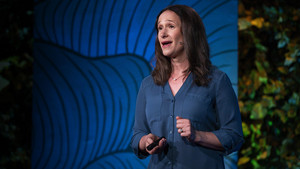
In her 2024 talk, food waste reducer Dana Gunders paints a picture of why food waste
is so bad for the planet and how not throwing it away at scale could solve the hunger crisis.
Her big ideas are coming up after the break.
Like TED Talks?
You should check out the TED Radio Hour with NPR.
Stay tuned after this talk to hear a sneak peek of this week's episode.
And now, our TED Talk of the day.
For the past 15 years, I have been obsessed with the amount of food we waste.
This makes me like the last person anyone wants to have dinner with.
Inevitably we're sitting there at the end of the meal, they're pushing food around
their plate they don't want to eat, and they're looking at me with some awkward excuse.
And I say, look, we can't eat our way out of this.
This is a systems problem, and it's just way too big.
How big?
Well, picture of farm.
It's the size of the entire United States.
It uses three times as much water as the whole country,
and it grows food all year long, and when harvested,
produces enough to fill 100 tractor trailers every minute all year long.
Those trucks then drive, fly, and float all over the world,
except instead of going somewhere to be eaten, they go straight to a landfill,
where the food rots and produces methane, a powerful greenhouse gas.
Seems crazy, right?
But that's effectively what we're doing.
From science experiments in the back of our refrigerators to truckloads of products
that are too close to some arbitrary expiration date globally,
one billion meals go and eat in every single day.
That's more than a meal per person for everyone on this planet who faces hunger.
Not to mention, it's worth $1 trillion,
and this whole ridiculous exercise has five times the greenhouse gas footprint
of the entire aviation industry.
Now, I know it's not obvious why food waste would have such a big climate impact,
so let me explain.
First, landfills.
Landfills are the third largest source of methane in the US,
and almost 60 percent of that methane is coming from food rotting.
And as big as that is, it's dwarfed by the huge amount of energy and resources
it takes to grow, harvest, transport, cool, cook food and get it to our tables.
And there's an even larger reason.
And that's land use.
We are looking ahead at a future in 2050,
where it's projected we'll need about 50 percent more food than we had in 2010.
And the question is, where is that food going to come from?
Are we going to cut down more rainforests to grow it,
or are we going to use the food that we already have?
Researchers estimate about 20 percent of that gap
could be met by simply wasting less.
When I first came across these numbers,
I thought to myself, gosh, this is the dumbest problem.
And I wanted to know why.
And it turns out there are all sorts of reasons
that are very different for a strawberry farm in California
than a market in Africa.
But to give you a sense, here are a few.
One is we don't measure it, so it's invisible.
And as we all know, you don't manage what you don't measure.
Also, in some places, food is relatively cheap,
and the fees to throw it away are even cheaper.
In other places, there's simply not the infrastructure to keep food cold.
At times, we're worried about running out,
because, God forbid, I don't have enough stuffed mushrooms for everyone.
And then at other times, we're worried about it making us sick.
When in doubt, throw it out, right?
And then there's my seven-year-old son,
who begs me for a peanut butter jelly sandwich in the morning,
and comes home in the afternoon with his lunchbox completely untouched.
And when I ask him what he ate for lunch, he says,
Oh, I just talked.
Now, I don't know what you do about that one.
But overall, fixing food waste is not rocket science.
It's really just about managing our food better, and it's solvable.
There's a lot we can do in our own lives, and I'll get to that in a bit.
And there is a lot we can do across the food supply chain.
At RE-Fed, the organization where I work,
that is entirely dedicated to reducing the amount of food we waste,
we have identified over 80 solutions that can help.
Many of them are about prevention,
about making sure that extra food does not occur in the first place.
Which is really our priority,
because prevention gives you the most bang for buck,
both environmentally and financially.
After that, we look at donating food,
and only when that's been exhausted,
at feeding it to animals, composting it or other recycling methods.
There are so many successful examples out there of these solutions.
One is a Nigerian company called Cold Hubs.
They build solar-powered cold rooms in markets and farms.
And in places that don't have electricity,
this extends shelf life dramatically,
giving farmers more time to sell their product,
and therefore the ability to fetch a better price.
They have saved thousands of tons of food so far,
all while increasing farmer incomes by 60%.
Another is Too Good to Go.
It's an app that restaurants and grocery stores can use to discount product
at the last minute before they might otherwise throw it out.
Businesses, they get extra revenue,
customers score a deal,
and it has spread like wildfire.
Now in 17 countries, they saved over 100 million meals last year alone.
From a different angle, there's Compass Group.
It's the largest food service company in the world,
and they are busy trying a lot of unsexy things,
like tracking their waste,
experimenting with smaller containers on buffets,
or offering different size portions
so that there's a smaller option if you say,
don't want a massive burrito.
They've had a lot of success across the world,
even decreasing waste up to 50% in some of their largest sites.
These are just a few of the many solutions that are being tried and tested.
Some are high-tech, some are low, many are win-win,
and they're starting to work,
but it's not enough, and it's not fast enough.
And now, back to the episode.
Countries and companies from around the world
have signed on to the UN Sustainable Development Goal
to cut food loss and waste in half by 2030.
The impact of this goal would be enormous.
It could avoid converting an area of land the size of Argentina into agriculture,
saving one-third of the biodiversity that we're projected to lose,
and avoiding as many emissions as taking every single car in the US and Canada off the road would.
Yet, despite that incredible potential and some beacons of progress,
overall, we are barely moving the needle.
And unlike the energy and transportation sectors,
attention and investment into food waste
have been completely incommensurate with the opportunity it presents.
There are so many solutions that are working out there.
Let's inject the funds to really scale them.
ColdHubs has been quite successful across Nigeria,
but we need that solution in every market without electricity, in every country.
Waste tracking, last-minute sale apps and other technologies are demonstrating they work.
Let's provide incentives so that every food business has those at their fingertips.
And we need investment to spark new innovation as well.
At Refed, we estimate that for the US alone,
it could take $18 billion to fully scale solutions.
A large investment.
But when you are throwing hundreds of billions of food away,
it actually can have a four-to-one return on that investment.
And other incredible benefits,
like providing four billion additional meals and food donations,
creating 60,000 jobs and huge water and greenhouse gas savings.
And because so much of the action needs to happen across the food supply chain,
we need food businesses to engage and prioritize this work.
They can be doubling down on streamlining their operations
and adopting new solutions as well.
We also need policy.
Ecuador, Japan, France and 10 states across the US
are just some of the places that have laws that restrict food from going to landfills.
Instead, they provide infrastructure for composting or other recycling methods.
And that compost then goes on to improve soils and even sequester carbon, potentially.
In addition, in some of those places,
they're seeing an increase in food donations and even closer tracking of waste.
These laws should be everywhere.
And then there's us.
One of my favorite bumper stickers says,
hate traffic, you are traffic.
Well, we as consumers are actually the largest source of food going to waste,
more than grocery stores, farms or restaurants.
And in the US, as a culture, we have also become really numb to it.
You know, I could walk down the street and throw half a sandwich on a sidewalk
and people would think I was crazy.
But if I throw that same half sandwich in a garbage can,
they wouldn't think much of it.
We need to be less accepting as a culture of wasting food
and we need to take steps in our own lives as well.
But before I get to that, let me tell you what not to do.
You are going to go out into the world now
and you are going to see food being wasted everywhere.
And you're going to want to, well, eat it.
This is not what we're going for, people.
Trust me, I have tried.
And I don't think it's what you're going for either.
Instead, here are five tips that you can try
to manage your food better in your own lives.
First, shopping.
Shopping is really where we commit to food
and so we need to be careful not to overbuy.
Old school things like shopping lists and meal planning really help.
And let me be clear, frozen pizza and takeout
are totally legit as part of your plan.
Next, as I tell my friends at the end of dinner,
love your leftovers.
They are the only true free lunch
and when you get sick of them, you can move on to number three,
which is freeze your food.
Your freezer is like a magic pause button
and so many things can be frozen that you don't think of.
Bread, milk, cheese and that half jar of pasta sauce you didn't use.
Next, use it up.
In my house, this looks like my husband eating that peanut butter
and jelly sandwich for dinner.
But for you, it might be whipping up a stir fry
with whatever veggies are wilting in your fridge.
Whatever it is, be sure to shop your fridge before you restock it.
And lastly, learn your labels.
Best buy and enjoy buy are really just guesstimates
of when food is at its best,
they're not an indication that it's gone bad.
So be sure to use your senses before you toss things.
These strategies are not earth shattering.
They're things that many of our parents and grandparents did
and you can be sure that my son is learning them as well.
Because as we tackle this massive climate crisis,
reducing food waste really is the low-hanging fruit.
But no matter how sustainably we grow that fruit,
it's only a good use of resources and nutrition
if we all do our part to make sure that it actually gets eaten.
Thank you.
APPLAUSE
That was Dana Gunders at TED's Countdown Dilemma Series
on the future of food in 2024.
If you're curious about TED's curation,
find out more at TED.com slash curation guidelines.
And that's it for today.
TED Talks Daily is part of the TED Audio Collective.
This episode was produced and edited by our team.
Martha Estefanos, Oliver Friedman, Brian Green, Autumn Thompson
and Alejandra Salazar.
It was mixed by Christopher Faizi,
additional support from Emma Taubner and Daniella Valarezo.
I'm Elise Hugh, I'll be back tomorrow
with a fresh idea for your feed.
Thanks for listening.
Jennifer Vail studies friction
and how to deliver just the right amount of it,
like when you get a flu shot.
If friction was working against you so much
that that needle is having to be pushed multiple times
and harder and harder because the stopper is getting stuck,
you would definitely know.
The hidden role of friction in our lives.
That's next time on the TED Radio Hour from NPR.
Subscribe or listen to the TED Radio Hour
wherever you get your podcasts.