I have a question.
How long do you think you need to learn a new language?
Less than six months?
Six months to a year?
One to two years?
Or more than two years?
Got your answer?
Good.
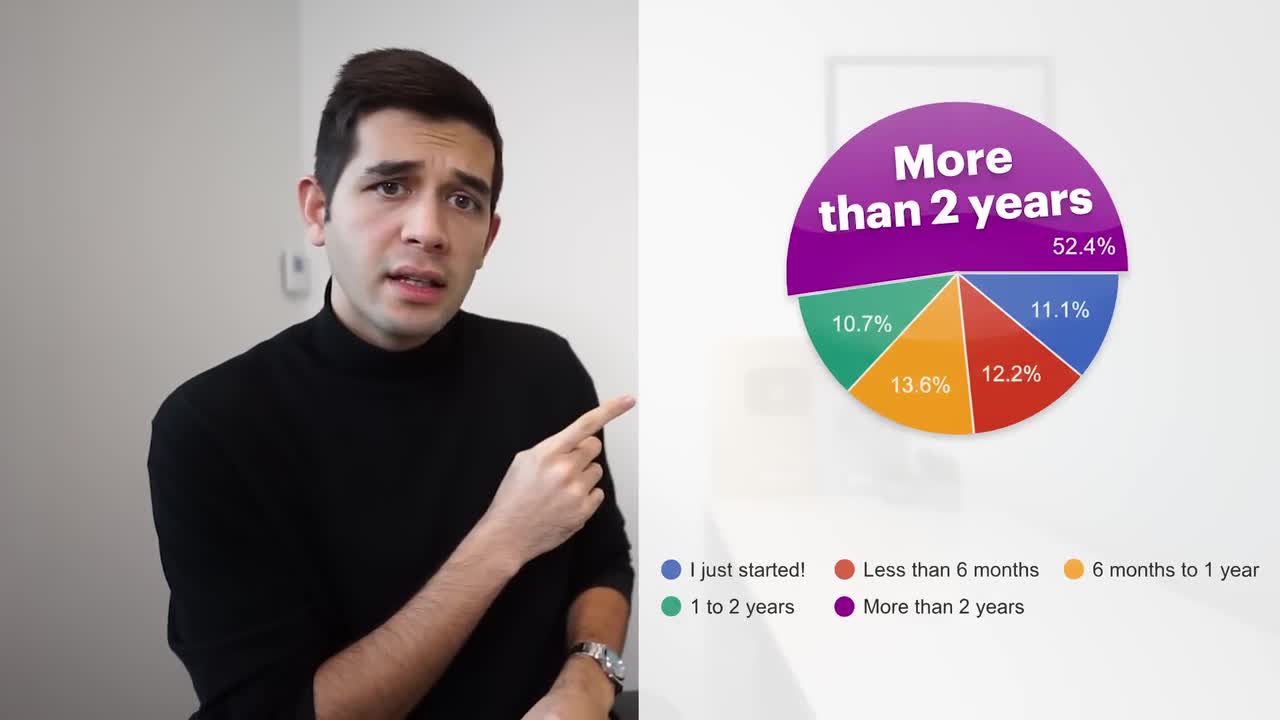
Because I asked the same question in a survey with more than 2,000 students.
And the answers shocked me.
Most people said that they have studied for more than two years, more than 50%.
But here's the real shock.
More than 70% said that they are still not fluent.
This means that something is wrong.
Something is very wrong.
And today I will show you five reasons that are holding you back.
So if you feel stuck and you want to become fluent and speak fluently, then watch this video very carefully.
Reason one, you only learn English, but you don't use English.
Think about how you learn or study English.
You read books, you listen to podcasts, you watch movies, or you watch YouTube videos or TV series.
And then what's your goal?
To speak?
You read, you listen, you watch movies.
These are all input.
And you want to speak?
Speaking is output.
Input, output.
Input is everything that goes in.
Output is anything that comes out.
So input can be listening, reading, or watching movies.
Output is only speaking and writing.
Now, if you want to improve your output, what comes out?
You need to work on the output, not on the input.
That means you need to work on speaking and writing.
But how?
In this video, I have thoroughly explained how to work on your writing and speaking skills.
So if you want to improve your output, go ahead.
Watch this lesson by clicking on the link above this video.
But watch it after this one.
First, finish this.
So to sum up the first reason you cannot expect to speak fluent English if English only stays in your notebook.
You need to use it.
You need to work on your output.
You need to write and you need to speak.
So here's a very good first exercise.
Go to the comments section of this video and start writing.
Remember, writing is output.
Go ahead, start writing and express yourself.
What do you think about this video?
How long have you been learning English?
What is your biggest English challenge?
Go to the comment section right now and start writing.
That is your homework.
Go ahead and do it.
Reason two.
You think in your native language first.
Look at this response in that survey by one of the students.
I first translate everything in my head and then I speak.
This is a shocking mistake because translating is one of the biggest killers of fluency.
Let's say you are Italian or German or Turkish or Indian or you have any other nationality.
Do you know what translating does to your fluency?
Translating kills fluency. fluency.
So what's the solution?
The solution is to learn how to think in English.
But is that possible?
Yes, and it's very easy.
You can think in English without thinking in your mother tongue first.
In this video I have explained how to train your mind to be able to think in English first and and never translate.
So go ahead, click on the link and watch this video, but after finishing this one.
To conclude, the second reason if you translate in your head, your brain becomes slow.
So learn to think directly in english.
Reason three you study alone with no feedback.
Many of the survey participants said things like I don't have anyone to talk to or I need to find a speaking partner.
This shows that a lot of you But the reality is that learning a language is a social activity.
Why do you learn a language?
You learn a new language to be able to communicate with other people, to make new friends, to find a better job position, to go to a university and study in a different language.
So the overall goal of learning a new language, in this case learning English, is to connect with other people.
It's not just about grammar or vocabulary.
It's a way of making social connections, getting closer to other human beings and exchanging cultures.
So it is not a good idea to study alone all the time.
It's good to study alone, but not all the time.
A fantastic idea is to become a member of a global community of learners.
Maybe you can find a community of learners on Facebook.
Maybe you can join a language school around your house, although in that case most of the students of that language school would be from the nearby neighborhoods, and that means you won't have a lot of chance for cultural exchange with people from different countries.
So a better idea is to join a global community, probably an online community, of learners.
And that is what we have at PUC English Academy.
We are proud to have a global community of English learners from more than 70 countries.
And there are more than 1000 active members in this community.
It's a place for you to practice your English, connect with other people, find study partners and ask your questions to either your classmates or your teachers.
We also have daily live speaking sessions on zoom, where you can see your classmates speak with them face to face, connect with them, make friends and improve your english.
If you want to join, simply click on the link above this video and on my website you can have a look at what we offer at POC English Academy.
Go ahead, try it now.
So, to sum up, the third reason studying alone is good, but try to become a member of a global English community so that there are other students and there are other people who are at the same place as you and you can feel like you are doing this together.
This is highly effective.
Reason four you learn words the wrong way.
This was a common response in that survey.
I learned new words all the time, but when i want to speak, I forget them.
And you know what?
It's a very common issue.
You learn new words all the time.
You read a lot of books, you see a lot of videos, you listen to podcasts and you learn a lot of words.
When you see these words on paper, you know what they mean.
Or when you hear them, you know what they mean and you understand.
But when you want to speak, your mind goes blank.
Let's say you learn adjectives such as respectful, reliable, trustworthy, wholesome, well-mannered.
But when you want to describe someone and say that that person is good, you would use adjectives such as good or nice or kind.
Why are you not able to use all these other adjectives?
Because those adjectives in your head are passive.
What's passive vocabulary and what's active?
Active vocabulary are the words and phrases that you can use when you are speaking.
Passive vocabulary, on the other hand, are those words and phrases that you cannot actively use when you are speaking.
But if you hear them, or if you see them somewhere, or if you read them, or if you're watching a movie and you see, those words know what they mean, so you can understand them, but you can't use them.
Those are passive.
So what's the solution?
The solution is to learn the words the right way.
That means learn the words in a way that they become active, not passive, and turn the passive words into active words.
But how?
I have a very good video for that.
Go ahead, watch this video.
In this video, i have thoroughly explained how to learn new words the correct way, so that those words are active and that when you speak english, you can actually use them.
Go ahead, watch this video.
After this one, add this to your playlist.
Reason five you expect fluency to be fast.
In the same survey, somebody wrote this i want to speak fluently in one month.
I'm sure you know that this is just Impossible.
When you are learning English, you need to set the right expectations.
Speaking fluency does not happen overnight.
It takes time.
So let's circle back to my very first question at the beginning of this video.
How long do you think it takes to learn a new language?
Less than six months, six months to a year, one to two years or more than two years.
What is the correct answer?
Well, Cambridge University has answered this question.
They have created something called guided learning hours.
You know that languages have different levels, A1, A2, B1, B2, C1 and C2.
A1 is absolute beginner and C2 is like native level.
So how long does it take to go from A1 to A2, from A2 to B1, from B1 to B2, from B2 to C1 and C1 to C2?
According to Cambridge University guided learning hours, This is how long it takes for each level.
Let's have a look.
The A1 level, the absolute beginner level, requires 90 to 100 hours of guided lessons.
Pay attention to the word guided.
I will explain later.
A2 requires 180 to 200.
To reach the level of B1, you need 350 to 400 hours.
For B2, you need 500 to 600. and for C1, 7 to 800.
What about C2?
You need an overall 1000 to 1200 guided lessons.
But let's put that into perspective.
If you want to reach C2 from absolute beginner, need 1 200 hours of guided lessons.
It's not just random practicing, it's not just randomly watching videos or randomly reading books or practicing alone.
It's guided.
That means there is a teacher or there is a course or there is a structure that is guiding you through the learning path.
So there needs to be someone or something that guides you.
And if you want to reach C2, you need 1,200 hours.
And if you study, let's say, very consistently, five days a week and each day you spend one hour, that means you need five years of consistent practice to reach the C2 level.
So is it possible to do it in six months?
No.
And again, I'm telling you, you need guided practice together with studying alone.
You need someone to guide you.
That means if it takes five years of guided practice, it needs another five years of individual practice.
Putting it together, that means 10 years, And that's exactly how long it took me to reach C2 level and band score 9 of IELTS.
It took me about 10 years, even more, I think 11 or even 12 years.
So learning a language is a long process.
Set the right expectations.
You cannot expect to reach the C2 level in six months.
And that's it, guys.
I hope you've enjoyed this lesson.
In this lesson I try to talk about five shocking reasons that I discovered in a survey of more than 2000 students as to why you are stuck and why you study but you're not fluent.
So go ahead, the three videos that I recommended, you have to watch them one by one.
They are very, very useful.
Also, if you're new to my channel, don't forget to subscribe.
See ya.