From The New York Times, I'm Rachel Abrams, and this is The Daily.
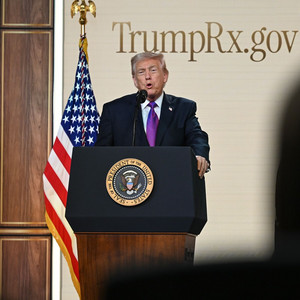
Last week, President Trump unveiled TrumpRX.
Dozens of the most commonly used prescription drugs will be available at dramatic discounts for all consumers throughout a new website.
It's called TrumpRx.gov.
The administration's answer to the high cost of prescription drugs.
This launch represents the largest reduction in prescription drug prices in history by anyone.
Many, many times.
And it's not even close.
You're going to see numbers that you're not going to believe.
The president hailed the website as a, quote, transformative health care initiative.
Congratulations to you on all that money you're saving.
Thank you.
Thank you very much, everybody.
Today, my colleague Margo Sanger-Katz explains how the site works and whether it will actually save Americans money.
It's Wednesday, February 11th.
Margot, welcome back to the show.
It's nice to be back.
I feel like I have been hearing about this Trump Rx thing for probably months now without having a good sense of what this thing actually was.
Like, I didn't know if it was an online pharmacy, a Trump branded online pharmacy, perhaps.
And last week, the website was actually unveiled.
So, Margot, start off by telling us what is Trump Rx?
So I think in some ways it's easier to say what it's not.
It's not a place that you can buy prescription drugs.
This is not a pharmacy.
It is not a store that's run by the federal government.
Instead, it's a place that you can go if you're looking to buy certain prescription drugs.
It will help you figure out how to get them at a discounted price.
So this is the federal government's effort to help you find drugs at a good price, but not to sell you drugs directly.
Which is so interesting because I'm pretty sure that pretty much every presidential candidate in my lifetime has talked at some point and in some form about bringing down drug prices.
And this website, TrumpRx, seems like an unusual step toward addressing a very intractable problem.
So how did the president arrive at this as the solution right now?
So I think there's two things going on.
One is that Trump is obviously under a lot of pressure right now to do something about affordability, and particularly about the affordability of health care.
Democrats have just been hammering the Trump administration on this.
And a lot of Americans are concerned about high and rising costs for health care.
The other thing is that drug prices have sort of been an obsession of Trump's.
Even from the time he started running for president in 2015, this was something that he would talk about on the campaign trail a lot.
He almost sounded a little bit like Bernie Sanders on this issue.
He was always complaining that Americans pay the highest prices for drugs in the world, which is true.
On average, we pay about three times as much as what other rich countries pay for prescription drugs.
And in his first term he tried to take some actions to do something about it, but they didn't really work out.
And can you just remind us, Margo, why do Americans pay more than other countries for drugs?
So the answer is a little bit complicated, but I think the simplest way to answer it is that most other countries, the government of that country negotiates directly with pharmaceutical companies.
And they say if you want to sell your drug to all of the patients in my country, you need to give us a good price.
We don't have a system like that in the United States.
The government in general is not involved in setting the price for drugs.
Instead, we have lots of different insurance companies that are making separate deals for different groups of customers.
The other difference is that in a lot of other countries if a drug maker has a new drug, that's really great but really expensive.
Those countries are willing to say if you don't bring the price down enough, we are willing to walk away from the negotiating table.
Whereas in the United States, I think, we have a culture and a politics and an expectation that if a new drug works, that we want to be able to offer it to patients here.
And so that means that the government, to the degree it's involved, and all of those individual insurance companies just have a little bit less leverage to pull the price down, because they can't walk away from the table.
The drug companies have a lot more power here to set whatever price they want for those drugs.
Which, if you think about it, means that we as the United States are in some ways underwriting the cost of drugs for other countries, right?
Because our country is willing to pay kind of whatever.
That probably makes it easier for drug companies to go to France or the United Kingdom or wherever else and say sure fine, we'll take whatever you're demanding we take for this drug.
I think that's absolutely true.
The United States market is incredibly important to the pharmaceutical industry.
We pay these super high prices.
Also, we're just a really big country.
And so a lot of the business model is sort of predicated on the idea that the drug company is going to make almost all of its money on a new drug in the United States market.
And then anything that they get from these other countries is kind of gravy.
So, OK, so you said Trump couldn't bring down the drug prices in his first term.
Now he's obviously back in office.
What has changed?
So one thing that hasn't changed is he's continued to think that this is a really important issue.
But here are a few things that are different.
One is that the market for drugs has changed a little bit.
The explosion of these GLP-1 drugs that treat obesity has led to many more consumers buying drugs directly and going around their health insurance.
So that's kind of a new consumer market for drugs that didn't exist before.
And the other thing is the political pressures around health care affordability that Trump is facing that Americans feel like health care is too expensive.
For example, he had this big campaign promise that he was going to be the father of IVF and he was going to help a lot of couples that were having trouble with fertility, make IVF more affordable.
And then, on top of that, the Congress, as part of its big tax bill, made major cuts to state Medicaid programs that provide insurance to lots of low income people.
And at the end of last year Congress allowed subsidies to expire that help millions of Americans buy Obamacare health insurance plans.
And so that's increasing the premiums for people who buy that kind of insurance and increasing the number of people who don't have coverage.
Mm hmm.
I think all of this is creating pressure for him to try to start to find solutions around rising health care costs.
And here's the thing about prescription drugs.
They are not the largest cause of healthcare spending.
Most of our healthcare spending goes to pay for hospitalization and doctor's visits.
But I think that drug costs are particularly salient for a lot of people because it's the one healthcare cost that people kind of deal with every single month.
And so Trump decides that he wants to focus on the pharmaceutical companies and their role in the system.
And he begins What does that mean?
Like, what does he actually start doing?
So he has his trade officials do an investigation and determine that they can impose major tariffs on pharmaceutical products.
And then he goes to the CEOs of individual pharmaceutical companies.
Hmm.
And he basically said to them, like, look, I could put a big tariff on you.
I could make it really hard for you to continue to do business in this country.
I really need you to make me a deal.
So he starts negotiating with all these drug companies one at a time.
And he begins hauling them out in public in front of the cameras to announce deals.
I think this is one of the biggest medical announcements that this office has ever made.
So he starts with the drug company Pfizer.
Pfizer has agreed to provide some of their most popular current medications to all consumers at heavily discounted prices.
And he has this press conference with the CEO of that company.
Mr. President, what an honor to be here.
And the press conference, like it has a little bit of like a hostage video kind of feel to it.
He has a beautiful office, but the Oval is the coolest, right?
What do you think?
I think by far.
You see the CEO of Pfizer get up in front of the camera and talk about how delighted he is to offer these big discounts on his products.
Now we have clarity about what is the framework for the U.S. pricing.
Which, of course, they never would have wanted to do before.
And going forward, this is how things will be priced in the U.S. and abroad.
And it's at that press conference that Trump mentioned the idea of this TrumpRx website.
Drugs will be available for direct purchase online at a website operated by the federal government.
Where all of these deals are going to be pulled together and made public for the American people to find.
And then over the next weeks and months, one by one.
President Trump, it is really a pleasure to see you again.
They have executives from numerous drug companies.
Mr. President, thank you.
Thank you, Mr. President.
It's a true honor to be here.
Come out for these press conferences.
We're going to be significantly lowering the cost of the medicines.
Announce these deals and say that they're going to be offering much better pricing to American consumers.
And that's a 70 percent price reduction.
And that also will be available on TrumpRx.
And at each one of these press conferences.
Now you're going to see numbers that nobody would believe possible.
Trump is using this incredibly hyperbolic language to describe the kinds of deals that are being offered.
500, 600, 700, 800 percent.
Saying you know, these are not discounts of 50 or 80 percent, but they are 700 800, 1000 percent discounts.
You're talking about 14 15, 1600 percent reductions, in some cases discounts that are mathematically not possible.
And I think, based on that, I won't even take questions today, because there's no way I can take questions that are anywhere comparable to what you just witnessed.
You just witnessed drug prices that will go down at levels never thought even possible, Marty.
So by the time this website rolls out, last week there's been this drumbeat of press conference after press conference.
And I think it's led to this expectation that it's going to be this huge deal and there are going to be all of these wonderful discounts on drugs.
But if you look at the details of these actual deals, the reality is very different than that.
We'll be right back.
So Margo, you said before the break that the way that Trump had been talking about this website had set up huge expectations that weren't necessarily met when you actually looked at the deals represented on this site.
So tell us a little bit more about what you found when you looked into this more.
So when you look at this website, it is absolutely not revolutionizing the price of most drugs that most Americans take.
First of all, there are only 43 drugs on this website.
There are thousands and thousands of prescription drugs.
So this is this tiny, tiny little fraction of the drugs that people need.
Right.
That is not a lot of the drug market.
Yeah.
And for people who have insurance, which is 85 percent of all Americans, this website is really not offering them a better price than what they already have.
But there are two categories of drugs where the deals are actually pretty good.
Those are drugs for infertility and for obesity.
I think we should take a look at this website together and just kind of like walk through what you might actually see.
Yeah, let's do it.
So I'm going to go to TrumpRx.gov, right?
That's the website.
I'm going there, too.
All right.
So the first thing that I see is in big letters it says find the world's lowest prices on prescription drugs.
And there's like a little pill instead of a period after the word drugs.
There's a vial kind of hovering over the word prices.
And let's see, you can scroll down.
We see comparisons between the USA and Canada.
OK, so keep going, though, because this is my favorite part.
There's a spinning globe with the United States in gold.
It's very catching.
And it says, You know, I think it's a very beautiful website.
The design is very clean.
It's enjoyable.
It's easy to understand.
But it is continuing to make these very hyperbolic promises that it really just doesn't deliver on.
OK, so let's look at the actual drugs.
I'm going to scroll down until I find a drug.
OK, so the first drug listed here is Wegovi, a weight loss medication, right?
Margot, tell me what we are looking at.
So Wegovi, this is one of these GLP-1 drugs.
This is a drug that is used to treat obesity.
And it says Wegovi Pen, 74% to 85% off.
And then there's this little chart that shows you, depending on what dose of the drug you're going to buy, what is the price?
So the list price for this drug is more than $1,000 a month.
On this website, it says original price $1,349.02.
That is what you would have to pay at the pharmacy, $13.50 a month.
And with the TrumpRx pricing, what they are showing you is for the highest dose of the drug, the price is only 349.
So this is some really significant savings for people who take this drug, don't have insurance coverage for it and are paying with their own money out of pocket.
I want to look at some of the other drugs on this website, because I noticed that a lot of the drugs listed of these 43 are fertility drugs, which are drugs that people often have to pay for out of pocket.
And I'd actually asked a girlfriend of mine who recently went through IVF to send me the list of drugs she had to purchase out of pocket from an online pharmacy recently.
So that's a significant discount.
Yeah, I think your friend's price is kind of illustrative, right?
The TrumpRx website is saying that the original price was $966.
Your friend was paying around $300.
So this is a big savings.
$168 is less than $300.
I think for these fertility drugs.
It's another example where the Trump administration did negotiate better discounts than were available before.
And I do think that the reduced cost of some of these infertility drugs is going to make these treatments more affordable for women who need them.
But it is not quite as big as what the website is promising.
Yeah.
So if you think about obesity drugs and infertility drugs, these two examples are the places where TrumpRx is actually doing the most work.
Okay, weight loss drugs, IVF drugs, got it.
But what about literally everything else?
So the literally everything else is a little bit more disappointing.
And here's why.
These other drugs are the kinds of drugs that treat more common conditions like asthma, high cholesterol, diabetes.
These are the kinds of drugs that almost everyone's insurance covers really well.
And so if you have insurance, then you're not paying the full price.
You're paying a copayment. which in many cases could be like $25 a month.
That's pretty much going to beat the Trump Rx price for all of these drugs.
And 85% of Americans have insurance coverage that covers their drugs.
So that really is most people.
Then, even if you're thinking about the people who don't have insurance and who have to pay for their drugs directly, with cash my colleague Rebecca Robbins and I went through this list of drugs.
And of the 43 drugs, we found that about half of them already have generics that are on the market that are cheaper than the prices that are being offered on Trump Rx.
So even for those people who don't have insurance, they would not be better off buying the drugs through this system.
They would be better off going to their pharmacy and just paying for a generic.
Is it going to be clear to people that this website might not give them the best deal for the drug that they're looking for?
The website has some disclaimers on it.
When you go on each individual page, you will see that there is a disclaimer, for example, that you should check and see if you have insurance.
It might be cheaper with a copayment.
So this is not a one-stop shop for people.
And even the people who have designed this TrumpRx website acknowledge that and are telling consumers that.
LESLIE KENDRICK, the general impression from the press conferences we talked about or others, that this is going to be the cheapest version of the way that you get your drugs.
You might just end up using Trump Rx right.
Even if it's not actually the best deal.
You might, but I think that most Americans actually are used to using their insurance for drugs.
They're not used to paying directly with cash and shopping around for the best price in the way that this website is encouraging them to do.
But some people that we talked to said that they're worried.
People are going to think that Trump Rx is offering them the best deal and they are not going to look into these other options and they're going to end up overpaying for drugs.
So the bottom line here, it seems from everything you've said, is that if you have trouble paying for your prescription drugs in the United States, this website is probably not going to fix that problem.
Yeah, this website just isn't really doing very much for most Americans who struggle with their prescription drug prices.
For example, some of the most expensive drugs on the market right now, and the ones that Americans and insurance companies struggle to pay for, are drugs for cancer.
There are not any drugs for cancer on this website.
And it's worth noting that this is just the beginning.
More drugs are expected to be added to this website over time.
But for right now it's very clear that this is not the solution to the problem of high prescription drug costs in America.
So Margo, if this website is really only going to help people who either want to lose weight or have more children, it does make me wonder about the decision to focus on those two groups to begin with, especially because candidate Trump made growing the American family such a big part of his campaign.
Do you think that this TrumpRx program is motivated more by ideology and perhaps campaign promises than by a desire to truly improve affordability?
I don't really think it is.
I think it's more of a happy accident that these are drugs that Trump would love to take credit for lowering the price of, because they connect to his campaign promises in the case of infertility.
And they're really popular in the case of weight loss drugs.
But they're also drugs where the drug company already had a pretty big incentive to offer a discount, that there is this big market of people who are already paying for it with their own money.
And the publicity of the Trump RX launch might help bring them more customers that will compensate for the lower prices.
But the whole exercise, I think, very much fits into the kind of salesmanship that we expect from Trump.
He does not really have a solution to the broader question of health care affordability.
He does not have a comprehensive plan to lower health care costs at the hospital or at doctors or any of the other places where most Americans are faced with the biggest bills.
And even more than that.
His administration has taken actions that are raising the cost of health care for a lot of Americans.
That could cause millions of Americans to lose their health insurance.
So this is not just a small solution, but it is a small solution to a problem that is getting worse on Trump's watch.
Margo Singer-Katz, thank you again for being with us today.
It's nice to be here.
We'll be right back.
Here's what else you need to know today.
During a congressional hearing on Tuesday, Todd Lyons, the acting ICE director, refused to say whether anyone had been fired after an ICE agent shot and killed Renee Good in Minnesota last month.
Can you tell us if at least, God, I hope at least one person has been fired for their conduct since these operations have begun?
Are you telling us you can't even say one person's been fired?
Sure, I'm not going to talk about personnel actions, but we will get back to you.
The Trump administration had labeled Good a domestic terrorist in the immediate aftermath of her death.
When pressed, Lyons refused to apologize for the label and declined to answer whether it was true.
And a shooter killed nine people and injured 25 others in a remote town in northeastern British Columbia, the third deadliest shooting in Canada's history.
Seven people were found dead in Tumbler Ridge Secondary School, including a person believed to be the shooter, who died from what appeared to be a self-inflicted injury.
Two other people were found dead in a local residence, while another person died while being transported to a hospital.
A motive for the attack was not immediately clear and authorities have not released details about the shooter.
Today's episode was produced by Alex Stern, Rob Zipko, Anna Foley, and Diana Nguyen.
It was edited by Lexi Diao and MJ Davis-Lynn.
Contains music by Marian Lozano and Diane Wong.
And was engineered by Chris Wood.
That's it for The Daily.
I'm Rachel Abrams.
See you tomorrow.