From The New York Times, I'm Michael Barbaro.
This is The Daily.
The question of what to do about undocumented immigrants has long bonded President Trump to his supporters, so much so that an overwhelming majority of them back his all-out crackdown over the past year.
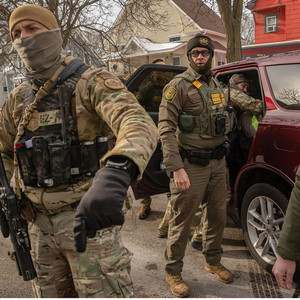
But then came the extraordinary events of the past few weeks in Minneapolis, where federal agents killed two American citizens in the streets.
Suddenly, two of the MAGA movement's biggest priorities fighting illegal immigration and fighting government overreach were colliding in the most vivid way imaginable.
Today.
We speak with Trump voters about how they're making sense of that clash and how, in some cases, it's fundamentally changing their view of the president.
It's Monday, February 9th.
Hello.
Hi, this is Caitlin calling from The New York Times.
How are you?
Hi, my name is Jessica Chung.
And we met a while ago around the Maricopa Republicans office.
Over the past few weeks as tensions in Minnesota ramped up.
Daily producers Caitlin O'Keefe and Jessica Chung spoke with over a dozen people who voted for Donald Trump in the last election.
I'm in Massachusetts.
Oh, you are?
I'm in my garage talking to you right now.
I'm smoking a cigar while we're having this conversation.
Nice.
Wow.
For many of them, immigration had been a major reason for that vote.
I remember they painted the picture that there was a large caravan.
That's what they called it.
A continuous flow of migrant caravans coming up.
That was my impression is that people were coming over in droves.
And it looked like there was 10, 20, 30,000 people or more.
And then they were like oh yeah, you know, there's all these Chinese people coming through the border.
Like it was just like random things you would hear.
And you're like, wait, what?
What is going on?
And from the moment Trump was sworn in for a second term, they were impressed with just how quickly and decisively he took action to close the border.
Oh, I think he did a fantastic job with it.
This is absolutely extraordinary.
And he just used existing laws.
He said, OK, border's closed.
We went from being invaded on a daily basis to borders where law and order prevailed.
We keep hearing people talk about how the immigration system's broken.
Well, the immigration laws are broken.
Yet, in fact, we discovered that was not true.
It's not broken.
It's just not enforced.
You just simply need to enforce them.
What a novel concept.
Once they closed the border, then the next step was to get people out that came in illegally.
In practice, that meant deploying thousands of federal agents into the streets of American cities.
It meant huge protests against ICE and Border Patrol, the National Guard going into neighborhoods, detentions at courthouses and federal agents showing up at workplaces, at stores and near schools.
It's still really scary to see our friends and teachers get tear-gassed.
At that point, some of Trump's voters begin to rethink their support for the president's plan.
They're grabbing kids or they're grabbing US citizens, detaining them and putting them in the back of the van and not giving them reasonable suspicion as to why they're being taken away.
I did not know that things like that would happen.
People that are doing this the legal way, that are going to the immigration office to take care of a lapse of paperwork or the next step in their process to become a citizen.
This is wrong.
The way they're going about this is inhumane and I don't support it.
I was like, I want to go and step up and do what I can and protest and be with my fellow humanity.
And then an ICE agent shot and killed a U.S. citizen.
The most recent situation that happened with Rene Good was an unbelievable eye-opener to what was going on and how this administration was going to handle things moving forward.
That was a kind of wake-up call for people like Chris Stinnett in Lexington Kentucky, and Carter Brown in Atlanta, Georgia.
I told someone close to me that, like, that could have been any of us.
And her reply back to me was well, I'd hope you'd have more sense than to ever be at somewhere like that.
They even started to wonder, could that have been me or a member of my family?
At first, I didn't know her race.
It broke me.
And then to find out that she was white afterwards, it scared me even more.
Does your wife also feel similarly?
Oh, 100%.
She's been very upset.
She's 37.
And so that resonates with her a little bit because Renee Good was 37.
And she's also a mom.
They had believed that Trump's enforcement actions would focus on the worst of the worst, people who had a record of committing violent crimes.
This wasn't that.
Both Carter and Chris, who supported Donald Trump in the last three presidential elections, now say that they regret their vote.
People hate that I use the word bamboozled, but that's the best way that I can describe how I feel.
On the outside looking in, you know, you're like, it was an open book test.
Everything was right there.
The community that I just left, Many of them have don't tread on me flags flying.
But you know what their reply back to what happened with Renee is?
Just comply.
So what is it?
Don't tread on me or just comply?
If we remove everybody, how many more people will die along the way?
But of course, not everyone with misgivings regrets their vote for Trump.
For some of them, it's more complicated.
Caitlin O'Keefe reached one such voter in Minnesota.
Can I just have you introduce yourself?
Yeah, I am Wilk Wilkinson.
A couple weeks ago, I called Wilk Wilkinson.
He's 50 years old, and he lives about 40 miles outside of Minneapolis, near Clearwater.
Grew up working in restaurants, working construction truck, driving very kind of a blue-collar atmosphere.
He says the populist message of the right resonated with him.
I voted for Donald Trump in 2016 and 2020 and 2024.
Now, he works for a nonprofit that aims to bridge political divides.
I wanted to understand how he was thinking about the battle over immigration enforcement going on in his home state.
I agree fully with the idea that we have far too many people in this country who came here illegally and have not done things the right way.
And we are a nation of laws, and those laws have to be upheld.
But there is also a right way to do things and a wrong way.
When the news broke on January 24th that federal agents had killed a man in Minneapolis named Alex Preddy Wilk went looking for the video.
You know, when I initially saw the first video and then I heard the narrative coming out of Secretary of Homeland Security Kristi Noem.
I do want to address the tragic situation that we saw in Minneapolis today, that unfolded on the streets.
It occurred with DHS law enforcement as they carried out their lawful duties to keep Americans safe.
I heard her say what she said.
This individual went and impeded their law enforcement operations, attacked those officers, had a weapon on him and multiple dozens of rounds of ammunition, wishing to inflict harm on these officers, coming brandishing like that and impeding their work that they were doing.
The first thing that I was looking for was any way that it could be considered, you know, brandishing a firearm, because that was the immediate narrative that came out.
I'm like, I've got to see if I'm missing something.
Is there something happening here that I am not seeing?
I watched every single video that I think is online.
I watched it several times.
I dropped it into my software, slowed it down, sped it up, trying to make it all make sense.
And so immediately that it was an outright fabrication on the part of Kristi Noem, unfortunately.
And And I'm like, this is awful, awful.
And I was so disappointed.
I got to be honest, because I was a huge Kristi Noem fan when she was the governor of South Dakota.
But then I think what was more disappointing was they stuck to it and then it instantly became tribalized.
People went to their side, went to their silos and started excusing things that they would never ever, ever otherwise excuse was the biggest heartbreak for me personally.
Another thing that concerned Wilk was the Trump administration coming out after the shooting saying that it was unlawful for Pretty to bring a gun to a protest.
As Christy said, you cannot bring a firearm loaded with multiple magazines to any sort of protest that you want.
It's that simple.
You don't have that right to break the law.
I mean, I will say this, Caitlin.
I'm a concealed carrier.
I'm a Second Amendment absolutist.
I've been around guns literally my whole life.
And was he allowed to carry a gun where he was by law?
Yes, he was.
Kash Patel, the FBI director, was clearly wrong about stating what he stated.
Kristi Noem was clearly wrong about stating what she stated.
The fact that they play so fast and loose with...
Making statements like that, when they were clearly wrong, says yes.
The Second Amendment is in danger of being violated by this administration.
Now, was it smart that Alex Freddie was armed while he was doing what he was doing?
No, not at all.
It was a very, very, very poor life choice that certainly contributed to him getting killed.
There's no question about that.
Does what happened to Preti?
Does that video change in any way the way that you think about the Trump administration and its enforcement of immigration policies?
I would say that the way that these policies are being enforced or were, I think Tom Holman actually introduces a level of calm and consideration that wasn't there before.
But the way that they were being enforced was all wrong.
Conservatives are supposed to be, in my opinion, suspect of government force.
And the government's sole role is to protect the individual from undue force and fraud.
I was definitely seeing an element of undue force being perpetrated by the federal government, which I am 100 percent against.
When they begin to use undue force on the citizens of this country, it changes the dynamic of that relationship.
And it's a very, very, very big deal.
Mm hmm.
And what were your views on mass deportations before, like the goal?
And, you know, have they changed in the past year and also in the past week?
So my opinion of mass deportations and the idea that we need to deport people who are in this country illegally has not changed.
Not because of this event, not because of what's happening in Minnesota.
Just because the way that something is being implemented in my opinion is egregious it's just terribly ineffective and incompetent does not change the fact that I think the thing itself is still the right thing to do.
So is it fair to say that President Trump still has your support, but they need to do better?
I would say that the Constitution has my support.
I mean, there are still some things that the Trump administration is doing that I fully support.
And the only thing that I can say in terms of continuing to support this administration is if Kamala Harris had won the election, I don't think anything that I wanted would have been accomplished at this point, and probably even made several things worse.
So there's that.
I'm still at least this way getting something.
But we still have a really really, really big problem with an administration that doesn't seem to have a lot of regard for the First Amendment, the Second Amendment, the Fourth Amendment and probably several others.
Let's be honest, it's problematic.
Recent polling shows that about 30 percent of Republicans think immigration enforcement tactics have gone too far.
But the vast majority say it's either on track or needs to go even further.
Looking at how the Trump administration is currently pursuing mass deportations, is there anything you would do differently?
As far as the Trump administration goes, no, not really.
He's doing all the things that he promised while he was running.
He's doing what I hired him to do.
I think that's exactly what I voted for.
So to sit back and complain that he's doing those things now is kind of stupid if you ask me.
If you voted for him, you'd need to be supporting him all the way.
My problem isn't with the deportations.
My problem is that these So-called protesters are instigating, like they want stuff like this to happen.
It's one thing to stand on the street and make your voice heard.
It's another thing to get in the middle of those guys doing their job and stand in their way.
You show up with a weapon, I'm sorry, they're going to use force.
I know this sounds very harsh, but you play stupid games, you win stupid prizes.
You know, you make stupid choices, you get stupid consequences.
I still support the deportation policy.
Illegal immigration is wrong, no matter how you look at it.
People have to leave the country.
You know, whenever they say we're going to get rid of the illegals and we're going to close the border, nobody ever says exactly what that's going to look like.
Or let's say making barbecue, for instance.
I don't know.
Do you like barbecue pork?
Oh, yeah.
Okay.
You may not like watching how it's made.
That it could be ugly.
It could be ugly.
After the break we hear from one of those Trump voters who thinks that the president's deportation effort should go even further.
And why, for this voter, that feeling runs so deeply.
So We'll be right back.
Can you tell me a little bit about yourself, your name, where you live, what you do?
My name is John.
I'm 53 years old.
I'm a Mason.
I live in Massachusetts.
I've been in the construction industry my whole life.
And I own a very small company.
I have a wife, two kids, and that's me in a nutshell.
I first connected with John Palema about three weeks ago.
He lives in Bolton, a rural town in central Massachusetts.
Is there a political party that you have historically identified with?
Initially it would have been the Democratic Party when I was in high school and probably a few years after.
And then I generally kind of turned conservative and I voted for Trump in 2024.
And did you vote for him in 16?
You know, have you always felt like he's a politician that you've believed in?
So in 2016, 2020 and 2024, I believe I was given the option and excuse my French.
I was given the option to eat shit or drink piss.
And in all three cases, I drank piss.
So there's your answer.
And in all three cases, I voted for Trump.
So that's how much passion I have for the man.
What were the most important issues to you when you cast your ballot in 2024?
Well, immigration was a major issue, but that has been an issue my whole entire life.
Can I ask why?
Because of what I do.
To be kind of simple, I move mass with my body.
I'm a laborer at the very root of what I do.
I move things.
I pick things up.
I put things down.
And that kind of work has been compromised by illegal immigration greatly.
I got into construction purely as an accident.
I was sort of a juvenile delinquent a bit.
And my cousin said, worked for me in Nantucket for a landscape construction company.
And I went down there and I worked as a laborer.
And then as I did it, I became a pretty good laborer.
Later I worked for other companies and I was seeing people getting hired and getting paid a lot less than me.
And When I inquired about it, my boss would say, well, they're less expensive.
I don't have to pay workman's comp on them.
I don't have to pay general liability insurance on them.
If they get hurt, they'll go to the emergency room.
No sweat off my back.
And I was getting paid less and less because I was competing against people who were hired, because it cost less to hire them or employ them.
And that bothered me.
And then, when I became a Mason and I started building, I found that I was competing with companies that did that practice.
And I couldn't hire an illegal alien.
I just didn't seem right.
It's illegal by the way, but people are getting away with it and I'm competing against them.
And you notice it by just simply seeing the crews that are going out there.
And when you give a price to somebody to do work, You're not even close to the lowest or the mid price.
You're always the highest price.
I'm never going to get a certain percentage of jobs.
And then I can't increase my rate because it's an unfair marketplace.
I like the idea of working for myself and I could do the work and I was good at it.
But it's getting to the point.
I'm getting older and it's harder to do, especially now.
I can't hire a laborer because I don't feel that I can give them a living wage.
So it's just me doing the work, which is beating me up quite a bit.
But I try to stay in shape and I keep going.
Did you feel under Biden that that problem was worse?
The problem of competition from immigrant labor?
No, it's been steadily getting worse.
What recently kind of narrowed down my thought process on that was what Trump did at the border, his second term, by immediately shutting it down the border crossing.
All the way back to when I started working when I think it was Bush Senior was president.
We had illegal immigration problems.
It seems like every president had an opportunity to stop that flood of illegal immigrants going over the border.
And none of them, Democrat or Republican, did anything about it.
And the fact that it could have been done so quickly, as we have seen, is a little alarming to me.
It makes me feel like I'm forgotten as an American worker, as a working class person.
They talk about the working class in this country.
They talk about the business owners in this country being the backbone of the country.
But politicians don't believe that or they don't act on.
Well, this brings me to the next question that I wanted to ask you, which is how do you feel about what President Trump has done on immigration so far this first year of his second term?
I'd like to say he's doing enough.
I don't think he is.
But this country seems to not be able to handle it.
I don't think we have the stomach for it, what needs to happen.
ICE agents shouldn't be put in a situation where they have to fight citizens of the country to do a job that should have never happened.
We shouldn't have had this issue with illegal immigrants.
But now we do.
It's very hard to stomach what we need to do to take care of it.
What do you think needs to be done?
Well, I think we need to do what he's doing.
I think we do need to remove all illegal immigrants, no matter how long they've been here.
In fact, I'm not uncompassionate to the people. that are illegally here.
They are generally good people.
And I think everyone can agree that they generally aren't violent.
But this is where the compassion problem is, in my opinion.
So we have compassion for these people who need work and they need to better their lives.
But my compassion has to lie with the American worker first.
And we should really think about immigration policy in general if The people here can't find the American dream.
I don't know if he's doing enough.
And I fear that, if he did more, accidents like we've seen have happened will happen, which is horrible, horrible.
But we have to step back and say, why did that happen?
Why is there an ICE agent in Minnesota?
There shouldn't be an ICE agent in Minnesota.
We just shut the border down.
The ICE agents in Minnesota, because of 40 years of illegal immigration.
Is there a point when you think it will be enough?
Like, what's the end goal that you think is right?
I mean, ideally, you want zero illegal immigrants in your country.
Is it achievable?
I don't believe it is possible.
I don't know, though.
And unfortunately, we're at the point where When we fix this, it's going to cost money.
I mean, you have to pay more to get your lawn cut, your roof done.
And you should pay more because that's how much the job takes.
And that's how much these people who do this job should make.
They should make a living to earn that American dream.
Just over a week after John and I spoke, federal agents killed Alex Preddy, the second US citizen in Minnesota in less than a month.
I called John back to see if this had shifted his views.
I saw some of the video, but I didn't analyze it.
I just know that probably there were a couple of faults there.
I don't believe he should have been shot.
I believe probably the officer that shot him may not have known that the gun was taken away from him and may have heard another officer yell gun.
So there's faults with the video not kind of showing that, but I don't know if you can get the whole story out of that video.
I certainly didn't.
I know that a person died, and that's wrong.
And I know officers felt threatened, and that's wrong.
However, what bothered me most about the whole thing is that in 2025, there were people that died by the hands of illegal immigrants.
I just looked it up quickly, and some of them were pretty bad.
And I put their names on the Google to see if I could find news stories about them.
And I particularly went to the New York Times.
And there's no news on the first people I put in, not one news article.
Yet on this man that got shot by the border patrol, there's 18.
I stopped counting at 18.
But there was a boy that got killed by an illegal immigrant when he was helping his mother or stopping her from getting raped.
Just 2025.
No report from the New York Times.
And it's just, there's a moral kind of compass there that I think has been lost.
So that bothers me, like, a lot.
Beyond the drumbeat of news coverage around Alex Preddy's death, John told me he was also frustrated that local law enforcement wasn't helping federal immigration officials carry out the deportations.
That ideally, they'd be working together as a team.
But despite these challenges, despite the death of two American citizens, despite the protests, John still wanted the Trump administration to stay the course in Minnesota.
Just because the job isn't working doesn't mean you stop doing the job.
I believe in people's civil rights and their right to protest.
When the protests stop a federal agent from doing his job, that's when it stops being protest.
You know the free speech amendment is you can say anything you want, but you can't yell fire in a packed movie theater.
You can't take it to that extreme.
You can be on the sidelines in protest and the state and local government should be there making sure the protest is not getting involved with the federal officers, and they can protest and they have every right to and they should if they don't feel this is right.
They should protest.
Absolutely.
But they should not get involved in the operations of federal agents going after illegal immigrants.
That was a course of action that was mandated by the people of this country.
Is there a point at which the cost becomes too much, the cost of pursuing this goal of deporting people in the country illegally?
One life should be too much.
But the people who are getting hurt here are people who are getting themselves involved in an action that is inherently risky, violent.
It involves weapons.
It involves human beings moving other human beings who don't want to be moved.
If someone puts themselves in a situation like that, they're going to have issues.
Just stay home.
Let the government do the job that your previous government got them into.
It's not like Trump brought these illegal immigrants into these areas just so he could kill American citizens.
I mean, that's what it sounds like if you read the newspapers.
It sounds like Trump started all this and his border control started this.
Well, if everyone just stayed home and let them do their jobs, there would be no deaths.
I wonder just what does the ideal situation look like when you think about the immigration system you'd like to live under in 10 years or 20 years?
I guess what it would matter on the state of this country in terms of how it treats its lowest income earners.
So if we have the ability for our citizens to, you know, after high school, to get a job, to make a good income, buy a house, possibly to raise a family, then we should have an immigration policy that's very liberal, with vetting of all people from all places, and have it equal to people of all places.
They like it to be an actual melting pot of people all around the world.
So that's where I see it in the future.
Well, thank you for talking to me and talking to me a couple times.
Thank you, and I hope you're doing well as well.
Bye-bye.
Bye-bye.
We'll be right back.
Here's what else you need to know today.
The latest disclosure of documents related to Jeffrey Epstein has led to the resignation of a top aide to Britain's prime minister.
On Sunday, Morgan McSweeney, the chief of staff to Prime Minister Keir Starmer, stepped down over his role in the appointment of an Epstein friend as Britain's ambassador to the United States.
New emails show that the ambassador, Peter Mandelson, had a close relationship with Epstein and even shared sensitive government information with him.
McSweeney said that he now regrets recommending Mandelson for the ambassadorship.
The latest Epstein disclosures will be the subject of tomorrow's show.
And Days after the Washington Post laid off hundreds of journalists, its CEO and publisher, Will Lewis, has resigned.
Lewis, who was appointed by Post owner Jeff Bezos, failed to turn around the Post's finances and had a strained relationship with its newsroom.
That relationship was further inflamed by Lewis' decision not to speak to the newsroom during the layoffs.
Instead, around the same time, he was spotted attending an event related to the Super Bowl in San Francisco.
Today's episode was produced by Caitlin O'Keefe, Jessica Chung and Stella Tan, with help from Mujzadi.
It was edited by Lisa Chow and Liz O'Balen, contains research help from Susan Lee and original music by Dan Powell, Mary Lozano, Pat McCusker and Alicia Baitube, and was engineered by Chris Wood.
Special thanks to Ruth Igelnik.
That's it for the day.
I'm Michael Barbaro.
See you tomorrow.