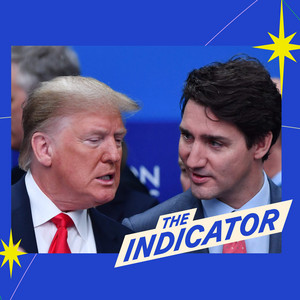
N -P -R The seismic economic event right now is President Trump's tariffs on Canada, China, and Mexico.
Now, Canada and Mexico have been spared these 25 % tariffs for now.
They reached a deal yesterday where the U .S.
will delay these tariffs for a month.
But if put into effect, these will be part of extraordinary measures that are far more expansive than the trade war during the first Trump presidency.
A big question people are asking right now is why?
What's Trump's end goal here?
Are the tariffs really because Donald Trump wants Mexico, Canada and China to clamp down on fentanyl?
Is it migration at the borders?
U .S. trade deficits with these countries?
Are they a way to raise money for the government?
Donald Trump says yes to all of the above.
One thing on Friday he said this is not is a negotiating tool.
No, it's not. It's pure economic.
We have big deficits with, as you know, with all three of them.
But Donald Trump has used tariffs as a negotiating tool as recently as late January.
And it worked. Now, it's a foolish game to try to get into the president's head.
But we thought dissecting a recent showdown can at least reveal some of the tactics Trump is using as he threatens America's biggest trade war in generations.
This is The Indicator from Planet Money.
I'm Darian Woods. And I'm Waylon Wong.
Today on the show, the game theory of tariffs.
Why Donald Trump is so quick to escalate tariffs against friends and foes, even for issues that have nothing to do with trade.
This message comes from Charles Schwab.
When it comes to managing your wealth, Schwab gives you more choices, like full -service wealth management and advice when you need it.
You can also invest on your own and trade on Think or Swim.
Visit schwab .com to learn more.
Support for NPR and the following message come from Edward Jones.
What does it mean to be rich?
Is it your choice, not theirs?
That's why, when it comes to managing your wealth, Schwab gives you more choices.
You can invest and trade on your own.
Plus, get advice and more comprehensive wealth solutions to help meet your unique needs.
With award -winning service, low -costs, and transparent advice, you can manage your wealth your way at Schwab.
Visit schwab .com to learn more.
This message comes from Charles Schwab.
When it comes to managing your wealth, Schwab gives you more choices, like full -service wealth management and advice when you need it.
You can also invest on your own and trade on Thinkorswim.
Visit schwab .com to learn more.
To learn more about why Donald Trump is so emboldened when it comes to tariffs, we can look back to late January.
Sunday, 2 a .m., two U .S.
military planes were en route to Colombia, carrying migrants who were being deported.
The planes had prior authorization to land in Colombia.
But suddenly, mid -flight, this authorization was revoked.
Colombian President Gustavo Petro wrote on X, The U .S.
cannot treat Colombian migrants as criminals.
I deny the entry of American planes carrying Colombian migrants into our territory.
The reaction from U .S.
President Trump was swift.
That day, he posted on Truth Social that he had directed his administration to immediately place 25 percent tariffs on all Colombian goods, raised to 50 percent in a week, among other measures.
For Colombia, this would be devastating.
Roughly a third of Colombia's exports go to the U .S.
Oil, flowers, gold, coffee.
After a long social media post from Petro digging in his heels, the Colombian government eventually relented that evening and allowed deportation flights to land.
The tariffs did not go ahead.
What was striking about this incident was its speed.
Colombia wasn't really on the president's radar.
And then within a day, the U .S.
seemed like it was about to go to trade war with a friendly country.
And whether it's Colombia or Denmark or now Mexico and Canada, threatening steep tariffs when countries defy Donald Trump seems to be a pattern.
Now, Trump may not know he's using a strategy from game theory, that is, the medical science of cooperation or conflict.
But in game theory, Donald Trump's strategy has a name.
It's called, in game theory, a trigger strategy, or sometimes called grim trigger, which sort of has a cowboy -esque ring to it.
Kevin Zulman is a professor at Carnegie Mellon, where he specializes in game theory.
The trigger strategy sort of says, cooperate with me on my terms until you do something that I don't like, at which point I will punish you sometimes severely and sometimes indefinitely.
Now, Trump isn't saying that tariffs will be placed on other countries forever.
But Kevin thinks the trigger strategy of severe punishments can be used to think about Trump on the world stage.
And Kevin says for a trigger strategy to be successful, the threats have to be big.
Even if you're harming yourself, you have to be harming the other person sufficiently to make it worth them cooperating on your terms to begin with.
The fact that Colombia's economy is much smaller than the U .S.'s helped Trump in this respect.
For larger economies like China, Mexico, and Canada, it's less clear.
Over the weekend, Canada's Prime Minister Justin Trudeau was adamant.
We didn't ask for this.
but we will not back down.
Still, this Monday, both Mexico and Canada negotiated a month -long pause on the tariffs and vowed, among other things, to increase security along the northern and southern borders.
China, meanwhile, is complaining to the World Trade Organization.
Gevin says to be effective, the threats have to be plausible.
Game theorists would tell you you have to make sure that the threat is credible.
How much does Trump care if he harms the U .S.
economy? How much does Trump care if the price of coffee goes up?
or avocados, cars, or even gasoline.
And arguably, the spat with Colombia was part of building that credibility, not just for Colombia, but for all countries that might want to go against Donald Trump's wishes.
Part of what Trump might be trying to do here is make his future threats more credible by trying to demonstrate to other countries that he doesn't care about crashing the U .S.
economy or about increasing inflation or about increasing the costs of goods by putting tariffs on other parties so that then they take those threats more seriously because they think they are in fact credible rather than non -credible threats.
And part of that credibility might involve sounding a little crazy.
This is known as madman theory.
When your opponent takes you seriously because you're acting like a madman, that might well do something awful that harms both of you.
It's one of those things where there could be many levels here.
It could be that he's carefully calculating the benefits and thinking if I make the world think I'm crazy, then that will get better deals for me.
And so I'll pretend to be crazy.
It could also be the case that he learned that behavior without maybe necessarily being cognizant of it.
So he may have found in his business dealings in the past that just behaving in this way got him better deals.
He doesn't quite know why and he just does it anyway.
And you know what? He might be genuinely crazy.
I mean, that's the other possibility, right?
And it just so happens that it's working in his favor sometimes.
And in the case with Colombia, his madman approach of calling for the tariff trigger to be pulled did seem to work.
And Trump didn't even need to place those tariffs on Colombia.
Kevin Solomon says, when the strategy works, it can be great for getting what you want.
Kevin Solomon says, when the strategy works, it can be great for getting what you want.
But it still made us wonder, how sustainable was this trigger strategy?
The downside is that it is very unstable to what we think of as errors in game theory, which are either misperceptions or accidental actions.
So if the cooperative partner, say, does something that Trump thinks is not cooperating, even though it was, he just misunderstands what they were doing.
And so he institutes those tariffs.
And then if he does, you know, the other party, Colombia, might look and say, wait a minute, like, we didn't do anything wrong.
Why are you doing this?
We're going to retaliate against you.
And so the trigger strategies can cause these chain reactions of retaliatory behavior, especially if both sides are using these strategies.
So what's an alternative strategy?
You don't want to just be somebody who says, I'll be nice to you no matter what you do to me, because then you'll get taken advantage of.
But you can also be slightly more forgiving.
So you can say, look, I'll allow some apparent deviations and once you fix it, then okay, we're back on good terms.
But if you don't fix it, then you start to think about maybe implementing a grim trigger strategy.
In game theory, a little forgiveness can go a long way.
It can keep that cooperation going further into the future.
The other thing, of course, is these things become less necessary the more that cooperation is just in both parties' mutual interests.
So the less one -sided the negotiation, the less threatening you need to be.
Because if you can find a negotiation that is genuinely win -win, where both parties feel like they've benefited from it, well, then there's very little need for a threat of retaliation because both parties are perfectly happy to continue doing what they're doing.
Most of the countries we've talked about are friends of the U .S., countries that have supported the U .S.
military, shared intelligence, and built businesses together.
That goodwill is now in jeopardy.
Well, and did you see that Canadian ice hockey game where they booed the U .S.
national anthem? I mean, it's like the goodwill just evaporated instantly.
This episode was produced by Corey Bridges with Engineering by Robert Rodriguez, who's fact -checked by Sierra Juarez.
It was produced by Corey Bridges with Engineering by Robert Rodriguez, who's fact -checked by Sierra Juarez.
Kate Concanon edits the show, and The Indicator is a production of NPR.
This message comes from Tourism Australia.
No matter what you're into, Australia has something for everyone all year round, like the Daintree rainforest this spring, Melbourne's music scene in the summer, and the wineries of Barossa Valley in the winter.
Come and say good day.
More at Australia .com.
This message comes from ShipBob.
Outgrown how you ship your business's orders?
ShipBob's fulfillment scales with you across locations and channels, delivering smart inventory distribution, two -day shipping, and real -time analytics.
Go to ShipBob .com for a free quote.
This message comes from NPR sponsor, Oracle Cloud Infrastructure.
AI needs lots of speed and computing power.
So how do you compete without cost spiraling?
Upgrade to Oracle Cloud Infrastructure.
OCI is the blue.