You're listening to the Global News Podcast from the BBC World Service.
Hello, I'm Oliver Conway.
We're recording this at 5 o'clock GMT on Tuesday, December the 16th.
President Trump launches a multi-billion dollar lawsuit against the BBC for editing his speech on January, the 6th.
The German Chancellor says a ceasefire between Russia and Ukraine is possible for the first time since the war began.
And a BBC investigation exposes an international scam that claims to raise money for children with cancer.
Also in the podcast we have the latest on the investigation into the Bondi beach shooting and I can't process what it'll mean to have lost two of the most important people who have done more to help me and my family and thousands of families like our family.
It's a devastating loss.
Remembering Rob Reiner and Michelle Singer Reiner after their son is arrested on suspicion of murder.
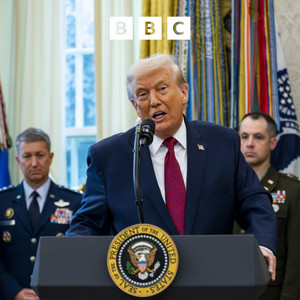
Donald Trump is suing the BBC for 5 billion after a TV documentary spliced together two sections of a speech he gave to supporters ahead of the US Capitol riot nearly five years ago.
The US president accused the BBC of defamation and violating a trade practices law.
The BBC has apologised for the edits but refused to pay compensation, saying there's no basis for a defamation claim.
Our North America correspondent Peter Bowes told me more.
President Trump threatened to do this.
He's spoken about it several times.
And now, well, it is official.
These court papers have been filed in Florida in some detail, looking through the various documents.
But essentially he is accusing the BBC of false defamatory disparaging, inflammatory and malicious depiction of him, President Trump, all relating to that panorama programme that aired a week before the 2024 presidential election.
And the edit that was made on a section of his speech from January the 6th in 2021, essentially putting two bits of the speech that were separate, but putting them together, which the president and his lawyers argue give the false impression that he was encouraging the his supporters to carry out a violent attack on the capitol building, so essentially saying that it misrepresented what he was saying overall in that speech.
Now we know that the bbc has apologized, although rejected president trump's initial call for compensation, but this is indeed a huge lawsuit with billions of dollars.
As far as the president's claim Yeah, and remind us why he's filing it in Florida rather than in the UK, where the programme was broadcast.
Well, to file a lawsuit in Florida, the reasons could be several.
First of all, President Trump is a resident of Florida, so the federal courts in that state are a natural place for him to file lawsuits.
But I think at the heart of the argument and this is detailed in these documents is that the Panorama program, according to Mr Trump's lawyers, could potentially have been seen, at least for a limited period of time, through a streaming service in Florida, but indeed in other parts of the United States as well, by Americans, and the argument being that, before the election, it may well have influenced people in this country.
That has been one of the big issues and debates over this lawsuit, as to whether it indeed affected the election, because there's been a question mark over whether Americans actually got to see it.
Peter Bowes in Los Angeles.
One of the main sticking points in negotiations to end the war in Ukraine has been how to prevent Russia resuming its invasion in the future.
After talks in Germany between Ukrainian, European and American negotiators, the US has offered to provide Kiev with NATO-style security guarantees.
That's prompted the German Chancellor to say there is a real possibility of a ceasefire.
And President Trump is also optimistic.
I had a long talk with President Zelensky.
Also I spoke with the heads of Germany Italy NATO Finland France, the United Kingdom Poland Norway, Denmark and the Netherlands.
And I think we're closer now.
And they will tell you that they're closer now.
We had numerous conversations with President Putin of Russia.
And I think we're closer now than we have been ever.
But the question of handing over Ukrainian territory to Russia remains a sticking point.
President Trump appeared to suggest that Ukraine should give up parts of the eastern Donbass region that it still holds.
And that is something the Ukrainian president, Volodymyr Zelensky, has previously ruled out.
So, although US officials say 90 of the deal is agreed, the remaining issues could prove difficult, as Oleksandr Marezhko, head of the Ukrainian Parliament's Foreign Affairs Committee, explained.
It seems to me that the rest 10% might be crucial.
I suspect that there might be about two extremely important issues.
First of all, about Russian demand for Ukraine to withdraw our troops from the rest of the Donetsk oblast, which is totally unacceptable for us for many reasons.
And second issue about security guarantees and NATO membership for Ukraine, because this remains to be the only guarantee of our survival as a nation and as a country.
So what should we make of the talks?
James Kumarasamy asked Jessica Parker in Berlin.
The progress is tempered with the reality that any proposals would also need to be signed off by Russia and the fact that the issue of potential territorial concessions by Ukraine that is unresolved.
But US officials briefed earlier that Ukraine was being offered Article 5-like sanctions security guarantees, because they're not, it seems, going to get a pledge of nato membership, membership for the nato military alliance.
And then the europeans european leaders who are here released a statement earlier putting forward a set of proposals that are really interesting.
It's the kind of detail we haven't seen before on this idea of security guarantees.
So This European led multinational force that could assist Ukraine in terms of securing its skies, a legally binding commitment in case of a future armed attack and potential assistance there in the US, leading on on monitoring a ceasefire.
So the contours of what security guarantees could actually look like taking shape tonight.
Yes, but it's the contours of the territory that Russia is essentially going to be given in this deal, as you say.
That is the sticking point, isn't it?
And it's a question of that eastern region of Donbass which, at the moment, is only what two thirds of it controlled by Russia.
Yes.
So Ukraine wants to keep hold of the territory that it still controls, not just because Ukrainian people live there, but also because they have dug in defensively.
There's this sort of fortress belt described in the west of Donetsk, that they would be loath to retreat from.
And President Zelensky has said look, if we're being told to move five, ten kilometres back, why wouldn't the Russians be asked to do that?
And he admitted in the press conference that there are still differences there.
The Russians have of course said that if they can't get control through diplomacy of Donbass, then they'll just take it by force.
And I think the big question mark tonight is, even if there is a lot of progress in these US-Ukraine talks with plenty of European allies input as well,
What ultimately will Russia do?
And the Kremlin's critics of course think that Vladimir Putin is simply continuing to play for time.
Jessica Parker in Berlin.
A BBC Eye investigation has found that some parents whose children have cancer have been scammed by a network of people working for associations registered in Israel and North America.
Nine families across five continents say they have not received a penny of the four million dollars apparently raised in their children's names.
Simi Jalawasho reports.
When Khalil Tabasa was just seven years old, he was diagnosed with leukemia.
We were lost.
We didn't know what we were going to do.
Our whole world crashed.
His mother, Algin, says they were struggling to pay for his treatment.
We were faced with a very large bill.
I really needed money for Khalil's treatment.
That's when they were approached by a local Filipino man who said an international sponsor could help.
He just told us that all we would have to do is make a video to earn the money.
Over voice notes that she shared.
You hear the local man telling Algen.
The campaign will be seen worldwide and provide her with much-needed financial assistance.
Khalil is given a script to practice.
We have no money for my treatment.
I want to be a normal kid.
I want to go to school.
Please help me, please.
The foreign sponsor then comes to the Philippines to direct the filming at a local hospital.
He insisted that we shaved off Khalil's hair so that we could convince people watching that Khalil was very sick.
They rubbed menthol ointment on his face and put onions in front of his eyes so that he would fake cry.
The BBC has identified this man as Erez Haddari, an Israeli living in Canada.
Arjun says he gave her the equivalent of 700 US dollars on the day and told her that there would be more money if the campaign was successful.
Hello, my name is Kareel.
Two months later, the video went live under an organisation called Chance Latikva.
The campaign page says it has raised more than $27,000.
But Algin received none of the money and only saw the link when I tracked her down and showed it to her.
Sadly, Khalil died a year after filming the video, but the campaign is still taking donations.
It makes me angry to see how many people tried to help us.
We did everything he asked us to do so that we could get the help that we needed, and he kept that from us.
After Algin found out about the live campaign for her son, she confronted Erez Hadari in a video call.
Because I see the link of Khalil's fundraising is still running, but it's not stopped.
There's nothing there.
There's no, it didn't start.
There is a money that you have fund.
It's $27,000, right?
There is cost of advertising.
So the company lost money.
They advertise and advertise and they didn't receive money back.
They lost money.
I lost money too.
The money that I gave you, the money that I spent on production, I lost.
BBC Eye spoke to nine families across five continents.
And across all the campaigns we investigated, it didn't matter how much money they raised.
The outcome for the families was the same.
They received none of the money raised.
BBC Eye put out allegations to Erez Haddari and Chancellor Tikva, but they did not respond.
Simi Jalawesho reporting and you can hear that story in full in the new season of World of Secrets the child cancer scam, wherever you get your BBC podcasts.
Police in Los Angeles are questioning the son of the film director Rob Reiner and his wife Michelle, after the couple were found dead at their home on Sunday.
Nick Reiner is being held on suspicion of murder.
There are reports he'd been seen arguing with his father at a party the evening before.
President Trump meanwhile, has been condemned for a social media post in which he said Rob Reiner died because he'd criticised him.
The director was a long-term supporter of the Democrats and a social campaigner.
He and his wife were friends of Chris Perry, who served as the plaintiff in a landmark case that eventually overturned a ban on gay marriage in California.
She spoke to the BBC's Sean Lay.
From the very beginning of the time I've known Rob, Michelle was right at his side.
I think that she was an inspiration to him and that helped him to do more of the good work he did on behalf of the state of California.
But also when it came to marriage equality.
I think that they together imagined a way to push back on this unfair law as a team.
And they brought so much love and compassion to their work.
And it inspired not only their friends in Hollywood that were generous and helped to contribute to the cost of the case, but to the lesbian and gay community.
They extended so much warmth and support, living through a time when we were fighting for these basic rights.
I can't tell you just how easy it was to interact with them and be in their company.
It never seemed as if you were with Hollywood royalty.
That was over decades.
It wasn't just in service to one initiative.
It was who they were year in and year out.
Now I can't process what it'll mean.
To have lost two of the most important people in my life, who have done more to help me and my family and thousands of families like our family.
It's a devastating loss.
When did you last spoken to the Rhiners?
My wife Sandy and I had dinner with them in June.
We were in Los Angeles for a weekend and we called them up and asked if they wanted to have dinner, and they jumped at the chance to meet us.
We had dinner at an Italian restaurant and we heard all about Spinal Tap 2 and it was just like old times.
It's a good memory to have as your last memory of them.
Yeah, I'm really glad we had that.
Do you know anything about the relationship they had with their son, Nick?
Having known them this long, we've seen their kids grow up just like our kids, almost the same ages.
And we've known that Nick has struggled with mental health issues for a long time and that they have tried and tried to help him with those.
And when we saw them, they were feeling optimistic about his success, mental health, and that he was in a better place, and i could see the relief on their faces of maybe reaching a place where things could be calmer.
But they adored, adored their children and dedicated to them.
Their happiness and their well-being is so genuine and thoughtful.
I mean, the reporting is that it was their daughter who found them, and now, of course, we know that the police are questioning nick over the deaths.
As family tragedies go, it is a horrendous one, Correct?
Knowing them all, I can't help but think about all three children and what this means for their lives and what they've lost.
My heart is broken for all three of them.
Donald Trump issued a fairly scathing post on social media reacting to the Reiner's deaths.
I wonder what you made of that.
I don't think it's ever the right time to make a family tragedy about yourself.
And so I think it's a really inappropriate comment to make when you know that a family has been destroyed and that the parents were dedicated, generous public servants and cared deeply about the future of America.
It's cruel to do something so petty at a time that's so terrible.
Yeah.
Chris Perry, education charity executive and friend of the Rhiners.
Still to come.
On the podcast There are quite clear indications that these balloons were deliberately sent to stop air traffic.
The giant balloons causing a national emergency in Lithuania.
You're listening to the Global News Podcast.
Now more details have been emerging about the father and son who killed 15 people at a Jewish festival on Bondi Beach on Sunday.
The Australian Prime Minister, Anthony Albanese, said they appear to be driven by Islamic State ideology.
A short time ago, the New South Wales Police Commissioner, Mal Lanyon, gave reporters this update.
There has been reports in the news about our two offenders travelling to the Philippines last month.
I can confirm that they did travel to the Philippines.
The reasons why they went to the Philippines and the purpose of that and where they went when they were there is under investigation at the moment.
I also confirm that the vehicle which is registered to the younger male contained IEDs, but I also confirm that it contained two homemade ISIS flags.
The younger of the two gunmen, Naveed Akram, was investigated by intelligence agencies in Australia in 2019 over possible links to IS.
The Australian government meanwhile, has promised tougher gun laws after it was revealed that the father, Sajid Akram, had six registered weapons.
Our correspondent Phil Mercer is on Bondi Beach.
Every day we're learning more about the two attackers who perpetrated this atrocity.
There are media reports here suggesting that they recently traveled to the Philippines for military style training.
That prompted the response that we've just heard from the New South Wales police commissioner.
They didn't confirm the story about military training, but the police do say that this pair did travel to the Philippines.
And we also understand from the military in the Philippines that they are aware of these reports too.
So this investigation now has quite a significant international component.
We know too that the younger man has had surgery in hospital and is reportedly in a coma in a hospital here in Sydney.
As to their motive, that remains unclear.
But, as you've said, the police do believe that there is a strong connection now with Islamic extremism.
And, of course, they were able to carry out this attack because the father had six legally registered weapons.
What changes might be made as a result of this attack in terms of Australia's gun laws?
Well, there seems to be a real political appetite now for gun control laws.
And in recent times when gun reform has been mentioned, there is quite a strident, vocal gun lobby in this country pushing for more relaxed firearms legislation.
But the government seems to be heading in a very different direction for obvious reasons.
What the Prime Minister, Anthony Albanese, has been outlining is that perhaps individuals won't be able to own as many guns as the 50-year-old father who was shot dead by the police.
He had six legally registered firearms.
There will be, under Anthony Albanese's suggested plan, a stricter policy when it comes to licensing and also more controls at the border.
They are well aware of the influence of 3D printing and firearms, but there does seem to be a real political ambition here to pursue very strict gun control laws in a country that already has a very strict legislation.
And briefly, just tell us about the scenes where you are.
I'm looking at pictures of a huge pile of floral tributes that have been laid there.
Yes, I'm standing about 10 metres away and every day it grows, every hour it grows.
This has become the epicentre for people to come and stand in quiet reflection to remember the horror here that was perpetrated on Sunday evening.
Phil Mercer in Sydney.
And for more on the Bondi Beach Massacre, search for BBC News on YouTube, choose podcasts and then Global News Podcast.
We update it every weekday.
As we heard earlier, Europe may be offering security guarantees to Ukraine, but the continent is already facing threats from Russia in what intelligence services are calling a hybrid war of sabotage and cyber attacks.
Lithuania has experienced a wave of arson and foiled a parcel bomb plot.
The government there has now declared an emergency situation because of what it calls a deliberate attempt to cause chaos by Russia's ally Belarus.
Sarah Rainsford reports now from the Lithuanian capital, Vilnius.
Every night now, on Lithuania's eastern border with Belarus, the military go out on patrol.
Soldiers stopping and searching, checking documents and car boots.
They're looking for signs of the latest hostile activity by their neighbour.
It comes in unusual form.
Giant white balloons that have been launched at Lithuania in waves and are causing massive disruption to air traffic here.
The spot checks are part of the emergency response to what the government is calling a hybrid attack by Russia's closest ally.
Living here, so close to the Belarus border, this woman tells me she is nervous.
She says the whole situation these days is worrying.
The balloons are making air travel here a bit of a lottery.
They've shut down the airspace over Vilnius airport 15 times in recent weeks, cancelling hundreds of flights and creating huge costs for the airlines.
The balloons are used by smugglers who lift cheap cigarettes across the border that way from Belarus.
But their number has suddenly increased lately and they're now being directed at the airport.
This is a completely new thing for aviation sector.
I mean, none of the airports in Europe experience that.
This is Simonas Batkus, who's CEO of the airport.
There's one thing, of course, extra costs for us, extra costs for airlines.
Even higher risk is the passengers will start to lose the trust in air travel.
So you think it's a deliberate attempt to disrupt life in Lithuania as much as possible?
Yeah, I think so.
There are quite clear indications that these balloons were deliberately sent to stop the air traffic.
In Belarus itself, Alexander Lukashenko brushes off such talk as foolish.
The authoritarian leader there claims this is just criminal activity.
But he's not stopping the smugglers.
And he has got form when it comes to weaponising the border.
Remember the migrant crisis of 2021?
That's when Belarus helped tens of thousands of migrants to the border with the EU and even across it, causing huge tensions.
That's another reason why the Lithuanian government is so sure it's dealing with something much more sinister than smugglers.
I spoke to the foreign minister, Kestutis Budris.
They see this as a leverage.
You have a border with us, we can cause you huge problems with this border.
And the border is of the EU, but both of NATO.
And therefore, we want to prevent from military escalation of the situation.
And just a few steps from Belarus now, standing by a tall metal fence that runs all the way into the distance.
For as far as I can see,
And it's topped by big coils of barbed wire.
A couple of border guards looking back towards me.
This area has changed completely in recent years and this fence all of this security, a sign that Lithuania and, by extension Europe, really see Russia and its ally Belarus as a major threat.
So the emergency measures and the military spot checks continue because, as Washington starts engaging again with Minsk and with Moscow, the mood here is completely different.
Our Eastern Europe correspondent Sarah Rainsford in Lithuania.
The new head of Britain's foreign intelligence service MI6, has voiced her own concerns about Russian sabotage in her first speech since taking over the spy agency.
Blaise Metrovelli said Moscow was testing the West, placing the UK in a space between peace and war.
It's important to understand their attempts to bully, fearmonger and manipulate, because it affects us all.
I'm talking about cyber attacks on critical infrastructure drones, buzzing airports and bases, aggressive activity in our seas, above and below the waves, state-sponsored arson and sabotage, propaganda and influence operations that crack open and exploit fractures within societies.
The export of chaos is a feature, not a bug. in this Russian approach to international engagement.
And we should be ready for this to continue until Putin is forced to change his calculus.
Our security correspondent, Frank Gardner, told Charlotte Gallagher more about the MI6 chief's remarks.
She singled out just Russia.
She only gave a very passing reference to China.
And she really laid it on thick actually on Russia, accusing it of not just hybrid warfare, but of President Putin sacrificing his own people as he drags his feet over peace negotiations.
She also talked a lot about technology, which isn't surprising given that she has come from Q Branch which obviously, if you've watched a James Bond film, you'll know what Q is, who Q is.
Can you tell us a bit about her background and also what she wants to focus on?
It came as a surprise to me when I first learned about this that there really is an in-house division within MI6, the Secret Intelligence Service that is called.
It's dubbed Q Branch.
I mean, it's technically, it's called the Branch of Technology and Innovation Branch.
But it's everybody calls it Q branch.
And it's a sort of cell within a cell.
And she has been running that because she's got a background in technology, although she's a graduate from Cambridge University, Pembroke College in anthropology and she's done psychology.
She's a scientist, I think, in her approach.
And what Q Branch does, amongst other things, is that they design the gadgets and gizmos that keep their officers and agents safe in the field.
And this is incredibly important for them in an age of biometric data.
So roll back a few decades to the age of Smiley and you know, John le Carré, and you could get somebody into a country like East Germany, disguised Professor Higginbottom, With a fake beard, a hat, glasses.
All of that.
You know, perhaps a bit of makeup, etc.
That doesn't work any longer, because you've got biometric data facial recognition, voice recognition, gait recognition, iris recognition, all of these things.
And countries like China and Russia have got this vast database, particularly the Chinese of everybody.
You and I are probably on it.
Who knows?
With their details.
So if you're a spook, if you're a spy and you're trying to get into a country and pretend you're somebody or not, that's going to get exposed.
You know, mastery of data is absolutely vital.
And for MI6, which is a human intelligence gathering organization, in order to remain relevant and not become an anachronism in 2025, they need to be right on top of data, on top of AI, of quantum of cyber, all of this.
And I think you know they are going to have to become quite a different organization from what they were.
One of the things she said in her speech is we need our officers to be as comfortable with the language of computing, with code, with software programming, just as comfortable with that as they are with languages.
Frank Gardner.
World leaders often exchange gifts when they meet, but what happens to those presents when they go home?
The Italian Prime Minister, Giorgia Maloney, has decided to get rid of items she doesn't need or want.
Hundreds of gifts she's been given will soon go under the hammer, with the proceeds going to charity.
Wendy Urquhart has the details.
World leaders have received some very weird and wonderful gifts over the years, and some of them are a bit pricey.
The stash that the Italian Prime Minister, Ms Maloney, is putting up for auction is worth more than 900000.
But that pales in comparison to the 400 million luxury jet that President Trump received from Qatar on his world tour, which is being refitted as the new Air Force One.
When Emmanuel Macron toured China in 2018, he gave President Xi a horse worth around $5,000.
In 2013, the Queen of Brunei handed Michelle Obama jewelry worth more than $71,000.
And a year later, the King of Saudi Arabia gave the Obamas gifts worth $1.3 million.
The late Queen Elizabeth received a 4000 Tiffany brooch from Donald Trump in 2019, which might have been slightly more useful than the bull elephant she got from the president of Cameroon.
Vladimir Putin's received gifts have included several dogs, and the Russian president once gave the North Korean leader an African lion, two brown bears, five white cockatoos and dozens of pheasants.
The former French President François Hollande was given a camel by the authorities in Mali and former US President George W. Bush got a Komodo dragon from the President of Indonesia.
So if you're hankering after a statuette of the Argentine President, Javier Millet, holding a chainsaw, a pair of blue python skin shoes with gold heels or some Slovakian jewellery, Keep an eye out for Giorgio Maloney's auction, which is scheduled to take place at Bertolami Fine Art in Rome in the next couple of weeks.
Wendy Eckhart reporting.
And that is all from us for now, but the Global News Podcast will be back very soon.
This edition was mixed by Riccardo McCarthy and produced by Paul Day and Peter Goffin.
Our editors, Karen Martin.
I'm Oliver Conway.
Until next time, goodbye.