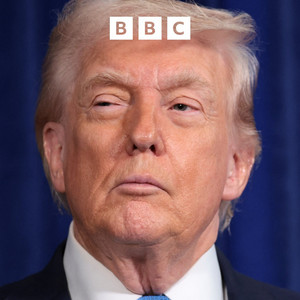
This is a special extra edition of the Global News Podcast marking the momentous events in Venezuela from the BBC World Service.
I'm Alex Ritson, and at 21 Hours GMT on Saturday 3rd January, these are our main stories.
After a Hollywood-style raid by 150 aircraft and US special forces on a fortress in Caracas, which snatched President Nicolas Maduro.
Donald Trump says he's now in charge of Venezuela.
We're going to run the country until such time as we can do a safe, proper and judicious transition.
And it has to be judicious.
We can't take a chance that somebody else takes over Venezuela that doesn't have the good of the Venezuelan people in mind.
Decades of that.
Mr Trump announced US oil companies will fix Venezuela's broken infrastructure and start making money for the country.
The US president also released a photo of a blindfolded and handcuffed Nicolas Maduro aboard a US Navy ship on his way, he says, to face justice in New York.
But Venezuela's vice president, Delcy Rodriguez, now sworn in to take charge, has taken to state TV to say there is only one president of Venezuela and his name is Nicolas Maduro.
Also in this podcast, we'll be looking at how far the US operation complies with international law.
Following on from the capture by the US military and the deposing of the Venezuelan leader, Nicolas Maduro, President Trump has said that the United States now intends to run the South American country.
Mr Trump spoke just hours after Mr Maduro was, along with his wife, Celia Flores, taken from the Venezuelan capital Caracas, in an air, land and sea operation in the early hours of Saturday morning.
US special forces and 150 military aircraft took part in the pre-dawn raid.
Mr Trump first spoke to the US network Fox News about the operation and said it was like watching a television show.
We were going to do this four days ago, but the weather was not perfect.
The weather has to be perfect.
And we had just the perfect weather.
And we said go.
And I'll tell you, it was just amazing.
And what was he doing?
He was in a very highly guarded, like a fortress, actually.
He was in a fortress.
It had steel doors.
It had what they call a safety space where it's, you know, solid steel all around.
He didn't get that space closed.
He was trying to get into it, but he got bum-rushed so fast that he didn't get into that.
We were prepared.
We had, you know, massive blowtorches and everything else that you need to get through that steel, but we didn't need it.
Soon after Mr Trump posted a photo online of Mr Maduro who, just hours earlier, was the authoritarian leader of a country with a population of around 30 million people.
Now he was seen wearing a grey tracksuit, blindfolded and handcuffed on a warship, the USS Iwo Jima.
He and his wife are now heading for New York. to face drug trafficking and terrorism charges.
A 25-page indictment charges the couple, along with their son, two other politicians and an alleged cartel leader, with running a violent cocaine trafficking empire for their own enrichment.
Mr Maduro has always rejected the accusations as an excuse for regime change.
After speaking to Fox News, President Trump held a news conference at Mar-a-Lago, his resort in Florida, where he made this announcement.
We're going to run the country until such time as we can do a safe, proper and judicious transition.
So we don't want to be involved with having somebody else get in.
And we have the same situation that we had for the last long period of years.
So we are going to run the country until such time as we can do a safe, proper and judicious transition transition and it has to be judicious because that's what we're all about.
We want peace, liberty and justice for the great people of venezuela.
Going to stay until such time as the proper transition can take place.
So we're going to stay until such time as we're going to run it, essentially until such time as a proper transition can take place.
As everyone knows, the oil business in Venezuela has been a bust, a total bust, for a long period of time.
We're going to have our very large United States oil companies the biggest anywhere in the world go in, spend billions of dollars, fix the badly broken infrastructure, the oil infrastructure, and start making money for the country.
And we are ready to stage a second and much larger attack if we need to do so.
The BBC's American broadcast partner CBS, has learned that a CIA source inside Venezuela's government helped to track Mr Maduro's location before he was captured by elite soldiers in the US Army's Delta Force.
The chairman of the US Joint Chiefs of Staff, General Dan Cain, gave details of the operation.
On arrival into the target area, the helicopters came under fire and they replied with that fire, with overwhelming force and self-defense.
One of our aircraft was hit and that aircraft remained flyable during the rest of the mission.
Maduro and his wife, both indicted, gave up and were taken into custody by the Department of Justice, assisted by our incredible US military, with professionalism and precision, with no loss of US life.
I heard more from our correspondent in Washington, Sean Dilley.
I think for some time President Trump has said that he would be looking to take direct action in Venezuela and you know, tensions have been escalating and escalating and it did seem that something had to give.
Yeah, and that incredible photo of Mr Maduro handcuffed and blindfolded.
And now what's going to happen to him and his wife?
He's expected to arrive by aircraft in New York later, as is his wife.
Now, there is an indictment.
That's a formal charge by the Southern District in New York.
And it's expected probably fairly early into the week.
We will see the man who holds the title, as you say, of Venezuela's president and he still holds that title at the moment appearing in custody, no doubt looking much more like a federal prisoner in any other court case domestically.
And of course, this again extraordinary statement from President Trump.
He says the US will now run Venezuela.
What does that mean?
Now, he didn't give any details about what that transitional government would look like.
He is talking about billions of investments and large US oil companies moving in.
And, of course, President Maduro's line had always been attacking the United States, accusing them of being interested in its oil supplies.
I don't think the United States would say it's not interested in what happens with the oil.
But the argument that they are framing this within is that this would benefit Venezuelans.
Sean Dilley in Washington.
So what happens next for Venezuela?
Democrats in the United States have condemned a prolonged American involvement.
For now, the Venezuelan Interior Minister, Díaz Dado Cabello, gave a video message from the street.
Wearing a helmet and flak jacket, he was surrounded by army and security personnel.
Mr Cabello urged Venezuelans not to cooperate with those he described as the enemy.
After evaluating the damages caused by the criminal and terrorist attack against our people, our patriotic ground, our electrical facilities, our revolution and even those who aren't related to the revolution.
It is an attack on Venezuela.
I ask to stay calm, trust in our leadership, trust in our military, our political leaders, during the situation we are facing.
No one should fall into despair.
No one should make things easier for our invading enemy.
After these attacks, we will win in the end.
May the country win.
Venezuela's opposition leader and Nobel Peace Prize winner, Maria Karina Machado, welcomed the capture of Nicolas Maduro.
She said the hour of freedom had arrived, but Venezuela's vice president, Celso Rodriguez, now sworn in as leader, at least for now, appeared on state television and said the country has only one president Nicolas Maduro.
To our Venezuela, to our people, there is a government here with clarity.
We are ready to defend Venezuela.
We are ready to defend our natural resources that must be for national development.
The extremists who have promoted this armed aggression against our country.
History and justice will make them pay.
She added that Venezuela would never be a colony of any other nation.
In the meantime, how realistic is it for the US to run Venezuela, as President Trump said?
Here's our global affairs correspondent Mimi Swaby, who has reported from South America.
I think it's quite a deceptively simple idea to think that the US now has control from Venezuela, even though it's still unclear whether Donald Trump wants to actually put boots on the ground or if, like he said, the people behind him at the news conference, including the defense secretary and secretary of state, will be leading the show from the US.
There was discussion of the vice president, Delcy Rodriguez, who is kind of constitutionally second in command to Nicolas Maduro's, to her to step in.
She's already been sworn in as president and we understand that Marco Rubio, the Secretary of State, had a satisfactory phone call with her.
Yet there is questions now for the opposition.
This all, seemingly this whole operation, which started in early September and has come to a head early on Saturday morning with the removal of Nicolas Maduro and his wife, was for the opposition to come in, swoop into power, and That doesn't look like it's going to happen.
Very simply, it won't happen without many other steps happening first.
Maria Corina Machado.
According to, Donald Trump, in his press conference very recently, said that she isn't able or it'd be very hard for her to be the leader as she doesn't have enough respect within the country.
Now, this is... very different to all the kind of sentiment and praise he was giving her.
Only a matter of days ago, he kind of has been a strong ally of her.
So this will confuse the opposition, especially Maria Corina Machado, who's said with force once again that Edmundo Gonzalez, who many believe won the presidential election in 2024, should now take his position and take the mandate and be recognised by the army.
The army.
Now are Maduro's supporters, kind of saving grace.
They are the people who cemented his power.
So for them to switch, that would be a very decisive moment.
So Nicholas Maduro has a very loyal inner circle around four individuals.
That includes the Vice President, the Minister of Internal Affairs he's thought to be his number two in command.
He does run the show to much of much extent as well as the Defence Minister and others.
However, the military, like I said, they really are the backbone to him containing power and exercising a huge amount of political repression.
From the disputed 2024 elections, we've seen political repression only increase.
Any dissent has been met with very much force imprisonment, and we've had reports of extensive tortures and disappearances.
So fear is something that has run through all levels of Nicolas Maduro's government.
But now we're looking at whether the military will shift.
And that is something that the opposition leader has touched on.
And Donald Trump has warned.
He said Nicolas Maduro in his press conference will be used as an example to any of the other political figures or military figures in Venezuela who are thinking about opposing whatever lies ahead with this US now saying they were planning to rule Venezuela until a safe and judicial transition can happen.
Mimi Suebi.
So, is Donald Trump's action in Venezuela legal?
Venezuela's highest-ranking law officer, Tarek William Saab, had this message.
As Attorney General of the Republic, I strongly condemn the vile and cowardly attack by the imperial enemy, carried out in the early hours of the morning, against innocent civilian targets in our country.
It shows that everything President Nicolas Maduro said about an imperial threat is now turning into bloodshed, with innocent victims mortally wounded and others killed by this criminal terrorist attack carried out in the most cowardly manner, with premeditation and malice.
But what about international law?
Brian Finucane heads the US programme for the International Crisis Group, an independent think tank.
He's sceptical, as he explained to my colleague Lewis Vaughan-Jones.
It appears to be a flagrant violation of international law, Article 2.4 of the U.N.
Charter.
But it also follows the pattern, the precedent that this administration has cited, of the 1989 intervention in Panama, Operation Just Cause.
And today is the 36th anniversary of the capture of Manuel Noriega.
Let's look at some of the more detailed legal arguments here then.
What's your assessment of the charges that they seem to potentially be facing, Nicholas Majuro seem to be facing, on US soil?
So according to the U.S.
Department of Justice, the Attorney General, Nicolas Maduro and his wife faced a number of charges related to drug trafficking and someone amusingly also related to possession of machine guns, which is not exactly a surprise given that Maduro was the leader of a country with a military.
But these US criminal charges, regardless of their strength, provide no legal justification as a matter of international law for this military intervention in Venezuela.
What about the argument that this does come under presidential powers of protecting US and US citizens from a threat or even a potential threat?
Well, the problem with that is that there is no threat that exists in reality.
The administration has referred to Maduro, as I suppose a terrorist has alleged or suggested that somehow fentanyl is coming from Venezuela that kills Americans, which is simply not the case.
And so any sort of legal justification premised on the president's authority under Article 2 is extremely weak, given the absence of any credible threat to Americans from Maduro or Venezuela.
Brian Finucane from the International Crisis Group.
To end, here's an assessment from our South American correspondent, Ione Wells.
There was much speculation about whether something like this would happen.
I don't think anyone predicted it would all happen at once.
This morning started for Venezuelans with huge explosions around Caracas as military sites were struck.
And then this extraordinary statement by Donald Trump saying that President Nicolás Maduro had been captured and was on his way to the US.
And we then saw – and again I'll use this word extraordinary photo – of a man who has so much power, or did have so much power in that country, running all the institutions, the electoral system, the judiciary, the military, the government, pictured powerless, being sent to be in detention in New York.
And it's just an extraordinary fall from power for somebody who has had such a tight grip on it in the country for so long.
To an extent, is the US grabbing Venezuela?
Well, Trump's rhetoric is that they are going to run it.
But what is really quite bizarre, I think, about this evening's events is we just don't know what that means.
I think it is worth sort of reiterating here, the US hasn't invaded yet Venezuela.
There are not sort of, as far as we know, troops on the ground.
And yet he has said that the US is going to be running it.
So we don't know what exactly he means by that.
Are they going to send in troops, for example?
Are they going to try and force elections?
Are they going to try to depose other members of the government that are still in place there?
I think one reason why this is not potentially as smooth as Donald Trump is claiming is there are still many political and military figures in Venezuela who are loyal to Nicolas Maduro, and they will be acutely aware that of the fact that if they go without a fight, there could be similar repercussions for them.
And I think you know, so far millions of dollars worth of rewards.
The military pressure we've seen over the last few months hasn't been enough to convince them to go.
So I think there are certainly sort of mixed feelings about whether or not essentially, the US will be able to transition power in the way it claims.
Yeah, the opposition has been waiting for this day for years.
Maria Machado was a key ally of Donald Trump.
She sent a strong message, but Donald Trump slightly pushed back.
Where is the Venezuelan opposition in this?
I mean for the Venezuelan opposition leader, as you say, Maria Corina Machado.
She has said that this is a day of freedom.
For many in the opposition, this is a day they've been waiting for, a day when finally, they see a leader they saw as authoritarian being removed physically from the country.
However, again, I would say it's not as simple as that.
The opposition itself is quite divided.
There are some who don't like Maria Corina Machado's alliance with Donald Trump.
There are some that hate Nicolás Maduro, but certainly some I've spoken to who are very, very sceptical of US intervention in the country, not least because of the US's history in the region, the way that throughout the 20th century it backed various military coups, it deposed various leaders or helped to depose various leaders.
And I think there's a scepticism among some in the region that they don't remember US intervention very fondly and fear that this could potentially lead to further destabilisation too.
Yeah.
And this on the day that 36 years ago, the US grabbed General Noriega.
Symbolic.
Very symbolic.
But certainly that was the last time we saw such significant intervention.
And I think, as I say, it is important here to sort of stress that this is by no means certain.
We know from other types of attempted regime change, whether that be in Iraq or Libya, that sometimes this can lead to seriously destabilizing countries.
Ione Wells with her thoughts on a momentous day.
And that's all from us for now, but there'll be a new edition of the Global News Podcast later.
If you want to comment on this podcast or the topics covered in it, you can send us an email.
The address is globalpodcast at bbc.co.uk.
You can also find us on X at BBC World Service.
Use the hashtag Global News Pod.
This edition was mixed by Nikki Brough and the producers were Guy Pitt and Daniel Mann.
The editor is Karen Martin.
I'm Alex Ritson.
Until next time, goodbye.