From The New York Times, I'm Natalie Kittroweth.
This is The Daily.
A new poll shows more Americans than ever disapprove of President Trump's handling of the economy.
This week, all eyes have been on the economy.
Me and my husband just left the grocery store.
Everything has just went up double.
This is getting crazy.
We can't even afford groceries anymore.
To put 20% down on our house, that's a lot of money.
Even I can't do it working double shifts.
I'm 70 years old.
I cannot afford to retire.
With anxieties over affordability building, President Trump made a push to reassure Americans.
The US labor market is showing further signs of cooling, as the latest jobs report shows, unemployment rising to 46 percent.
Just as the government released long-awaited data that raised new questions about the economic health of the nation.
Today, my colleagues Tony Rahm on how Trump is trying to take control of the issue that's become his biggest political vulnerability.
And Ben Castleman on what the latest numbers tell us about why people are still so frustrated.
It's Friday, December 19th.
Welcome back to the show, Tony.
It's great to have you.
Hey, thanks for having me.
There's been a lot of focus on the economy recently, especially since the November election, when voters made it very clear that affordability was a major concern for them, that they were stressed and anxious about it.
And for the past few weeks we've seen the administration go out and talk a lot about these concerns, including in an address to The Nation by Trump on Wednesday.
So please, Tony, walk us through what exactly Trump and his allies are saying.
Yeah, this is really an attempt by President Trump to try to reclaim the narrative on affordability.
And this is all happening right now because voters increasingly report that they're frustrated with President Trump's handling of the economy, and they're frustrated with the fact that prices continue to remain so stubbornly high.
And so, within the last couple of weeks, we've seen President Trump start to hit the road to sell his economic agenda.
I just want to say hello, Pennsylvania, and I'm thrilled to be back.
The first of those appearances came on December 9th, when the president traveled to Pennsylvania an important electoral battleground to try to talk to voters about the work that he has done to bring down prices and to boost jobs.
The speech ended up lasting more than an hour and it saw the president touch on many topics far outside the context of the economy, including windmills and transgender people, and even his relationship with the Philadelphia Eagles running back Saquon Barkley.
By the way, if I read for it on the teleprompter, you'd all be falling asleep right now.
The president had a really hard time staying on message.
You know, because I love the weave, the weave.
You know what the weave is?
You go here, bing, bing, bing, bing.
You always have to get back to the right location.
Now, President Trump did turn to the economy several times during his speech.
And on the issue of affordability... They have a new word.
You know, they always have a hoax.
The new word is affordability.
He called it a hoax.
So they look at the camera and they say, this election is all about affordability.
Which is something the president has said repeatedly in recent weeks, as he tries to deflect attention on the fact that prices continue to remain high even under his leadership.
He even said that people should purchase fewer dolls and fewer pencils if they're looking to get away from higher prices.
It sounds like the speech was overall pretty undisciplined by the president.
And it was also him kind of trying to make this problem go away by insisting it doesn't even exist.
Like, nothing to see here.
Yeah, that's been the strategy of the White House.
It's really been to deflect.
Which is what made it so remarkable that just days later, on Wednesday night, President Trump gets up in front of the nation and tries to make his more forceful case for why the economy is in good shape and why his policies are working.
— Eleven months ago, I inherited a mess.
And I'm fixing it.
And so what we got from the president was a roughly 18-minute speech in which he was more concise and spoke more to the issues of the economy.
He brought up a lot of data, but some of that data was exaggerated or incorrect to make his record look better than it actually was.
On the economy,
When I took office, inflation was the worst in 48 years and, some would say, in the history of our country, which caused prices to be higher than ever before, making life unaffordable for millions and millions of Americans.
The president comes out and says that he has done extensive work to try to undo the inflation that we saw during the Biden administration, and said that the work of his administration was going to take time but had already resulted in rising wages and in lower prices for millions of Americans.
Tonight, after 11 months.
Our border is secure, inflation has stopped, wages are up, prices are down, our nation is strong, America is respected and our country is back stronger than ever before.
We're poised for an economic boom the likes of which the world has never seen.
He said that he was going to have a whole new policy coming soon meant to help lower housing costs.
He talked about how he was going to try to do the same thing with health care costs and had touted some recent work with respect to drug pricing.
And perhaps most importantly, the president ditched the language where he was calling affordability a hoax.
He wasn't in the position that he was only days earlier, where he was dismissing the whole issue of cost of living outright.
And what do you make of that, Tony, that he dropped the hoax language?
Do you think it's a sign that he's realizing that is not going to work?
People are not going to buy that this is a hoax, because it's something they're actually living every day.
You know, it might be a sign that the White House's messaging is shifting a little bit on the economy, as it recognizes that people really don't like being told that things are better than they are.
But the underlying principle here is that the president believes his policies are working and that things like tariffs, for example, aren't causing prices to rise.
And that philosophy hasn't changed.
And so, while the way they're talking about it might be shifting right now because of public opinion, the policies that inform what they're doing have stayed the exact same for the most part.
They have told people to just hang tight and that the full weight of their agenda will start to take effect, especially into early next year.
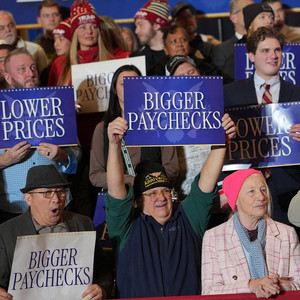
And that's when people will start to see relief in the form of more jobs and bigger paychecks and so forth.
And the give us more time request, like, what are they actually asking for the time to do?
What's supposed to be happening next year that may help people feel differently in their estimation?
So much of this rests on the implementation of the president's sprawling set of tax cuts that Congress adopted this summer.
That's when people may start to see some of the benefits that the president has touted in recent weeks.
And that'll happen generally in two forms.
The first is that people are going to see bigger tax refunds because there are a number of perks in that tax cut package that will expand how much certain Americans, like seniors, will receive when they file their taxes.
And so that's going to be a chunk of cash that people get.
So that's actually true.
That will happen.
That will happen.
Now, the amount that that happens will vary depending on the kind of person that files.
But people will see larger tax refunds.
You know the Trump administration also did not update the tables that determine how much is taken out of your paycheck throughout the year for federal taxes.
So refunds will be larger in 2026 because of that, because people's paychecks were not adjusted in a way to reflect the work that Congress did wrapping up this past summer.
And then, beyond that, I think the administration believes that the implementation of that tax law and the work that they're continuing to do in areas like trade will boost the work of companies to invest here in the United States, meaning more hiring and more domestic production.
And that means more opportunities in areas like construction and manufacturing.
And that's why the administration says that it believes that the United States is on track to see some significant growth next year because of all of the money it's pumping into the economy to stimulate that growth, particularly in the form of its tax law.
And it sounds like that could actually be quite meaningful, both for individuals, who get you know this version of a stimulus check in the form of a bigger tax refund, and for businesses, if they are able to channel some of those savings into hiring or growth.
What else is the administration banking on in 2026?
Yeah, the president has talked for weeks about sending perhaps 2000 rebate checks to Americans, funded through the tariffs that the United States has collected as part of the president's trade war.
Hold on, how exactly would that work?
Yeah, well, I think that's the question we're asking, too.
You know, the administration has said that it will be about a 2000 check and that it would go to Americans who make under 100000.
But that's all we have gotten from the White House.
The president has talked about this since about July or so, but they haven't really put pen to paper on a policy.
And even on top of all that, there are some Republicans in Congress who are a little bit worried about that idea and aren't super supportive of it.
But the president has talked about it as one of the things that might put money in the hands of Americans in 2026, even though that could potentially worsen the problem of inflation that they're trying to resolve.
The idea is that this check in theory would potentially offset the higher costs that people are paying because of his tariffs.
It almost sounds like a way of kind of rebranding tariffs by saying to people look, you get something out of this.
Yeah, it's interesting you use that phrasing because the president's own aides have sometimes framed it that way themselves.
They have said that this is the sort of thing that might help show Americans why tariffs are so rewarding for the US government.
But you're right, Republicans haven't expressed a great deal of support for this.
And it also remains unclear if the United States government can do this, just given the legal issues that surround the president's tariffs right now.
I'm struck Tony, that the messaging that you're describing from the White House it is essentially telling people to hold tight.
Like, good times are around the corner.
Wait.
Hang on.
That demands a lot of patience from people who are saying at this point, I am already looking at health care costs that are about to skyrocket.
I can't afford holiday gifts right now.
My bills are too high this month.
And you're asking me to wait.
You're right.
And it's not the first time that the administration has asked for that kind of patience.
You might remember, earlier in the president's term, when he first started introducing his tariffs, the message from the White House was there might be some short-term pain.
But they said that was in the service of a better economy.
And so we're now seeing what that pain looks like.
People are experiencing it.
And the message that we're getting from voters, as evidenced by some of the recent polling, is they're frustrated with the pain.
They're feeling it.
They don't like it.
And they want to see the White House and this administration do more about it.
But the message from the White House has been that they're going to stay the course because they believe that they have the recipe to lower prices and to boost the US economy.
And so there's a disconnect and there's a real risk for the administration.
And it remains unclear if American families can hold on for as long as the Trump administration would like them to hold on as they pursue this vision of a better economy.
When we come back Ben Castleman on what the latest data actually shows about the current state of the economy and what Trump gets right and wrong about it.
We'll be right back.
Ben, we've heard that Trump is asking people at this moment to hold on and wait for better times, and that that is complicated by the fact that in this economy, many people are hurting.
That's something that's reflected in polling.
It's something that is just a reality that I think we all see in people's experiences these days.
You have been looking at the data.
And so based on that, why do you think people are feeling so bad about the economy at this moment?
I think there are two answers to that question.
The first is that by most measures things are actually worse today than they were a year ago.
Unemployment is higher.
Wage growth is slower.
Consumer spending is growing more slowly.
Inflation is still stubbornly high.
And so the economy, by the sort of standard measures that we use, is not a disaster.
It's not falling off a cliff.
But it has deteriorated.
And a gradual deterioration is still a deterioration.
Right.
It's not surprising that people wouldn't feel terrific about a deterioration.
Absolutely.
But then the second reason is that all of the things that I hear the most when I talk to Americans about what bothers them, This sense that housing has gotten expensive, that child care and elder care and health care are all unaffordable, that their incomes are not delivering for them the kind of middle class life that they had hoped for and expected
None of that has gotten better.
And some of it has gotten worse.
Now, those are long-run problems.
And I don't think anybody thought that Donald Trump was going to come in and in 12 months, fix all of these longstanding problems.
But to the extent that they really haven't improved that, he hasn't even really talked very much about them.
I don't think it's that surprising that people emerge from that and say I don't feel good about where things are.
Right.
These are like open wounds that they're saying have not been treated.
Have not been treated and the administration is being really quite dismissive of.
So we just got new numbers on several of these issues that, as you mentioned, have been longstanding pain points for people.
So can you just walk us through what they tell us about where we stand on these issues?
Yeah, it's been a huge week for economic data, right?
We went for an extended period with no numbers because of the government shutdown.
And so we're sort of finally getting it all flooding back in.
Right.
And we're trying to make sense of what it all means.
Start with the jobs report that we got on Tuesday.
It showed that job growth was actually okay in November.
But the unemployment rate rose to 4.6%.
That's the highest since we were emerging from the pandemic.
How do you parse that?
So I think what it tells us is that the labor market is stuck, and it's been stuck for kind of a while.
We hear about layoffs or we hear about big companies that are cutting jobs.
But if you look at the data, layoffs have really not been very high.
In fact, they've been quite low.
So if you've got a job, you don't seem to be at that much risk of losing it right now.
Right.
But there's very little hiring going on.
Economists talk about this as a low hire, low fire environment.
So if you're looking for a job, if you're just graduating from college or from high school, if you're trying to reenter the workforce after a time out you know, raising children if you have been unemployed and now you're trying to get back into the workforce, it's a really hard time to do that.
And if you do have a job okay, you're holding on to it, but you're probably not getting much of a raise right now.
And what's the best way to get a raise?
It's to go and find another job, change jobs, or tell your boss, like, hey, I've got another offer.
If there aren't a lot of offers out there, You're not getting that raise and you're probably feeling pretty nervous, right?
You're like, if I do lose my job, I don't know that I'm going to be able to find a new one.
And so there's a real reason for people to have a level of anxiety over the labor market, even though –
It's sort of not that bad in an absolute sense.
There's a kind of stagnancy there.
You use the word stuck that helps explain why people are feeling negatively.
What about inflation?
We just got that report.
On the surface, the numbers were really pretty good.
Inflation slowed.
Prices were up 2.7 percent from a year ago.
That's still above where we'd like to see it, but significantly better than it's been in quite a while.
So good news for the administration.
Good news for the administration.
And, as you might imagine, the White House was out there right away talking about how the president has solved inflation.
But if you talk to most economists, they will say, read these numbers with a lot of caution.
And that the bigger picture on inflation is that it has cooled.
It's not looking as bad as some people feared that it would.
But we're coming off of this period where inflation was really high.
Right.
Grocery prices are up 25 percent over the past five years.
Wow.
So the fact that they're only up 2 percent over the last year doesn't make people feel great.
And there's still these sort of isolated categories where you see big price increases.
Beef prices are up something like 15 percent over the past year.
And look, on one level an economist is going to say well, you can always cherry pick one price or another.
That's up a bunch.
But if you're a shopper who has experienced this increase in prices over the last few years and now you go and look at a pack of ground beef and it's so much more expensive than it was a few months ago, you're going to say I can't believe this is still happening.
And I think that's what we're hearing from voters right now.
Right.
Things getting a little better this year doesn't feel like all that much of an improvement when you're looking at something just becoming so much more expensive over the course of very recent history.
Yeah.
And remember, prices are still rising.
They're just rising more slowly than they were.
And so if you're out there grocery shopping, you're not saying like aha finally, things are getting better.
You're just saying, oh, well, they're getting worse a little bit more slowly than they were before.
Yeah.
Still doesn't feel good.
And I think that brings us to the other big data point that came out this week, which was retail sales data.
Consumer spending has been quite strong by all reports.
The holiday season looks like it's been a very strong season for spending.
Mm-hmm.
But if you sort of drill down on those numbers, it's really being driven by a relative handful of high income spenders.
Right.
If you've got money in the stock market, if you own a home, right, you're feeling pretty good.
You're spending freely.
Everyone else is sort of feeling that pinch right of higher prices, of weaker wage growth, of nervousness about the state of the economy.
And so we're seeing sort of a lot of evidence of this bifurcation in the economy, where one well-off group is spending freely.
Everybody else is feeling a bit more nervous.
So even if consumer spending looks pretty good on the whole baked in there, if you look under the hood it's actually not that rosy of a picture.
There's many people that aren't spending as much as they were.
That's right.
And I think that really speaks to something that's happening in this economy broadly right now.
The unemployment rate is relatively low but it's risen a lot recently for black workers, for young people, right.
Spending is strong in the aggregate, but that's being driven by people at the top.
Incomes are rising, but a lot of that is stock market gains, not wage gains.
There are these pockets of the economy where we're seeing real evidence of strain.
Is it possible then, to actually get a wholesale picture of the economy, if things are so segmented as you're describing?
Yeah, I mean.
Look, the economy is always made up of all these different groups and different industries and different people experiencing different things, right?
And so on some level, my job economists job right is to step back and try to put it into some sort of larger context.
And when we do that right now, I think it's worth recognizing that there's actually a lot of resilience here that maybe we didn't fully expect.
If you think back to the spring, there was a lot of fear that we were going to plunge into a recession, that unemployment was going to skyrocket, that hiring was going to stop.
And that is not really what we've seen.
It doesn't look like we're in a recession.
Unemployment has risen, but it's not super high.
Spending has held up relatively okay in the aggregate.
So this isn't a picture of the whole economy pitching off a cliff, right?
It's a picture of things getting kind of gradually worse instead of better and looking pretty grim for some groups.
And I think in that context it's understandable that people aren't jumping up and down and cheering about the state of the economy.
Right.
And just to turn back to Trump's predicament in this moment, it's not a very easy sell to kind of turn around to people and say look, it's not as bad as was predicted.
You know, it's hard to go to a voter and sell them on your economic agenda with a message like that.
We just came through four years of a Biden presidency that taught us that exact lesson, right?
It's hard to tell people imagine how much worse it could have been, or to say, actually things are pretty good once you stop and think about it.
That didn't work for President Biden.
And it certainly doesn't seem like it's working right now for President Trump.
Okay, I want to turn to next year.
Our colleague Tony, told us about how the Trump administration is asking people to be patient.
You know, saying that things are going to turn around.
And the administration is specifically banking on these tax refunds that are going to come next year and they believe will be a form of stimulus money.
Could those actually be enough to change people's outlook or potentially turn around any of the trends we've been discussing?
Yeah.
In the short term, yes, maybe.
You know, people like getting money.
And when money flows into the economy, it ripples through and has wide-reaching effects, right?
If people start getting these larger tax refunds that the Trump administration is anticipating a few thousand dollars they're going to turn around and spend that money.
Businesses are going to take in that money and maybe hire more workers as a result, and those people get more paychecks.
This is the classic virtuous circle that happens in the case of economic stimulus.
We've seen this before.
We saw it during the pandemic.
There's no reason to think that those sort of economic laws don't apply now.
So yeah, I think it's very possible that if that plays out in the way that the administration is hoping that we could see a lift to economic sentiment and a lift to real economic activity,
At the same time, to the extent that a lot of the things that are bothering people about the economy right now are these longer run challenges right.
Housing and child care and health care, right?
Those are not things that this solves.
And if we see the Affordable Care Act subsidies go away at the end of this year as expected and a lot of people see their healthcare premiums rise, if we see other forms of benefits get cut back and if we don't see improvement on some of these long-run affordability challenges, then I don't know that that kind of near-term stimulus boost is going to have a long-term impact on how people think about the economy.
And so I think, when we sort of pull back here and say yes, there's reason to think that the economy next year might be better than the economy this year.
And if that's true, people will feel a bit better next year than they do this year.
But there's nothing that we're seeing right now that's going to get at these sort of fundamental problems that have led Americans for years now to feel like this economy is not working for them.
Well, Ben, thanks for being here.
Thanks for having me.
We'll be right back.
Here's what else you need to know today.
Good evening.
My name is Ted Dock, special agent in charge of FBI Boston.
We got him.
On Thursday, a suspect in the Brown University shootings was found dead, five days after two students were killed when a gunman stormed into a classroom on campus.
Authorities say they believe the man may also be connected to the shooting of a professor from MIT earlier this week.
That's how these cases sometimes go.
You can feel like you're not making a lot of progress.
You can feel like you're chasing leads and they don't work out.
But when you do crack it, you crack it.
Rhode Island's attorney general said the biggest break in the case came when a man who appeared to have crossed paths with a suspect came forward with information that ultimately helped identify him.
And that person led us to the car, which led us to the name, which led us to the photographs of that individual renting the car which matched the clothing.
Authorities ultimately found the suspect's body in a storage unit in New Hampshire.
He died from a self-inflicted gunshot wound.
He was named as Claudio Neves Valente, who officials said was a 48-year-old Portuguese national and a permanent resident in the US.
Brown's president said Neves Valente had attended the university to pursue a graduate degree in physics but was only enrolled for one year, from 2000 to 2001.
So I think it's safe to assume that this man, when he was a student, spent a great deal of time in that building for classes and other activities.
The FBI said Neves Valente had also attended the same university in Lisbon as the MIT professor who was killed, who was also from Portugal.
And on Thursday the federal government moved to block access to gender-related care for minors across the nation.
New proposed rules would punish hospitals by pulling federal funding if they provide such treatments, which can include puberty-blocking drugs, hormone therapies and surgeries.
The loss of that funding would effectively shut down the hospitals.
The move follows the clear roadmap set out by President Trump, who issued executive orders in his first days in office that denied the very existence of transgender people.
The administration's proposal will most likely be subject to legal challenges before going into effect.
Today's episode was produced by Nina Feldman, Ricky Nowetzki, and Alex Stern.
It was edited by Lisa Chow and Maria Byrne, contains music by Dan Powell and Marion Lozano and was engineered by Alyssa Mosley.
That's it for The Daily.
I'm Natalie Kitchler.
See you Monday.