This is the Global News Podcast from the BBC World Service.
I'm Charlotte Gallagher, and in the early hours of the 28th of January, these are our main stories.
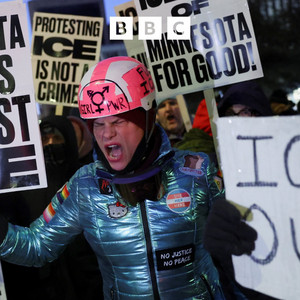
President Trump says his administration is going to, in his words, de-escalate a little bit in Minneapolis following the deaths of two people at the hands of federal agents.
The Democratic Congresswoman, Ilhan Omar, has been attacked by a man while delivering a speech at a town hall event in Minneapolis.
She wasn't injured.
Jewelry selection has begun in a landmark trial against some of the world's biggest social media companies.
Also in this podcast.
Every major technology revolution that we see feels like hype to begin with, right?
And there's been a lot of discussion about is this a bubble?
And the answer is probably yes.
Why huge tech company is warning of carnage on the way.
We begin with the immigration crackdown in Minneapolis that's seen two US citizens shot dead in broad daylight, with President Trump saying he will de-escalate a little bit.
He said the killings by federal agents were terrible, but added that Rene Good may have been radicalized and claimed Alex Preti shouldn't have been carrying a gun.
President Trump's border chief, Tom Homan, has been meeting local officials as he takes over the operation in Minneapolis.
The man who'd been leading the immigration raids until now, Greg Bovino, is expected to leave the city in what may be seen as a climb down by the White House.
Our correspondent, Tom Bateman, is in Minneapolis.
Protesters were in the Minnesota State Capitol building demanding charges against the immigration agents who killed Alex Preti and Renee Good.
Donald Trump on a visit to Iowa has been under growing pressure, even from his own political allies, who are seriously troubled by the crisis.
As he again sought to defuse it.
He suggested blame belong to the man who was killed, who lawfully carried a gun.
Certainly shouldn't have been carrying a gun.
But all of Hey look, bottom line everybody in this room we view that as a very unfortunate incident okay.
Everyone, unless you're a stupid person.
Very, very unfortunate incident.
I don't like that he had a gun.
I don't like that he had two fully loaded magazines.
That's a lot of bad stuff.
That comment will alarm those calling for an independent probe into the killing of Alex Preti.
It is also remarkable from a Republican president strongly allied with gun rights groups.
All this after federal agents protected the hotel said to house Greg Bovino, the border patrol boss now being moved from Minneapolis.
They wrestled a protester to the ground as the backlash here persists.
The atmosphere changed suddenly as these agents pushed the crowd back.
I saw one of them firing onto the ground here, some kind of irritant, and it forced the crowd away from them.
They're determined not to have this crowd close to the hotel.
They'd gathered when they heard Mr Bovino would be leaving, wanting to give him a send-off he wouldn't forget.
And we're not letting him get out of here without letting him know how much we hate him and the absolute havoc and murder that he has wreaked on our state is unacceptable.
It was Mr Bovino who alleged Alex Preti was shot dead because he intended to massacre agents, a claim for which there was no evidence.
Mr Preti's sister Michaela, issued a statement paying tribute to her brother, adding Hearing disgusting lies spread about my brother is absolutely gut-wrenching.
My family is deeply grateful so many people have stood up and helped tell his truth.
There is a lot of noise, but this is not a full retreat by the Trump administration.
Its deportation drive goes on, even if its most publicly known face is being forced out of town.
Tom Bateman.
And in another development, the US Congresswoman Ilhan Omar has been attacked during a town hall meeting in Minneapolis.
She wasn't injured after being sprayed by an unknown liquid.
Police say the man responsible has been arrested on suspicion of third degree assault.
Our reporter Anna Fagy was there.
Yeah, Congressman Omar was just starting her remarks and she was just speaking normally when all of a sudden there was a large commotion and someone came up and began spraying, some spraying something at her.
We didn't know what it was, but immediately it started to smell.
Security stepped in, pulled her out, and then we saw a pause.
She took a minute, everybody got their composure, and we went from there.
That was Anna Fagy reporting from Minneapolis.
President Trump has previously said he'd use military force to protect Nigerian Christians from persecution after the administration claimed a Christian genocide was taking place in the West African nation.
These allegations have not been verified by the BBC.
Alex last went to Plateau State in central Nigeria, where ethnic and sectarian violence has been a focus of US concern.
He found a more complex situation than the one described by Mr Trump.
My house is up there.
It's on top of the hill.
Yes.
So all of us in the house, we ran.
That was how we survived.
Joseph Izizino is a university student and a youth leader among the Christian Irigwe ethnic group who live in this part of Plateau State in central Nigeria.
He was on a visit home when, on a Sunday night in April last year, gunmen attacked his village.
You hear gunshots and people screaming.
They were here with guns, just stealing people and doors open.
So it was very terrifying, very terrible.
52 people, men, women and children, were killed in Zikai.
It's not clear who exactly carried out the attack.
No one has been prosecuted.
But people in Zikai are convinced that those responsible were ethnic Fulani, traditionally cattle herders, but predominantly Muslim.
This is not a clash, it's nothing, but I call it the pure genocide of Christians.
They want to wire power to themselves and then grab the land.
Such attacks have fueled claims that Christians face persecution in Nigeria, claims rejected by the Nigerian government but which have been used to justify US military intervention in the country.
Plateau State is ethnically diverse.
Christians are the majority.
They dominate the state government.
Muslims are the minority.
In parts of Plateau.
There's been violence on and off for decades, and a key issue is the struggle over land.
In Plateau that often pits farmers who are from mostly Christian ethnic groups against herders who are mainly Muslim Fulani.
There is no any Christian genocide in Plateau State.
The killing in Plateau State is both sides, and it's the clashes between farmers and herders.
Because of the competition of the land.
Abdullahi Youssef Ibrahim is secretary to an influential Fulani chief in Plateau State.
Our own Fulani communities are being attacked daily, but because we didn't have media to expose what is happening to us.
That is why people don't know what is happening to our side.
Like many here, he has little faith in the authorities.
There's little security presence in the countryside.
Few are ever prosecuted for their violence and that's created a culture of impunity, a culture of reprisal.
When killing happens, securities are not going to investigate.
And in the Fulani community, if you come, we have some criminals.
If you go to the other native, they also have their own criminal.
But the problem is that there is no justice for the government.
In Plateau, despite the rhetoric, the violence is not universal and many are working for peace.
Jacob Chodji Puakim is the founder of the Youth Initiative Against Violence and Human Rights Abuse, or IAVA.
He has one project funded by the British government that brings together communities who've been locked in conflict for years.
This is one of the farms where we have brought in both Muslims and Christians to jointly work together and to discuss, to establish a line of friendship.
We are planting the Irish potato.
We are all together, working together.
That's unity.
And at the end of the day, it brings us to peace.
Amos is from the mainly Christian Birom ethnic group.
Next to him, his friend Abdullahi is a Muslim Fulani.
We enjoy being with them because we are cracking jokes together.
We live together now and this one is impacting a lot in building peace in this community.
It's not easy.
The wounds here run deep, but they believe they can at least show what is possible.
Everybody has lost.
But peace is a gradual thing that you build, you build, you build until we live together in peace like it was before.
Alex Last reporting from central Nigeria.
Now, if you're a person like me who spends too much time online, who's to blame?
It's the question at the heart of a court case in the US brought by a 20-year-old woman from California who argues she suffered depression and anxiety after becoming addicted to social media.
You might think taking on major tech companies is a big ask, but TikTok has joined Snapchat in reaching an out-of-court settlement with the woman.
It leaves just Meta and YouTube to fight the case in which jury selection has now begun.
Benjamin Zapersky, a professor at Fordham Law School, says it's a landmark battle with parallels to when tobacco companies faced legal action in the 90s.
The similarity is that there are documents that appear to show that these companies were aware of the addictiveness of their product.
And, according to the lawyers of the individuals injured, they claim that they moved forward with their products thinking because they wanted to make money from them, notwithstanding the awareness that they were producing addiction and serious physical injury.
That's the plaintiff's argument in both cases.
Our North America tech correspondent, Lily Jamali, told me more.
It is a fascinating case and one that really could set a whole new set of legal precedents for these companies.
Why did TikTok and Snapchat settle?
Possibly because they don't want their executives to have to testify.
When Snapchat's parent company, Snap Inc, reached this settlement.
We don't have the details of their deal with the plaintiff KGM, who you noted.
But when they settled last week, it was immediately clear someone who was set to take the stand, CEO Evan Spiegel, was no longer going to have to do that.
And that's what we're seeing with TikTok now as well.
Meta and YouTube, the remaining defendants in this case, they have very deep pockets.
Remember, YouTube is owned by the same company that owns Google.
And at least for now, they are making really posturing in the way to send the message that they are going to fight these allegations to the end.
They say they strongly disagree with the allegations and that they're confident in their cases.
Meta does.
And what do you think is at stake for tech companies here?
Well, you know, first of all, just kind of looking at the historic nature of these cases, the trial that starts today involving KGM in Los Angeles is, from what her lawyer told us last week, the first time that a jury will have the opportunity to hold social media companies to account in a court of law anywhere in the world.
That is a very big deal.
And I mentioned the legal landscape.
You know, this could potentially have had a chrismic impact on the way that these companies comport themselves in the American legal system.
For years they've used this 26 word legal provision that was enacted 30 years ago, before there was social media.
It's called Section 230 in the Communications Decency Act of 1996.
And they say that that law basically protects them from legal liability for what anyone posts to their platform.
And they've actually had a lot of success wielding that provision in the courts.
This case focuses on not what their users say, but the way the companies design their platforms, design the algorithms and notifications in a way that plaintiffs allege keep users scrolling, sometimes for very long periods of time.
Lily Jamali.
One of the world's leading technology bosses has warned there could be carnage along the way if the bubble in the price of AI shares bursts.
The chief executive of Cisco, Chuck Robbins, has told the BBC that, while some companies won't survive, artificial intelligence will be bigger than the internet.
Cisco, which provides much of the network infrastructure underpinning both the internet and AI data centres, weathered the original internet crash 25 years ago.
Our economics editor, Faisal Islam, reports.
Cisco is one of the world's leading technology companies behind some of the critical IT infrastructure enabling the day-to-day use of AI.
It was hit when the original dot-com bubble burst in 2000, but survived and thrived after losing 80 of its value.
Now its boss, Chuck Robbins, confidant of President Trump, says while AI technology is unstoppable, there may be some financial turbulence ahead.
Every major technology revolution that we see feels like hype to begin with.
Right, and there's been a lot of discussion about is this a bubble?
And the answer is probably yes, but we had a bubble in 2000 with the internet, and look at where we are today.
So the winners emerge and there's carnage along the way, but it is going to be bigger than the internet.
Mr Robbins said some jobs were already being eliminated by AI, particularly in areas like customer services, where he said companies would need fewer people.
But he urged people not to be afraid of the technology and embrace it in their lives.
An area of key concern, he said, was in online security, with cyber attacks and scams becoming more convincing and likely to become even more high-tech because of the incredible power of quantum computers, he said.
Chuck Robbins also chairs a key group of American chief executives.
He acknowledged that they had some concerns about recent geopolitical and trade instability, saying they didn't always agree with President Trump.
But at least we have the dialogue.
That was Faisal Islam.
And for more on one of today's big stories.
You can go on YouTube search for BBC News.
Click on the logo, then choose podcasts and Global News Podcast.
There's a new story available every weekday.
Still to come in this podcast.
If a pro tennis player wants to go to a private place and smash up their own racket, is it any of our business?
I tried to go somewhere where they wouldn't broadcast it, but obviously they did.
So yeah, maybe some conversations we can be had, because I feel like at this tournament, the only private place we have is the locker room.
This is the Global News Podcast.
Despite the shudderingly cold weather, the war in Ukraine continues.
President Zelensky says four people have been killed and four others are missing after Russian drones attacked a passenger train in the east of the country.
Our correspondent Sarah Rainsford sent this report from the capital Kiev.
The train was travelling east towards the Donbass region when two drones struck near the rails.
Then a third drone hit a carriage directly, setting it on fire.
Images from the scene show it smashed and in flames and a soldier helping a group of passengers to safety from further down the train.
They include a woman in floods of tears with a tiny baby in a carry cot.
This route is used by local residents as well as soldiers heading home on leave from the front lines or their wives and girlfriends travelling east to see them.
Ukraine's railways were always thought relatively safe, even in this all-out war, but not anymore.
Vladimir Zelensky is calling this drone attack an act of terrorism by Russia, for which he says there can be no military justification.
Several people are still missing and rescuers say DNA tests will be needed to identify the victims' remains.
Sarah Rainsford.
Given the Russian army's failure to make any significant progress on the battlefield, military planners in Moscow have been targeting Ukraine's civilian infrastructure.
Vitaly Shevchenko explains how buildings that were constructed in Soviet times are making it easier for Russia to hit Ukrainian apartment blocks.
And a warning, his report starts with the sound of an air raid siren from a war zone.
Ukraine is now living through the most difficult winter in recent memory.
As temperatures plummeted below minus 15 degrees Celsius.
Russia has been attacking energy infrastructure.
The capital Kiev, is the main target of such attacks, which have left hundreds of thousands of people without heating.
Margarita Marenko is one of them.
In some really cold nights that I spent in my apartment under like three blankets and sleeping in my winter cloak, I could see my breath evaporating because the temperature was so cold that you could see steam coming out of your mouth.
What is making things much worse for people like Marharita and easier for the Russian military is the widespread prevalence of apartment blocks which rely on communal central heating, where water is heated up elsewhere and then pumped into their radiators.
This is the result of how cities were built across the Soviet Union, including in Ukraine.
The focus of huge construction programmes back then was on cheap, mass-produced housing.
Look at any city in the USSR and its landscape will probably be dominated by ubiquitous nine-storey residential buildings made out of pre-fabricated concrete panels, known as panelki, or smaller five-storey blocks of flats known as khrushchevki after Nikita Khrushchev, the Soviet leader who oversaw their construction in the 1950s and 60s.
They all need heating to be supplied from outside.
Heating plants, known as PETs, in Ukraine are huge, and when they're targeted by Russia, this affects many thousands.
The authorities say that all such power plants have now been hit.
Yuri Korolchuk is a Ukrainian energy expert.
Ukraine inherited the Soviet heating system and it hasn't changed anything.
It stays predominantly centralized.
These heating plants were not designed to be attacked with missiles or drones.
That's why these vulnerabilities came to the fore during the war.
During the previous winters, there were no such strikes against the heating system.
They happened only occasionally, and they didn't directly target heating plants.
For security reasons, Kyiv's local power company will not say exactly how many residents rely on communal heating.
In the frontline city of Zaporizhia, it's almost three quarters.
The Ukrainian government is acutely aware of this vulnerability, but undoing decades of Soviet urban planning will not be quick or easy.
Vitaly Shevchenko.
To Saudi Arabia now, where the construction in the capital of a huge skyscraper large enough to contain 20 of New York's Empire State Building has been suspended.
The future is unclear, with the building's financing and feasibility being reassessed.
The project was part of Crown Prince Mohammed bin Salman's Vision 2030, a framework he launched to diversify the country's economy away from oil.
But some projects have been postponed, including the hosting of the 2029 Asian Winter Games.
So what's going on?
Alex Ritson has been speaking to our Middle East analyst, Sebastian Usher.
This was a massive building, 400 metres by 400 metres.
And it was going to have the biggest, with a dome, the biggest AI kind of projection facility ever.
So you would enter it and you'd enter these new worlds, essentially.
And I think it's a retrenching of a number of these extraordinary projects, partly because economic reality is hitting home a little bit.
These are essentially being financed by the PIF.
This is a private investment fund which is essentially under the personal control of Mohammed bin Salman.
But spread across all of these extraordinary projects, it's becoming difficult, it seems, to actually be able to pursue some of them.
Oil prices are not what they were.
So I think that is also a cold shower of reality.
Saudi Arabia has been trying to change its image with these projects.
A lot of the construction-type ones seem to be going nowhere, but it has had success in other areas.
Riyadh, compared to how it was 20 years ago, is just a completely different city, bursting with entertainment, whereas once it was a wasteland, there was nothing.
There'd be restaurants you could go to, but it'd be segregated.
There would be no public entertainment spaces essentially.
Now it's full of them.
So that has been delivered on.
Major sporting events have attracted people to come on visa specifically for those events.
But it's these mega projects.
This ski resort that was going to be built was meant to be ready in 2021.
Nine for the Asia Winter Games now is being delayed.
The line.
This was a city which was essentially going to be half a kilometre skyscrapers facing each other for 170 kilometres through the desert.
It never looked like it was going to happen and it isn't now.
It's been very much curbed and curtailed and all this news has come out really just in the past week or two.
Is Saudi Arabia's effort to reinvent itself on track?
It's difficult to know on track because the ambition of it was so extreme that it could never match that.
And remember that Saudi Arabia is going to host the World Cup in 2034.
So I think some of this is looking at what money they have now and where they can get the best bang for their buck.
And also certain things that they cannot back away from.
I mean, the World Cup, they can't.
They have to come up with extraordinary stadiums and so on for that.
But these extraordinary pie-in-the-sky mega projects, the mega cities, the mega this, the mega that, the futuristic concept of Saudi Arabia, I think that's on hold.
Sebastian Usher.
Now, all of us lose our temper occasionally and you just want to go somewhere to scream and shout crucially, in private.
But when one of the world's top tennis players lost her temper, she wasn't able to do that.
Terry Egan reports.
The player was Coco Goff.
Despite being the number three seed at the Australian Open, she slid to defeat in her quarter-final match in under an hour, committing 26 unforced errors.
But then, as she was trailing despondently back to the changing rooms in the players' area, she was filmed smashing her racket in frustration.
In a very determined assault, she thwacked it on the floor seven times, leaving the racket mangled.
I don't.
Tried to go somewhere where I thought there wasn't a camera, because I don't necessarily like breaking rackets, but I lost one and two.
I broke one racket on quarters, I think, or round 16 of French Open, I think and I said I would never do it again on court because I don't feel like that's a good representation.
But, yeah, I tried to go somewhere where they wouldn't broadcast it, but obviously they did.
So, yeah, maybe some conversations we can be had because I feel like at this tournament –
The only private place we have is the locker room.
The former Wimbledon champion, Pat Cash, backed her up, saying there were cameras everywhere and that players needed to be vouchsafed a sanctuary or private space.
Right now, he said, the only place they have is the hotel room.
So the question is perhaps, how much privacy is a high-profile player entitled to?
Dr Amanda Owens is a former GB world-ranked tennis player and a leading sport and performance psychologist.
The anger level, it was extreme.
She lost her temper, smashed a racket.
It wasn't just smashing a racket, it was really extreme anger.
I believe that players ought to have some privacy.
However, also with the modern day sports, they're in the public eye 24-7.
So Coco would know that she's more likely to be filmed.
Smashing one's racket, regardless of whether it was filmed or not, is unhelpful.
The tennis authorities can take a hard line on players expressing their frustration.
Last year, Daniel Medvedev was fined $40,000 for racket abuse and unsportsmanlike conduct.
But that was on court, while Coco Goff's venting of emotions was supposed to be a private moment.
Either way, fits of rage from the top players will always make the headlines.
Terry Egan.
And that's all from us for now, but there will be a new edition of the Global News Podcast later.
If you want to comment on this podcast or the topics covered in it, you can send us an email.
The address is globalpodcast at bbc.co.uk.
You can also find us on X at BBC World Service.
Use the hashtag Global News Pod.
This edition was mixed by Holly Smith and the producer was Charles Sanctuary.
The editor is Karen Martin and I'm Charlotte Gallagher.
Until next time, goodbye.