From The New York Times, I'm Rachel Abrams, and this is The Daily.
Over the past week, ICE and Border Patrol agents have clashed with the residents of Chicago.
And Federal Guard troops arriving in the city might only inflame tensions further.
Today, my colleagues Julie Bosman and Mattathias Schwartz explain the situation on the ground and how Chicago fits into a broader fight between the Trump administration and the states, where the president is trying to send the National Guard.
It's Wednesday, October 8th.
Julie.
We've seen this flurry of activity around the country in places where President Trump has tried to send the National Guard troops in.
Two places that we're watching super closely are Chicago and Portland.
And in both of those cities, the officials are desperate to try to keep these federal troops out.
And in Portland, they've been successful so far, but not in Chicago.
Federal troops are actually on their way to Chicago as we speak at about 11.15 a.m. on Tuesday.
And you are there.
You've been reporting on all of this.
Why are the troops coming to Chicago?
So the explanation from the Trump administration is that the National Guard is needed in Chicago to help support ICE agents, to help support other federal agents who are working here and, in particular, to protect ICE facilities.
So we really saw this begin in early September, when the Trump administration announced what they called Operation Midway Blitz.
The White House says it's going after what it calls the worst of the worst criminals who are here in the country illegally.
Which they said was going to be a crackdown on illegal immigration.
They said that they were going to come in and really lay down the law in Chicago, which is a sanctuary city.
They don't cooperate with federal immigration authorities.
So the operation known as Operation Midway Blitz in Chicago continues.
We are told that hundreds of migrants have been arrested.
So in the beginning, we saw more arrests than usual.
And then, around mid-September, ICE agents were attempting to make an arrest in Franklin Park, a suburb of Chicago.
Breaking news a man is dead and an ICE agent seriously hurt after an immigration arrest ended in gunfire in Franklin Park.
They pulled over a man and he, according to video and according to witness accounts, tried to drive away from the agents in the course of this attempted arrest.
And the agents responded and one of the agents shot and killed this man.
Yeah, the video investigations team here at The Times actually took a close look at that shooting.
And the ICE agents claimed that the man that they shot was trying to run them over.
But if you watch the video, it's not entirely clear that either of them was truly in harm's way.
It's like a little bit ambiguous.
Right.
And it was a shocking incident to so many people.
They said, look, this man was not a violent criminal.
Why was ICE arresting him?
He had just dropped off his children at daycare and then he's pulled over in broad daylight and shot.
And I think that that incident really started to raise questions about ICE's tactics and their training and how they were performing these arrests and whether they were doing it in a way that was really in line with police and law enforcement standards.
And after that, protests outside of the ICE facility in Broadview, which is a suburb of Chicago, really began to intensify.
And ICE's response to the protesters who were nonviolent but were trying to physically block vehicles from entering and leaving the facility.
ICE began to respond with pepper spray, with tear gas.
They had agents on the roof and they would fire pepper balls into the crowd.
We saw a pastor being tear gassed.
Journalists were tear gassed.
An ICE agent that was masked pointed his weapon and shot directly at my car.
He saw my window was open and he shot right here.
You can see the point of impact right there.
One CBS reporter who happened to be just driving by in her car to check on the facility when there was no protest going on, was shot with a pepper ball through the open window of her car.
Oh, wow.
The scariest part about this is I could have been anybody, and I could have been killed.
Yes, and this was pretty shocking.
I mean I've covered a lot of protests and usually if law enforcement uses pepper spray or tear gas, they give plenty of warning.
They tell people to disperse.
There are a number of actions that take place before they get to that point.
And ICE was just deploying tear gas and pepper spray whenever they wanted to.
And it was really shocking for those of us who were in attendance and seeing what was going on.
Especially, as you mentioned, because these protests it sounded like they were disruptive, but mostly nonviolent.
Absolutely.
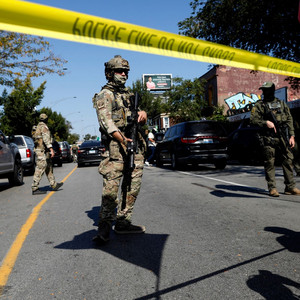
And then, a couple of weekends ago, we saw something that was even more shocking to people in Chicago, which is that the Border Patrol began marching through downtown streets.
We would see groups of border patrol agents in camouflage.
Wait, border patrol?
I didn't realize that they would have jurisdiction there.
So that has been one of the strangest and most startling elements of this.
So we are not near a U.S. border, but yes, border patrol has been here as well.
And they have done a lot of the immigration arrests alongside ICE.
And Governor Pritzker addressed this at a news briefing on Monday.
CBP is only allowed to operate within a certain number of miles of the border.
Where he said, why is the Border Patrol in Chicago at all?
Well, they have declared that the border is at the shores of Lake Michigan.
That is why they're allowed to operate now, or at least why they're being told they're allowed to operate in the city of Chicago.
And his answer was that the US government has now said that the border is at the shores of Lake Michigan.
That doesn't seem right to me.
The border as far as I know.
First of all, if you go all the way across Lake Michigan, you'll find a border.
But but also, you know, more than a thousand miles away from here.
So I think there's a question of whether the border patrol belongs in Chicago at all.
So then, last Tuesday, we woke up to the news that Border Patrol and the FBI had conducted a really large raid in an apartment building on the south side of Chicago.
This was, from what we were hearing, the biggest raid that they had conducted yet in Operation Midway Blitz, and that this was just a giant operation by Border Patrol standards.
Yeah.
So I immediately drove down to the south side and talked to people who lived in the building, lived across the street from the building.
And the first person I talked to was standing on the sidewalk and he pulled out his phone and started showing me videos that he had taken at one in the morning.
And what he had seen were Blackhawk helicopters hovering over the building.
He had seen dozens of vehicles pulling up outside, agents breaking windows.
They were going in all entrances of the building.
And then he saw people being taken out of the building, zip-tied.
And he said he could not believe what he was seeing, that it felt like the whole neighborhood was under siege, that he just couldn't believe that this was going on.
But there was a different message coming from a video that DHS produced after the raid.
And what we saw in this video was really a kind of Hollywood-style documentary version of this raid.
There was overhead camera shots from a drone.
There was imagery of the helicopters, of agents rappelling down onto the roof.
You saw armed agents climbing on ladders into windows and the agents were wearing ballistic helmets.
You saw people who were being taken out of the building.
Some of them were shirtless young men zip tied and being led away from the building by agents.
So this was the version of the raid that DHS provided, and they said that they were arresting people who needed to be rounded up and arrested.
Do we know who they actually detained?
So they said that they had arrested at least 37 people who did not have legal immigration status.
Mm-hmm.
They described these people as, you know, some had criminal records.
They said that they were living in this apartment complex that was frequented by members of a notorious Venezuelan gang.
And they said that this was a raid that was really targeting people who were violent criminals.
But then when we talked to lawyers for some of the people who were arrested, said that there were people who who had been swept up in this raid, who were US citizens.
DHS officials did acknowledge that there were at least four children who were U.S. citizens who were taken into custody at the apartment complex.
Presumably by mistake.
Either by mistake or just as collateral damage.
As part of the operation, just pull everybody into custody and then sort out later who is a US citizen and who isn't.
And then we heard from Mayor Brandon Johnson of Chicago just this week that people had been separated, that Latinos and Black people had been separated into two different vans.
And Mayor Johnson, of course, condemned this raid and the treatment of people who were either illegal immigrants or US citizens.
He just said the entire operation was inhumane.
It sounds like this video is one of the many examples of how there are sort of these conflicting narratives about what is happening on the ground.
And clearly the administration is seizing on one narrative in order to help justify and message what it's doing.
Yes.
And I think what DHS is saying is look, we don't believe that Chicago and Illinois are arresting all of these people and they're not going after them.
So the federal government just has to step in here and arrest these violent criminals.
But we are still at this moment, working to learn more about the people who were detained and arrested in that raid.
We need to find out a lot more about whether they had criminal backgrounds, whether they were in the United States illegally.
And I think that we will learn a lot more in the coming days about who those people were.
So what happened after this raid is that people responded by saying look, this is really out of control.
Federal agents are not accountable to the people of Chicago.
And it really hit its high point over last weekend.
On Saturday on the southwest side of Chicago we began hearing that there were crowds building in the Brighton Park neighborhood.
And what we began to learn is that, according to DHS's account, federal agents were chased by two motorists from the city of Oak Lawn, which is just outside of Chicago, into the southwest side of Chicago.
And then the two motorists rammed their vehicles into the federal agents' vehicles.
Again.
According to the DHS account, a female motorist then drove her car in the direction of one of the agents who had gotten out of his vehicle.
And at that point, the federal agent shot the woman.
She was injured and went to the hospital and was released.
So we immediately went to the neighborhood to see what was going on.
And what I saw looked like a very organic, spontaneous protest that had popped up.
You are treating people like animals.
And people were waving Mexican flags and American flags.
Some people had bullhorns.
Go home!
Go home!
Go home!
And there was just a lot of anger being directed at the ICE agents.
Take off your face masks!
Take off your face masks!
And there was also a liberal amount of tear gas that was being deployed.
Ice agents were shooting pepper balls.
They were trying to disperse the crowd.
Again, this is in a residential neighborhood.
There are homes apartments, storefronts right along this stretch of street where this is all happening.
And then we saw that Chicago Police Department officers began to respond.
And they began to form a line between the ICE agents and the protesters.
And some of the Chicago police officers were also tear gassed because there was not a lot of coordination between the federal agents and the local police officers.
So the police officers were also coughing and choking on tear gas, along with members of the crowd and journalists.
Julie, it feels worth noting just as I'm listening to you that, again, the Trump administration is saying that the federal troops are now needed to protect ICE so that ICE can do its job.
But in a lot of these chaotic moments that you have described, it sounds like either federal agents were the ones being the aggressor in the situation or, in the case of the driver who was shot, it was unclear whether there was actually any danger.
It just sort of feels as though ICE is being the aggressor in most of these situations.
Is that accurate?
It depends who you ask.
I think that DHS would say, look, these immigration agents are doing their job.
This is a function of the federal government to arrest people who are in the country illegally and we are stepping up and doing that.
If you look at it from the perspective of a lot of people in Chicago, especially people who are Latino and feel unfairly attacked and targeted, they would say look, this is a rogue police force.
They are sweeping up U.S. citizens in their dragnet, and they are not using proper policing tactics.
They're not trying to manage crowds properly.
And they are the ones who are behaving in a dangerous fashion, and they are causing the conflict.
You know, it wasn't that long ago that we did an episode about federal troops going into D.C.
And at the time that we did that, there was a lot of speculation that Chicago was going to be next.
And people who were skeptical that that would happen said, no, no, no.
Trump does not have the same jurisdiction in Chicago that he does in D.C.
It's much easier to send troops to D.C.
You're not going to see him so easily deploy troops to cities around the country.
And yet here we are, not that many weeks later, and it feels worth noting that they are on their way to Chicago now.
So it seems like perhaps it was actually much easier than folks had thought.
Right.
He's had more success than I think we had originally expected.
But on Monday the state of Illinois and the city of Chicago sued the Trump administration, saying that there was no justification for sending the National Guard into the state.
That there was nothing happening here that required this.
That local and state law enforcement had the situation completely under control.
And what Governor Pritzker has also made clear is that he sees this as a purely political ploy, that President Trump is doing this to try to make cities that are led by Democrats vulnerable look like they are out of control, and also that the president is trying to establish a legal precedent that will allow the military to be patrolling American cities.
So again we see these two different versions of what's happening on the ground, this sort of competing narratives and different sets of facts.
That's right.
And I think we're going to get some answers from the courts in the next few days.
We are waiting for a federal judge to make a ruling later this week.
And that will hopefully tell us whether it is legal or not to have the National Guard here in Illinois.
Julie, thank you so much.
Thank you, Rachel.
Thank you.
We'll be right back.
Matt, hi.
Thank you for joining us.
Hi, Rachel.
Glad to be here.
So Matt, we are waiting for a judge to decide whether the Trump administration's decision to send the National Guard into Chicago is legal or not.
And you have been following the tension between Trump and the lower courts throughout this administration.
So I'm wondering how the fight in Chicago fits into this larger picture, specifically as it relates to the administration's efforts to get National Guard troops into various cities across America.
Yeah.
So one way to look at the challenges to these troop deployments is sort of the latest front of this running battle between Trump on one side and democratic states and cities on the other who have filed lawsuits to try to stop the administration from carrying out different pieces of its agenda.
And, once again, the first people who are going to have to figure out who's on the right are federal judges in the district courts where these lawsuits are being filed.
So basically these judges are the ones in the middle.
Yeah, the district court judges are in the middle between these two sides and they have two different jobs.
First of all, they need to figure out who's right on the facts and the law.
And second, they have to preserve their own legitimacy.
They have to make rulings in a clear and transparent way on the facts and the law and keep the public's confidence that they're not doing this on a partisan basis.
So it's a tricky line that the courts have to walk in such a politicized environment when such high stakes constitutional questions are heading into court on an almost daily basis.
So just to get into the specifics of a couple of the most recent cases in Portland and Chicago, what exactly are they deciding?
Yeah.
So it's now up to these district court judges to decide whether it's legal for the Trump administration to federalize National Guard troops and then send them to Portland and Chicago and potentially to other cities down the line.
So Title 10, Section 12406 gives the president the power to federalize the National Guard and send them out into the states if he deems that there is a rebellion.
And the judges have two questions that they are going to need to answer.
One is, is this actually a rebellion?
And two, is that question judiciable?
Meaning?
Is it the place of the federal courts to check the president and to potentially say no executive branch?
You say it's in a rebellion.
We find that it isn't.
And we have an early indication of where these district court judges might come down.
Over the weekend, Judge Karen Emmergut issued a ruling in Portland saying that she was going to block the Trump administration from sending National Guardsmen to Portland for the time being.
It's a preliminary ruling, but it's a sign that the judge is taking the arguments made by the states and the cities very seriously.
And how did the White House respond?
So on social media and on cable news we saw Stephen Miller, one of Trump's top advisors, who's kind of the architect of this whole push to send soldiers into American cities, repeating some familiar refrains that we've heard a lot of over these past few months.
Every night they come, they assemble, they fight.
They try to impede movement.
They physically attack.
For what purpose?
To use actual physical violence to change the result of the election.
And he basically talked about the situation on the ground in very warlike terms.
It is domestic terrorism.
It is insurrection.
And no amount of.
He said the protesters were engaged in domestic insurrection, which is a very loaded word.
ICE officers should not have to live in fear and violence to do their jobs.
And he sort of echoed things that we've been hearing from President Trump himself.
We have to leave the conversation there because we're short on time.
But nevertheless we do appreciate you making the time for us and coming on CNN and sharing your point of view.
Always.
And we've seen this again and again since President Trump has taken office that when a judge rules against him, he doesn't just say the judge didn't see him, my way.
He goes after the judge personally and characterizes their decision as political and suggests that he may not necessarily be legally bound to follow it at times.
You know, I saw the interview that Stephen Miller gave to CNN and it reminded me a lot of what he and other Trump officials were talking about at Charlie Kirk's funeral just a few weeks ago.
Basically setting up this like us versus them, good versus evil paradigm.
And I just sort of wonder if you are seeing any echoes of that in what you're looking at with these cases in Portland and Chicago and some of the response.
Yeah.
Absolutely.
I think this troop deployment could be characterized as part of a post-Kirk moment for the administration, where they really do in some way feel like they are at war.
And I think there's a kind of attitude that you've seen it again and again that just he who is not with us is against us.
And that includes federal judges.
A them, a them from the us versus them paradigm.
Exactly.
Yeah.
Yeah.
And what's so striking about this Portland ruling is that the judge who made it was actually chosen by President Trump himself to be a federal judge.
So they're trying to cast Judge Emmerget into a certain mold and it's not an exact fit.
Far from it.
Wait, tell me, tell me more about her and why is that not an exact fit?
So for starters, as I mentioned, Judge Emmerget is a Trump appointee.
He did nominate her to be a federal judge during his first term.
So if she's such a terrible far left judge who's ruling against the law and the facts, then one might ask why did he choose her to join the bench in the first place?
Now it's important to remember that judges are more than just the president who appointed them.
That being said, Judge Emmerget has very strong conservative credentials.
She spent decades as a prosecutor in Oregon.
She was chosen to be the U.S. attorney for Oregon by George W. Bush.
She served under Kenneth Starr.
During the investigation of President Bill Clinton, she personally deposed Monica Lewinsky about her encounters with President Clinton, surfacing some of the most granular details that made their way into the Star Report, and her time working for Ken Starr coincided with Justice Kavanaugh's time also working in that same office.
Chief Justice Roberts also worked for Kenneth Starr earlier when Ken Starr was Solicitor General.
So she's certainly someone who came up through a kind of farm system and a track that many of the leading jurists on the right have also followed.
And what did she actually say in her decision over the weekend?
The essence of Judge Emmerich's decision is very clear.
Her finding is that what is happening in Portland is not a rebellion, as the government has claimed it is.
There's some also very I would say strident passages where she makes clear that the stakes of this case are incredibly high.
She says that this case goes to the heart of what it means to live under the rule of law in the United States.
She says that the relationship between the federal government and the states, between the military and domestic law enforcement, between the judicial branch and the executive branch she says all three of those deep constitutional relationships are at play here.
It sort of sounds like she's sounding the alarm a little bit.
I think that's right.
There's a real note of grave concern in this opinion.
And I think it's directed at a number of different audiences.
Obviously the parties, there's the appellate court, which might uphold or overturn it.
But I think she's also talking to the public and saying this is something that you really need to pay attention to.
So, given the judge's background and the argument in her decision, it does sound like it would be a really difficult case to make that this is some activist judge making an ideological ruling against the administration right.
I think that's right.
So the big question hanging over all this litigation in California, in Illinois, in Oregon is does the president get to define his own facts as a constitutional matter?
If he says it's a rebellion, is that enough to make it a rebellion?
And we've seen this question before with the Alien Enemies Act.
If he says it's an invasion, is that enough to make it an invasion?
And there are some lawyers and also we've heard some judges say that it is.
But, as you've said, this ruling from the judge in Oregon right gives us some indication that at least at the district court level, judges are putting their foot down and they're drawing a limit on the president's power.
So what might he do or what might his options be if those rulings stand?
So President Trump does have another option.
He could invoke the Insurrection Act.
It's a kind of nuclear option that would allow him to use the military for law enforcement purposes, to put down what he would declare to be a rebellion.
The Insurrection Act is a simply it's a stronger law than the section of Title 10 that Trump's operating under now.
The Insurrection Act hasn't been invoked for more than 30 years.
The last time it happened was during the Rodney King riots.
It's been used by presidents in very specific places.
To use it in a national way would have little or no precedent, but it's something that he and his advisors are talking about with greater frequency.
Trump even said at one point that if judges got in his way, that could be a potential trigger for him to invoke the act.
So time and time again, we're seeing the administration take these old laws and old authorities that haven't been used and blow the dust off them and use them in furtherance of expanding presidential power and, more often than not, point them towards their political opposition.
And Stephen Miller, in that same interview that I mentioned on CNN on Monday, seemed to be using language including the word insurrection, where one might interpret that he was also kind of setting up an argument for that.
Absolutely.
The administration often refers to protesters as insurrectionists or terrorists, which is not just rhetoric.
It's a strategic effort to broaden those categories.
The administration is actually staking out legal turf that this is a national security crisis that justifies the use of emergency authorities.
And the more they can make the case that the emergency is real, the harder it's going to be for the courts to legitimately intervene.
Another thing that's important to realize is that the facts on the ground can change.
So if this inflammatory rhetoric inspires more violent actions by protesters, that actually strengthens the administration's case in court that this is in fact a rebellion.
The idea that he could just declare something as an insurrection and therefore invoke the powers that he wants.
And I'm curious if that were to happen in this case, how likely is it that the courts would go along with his interpretation?
The Constitution gives the president tremendous legitimate power.
The courts have already said they have a very, very small to nil role to play when it comes to foreign policy and when it comes to military affairs overseas.
And this is something that President Trump and his advisors know and have been trying to make maximum use of.
If he were to invoke the Insurrection Act, those powers would grow further.
And the legitimate role that the courts would have to play to check President Trump when it comes to troop deployments would shrink dramatically.
It feels safe to assume Matt, that one of these cases maybe in Oregon, maybe in Illinois, maybe some later case one of them might eventually end up in front of the Supreme Court which, as we know, has been quite favorable to the president so far.
I think that's right.
So this is shaping up to be one of the great tests in this ongoing tension between the executive and the judicial branch.
Are the courts going to continue to give way to the Trump administration when it comes to the deployment of US troops on US soil?
And are they going to do so over the objections of their judicial brethren and sistren, at least one of whom has now said no, this isn't a rebellion and yes, it's my place to say so.
Matt, thanks so much.
Thank you, Rachel.
We'll be right back.
Here's what else you need to know today.
Madam Attorney General, let me ask you this question.
Were you consulted by the White House before they deployed National Guard troops in to cities in the United States?
I am not going to discuss any internal conversations with the White House.
Attorney General Pam Bondi stonewalled Democrats who demanded answers on everything from the deployment of federal troops to Chicago to the investigation into Tom Homan, President Trump's border czar, who was recorded accepting a bag with 50000 in cash in an undercover FBI investigation.
What became of the $50,000?
Did the FBI get it back?
Mr. Whitehouse, excuse me, Senator Whitehouse, you're welcome to talk to the FBI.
And Tuesday marked the second anniversary of the Hamas attack on Israel, which the country marked with somber remembrances and new hopes of ending a conflict that has killed tens of thousands of Palestinians, including civilians and combatants.
The Trump administration's Middle East envoy, Steve Witkoff, was expected to head to Egypt to join peace talks, as the White House signaled optimism about a potential deal.
Today's episode was produced by Nina Feldman, Muj Zaydi, Claire Tennis-Getter, and Rochelle Bonja.
It was edited by Lizzo Balin and Mike Benoit.
Contains music by Marian Lozano and Diane Wong.
And was engineered by Chris Wood and Alyssa Moxley.
That's it for The Daily.
I'm Rachel Abrams.
See you tomorrow.