From The New York Times, I'm Michael Barbaro.
This is The Daily.
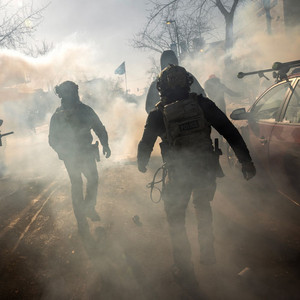
Today the story of how the fallout from Alex Preddy's death forced President Trump to change course in Minneapolis, and the debate over whether those changes are real or merely symbolic.
I spoke with White House reporters Zolan Kano-Youngs and Tyler Pager.
It's Wednesday, January 28th.
Zolan and Tyler, we are having this conversation with you on Tuesday afternoon, at this moment when President Trump has clearly decided to try to telegraph that he wants to change course or at least change the tone around his administration's immigration crackdown in Minneapolis following the killing of Alex Preddy and all of the outrage it inspired.
And we're going to talk about how meaningful or superficial that change really is.
But Tyler, let's first talk through what's actually happened behind the scenes in the days since Preddy's death.
So Michael, one of the interesting things just about this weekend is that it's one of the rare weekends in the winter where Donald Trump is in Washington and not in Palm Beach Florida, at his club and residence Mar-a-Lago.
And the reason that Trump stayed in Washington was because he was hosting a special premiere at the White House for the new documentary about his wife Melania.
Right.
And so the president is spending a lot of the weekend in the Oval Office and in the dining room off the Oval Office watching media coverage of what's going on in Minneapolis and the shooting of Alex Preddy.
He spent a lot of the time watching Fox News, but flips around channels.
Another American citizen has been shot dead by federal agents in Minneapolis.
The Trump administration is defending the agent's actions.
And just saw this cacophony of voices criticizing the response and the killing of this man in Minneapolis.
It should freak the American public out that the Trump administration lies this easily will lie to your face when you can see the evidence for yourself.
He was called by the Trump administration officials a domestic terrorist, when all he had in his hand was a cell phone.
Americans don't like what they're seeing right now.
Nobody likes feds coming into their state.
And so what's the goal right now?
And this criticism is notable and rare because it's not just Democrats and it's not the usual loudest critics in the Republican Party that are pushing back on him.
Senator Bill Cassidy, calling the situation disturbing writing.
The credibility of ICE and DHS are at stake.
You've got Senator Bill Cassidy, who said on social media that the shooting was incredibly disturbing.
Tom Tillis called for an investigation as well.
That's notable pushback against this White House, particularly a White House that demands loyalty from its party.
And beyond the Republican lawmakers, even some sympathetic media figures like Fox News hosts Trey Gowdy and Maria Bartiromo were also criticizing the rhetoric from senior administration officials.
You've collected the evidence, you said, right?
You have the handgun in your possession?
That's right.
And how was he using that handgun in terms of threatening Border Patrol?
What was the threat?
He had his camera, right?
He was filming it.
And Michael, that's to say nothing of what Trump would have seen if he tuned into MSNOW or CNN.
What do you see when you watch those videos?
An execution.
An absolute execution.
Every angle shows it.
And they continue to fire bullets at him while his body was lifeless on the ground.
Where officials were saying that the government basically gunned down this man and bungled the response.
The lies do more than mislead.
They justify the unjustifiable.
And in the absence of accountability from the Department of Homeland Security, from ICE, from Customs and Border Protection, it is up to us to hold on to the truth.
Right.
I caught some of that coverage and it was basically the government has murdered this man and then systematically lied about what happened in the face of video that very clearly contradicted it.
Absolutely, Michael.
And what the president was concerned about was not necessarily the incident itself.
You know, he was disturbed that a man had been killed, but...
Michael.
What he was really worried about was that this chaos, this narrative, was overshadowing all of the progress he felt he has made on the issue of immigration enforcement and the border with Mexico.
These are issues that are core to his political identity.
And the president was talking to aides and allies throughout the weekend and venting about how the narrative was being overtaken by this use of force and by the killing of a man.
And it was distracting from the message that he wanted to be driving home, which was that he had sealed the border and he was— getting rid of in his parlance the most violent undocumented immigrants in the country.
And, Zolan, when did we start to see him reacting accordingly?
Late Sunday night an interview with the Wall Street Journal published with President Trump in which he made somewhat measured comments for him.
He actually expressed a willingness in an investigation into this shooting and said that his administration was reviewing the shooting and that eventually they would come out with determination.
These comments are starkly different from the way the president was talking about this shooting even just 24 hours before.
In the initial aftermath, President Trump once again laid blame on the victim.
He attacked local leaders in Minnesota.
Now he's coming out and actually saying that they want to take a look at this.
That is really different than the usual reactionary defense we see from President Trump when it comes to anything really involving ICE or his immigration agenda.
And it turns out that ends up Tyler, being kind of just the beginning of a pretty public pivot that I wonder if you can keep describing here.
Yeah, it starts very early Monday morning when the president announces on True Social that he's sending in Tom Homan, the White House border czar, from Washington to Minneapolis to lead the operation.
And a few hours later we learn that Greg Bovino, a top Border Patrol official who had been leading these operations all over the country, would be leaving Minneapolis.
And it's a clear sign that changes are underway, at least in terms of personnel, in response to this horrible kill.
And the Bovino departure just to linger on that for a minute feels especially notable because he had literally been on the ground in Minneapolis very unapologetically defending the most aggressive tactics that ICE and Border Patrol were using.
And because he had told the public something that turned out to be completely wrong about Alex Bovino and about his intent and his actions.
That was very much contradicted by the videos that emerged.
And so suddenly it felt like there were consequences for that conduct.
Absolutely, Michael.
And I think, you know, it wasn't just Bovino who was spreading these false messages about Freddie.
They were echoed by Kristi Noem, the secretary of Homeland Security, Stephen Miller, a senior advisor in the White House, who is the architect of much of Trump's immigration agenda.
And the president was distancing himself from those exact messages.
He was not saying that Preti was a domestic terrorist, as Stephen Miller said.
And he also was not saying that Preti was an assassin who was trying to inflict mass harm on Border Patrol agents, as Kristi Noem suggested and Bovino did as well.
And so those individuals who were really spreading the most inaccurate messages about the victim were sort of being pushed aside.
And, on top of that, deciding to pull back Greg Bovino.
We also hear that President Trump is having these phone calls with Governor Tim Walz and the mayor of Minneapolis as well, Jacob Fry.
This is also pretty remarkable.
Just a couple days earlier, President Trump was attacking these same officials, blaming them for the unrest that we are seeing in Minneapolis.
And in fact his Department of Justice is actively investigating both of them criminally for blocking his immigration crackdown.
But suddenly he's having what, by all accounts, I think are somewhat diplomatic phone calls.
He doesn't just talk to them.
He also describes it kind of positively as well.
And based on the readouts from the calls Michael, it seems that they really did get into some substantive issues.
But I had two very good talks.
I had Jacob Fry and I had Governor Walz.
And I mean, they were great calls.
As you know, the president made clear that he wanted to enhance cooperation between state and local officials with federal officials on the ground.
And the Democratic leaders also pushed back.
First of all, I ask that we have a fair and independent investigation into the murder of both Renee Good and Alex, and that we have to be able to do that.
And he said, well, we'll look at that.
We'll take a look at that.
They said they wanted a real investigation into the shootings of Minneapolis residents.
And also on readout from Tim Walz's office, said that the president agreed to look into reducing the number of federal agents in Minnesota.
He pledged that, look, I'm going to send Tom Holman in.
We'll do things differently.
And really what it seems Michael, is that both sides had an opportunity to raise their own grievances and maybe had some breakthroughs.
Right.
And so it felt by Tuesday afternoon that we ended up in a situation that we've become kind of familiar with in the Trump presidency, which is the administration has gone too far.
People are furious.
I mean our colleagues described this, as I'm going to quote from them one of the gravest political threats to Trump since his inauguration in this second term.
And the president, based on everything you're describing here, seems to understand that and wants to say in his own way I get it and I'm ready to try to defuse this.
Michael, that's right.
And I mean just to that point, as we're speaking to you right now.
The president just told Fox News that his administration was going to work on de-escalating a little bit the situation in Minneapolis.
But not a Trump word, not a word you often hear from this president.
But look, I guess that's the big question we have now moving forward.
Are these just words?
You know, is this just lip service at this point in the response to intense political backlash?
Or are we in the midst here of a real moment where we could see concrete change on the ground when it comes to these kind of federal crackdowns on American cities?
We'll be right back.
So, Tyler and Zolan, let's further pursue the question posed right before the break, which is amid all these Signals and symbols of some sort of a change in course and tone from the president.
Has anything actually changed on the ground in Minneapolis, where ICE and the Border Patrol are still very much there?
And has the administration's thinking about its role in the city changed at all?
Yeah.
So even if we've seen a rhetorical shift here, we really don't have all that much evidence that we're seeing a substantial change on the ground.
This operation in Minneapolis still appears active.
We're hearing as well that roughly 100 arrests were recorded in Minneapolis just today.
So at this point we have not seen that reality on the ground match the shift in rhetoric from the president on this topic.
Tyler, what would it look like for things to actually change on the ground?
One obvious step Michael, would be that they pulled back the Border Patrol agents and the other federal officials who are patrolling all across Minneapolis and other cities where leaders have said they don't want those forces there.
They'd start to reduce the numbers.
They would literally recall these agents.
Right.
And another step could possibly be that there's firings of President Trump's aides.
There are many critics of the president and even some of his allies privately saying someone like Kristi Noem maybe isn't right for running the Homeland Security Department.
But the president walked out of the White House today with Stephen Miller and told reporters that Kristi Noem was doing a great job and she certainly was not resigning.
Right.
I mean, I suppose the other sign of an on-the-ground change that matched the rhetoric to use your words, Zolan would be that the administration took steps to follow through with an investigation into Alex Preddy's killing.
They could, for example, name the Border Patrol agent who shot him.
They could... open an investigation into that agent.
They could arrest that agent, in theory.
Right.
As of right now, the investigation into this shooting does not involve looking into criminal wrongdoing of the agents that were involved in this shooting.
Right.
We've seen that this administration not only has blamed the victims of these shootings, but has also refrained from actually investigating real wrongdoing when it comes to the federal agents involved here.
So that would be an active step.
And you know yes, ICE does typically have a presence in all of these cities, but it's worth reminding folks that we have something different with this kind of operation, which is that you have this alphabet soup of federal agents that are in Minneapolis right now.
It's not a normal ICE deployment.
You also have Border Patrol, which was involved in this shooting. as well as other federal agents.
So that's another step they could take in just sort of turning this into a more typical ICE deployment, rather than one where you have this hodgepodge of federal agents donned in camouflage that are now currently marching through the streets of Minneapolis.
Right.
And seemingly with a hair-trigger approach to something as simple as somebody holding a phone out in front of them in the case of Alex Preddy.
That's right.
You would not only be saying, as the president, we're going to de-escalate this situation, but actually taking concrete steps to scale back this operation, which could then lead to de-escalation as well.
Right.
I mean, I'm repeating what you said to a degree Zolan, but when you step back and really examine what's truly different here, beyond the rhetoric, it seems like the answer is not much.
Not much yet.
Right.
And that's important because often with President Trump, when you're going through these news cycles, when he's facing political blowback, and this one, it's definitely relevant.
He kind of has this two handed approach.
Right.
He both has this reactionary defense for federal agents, for the federal crackdown, for his agenda.
And then, at the very same time, he will try to distance himself from that same agenda when it gets political backlash, when it causes trouble for him.
Right Zolan, when you walked out of the Oval Office with Tyler a week and a half ago after your interview with Trump, you described this as the president conducting himself like a bystander to his own presidency and its policies and its actions.
Yes, and I think this is another example of that of the president trying to be a bystander to his own policies.
This is the president that talked about mass deportations not only mass deportations, but deploying federal agents to American cities.
Right, and this is what's come with that.
This is also the president that at times, has talked about how law enforcement could deter crime by holding quote, one really violent day.
That's something he said during his own campaign.
Right, and we have seen many violent days, That's right.
But it seems, at least in this current moment, we're seeing President Trump as a bystander to his own policy, and not President Trump aggressively defending his policy, no matter the circumstances.
Tyler, if people sense that this tone shift is just a tone shift, really kind of a veneer, It's clearly not going to satisfy the fury of Minnesotans, of those Republicans in Congress who are demanding change, who are demanding hearings, including in the Senate.
And it's especially not going to satisfy Democrats, who are currently threatening to block funding bills required to keep the federal government open through the end of this week.
Yeah, Michael, we have not seen the end of this story.
And just as we're talking now, the president is taking questions.
And when he's asked, do you plan to pull agents out of Minnesota?
He says, we'll do what's ever appropriate.
That's a decision that the president gets to make.
And he's not defining the parameters by which he would change course.
And I think that's really notable.
And I think those are going to be the questions that lawmakers are asking of the administration as they move forward with these critical government funding bills.
I mean we just saw Susan Collins, a Republican of Maine, who told Kristi Noem that she wants a pause of ICE enforcement in Maine and Minnesota.
So very quickly.
Is there a real risk that a situation that the president and those around him have created in a place like Minneapolis, with ICE, with Border Patrol, could actually lead to some form of a government shutdown in the next few days?
It's always tough to make a prediction, particularly when it comes to Congress.
But when you have not only Democrats but also Republicans who are expressing concern about the agency at the center of this operation.
And, as Tyler said, you also have someone who's incredibly influential in the Appropriations Committee, Susan Collins, also expressing that concern.
That is like a red alert moment for those in the White House who are anxious about a government shutdown right.
So we have to watch what's going to happen here.
But there are definitely signs that members of Congress that would be needed in order to prevent a government shutdown, that they are watching what's going on in Minneapolis, as well as other cities when it comes to this operation.
Just to end this conversation.
It strikes me and Zolan, you talked about this in the very beginning of this conversation that the president has, just objectively speaking, over the past year quickly achieved many of his immigration goals.
He sealed the border.
He reduced crossings to a historic low, a trickle.
And then with these deployments of ICE and Border Patrol in cities like Minneapolis, it no longer feels like much of a debate here.
He turned what many see as a kind of achievement into this exceptionally dark chapter of his presidency.
And it just didn't need to be that way.
Yes, and...
You know this policy more than any other policy.
The president has just been incredibly emboldened.
He's been surrounded by people that will turn his impulses into actually policy that will impact people on the ground.
He has felt that he has had the political support of his own party and, for the most part, the country, when it comes to this immigration agenda from the campaign until now.
And yeah, he's faced pushback at times, but he has never really even rhetorically acknowledged the need to scale back.
And now it seems we are at the point where the president has realized that he might have overshot on this agenda item, where actually he went so far on this agenda that That now the optics are actually not working in his favor.
And it is still early in this cycle.
And we don't know what's going to happen next.
But we actually do have one takeaway that we can say already from this.
And that's that President Trump wasn't moved to scale back this operation upon learning that Rene Good was shot and killed, or upon learning that Mr Preti was shot and killed.
In fact, he initially laid the blame on both of them.
He was moved on this when he heard that it was hurting him politically.
That's the guardrail, it seems at this moment, for his immigration policy.
And I think that's notable.
And it's something we should watch as we try to report out just how much further this is going to expand or if this is really going to be scaled back in a definitive way.
Well, Zolan and Tyler, thank you very much.
We appreciate it.
Thanks so much, Michael.
Thank you, Michael.
On Tuesday night, White House Deputy Chief of Staff, Stephen Miller, appeared to back away from his original inaccurate claims about Alex Preddy's death.
In a statement to CNN, he said Miller said that the White House was now evaluating why the Border Patrol agents responsible for Preti's death may have failed to follow government protocols.
We'll be right back.
Here's what else you need to know today.
On Tuesday night, a man tried to attack Democratic Congresswoman Ilhan Omar of Minnesota, a frequent target of personal insults from President Trump.
The attack, which involved a syringe, Came during a town hall meeting moments after Omar called for abolishing ICE and impeaching Kristi Noem.
The attacker was quickly tackled and arrested, and Omar was unhurt.
Anne.
New census data shows that over the last year, America's population grew at one of the slowest rates in the country's history.
A major reason for the slowdown was the decline in immigration, which plunged by more than 50 because of President Trump's second-term policies, combined with a long-term decline in the American birth rate.
Overall, the country's population grew by about 18 million people, a growth rate of about half a percentage point.
Today's episode was produced by Eric Krupke, Mary Wilson, and Rob Zivko.
It was edited by M.J.
Davis-Lynn contains music by Marian Lozano, Rowan Emisto and Dan Powell and was engineered by Chris Wood.
That's it for The Daily.
I'm Michael Barbaro.
See you tomorrow.