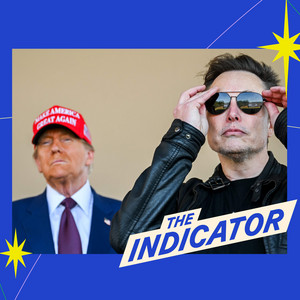
NPR. The way things are going, it's looking likely that President -elect Trump's incoming cabinet and staff will quite literally be run by billionaires.
Okay, not only billionaires, but way more billionaires than your typical presidential administration.
We don't have time to go through all of Trump's nominees, but here's some of those reported billionaires.
Hedge fund CEO Scott Besant for Treasury Secretary.
Howard Lutnick, CEO of a financial services firm for Commerce Secretary.
Linda McMahon, former CEO of World Wrestling Entertainment for Education Secretary.
And then there's Vivek Ramaswamy, a pharmaceutical billionaire who's been tapped to co -lead the so -called Department of Government Efficiency.
Along, of course, with the world's richest man, the billionaire of billionaires, Elon Musk.
Again, this is just a partial list of Trump's billionaire nominees and appointments.
And we haven't even gotten to the millionaires.
Now, estimates are that the total combined wealth of Trump's picks for his cabinet and administration would be upwards of $300 billion.
And granted, the rich and well -connected have always had a leg up in politics and government.
But if Trump's picks are confirmed, the amount of personal wealth held by top government officials would be unprecedented.
This is The Indicator from Planet Money.
I'm Adrian Ma. And I'm Waylon Wong.
Today on the show, what does this influx of the Uber wealthy into high office mean for the country?
This message comes from Wwise, the app for doing things in other currencies.
Send, spend or receive money internationally, and always get the real -time mid -market exchange rate with no hidden fees.
Download the Wwise app today or visit wwise .com.
Tease and seas apply.
Support for NPR comes from Amazon Music.
Prime members have access to a catalog of news podcasts, ad -free breaking news without the breaks, available by downloading the Amazon Music app or visiting Amazon .com slash ad -free.
It's cuffing season, the cold months where we might look for a warm somebody to cuddle up to.
But dating isn't always warm and fuzzy.
And this year, there were so many big debates about how we love.
On It's Been a Minute, our cuffing season series will help you answer some big questions, like what is the ick really about?
Or is it okay to date for money?
To find out, listen now to The It's Been a Minute podcast from NPR.
If Trump's picks become reality, it would be unprecedented to have so many millionaires and billionaires staffing key roles in federal government, leading agencies and advising the president.
So I guess my first question is, what do you make of that?
I wasn't surprised.
That's Steve Nelson.
He's a professor of political science at Northwestern University.
And recently he and his colleagues did a study looking at how often billionaires enter politics and government.
So we used the Forbes list, which had just over 2000 billionaires from around the world.
And so what we ended up doing is looking for evidence that they had formally entered politics.
And we found that 11 percent of the people on the list had entered politics, which means if you take nine randomly selected billionaires off that list, one of them is going to have political ambitions that go beyond just giving campaign contributions.
They actually go into politics.
So I wasn't super surprised to see that Trump found fellow members of his billionaire class that were willing to throw their hats into the ring.
Here's what was sort of surprising to Steve, though.
The 11 percent of billionaires getting into politics or government was way higher than it was for other groups we often think of as producing a lot of politicians.
For example, Steve says less than one percent of lawyers in the U .S.
go into politics. So what do you make of that sort of overrepresentation?
Why would billionaires give up running their business, which has given them like a very healthy income to go into politics?
It does seem odd to me because super rich people can use other means to try to get what they want in the political realms.
They can just give a bunch of money to a candidate and basically try to steer the policy agenda in that way.
So why is it that these billionaires are entering politics at such a high rate?
Well, one thing is that they are unconstrained.
They don't have to go around with hat in hand asking for funds.
They can just mobilize funds themselves.
The other thing is to think about billionaire politicians and their interests.
It's possible that billionaires are entering politics at such a high rate because they have particular interests in pursuing policies which help not only to protect their wealth but to expand their wealth.
Interestingly, Steve says it's more common to see billionaires get into the political realm in countries where the governments are more authoritarian.
China and Russia alone account for about half of the world's billionaire politicians.
And so in those two settings, what we think might be going on and in other authoritarian regimes is that billionaire politicians are motivated to absorb the costs of entering politics because the benefits are really high.
The incentives are really strong because what they really worry about is protecting their wealth because authoritarian regimes have weak rule of law.
There's a risk of expropriation and there's also the need to show fealty to the ruling regime.
And the best way to do that for many billionaires is to say, I'm going to set aside some of my time and serve in the legislature or serve in a political post to make contacts, ensure that I am showing that I am loyal to the regime and that way I can try to protect my wealth.
So if billionaires in government are more common in authoritarian regimes, what should we make of the fact that Trump's nominees draw heavily from the ranks of the not just the merely wealthy but the super rich, the 1 % of the 1%.
Darien Stacy is a political science professor at the US Naval Academy and he studies how politicians wealth can translate into policy.
There's some research that has looked at the impact of wealth on governance, but the research is really sort of a mixed picture.
Darien, by the way, says he's speaking as a private citizen, not on behalf of the Naval Academy or the US government.
Some of these individuals might bring fresh ideas and a mindset that prioritizes results, which can often be a positive change in government.
Some studies have shown that wealth can correlate with certain leadership traits like risk taking or decision making skills and strategic thinking, which are useful in both business and public administration.
And then wealthy individuals often have access to large networks and resources that can aid them in policy development and implementation.
On the other hand, Darien says there's also evidence that extreme wealth can create a disconnect between average citizens and those in power.
So studies on things like socioeconomic diversity and leadership suggest that leaders from wealthier backgrounds are less likely to prioritize policies addressing things like inequality, poverty and social safety nets.
And some evidence that they might also unconsciously favor some policies that align with their own experiences and priorities, which if you are looking to address inequality, those unconscious biases actually perpetuate inequality.
Darien says another possible problem with uber wealthy business people in top tier government roles is the potential for conflicts of interest.
During Trump's first administration, government watchdogs alleged that the president used his position to benefit his real estate business.
This time around, Trump will be surrounded by even more fellow billionaires.
The concern is these billionaire politicians could use their power and influence to benefit their own bottom lines.
When you look at the wealth of the incoming Trump administration, Steve from Northwestern says it fits into a global pattern.
While there are plenty of rich people out there with liberal leanings, he says the super rich are different.
The super rich are much more likely to affiliate with a conservative party, with a party on the right side of the political spectrum.
And that's true in the United States.
There's two and a half times more Republican billionaire politicians in the United States, but it's also true outside of the United States.
Steve says whether you think that's a good thing or not may come down to whether you feel like the policies and politics of an administration align with yours.
But for Steve personally, he says it comes down to how he thinks about democracy.
Regardless of whether you're a partisan of a left or the right or whether you think that billionaires are more effective in decision making roles, I think the problem with having a huge number of super wealthy people or a high share of super wealthy people occupying government positions is it creates
a dilemma for democracy.
Steve says if democracy is about average people picking leaders to represent the people's interest, will a government staffed by millionaires and billionaires be able to do that?
This episode is produced by Cory Bridges and engineered by Jimmy Keeley.
It was fact checked by Sierra Juarez, Kicking Cannon edits the show and the indicators of production of NPR.
I'm Lakshmi Singh. Public radio reminds us of our shared humanity, even at our darkest hours, like with a story of an artist couple who make beautiful spaces for communities to grieve.
We found that people will usually stop by and just feel a little bit more open and willing to talk and share.
Help us make room for light in the dark.
Give before the end of the year at donate .NPR .org.
What are the best albums of 2024?
Find out on the latest episode of NPR's All Songs Considered.
There's a lot of people who could sing that exact line and I would be like, you're under arrest.
But she pulls it off.
Download new episodes of All Songs Considered every Tuesday, wherever you get podcasts.