If you find yourself bewildered by this moment, where there's so much reason for despair and so much reason to hope all at the same time, let me say I hear you.
I'm Ezra Klein from New York Times Opinion, host of The Ezra Klein Show.
And for me, the best way to beat back that bewildered feeling is to talk it out with the people who have ideas and frameworks for making sense of it.
There is going to be plenty to talk about.
You can find The Ezra Klein Show, wherever you get your podcasts.
From The New York Times, I'm Rachel Abrams. This is The Daily.
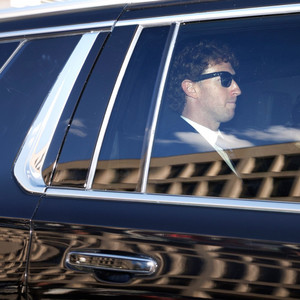
Testimonies began this week in one of the most aggressive cases the government has ever brought against a big tech company, and over the next eight weeks the Federal Trade Commission will argue that Meta, the company founded by Mark Zuckerberg in his college dorm room, should be broken up.
Today my colleague Cecilia Kang on the strange and contentious relationship between Zuckerberg and President Trump that has led to this moment.
And what the case means for both of them.
It's Thursday, April 17th.
Cecilia, you are talking to me from your car, I believe.
Why are you talking to me from your car?
Yeah. I had to run to my car because I'm on a lunch break during an antitrust trial where the Federal Trade Commission is seeking to break up META.
And this is a really high -stakes case for Metta and for Mark Zuckerberg because this case really threatens the company's entire existence.
It's existential because the government is trying to break up this company that he co -founded two decades ago.
And I have just spent the first half of this week watching Zuckerberg testify as the first and star witness in the government's case against Meta.
And when I go back, he will finish up and then we will have the former Chief Operating Officer, Sheryl Sandberg testify.
What's the first week been like?
It's been pretty crazy.
Long lines to get into the courtroom.
The courtroom itself is full of Meta's many, many lawyers as well as the FTC's lawyers and media and a lot of just people from the public.
And it's interesting because up until really the minutes before the trial began, I wasn't even sure that it was going to happen.
Why is that? In recent weeks, senior Facebook officials have been trying to get the White House to stop this case from going to trial.
And recently, as reported, Mark Zuckerberg was at the White House himself meeting with the President and his top aides.
trying to get the president to drop this case before it could go to trial.
And so this case, which has huge implications, can be seen as a reflection of this ongoing and strange relationship between these two men, Zuckerberg and President Trump.
It's sort of surprising to hear what you're saying, because we've talked on the show about how the big tech giants have been increasingly cozying up to President Trump.
I think a lot of people, myself included, saw photos of Zuckerberg at the inauguration.
I sort of had the impression that these two men were at least a little bit warm toward each other, so maybe you could just unpack this a little bit.
What exactly is their relationship, and how has it affected this case?
So it's interesting, the story of Zuckerberg and Trump really goes back almost a decade, and their relationship has really changed and evolved over those years.
I think it's fair to say that what started as a story of two very powerful, but very different and maybe even opposing figures, has turned into something quite different.
Lately, Zuckerberg has been very positive about Trump.
He's really tried to get into Trump's inner circle, but Trump at this point has not returned the same sort of interest nor affection.
I would say that the relationship is pretty one -sided at this point.
Zuckerberg, for most of Facebook's history, has never been overtly political.
It's actually sort of a mystery as to how he votes.
He donates to both parties.
He's not particularly vocal about politics generally.
Things get a little bit more complicated when it comes to Trump's first election victory in 2016.
That was a huge deal for Facebook, but not necessarily in a positive way.
I remember that Facebook was really widely seen as one of the reasons that Trump won the election.
That's right. The left blamed Facebook for Trump's victory.
They say that there was a surge of political misinformation that really helped Trump in winning.
And Zuckerberg reacts to these concerns by creating new policies and new changes to the platform, instituting things like fact -checking, all with the purpose of trying to slow the spread of misinformation on the site.
And the right hates this.
They say that these actions are essentially censorship and censorship of conservatives.
They say that the company's leaders and their employees are liberal and they have a bias that's against conservatives in Trump, and Trump comes out for the first time as anti -Facebook.
It sounds like hating Facebook becomes basically a bipartisan issue at this point.
Yes, at this point we're starting to see Facebook getting caught in between both political parties.
And eventually, the Federal Trade Commission, under the Trump administration, decides to sue in December 2020, which was right before they leave office.
that lawsuit leads to the trial that I've been covering this week.
And then on January 6, we know what happens.
Trump's supporters storm the Capitol.
And at first he is urging the crowds.
And while his supporters are in the Capitol building and police are trying to take control of the situation, Trump addresses his supporters in a video.
I know you're paying.
I know you're hurt.
We had an election that was stolen from us.
It was a landslide election and everyone knows it.
That video is posted across social media, including Facebook and Instagram.
People in Law & Order, we don't want anybody hurt.
It's a very tough period of time.
There's never been a time like this where...
And employees of the company, as well as the public, are very concerned with Trump's speech. What Facebook decides to do next is very important.
They decide to remove those videos and they cite a policy that the company has on speech. The company forbids any sort of incitement of violence.
And then Facebook escalates.
Facebook decides to remove Trump entirely off the platform.
Trump interprets that as a shot across the bow.
And at that point, he determines that Facebook is an enemy.
But when President Biden comes into office, all the sudden it is Zuckerberg feeling like Facebook is being censored.
How so? The real flashpoint was during the COVID -19 pandemic and when the Biden White House was reaching out to Facebook senior executives and really railing on them to clamp down on misinformation related to the virus.
The Biden administration, according to Zuckerberg and employees at META was quite strict about what kind of information that they thought was misinformation, any sort of skepticism about the vaccine, as well as any sort of conversation even around COVID where there might have been either just questions raised or maybe even satirical content about COVID -19 was the subject of real scrutiny by the Biden administration.
And White House officials were telling Metta that they need to take down all that content, which Metta thought was a real overreach. And in fact, the relationship between Metta and the Biden administration only gets worse.
Once Biden appoints a real trustbuster, Lina Khan, to be his top antitrust regulator.
Lina is a well known figure within the very small and esoteric world of antitrust law.
And she is seen as one of the biggest threats across corporate America.
And Lina Khan picks up that antitrust suit against Mehta that was initiated in the Trump administration.
So it sounds like at this point, basically Zuckerberg and the Biden administration could not be farther apart.
Yes. The animosity between the Biden administration and Mehta only grows and the companies feeling very much like a target.
So as Zuckerberg's relationship with Biden is deteriorating, what's going on with his relationship to Trump at this point in time?
Well the real inflection point was the assassination attempt on Trump.
Mm. And that was a moment when Mark Zuckerberg saw Trump emerge and stand up from that stage in Pennsylvania, with his fist pumped in the air, blood coming down his face.
It's seeing Donald Trump get up after getting shot in the face.
Zuckerberg later commented that he thought that was such a moment of heroism.
One of the most bad -ass things I've ever seen in my life.
And that he thought that, in his words, that Trump was a real bad -ass.
At some level as an American, it's hard to not get kind of emotional about that spirit and that fight and I think that that's why a lot of people like the guy.
And that was the first time that I'd heard Zuckerberg really speak out so positively about a political candidate.
He'd been very careful for many years to not take any strong position in politics.
And then after the 2024 election, things really start to pick up.
We see Zuckerberg almost racing to show his affection for Trump.
Hm. Facebook founder Mark Zuckerberg had a private meeting with the President -elect today at Mar -A -Lago.
This is just... First, he publicly congratulates the President on his election.
Well, Mark Zuckerberg's been over to see me and uh...
He visits the President -elect in Mar -a -Lago.
What's goin' on? You know, chill week.
Yeah. Sorta. He goes on the Joe Rogan podcast. It's one of the things that I'm optimistic about with President Trump is I think he just America to win." And for quite some time, talks about how much he admired the president." These people from the Biden administration would call up our team and scream at them and curse.
And how he had become so frustrated with the Democratic -led former White House.
Hey everyone. I want to talk about something important today.
We see Zuckerberg also change policies within the company.
Here's what we're going to do.
First, we're going to get rid of fact checkers and replace them with community notes, similar to X, starting in the US.
He gets rid of fact -checking.
What started as a movement to be more inclusive has increasingly been used to shut down opinions and shut out people with different ideas, and it's gone too far.
And he also gets rid of DEI, Diversity, Equity, Inclusion, sort of efforts at the company.
The recent elections also feel like a cultural tipping point towards, once again, prioritizing speech. These two big policy changes seem very much aligned with the Trump agenda and...
For a prime example of how Trump went from pariah to powerful, look to Metta.
The company confirms it made a million -dollar contribution to Trump's inaugural fund.
Metta donates a million dollars to the Trump inauguration.
He's really pulling out all the stops.
He's pulling out all the stops.
It's happening in rapid fire, all within a compressed few weeks.
And, you know, whether or not he believes in President Trump or whether he's just trying to do the best thing for his companies, I guess that doesn't really matter, because he's gone full MAGA, right?
Like he's fully aligning himself with the new administration.
But I have to note that looking at where we are today, it doesn't seem like any of that helped him that much. Yeah, Rachael.
I don't think so. The president still holds a grudge against Zuckerberg and Mehta.
And as somebody very close to the president told me just a few days ago, the president still wants his pound of flesh.
We'll be right back.
I'm Dane Bruckler. I cover the NFL draft for The Athletic.
Spending the whole year working on a draft guide, I'm looking at thousands of players putting together hundreds of full scouting reports.
All the nitty -gritty details, the testing data, the stats, but extensive background research as well.
Every journey is a little bit different.
I'm on the phone with a lot of these guys.
Hey when did you start playing football?
What other sports did you play?
Tell me about your family.
You know, learning more about these guys as people.
Our draft guide picked up the name the beast because of the crazy amount of information that's included.
I have no idea how to quantify the hours I've spent putting it together.
I've been covering this year's draft since last year's draft. There is a lot in the beast that you simply can't find anywhere else.
This is the kind of in -depth unique journalism you get from The Athletic and The New York Times.
You can subscribe at nytimes .com slash subscribe.
So, Cecilia, we just talked about how Zuckerberg couldn't get Trump to make this case go away.
But what exactly is the case that the government is bringing here?
Yeah, this case is really pretty novel in that this all centers around two acquisitions more than a decade ago, the acquisitions of Instagram and WhatsApp.
And what the federal government is arguing is that Facebook had a monopoly when they bought these companies.
And through these acquisitions, they were able to keep their monopoly.
The reason why that is such a eyebrow -raising argument, in particular, is because the very agency that is suing Meta was the agency that approved those mergers more than a decade ago in the first place.
Okay, explain that.
So I've got to take you back in a time machine to around 2011, 2012.
And this was a really pivotal time for Facebook.
Look, Facebook really struggled to create an app for the smartphone, and they were starting to see competition, particularly from Instagram, that made Mark Zuckerberg very nervous because Instagram had this new and very interesting photo sharing app.
And so Zuckerberg, in 2012, decided to buy Instagram, which didn't have that many users and had very few employees, for a billion dollars.
Wow. That in itself was a big deal at that time, but regulators thought that it was such a small company, Instagram, and it didn't directly compete with Facebook as a social network that they felt comfortable allowing that merger to go through.
And then Zuckerberg got nervous again.
Around 2014, he saw the rise of messaging apps like WeChat in China and WhatsApp, which was an app that was very popular globally, really picking up steam and getting tons of users around the world.
And he was afraid that those kinds of messaging apps could also compete with Facebook, because they could take on more social features like sharing between friends and family.
So then in 2014, he buys WhatsApp for $19 billion, huge price tag that drew a ton of interest at the time.
But again, regulators said, you know, this app doesn't directly compete with Facebook, so yes, we'll approve it.
So both mergers approved by the Federal Trade Commission.
So, it sounds like from what you're saying that there weren't any alarm bells ringing at the time when Facebook was acquiring these companies, but obviously, something changed.
What changed and why?
Well, a couple things changed.
First, Facebook becomes very powerful.
It hits 3 .5 billion users, and that sheer scale puts a spotlight on Facebook.
Suddenly people see that it has become an essential place for so many people around the world to obtain and to share information.
And once people start recognizing that, especially around the 2016 and 2020 elections, it changes the perception of Facebook and Mark Zuckerberg.
The other thing that changes is that regulators start looking at the Silicon Valley companies very differently.
They see that these internet giants only get bigger and stronger in ways that are unexpected.
They start to look at acquisitions that these companies have made over the years that may have not seemed either threatening or anti -competitive at the time because these big companies are often buying very small startups.
but those acquisitions become really important tools for these companies to continue to grow and to maintain their monopolies.
It used to be that the key way to determine if a monopoly was breaking the law was whether prices were going up for consumers.
But how does that apply to an internet company, especially a company that has apps like Facebook and Instagram, which are free?
And so regulators are saying there are different ways that we should look at how these companies have too much power.
So what is the harm that the government is arguing that Metta poses here, exactly, if not ripping people off, in terms of how much they're paying for a product?
So the government is arguing that there are other ways consumers have been harmed.
They say that if these mergers were not approved, that maybe Instagram and WhatsApp would have created much more competition that would spur Facebook to be more innovative and to make their app better.
So you might see fewer things like data privacy scandals, you might see the company do a better job when it comes to containing misinformation.
All these things that are not related to price, but do affect the consumer experience.
And most interestingly, the Trump Administration has introduced a new wrinkle.
— President Trump and his top antitrust regulators have argued that these platforms censor speech and that their ability to censor speech is a real sign, a symptom of a problem, which is that they are too powerful.
So they are arguing for the first time that I have heard a speech theory, that antitrust enforcement should include concerns about speech. Fourth, Cecilia, I can't help but notice that Zuckerberg, who has become this like free speech absolutist and rolled back so much of the company's past efforts to censor content on the platform, he's actually now the target of a case the present or his administration is taking on, at least in part, because he thinks meta holds too much power to shape speech. So it's really ironic in some ways Zuckerberg and Trump want the same thing.
They want complete free speech on the internet.
They want no censorship.
And Zuckerberg has tried to signal to Trump that, hey, we are on the same side on this issue.
But even though Zuckerberg has tried to do that and made so many other efforts to try to appease Trump, it really hasn't landed in the way that Zuckerberg wants and needs.
He still has to go through this trial.
And that's because even though they might agree on some things, Facebook is still viewed as simply just too big.
But it sort of sounds like from what you've explained that the government has a bit of an uphill battle here for two reasons.
One, they basically have to say, look, even though we approved these mergers back in the day, we've changed our mind, we want to unwind them, which seems tough.
And two, they've also got this new argument where they're trying to prove new harms in a theory that's kind of been untested before, right?
So should I take it from what you've just said that Metta is feeling pretty good about its chances here?
I think so. I think Metta is coming in really confidently.
I think legal experts are all saying that this is a tough case for the FTC.
But the real question that I have as I watch Mark Zuckerberg finish his testimony this week is what is he winning here?
They might win this trial, but he still needs to win over the president.
There are so many other issues that relate to his business and there's so much at stake with this administration as the company continues to try to expand new areas and grow.
So I would say this is just one step in a very long process for Metta to really get back into the good graces of Washington and particularly to, for the first time, win over Trump's support.
Because who knows what the next fight will be.
That's right, and there will be many.
Cecilia, thank you so much. Thank you for having me, Rachel.
We'll be right back.
This episode is supported by HubSpot.
Growing a business can feel impossible, but HubSpot's customer platform can help.
It's powered by Breeze, their suite of AI tools.
so you can generate more leads, close more deals and scale your service fast. With Breeze agents handling the busy work, customers are cutting sales cycles in half and saving hours on work each week.
Best of all, you can see results in days, not months.
Visit hubspot .com slash AI to learn more.
Here's what else you need to know today.
A federal judge threatened to open a contempt investigation into whether the Trump administration violated an order the judge issued, directing officials to stop planes of Venezuelan migrants from being sent to El Salvador.
The judge said he would begin the proceedings against the administration, unless the White House gives scores of Venezuelan men deported to El Salvador a chance to challenge their removal.
And… On Wednesday, Britain's Supreme Court ruled that trans women do not fall within the legal definition of women under the country's equality legislation, dealing a major blow to campaigners for transgender rights.
While the five judges involved in the ruling said the legal definition of a woman is based on biological sex, they emphasized that they were not commenting on whether trans women are women more broadly, saying it was not the role of the court to adjudicate the meaning of gender or sex. Today's episode was produced by Nina Feldman and Carlos Prieto.
It was edited by Brendan Klinkenberg and Mark George with help from Mike Benoit.
It contains original music by Pat McCusker, Diane Wong, Mary Ann Lozano and was engineered by Chris Wood.
Our theme music is by Jim Brumberg and Ben Landsberg of Wonderly.
That's it for The Daily, I'm Rachel Abrams, see you tomorrow.