Today's episode is sponsored by Indeed.
You just realized your business needed to hire someone yesterday.
How can you find amazing candidates fast?
Easy! Just use Indeed.
When it comes to hiring, Indeed is all you need.
Stop struggling to get your job posts seen on other job sites.
Indeed's sponsored jobs help you stand out and hire fast.
With Sponsored Jobs, your post jumps to the top of the page for your relevant candidates so you can reach people you want faster.
There's no need to wait any longer.
Speed up your hiring right now with Indeed.
Listeners of this show will get a $75 sponsored job credit to get your jobs more visibility at indeed .com slash brains -on.
Just go to indeed .com slash brains -on right now and support our show by saying you heard about Indeed on this podcast.
Indeed dot com slash brains -on, terms and conditions apply.
hiring indeed is all you need.
Molly here. Imagine this.
A friend comes over and you greet them in your slick new Brains On Shirt, they check out your rad Brains On Wall poster, and when you go to draw together they pick a color from your cool new Brains On Pencil pouch.
It could all come true if you win our giveaway.
Right now when parents sign up for our newsletter they'll be entered for a chance to win a Brains On shirt, poster, and pencil pouch.
Go to brains on dot org slash newsletter to sign up.
And parents, we made this newsletter with you in mind.
We cover topics like how to talk to kids about crushes or how to make friends as adults.
Plus we'll share parenting tips and cool facts.
Get on the list now by going to brains on dot org slash newsletter.
That's brains on dot org slash newsletter.
Everyone signed up for the newsletter will be in the drawing for the giveaway.
Again, that's BrainsOn .org slash newsletter.
They're listening to BrainsOn, where we're serious about being curious.
BrainsOn is supported in part by a grant from the National Science Foundation.
Hey Molly, hey Harlan.
Hi Mark. Wanna try some dry guava?
Oh sure, that sounds, whoa.
Nice pants, Mark. What, these?
Oh thanks. As you know, I've been learning to dry fruit.
And I think I finally got it down.
Check it out. I made rubbery apples, chewy cherries, not worthy nectarines, plants - Amazing!
Is that papaya on your pants?
What? Uh, oh yeah, yeah.
While I was tinkering in the kitchen, I accidentally tore a hole in the knee of my pants so I hot glued some dried fruit slices to fix it.
So, which leathery fruits neck do you wanna try first?
Whoa, the strawberries on your shins are so iconic!
Oh, and are those blueberries on the butt?
Turn around again and let me see.
Yeah, yeah, strawberries on the shins, blueberries on the butt, mangoes on the cuffs.
Look, I tore up my pants real good chopping and slicing and shredding all this fruit.
I didn't have time to put on new ones, so I just patched them with whatever was around, which happened to be dried fruit.
I don't see why this is such a big deal.
Oh. Can I have some of those dried kiwis?
Of course. Finally.
I was hoping you'd try some.
Look, I stapled kiwis on my cargo pants.
Now I'm wearing fruit pants too.
So cool. Do me next.
I want those dried orange slices on my sweats.
You're all missing the point.
Hey, these are snacks for eating, not for decorating your denim.
Ooh, good idea, Mark.
Let's put some jackfruit on our jeans.
We're gonna look so good.
You're listening to Brains On from APM Studios.
I'm your host, Molly Bloom.
And my co -host today is Harlan from San Diego, California.
Hi, Harlan. Hi. Molly and I are both wearing fruit pants today.
Mine are cherry covered chinos.
And I have bell bottoms bedazzled with blackberries.
They look great, and I always have a snack handy.
Fruit pants are so in right now.
Very in vogue. That's a French term meaning hip and trendy.
Which is great because trendy is the topic du jour.
That's French for of the day.
Oh, speaking of fruit pants, I made these for you.
Persim and pear is sheet pants, thanks Molly.
Just a little something I whipped up in La Garage.
That's French for the garage.
Anyway, like I said, today we're talking trends and answering a question from you Harlan.
My question is, how do trends start?
So how would you describe a trend?
I would describe it as one person does it and then more and more people do.
Very good description.
So there are a couple definitions of the word trend, but today we're talking about a style, a fad, or some behavior that gets popular among a group of people.
So Harlan, what made you think of this question?
I was scrolling on Instagram with my mom and my mom was like, ooh, these ruffled socks are a trend.
I was like, ooh, what does a trend mean?
And she's like, well, we can ask Brian Z Jin I was like, OK, nice.
Ruffled socks started this whole episode.
So what are some trends that you've seen at your school probably the baggy pants?
Yes. Do you like to wear baggy pants to Yes.
They're comfy, right?
Yeah, they're like really comfortable.
So are there any trends that you used to be into that maybe you're not anymore?
I used to need all the stuffies in the world.
Oh, yes. And are there any trends that have happened at your school that you're not a fan of, that you're like, no, no, no, I'm not gonna do that?
The tight shirts. Ah, yes.
So the look that a lot of people are wearing is a tight shirt with baggy pants.
Yeah. And so the tight shirt is not for you.
No. So what do you wear, instead of a tight shirt?
I wear baggy shirt, baggy pants, or baggy shirt, and then tight leggings.
Nice. So you're like, as long as the shirt is baggy, your happy camper yeah well listeners we asked you to tell us what you thought would make a good trend and here are some answers you sent in i think that my trend would be everyone would wear their blankets on as clothes and like clip them together and i wanted to start a trend where humans and pets wear matching ball gowns in suits and my A trend would be if people started listening to music backwards.
A trend I would like to try is everybody wearing one midden and one glove.
Hey, I think a cool trend would be buying pads that are too small for you, but then in between the legs you just cut a small hole for your head, and then you put it on like a crop top.
I think the trend for 2025 should be making stuffies out of recycled trash.
What I think a trend will be in the future is people carrying squishies around.
So they would do a makeover on a squishy, but they would make it their personality and they would carry their personality squishy anywhere.
I love all of those.
thanks to Jenna, Ellie, Julian, Cormac, Anya, Eloise, and Caroline for looking into their crystal balls.
Well, the fun thing about trends is that they come in all sorts of shapes and sizes.
Yeah, there are big trends.
Like whether it's into part your hair on the side or in the middle.
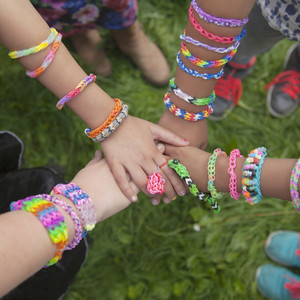
Or things like fidget spinners, friendship bracelets.
What kind of jeans you wear?
These are all big trends that lots of people around the country will know about.
There are also small trends, like the ones that happened in just your school.
Like if your friends start giving high fives with the back of your hand and it spreads to your whole grade.
Backhand high five?!
Wow, that is surprisingly satisfying.
But no matter the size of the trend, they usually spread in a similar way.
Wrong, wrong, wrong.
Sandyn, you didn't even hear what we said.
How do you know it's wrong?
What? No. I meant the décor in here.
Ugh. If I'm going to explain how trends spread, I cannot do it in a room with...
What is that... beige wallpaper?
Ugh. A team? Fix this.
Wait, that desk is important.
Do we really need that many couch pillows?
That's good. Yes, yes.
Love it, love it, love it.
Gotta marry it. Wait, uh, excuse me.
Is that a peach fuzz pink throw blanket?
Don't you dare. I am not letting last year's Pantone color of the year in this place.
It's this year's color, Mocha Moose Brown, or it's nothing.
Ah! Now that is much better!
There. Now I can talk.
Hi, Molly. Hi, Harlin.
Backwards five? You know it, Sandin.
Wow. Okay. It does look pretty good in here now.
Obviously. Now, trends usually get popular in a certain way.
In the 1960's, there was a sociologist named Roger Evert.
A sociologist is someone who studies how humans behave in groups.
Roger was interested in how new ideas and new technologies spread and he noticed a pattern.
Eventually he came up with a theory, or an idea, of how trends spread.
It's called the diffusion of innovation theory.
Oh, I read about this when I was getting ready to co -host this episode.
Diffusion means to spread and innovation is something new.
Ah. So, the diffusion of innovation theory is an idea about how new things spread.
Exactly. Now, the thing about trends is there is no real science to starting them.
Lots of businesses and creators have tried to make things go viral, but usually, it just falls flat.
There has to be a spark.
A certain je ne sais quoi.
Ooh, that's French for I don't know what.
I don't know what that's French for either.
I just know without it.
A fad is a flop. But according to...
The diffusion of innovation theory.
There's a certain kind of person who usually starts a trend.
Oh right. They're called innovators.
Innovators are people who like to try new things.
They're creative, inventive, and importantly, they're willing to take risks.
Often, these are artists or fashion designers, but they can also be just a really creative kid who thinks differently.
So when Mark invented fruit pants, he was sort of acting like an innovator, even though it was kind of by accident.
Yeah, by fixing his pants with a dried fruit, he tried something new.
Yep, it took creativity and it was risky.
Right, because it might have looked silly instead of super stylish.
Uh, that's as correct as pairing chunky loafers with frilly socks.
That means... It means very correct.
But it's not enough for an innovator to come up with an idea for a new trend.
The trend also needs to catch on, which brings us to the next step of...
diffusion of innovation theory.
Next, an idea is picked up by a group called the early adopters.
Early adopters are people who have their fingers on the pulse of what's cool and new.
Right, they don't invent new trends, but they're quick to jump on them and they're good at sensing which trends have staying power and which will quickly fizzle out.
That's why lots of other people often take their advice from early adopters about what's cool.
Sounds like an influencer on social media.
Very much like that.
Influencers can make a career out of sharing the right trends at the right time.
Hey, Fashion Fam. Miles here.
I just had to hype my latest find.
Two words, fruit pants.
Yeah, their pants with fruit slices.
So fun. They go with and people will literally light up when they see these puppies on you.
I just got a pair. I mean, I got a pair with a pair.
I mean, I got a pair of pants with a pair of fruit on it.
You know what I mean.
Best part, a pair of pair of pants pairs with practically anything.
Ooh, I want a pair of pretty pair of pants.
So, these early adopters are key in helping trends catch on, but they have to be pretty good about knowing what to hype, or people will stop trusting their taste.
The next group to pick up the new thing is called the early majority.
A majority is like the biggest part of a population, so it means most people.
Unlike the others, this is a big group.
The early majority, they're not really leaders or trendsetters, but they're a little quicker than most to pick up on a new idea.
And according to this theory, you know, they usually want to know more about a trend before they jump on it.
So maybe they get on board after seeing something on the news.
A new trend is taking the world by storm.
Fruit pants. You've seen them on the runways of Paris and Milan, and now they're even in school lunchrooms and on playgrounds.
In fact, I'm wearing some right now.
check out my key lime khakis.
So fun, so fashionable, so fruit -tastic.
Coming up, vegetable vests.
Are they the next big thing?
Huh, so they might ask questions like, do fruit pants really hold up or are they gonna fall apart?
What happens if they get wet from rain?
Will my fruit pants attract fruit bats?
All great questions!
Now when the early majority gets on board then you know you have a bonafide trend on your hands.
Then after the early majority, you get the late majority.
Oh yeah, these are people who are pretty skeptical of new things.
They usually don't jump on trends until most people are already doing it.
Right, generally the late majority aren't convinced until something is pretty mainstream.
At this point, most people are taking part in the trend and it might lose its appeal to taste makers.
Then finally, the last group to join are called laggards.
Laggards are a smaller group, kind of like the opposite of early adopters.
They don't really like change.
They don't chase what's cool or in at the moment.
Which kind of makes them cool in their own way.
Because like innovators, laggards don't care as much about what people think of them.
So a successful trend moves through all those groups, from innovators to early adopters, to the early majority and the late majority, and then, finally, to the laggards.
But, at that point, is it still considered a trend?
Huh. Good question!
You know, I would think at that point, it just kinda becomes part of life, like Blue Jeans, smartphones and regular front -facing high -fives.
I think the backwards ones will catch on, too.
Me too! They're just so fun.
Well, Shannon, thanks for explaining.
The diffusion of innovation theory.
to be free. No problem.
Now, if you'll excuse me, I cannot possibly stay in this out of date studio one second longer.
But Shannon, you just redecorated it yourself.
Yeah, like five minutes ago.
Keep up Molly, all of this is out of date now.
Well, it's been fun for you.
Bye. So Harlan, did that theory about how trends spread seem right to you?
Yes. So where do you think you usually fall in that cycle?
So just to remind ourselves there's the innovators, the early adopters, the early majority, the late majority and the laggards.
Probably the early adopters.
Nice, so you like see it and you're like that seems super cool.
Yeah. Speaking of trendy always in forever my passion.
It's time for the Mystery Sound.
Harlan, are you ready to guess a mystery sound?
Yes. Okay. Oh okay, Harlan what do you think?
I think it's like a of a loom, like being rubbed together or like with their hand going like that around it.
Yeah, the moment you heard that you were like, ah, I know what this is.
Yeah. Do you like to play with balloons and stuff?
Well, yeah. I bought some yesterday.
Oh my gosh. So it was like fresh in your mind.
Yeah, and like I blew one up and then I put it on my brother's head and I just rolled it on his head and his hair went up.
It was really funny.
Oh my gosh. I love doing that with balloons.
OK, so we're going to hear it again, see if you want to stick with your guests, and then hear the answer right after the credits.
So stick around. We're working on an episode about a time millions of years ago, when birds and dinosaurs lived side by side, and we were wondering if you could bring a living, breathing dinosaur to show and tell what kind would you bring, and why.
A gentle triceratops for all your friends to pet, a velociraptor to play hide and seek with on the playground.
Harlan, what about you?
What dinosaur would you bring to show and tell?
I would bring a borontosaurus because it could like put its head down and then I could sit on it and then it could bring its head up and then I could slide down it.
Oh my gosh, so fun.
Yeah, those borontosaurus are the ones with the really long necks, right?
Yeah. Nice, yeah, they're super cool.
Good choice, Harlan.
Well listeners, we want to know about what kind of dinosaur you'd bring to show and tell and why, so please record your answer and send it to us at brains -on -dot -org -slash -contact.
While you're there, send us your mystery sounds, drawings, and questions.
Like this one. How do scientists know how old fossils are?
You can find answers to questions like these on The Moment of Um podcast, a short dose of facts and fun every weekday.
Find Moment of Um and more at brains -on -dot -org.
And keep listening.
Brains on Universe is a family of podcasts for kids and their adults.
Since you're a fan of Brains on, you'll love the other shows in our universe.
Come on, let's explore.
It's alien laundry day!
While I wash my nose mufflers and tummy togas, I'll listen to a new History podcast Whoa, I was not expecting that to work or food to sound wasn't good.
That's the DJ Dolo technique When I say pizza you say bagel pizza Stay right there tell me told us Must find forever ago Listen to Forever ago, wherever you get your podcasts.
Hey friends Molly, Sandin and Mark here with some very big news.
Drumroll please. We're hitting the road in search of adventure, fresh air AND you.
That's right! We're going to be live at the Boulder Theater in Boulder, Colorado on Sunday, April 27.
Our science -themed live stage show takes the audience on an adventure through the brain complete with magic tricks, dance moves, out of body experiences, mystery sounds, and a game show.
Molly, you almost left out the most important part.
Yeah, Molly, don't forget the big party.
Oh, right. After the shows, we're throwing a brain -tastic bash.
Join us afterward for a VIP party where we'll play games, guess mystery sounds, pose for photos, and give as many high -fives as humanly possible.
snapping a spot by purchasing a VIP pass when you buy your show ticket.
Oh that reminds me, I've gotta start training.
These hands aren't gonna high five by themselves.
Five and five. Good idea.
And remember, spots are limited, so grab your tickets today at brainson .org -slash -events.
Today's episode is sponsored by Greenlight.
Who taught you about money?
Was it your parents, your school?
Let's be honest, most of us learned about saving and budgeting way later than we should have, but here's the good news.
You can give your kids a head start with Greenlight.
We talk to kids on this show all the time.
And when you talk to kids, you realize that they know so much more than you might give them credit for, and they're able to understand things that are pretty complex and amazing.
So even if you think it's not time to start talking to your kids about personal finance?
Well, it actually is.
My daughter's been asking me a lot of questions lately about credit cards, spending, money, saving and Greenlight is an awesome tool to help answer her questions.
Greenlight is a debit card and money app made for families that let's kids learn how to save, invest and spend wisely.
Start your risk -free Greenlight trial today at greenlight .com slash brains on.
That's greenlight .com slash brains on to get started greenlight .com slash brain's on you're listening to brains on I'm Harlan and I'm Mollie and today we're talking trends.
Trends can be anything from a way of dressing to an activity to a behavior or even flying we just talked about one idea of how trends spread.
They usually start with a group of creative people called innovators then they're picked up by early adopters who are kind of like influencers or trendsetters.
Finally, they spread to the rest of the population.
So, Harlan, if you could start a trend, what would it be?
Everybody has puppies.
Oh, yes! I am all for that trend.
So we all just have puppies all the time because they're the best thing ever?
Yeah. Great trend, Harlan.
I am on board. Let's check back in with our listeners about more trends and hear what trends they'd like to see sweep the nation.
My idea for a trend would be if on one day of every year, her businesses would have their products cost something that isn't money such as bananas.
I think the next trend should be wearing capes.
The trend I would like to start is on October 2nd.
It would be National Donut Day and on the day everyone would just eat ducks.
The trend that I would like to start is dress like the weather.
We think everyone could fall with no imaginary socks.
We think it's cool because we don't have the flow away of single socks when dryer, eat them.
And my trend is that everyone can wear their pajamas everywhere.
and I think that everyone should have like a pet because it could keep you company when you live alone, meow meow.
Thanks to trendsetters Augustus, Ivy, Mia, Jubilee, Chloe and Louis, Ananya and Fiona.
But you might be wondering why do we have trends in the first place?
One idea is that they help us bond with each other as humans.
This is called social connection.
When we follow a trend, we join a group of people who are into that same thing.
Like how some Taylor Swift fans wear friendship bracelets to let other Swifties know they're one of them.
This helps them all feel like they're in a group or a community.
Some scientists think that this willingness to follow trends helped early humans form tighter communities, which helped them survive better through tough times.
And get this! By not following a trend, you're also saying something about yourself.
You're saying you aren't a trend person.
That might help you make friends with other people who scoff at trends.
And you and those people might form your own anti -trend friend group – more social connections.
So trends can be good, but let's be honest, they can be bad, too.
Right. They can make you feel like you need to buy more things to fit in – and that can be expensive.
And it's wasteful to always get lots of new things like clothes or toys.
It's better for the planet when you use less stuff instead.
Plus a lot of people can feel left out of trends, and being left out is a major bummer.
Have you ever felt left out of a trend, Harlan?
Um, yes. One of my friends had a super cool stuffy that I wanted, and I couldn't get it, cause my mom told me that I had too many stuffies already and I was like, I'll give it a one she's like, no thank you for getting rid of no one though I totally hear that Oh that's really frustrating.
Yeah, I mean we can't always get the new things that we want right?
Yeah like I'm always like I want it though.
Yeah, I know it's frustrating to want something and not be able to get it for maybe you don't have room, maybe you don't have money maybe you just don't want to buy any more things.
So trends have an upside and a downside.
And get this, they also have an animal side.
We actually see trend followers in nature, too.
Like with birds. Over the past hundred years, scientists have studied how birds build nests.
And they noticed something chirp -worthy.
Turns out some songbird species are bird fluencers.
When one bird builds their nest with a certain plant or material, other birds in their community are more likely to do the same.
Hey there I'm Wendy the trendy tufted titmouse.
I just found this darling ball of yarn in the dump.
It's neon yellow and totally hunter chic so I wove it into my nest.
Wendy, you've got such an eye.
We're gonna put that yarn in our nest too.
Yeah, I want my nest to be just like yours.
You're too sweet. I guess that old saying is true, birds of a feather flock together.
But it's not just birds, chimps are also trend -conscious.
About 15 years ago some scientists started noticing a funny fad among a group of chimpanzees living in a sanctuary park in Zambia in southern Africa.
A female chimp named Julie started sticking a piece of grass in her ear.
The next year all the chimps were doing it.
Sticking a blade of grass in their ears wasn't useful behavior for the chimps.
it was just kind of entertaining, or fashionable.
This suggests that other species of animals copy their friend's behavior for social or cultural reasons.
Like orca whales. Oh yeah, orcas are famous for setting and following trends.
Back in 1987, when mullets and acid wash genes were all of rage, a female orca off the coast of Washington State started a sweet trend.
She swam around with a dead salmon balanced on her head.
Dead fish on my head, flobby and cold Feeling fly, feeling bold This fish is fashion gold She was a true innovator.
Soon, early adopters in her group started balancing dead salmon on their heads, too.
And then orcas in other groups started doing it.
Ooh, nice salmon cap, Bronson!
You too, Gail. Isn't this whole dead salmon headgear thing a whale of a trend?
Then, seemingly out of nowhere, the orcas stopped doing it.
The trend was over.
And scientists weren't sure why it caught on in the first place.
Maybe it was a form of communication or a way of attracting a mate.
Or the orcas were just fooling around, then just last year a photographer took a picture of an orca off the coast of Washington State wearing a dead salmon on its head and the photo drew a lot of attention.
People wanted to know is the dead salmon trend back?
So far it doesn't look like it, there isn't any other evidence that other orcas are doing it too, but maybe in a few months it'll catch on.
You never know! But we do know all All sorts of animals follow trends.
From songbirds, to orcas, to humans.
They're a hit! I'm a genius.
Mark, you're back. Yes!
And guess what? My dried fruit is selling like wild!
Really? That's great.
Yeah, I mean, sales were a little slow at first, but then I started throwing in a free pair of fruit pants with every order, and suddenly sales took off.
People are saying things like, these fit perfectly, and they go with everything in my closet.
Don't you think they're talking about the fruit pants, Mark?
What? No. They mean the dried fruit fits in their mouth and goes with everything in their food closet.
A .K .A. their pantry?
Obviously. Now, if you'll excuse me, I have about a hundred more orders to pack up.
Yippee! Trends can be big or small but they usually spread the same way.
Creative people called innovators come up with something new.
Then early adopters or influencers pick it up and spread it to other people.
It's hard to say why something is seen as cool or trendy but we know trends are important for humans.
They can help us form bonds and tighten our relationships.
Even some animals follow trends.
That's it for this episode of Brain Zaun.
This episode was written by Sandin Totten and Rosie Dupont and it was edited by Shayla Farzan Fact Checking by Rebecca Rand We had engineering help from Lena Alvarez and Derek Ramirez with Sound Design and Original Theme Music by Mark Sanchez We have production help from the rest of the BrainZion universe team.
Molly Bloom. Rachel Breathe.
Ana Goldfield. Miko Gonzalez -Wistler.
Ruby Guthrie. Lauren Humpert.
Joshua Reit. Charlotte Traver.
Anna Weiggle. Anne.
Aaron Waldes -Selassie.
Beth Perlman is our executive producer and the executives in charge of APM Studios are Chandra Kavati and Joanne Griffith.
Special thanks to Lindsay Jones, Maya, Donna and Malia.
BrainZone is a non -profit public radio program.
There are lots of ways to support the show.
Head to brainzone .org to sign up for the BrainZone Universe newsletter for bonus activities, reading recommendations, and more.
While you're there, you can send us mystery sounds, drawings, and questions.
Again, that's brainzone .org.
OK, Harlan, are you ready to hear that mystery sound again?
Yes. okay last time you're like I know what this is do you still feel confident I think it's that but also I feel like it's like maybe like somebody farting in the marcapone.
It could also be that.
And then like a coping.
Yes, I often record myself farting in front of crows.
I love it. Okay, so either balloons or me, particularly farting front of a crowd.
Okay, are you ready for the answer?
Yes. Okay, here it is.
Hi my name is Eve and that was the sound of me rubbing my fingers on a balloon.
I knew it. You did it.
You were 100 % correct and you knew it right away.
That was very impressive.
I think we need to give a shout out to your brother.
Yeah. Shout out to your brother for letting you rub a balloon on his head.
Amazing. Excellent.
Ears, Harlan. Now it's time for the brain's honor roll.
These are the incredible kids who keep this show going with their questions, ideas, mystery, sounds, drawings, and high fives.
Audrey from Covington, Kentucky.
Brooks and chase from Miquan, Wisconsin.
Ada from Boston. Hannah, Eleanor, and Stella from Castle Rock, Colorado.
Nathan from Calgary.
Lucas from Pittsburgh.
Elliot from Seattle Ada from Beverly, Massachusetts Jack from Melbourne, Australia Aria & Ellie from Downington, Pennsylvania Benjamin & Noah from Winter Haven, Florida Aioni from Liverpool, England Mihal & Nshama from Potomac, Maryland Reece from Downers Grove, IL Emma from Canada Evan from Reading, Connecticut Haddar & Neta from Israel Theo from Bridgewater Township, New Jersey Quetzal from Los Angeles Artemis from Asheville, North Carolina Elouise & Margot from Ames, Iowa Rowan & Desi from San Francisco Lizzie from Yale, Michigan Kaster from Vancouver Mackenzie from Corpus Christi, Texas from Union,
Georgia. Jet Bowie and Shepherd from Columbia, Missouri.
Thomas Caleb and Bradley from Fort Worth, Texas.
Juniper from Philadelphia.
Ava from Singapore.
Ariana from Maumo, Arkansas.
Clover from Altadena, California.
Beckham from Cochran, Alberta.
Cora from Houston. Sophie from Glenridge, New Jersey.
Hasey from Asheville, North Carolina.
Basil from Nodie, Oregon.
Calvin from Hillsboro, North Carolina.
Gabby from Boston. Zana from St. Petersburg, Florida.
Lennox from Columbus, Ohio.
Charlie from Mahopic, New York.
Henry from Lake Bluff, Illinois, Gaines from College Station, Texas, Natalie from Waterloo, Ontario, Sid from San Francisco, Olivia from Bangkok, Avi and Olive from Gilbert, Arizona, Johnny from Redmond, Washington, Everett Forest and Rosemary from Newmarket, Alabama, Joanna from Gordon, Georgia, Beau from Columbus, Georgia, Cora from Minneapolis, Emma, Benjamin and Vivian from Crownsville, Maryland, Jane and Lucy from Rui Dosso, New Mexico, Kinsley and Baron from Cape May courthouse, New Jersey, and Isabelle from Torrance, California.
This is the last episode of this season.
We will be back with brand new episodes on May 6.
Until then, you can check out Forever Ago, Smash Boom Best and Moment of Umm wherever you listen to Brains On or at our website.
Thanks for listening.
The Sold a Story podcast is about how teaching kids to read went wrong.
But now we have a story about a school district where things are going very right.
Let me make sure my friends are sitting crisscrossing applesauce ...
and is in their lap.
I've never had a child that couldn't read.
How did they do it?
When I tell some of my other colleagues that may be at other schools that this is what I do, they would say are you kidding me?
New episodes of Sold a Story are available now in your podcast app.