It is estimated that over four million people have been abducted by alien lifeforms. But only one of them asked for it.
This is Elio of Earth, if any aliens are listening come and get me.
From Disney and Pixar.
Yes, it's really happening.
He'll go where no one has gone before.
Welcome to the Communiverse.
This is the most beautiful place I've ever seen.
This is the bathroom.
Hi, this is Molly with something important to ask you.
Like, very important.
Like, so important.
Imagine everything I'm saying is in all caps with giant font and underlined in glitter.
The brains on universe is public media.
And public media is threatened like never before.
To keep doing what we do, we need your help.
We need you. That part's double underlined in glitter.
Your donation can make sure Brains On, Smash Boom Best, and more stick around through all of this uncertainty.
But we need you to give now.
Like right now. Please go to brainson .org slash donate.
We have an amazing community of listeners and we love answering your questions, hearing your mystery sounds, and admiring your incredible drawings.
And the cool thing is this audience is big.
If every family that listens donated just $10, we'd be all set.
But we truly mean it when we say any amount is helpful.
$5, $25. Maybe you like prime numbers and wanna give $31 or $83.
Just head to brainson .org slash donate.
That's brainson .org slash donate.
And when you give, picture me saying, thank you so much in rainbow font surrounded by heart emojis with extra glitter.
Thank you. You're listening to Brainzon, but we're serious about being curious.
Brainzon is supported in part by...
a grant from the National Science Foundation.
Okay, Madica, row chambeau.
Whoever wins this gets to try out the cheese ray first. Sweet beams of Gouda.
Here I come. Ready?
Oh, yeah. Rock. Paper.
Scissors. Tree. Mark, did you say tree?
No, that wasn't you.
Whatever, let's try this again.
Yeah, one more time.
Rock. Paper. Scissors.
Tree. OK. I definitely heard tree.
Trees beat rocks because trees eat sunshine and rocks can't.
I think the voices coming from the window.
They beat paper because paper is just old trees and old never beats young.
Behind the blinds? On the window sill?
It's a sapling in a pot?
And trees beat scissors because when we are big and mighty, nothing can get through us.
Trees win. I don't think that's how the game works exactly.
Also, a talking sapling?
Oh, please, you guys have talking bugs on your show all the time.
Are you really surprised?
Good point sapling, good point.
Plus, Sandin has been experimenting with giving voices to inanimate objects.
He's been paranoid that the staplers are plotting against him, and he wanted to get Intel from the water cooler.
So what's going on, Tiny Tree?
The name is Sapina, and I'm just photosynthesizing and pondering the big questions.
Like, if I was all alone in a forest, and I fell down, would I make a sound?
JK LOL! Of course I'd make a sound!
I'd sound like this, ow, I fell over, ouch, that hurts, someone call the tree doctor!
Hey -o! Ah ha! You're pretty funny!
You know, Molly is literally about to do an episode about trees right this very minute.
We should totally have you on!
Me? What could I possibly talk about?
Psych! I could talk about anything!
I have so much to say!
Want to hear my thoughts on ponies versus puppies?
Or the best kind of not?
I'm a big fan of the figure eight, but a timbercage is...
Okay, come here, tiny tree.
because let's get you to the studio.
Okay, you guys. Go ahead.
Let me just put this cheese right away.
Whoa! Whoa! You just turned the copier into cheddar.
Oops. I guess my finger slipped.
But, Manica, if you hurry back, you can help me eat this.
You're listening to Brain's On from APM Studios.
I'm Molly Bloom. Brain's On is public media, and public media is threatened like never before.
To keep doing what we do, we need your help.
We need you. Your donation can make sure Brains On sticks around through all this uncertainty.
But we need you to give now.
Like right now. Please go to brainson .org slash donate.
Any amount is helpful, $10, $5.
Maybe you like prime numbers and want to go for $83.
Just head to brainson .org slash donate.
that's BrainsOn .org, slash donate.
Thank you, thank you, thank you.
Today I am very excited to welcome my co -host Julius from London, England.
Hello, Julius. Hello!
We're also joined by Sapena.
She's a tree sapling.
That's what you call a small young tree.
Hi, I'm Sapena, and I'm a blackjack oak.
Today we're talking trees.
And Julius, you wrote into us a long time ago asking about trees I'm just wondering do you still think about trees yeah I do I guess I always wondered how they communicate and stuff like that it's very interesting do you have a favorite kind of tree I would have to say maple because of maple syrup it's very delicious when you think of a tree what is the first part of the tree that you think of the first part of the tree I think of is the branches cause you know calculating the best way to get up it definitely finding your climbing route yeah I think one of my favorite outdoor activities is probably tree
climbing oh do any tree climbing tips upper body strength is really important seeing just some training first pulling yourself yeah you have to train what about you Sapina do you think about trees a lot too oh yeah I think about trees all the time we're just so amazing that makes sense and you are in good company.
Our listeners like pondering trees too.
Hi, my name is Malcolm.
My question is what happens inside of a tree while it is growing?
Hello, my name is Oliver and my question is how do trees grow?
Hi, my name is Sarah and my question is how do trees grow?
My name is Claire. How do little tiny seeds become big trees?
Hello, my name is Julia and I'm eight years old.
My question is how do trees grow and while while they're growing, go to the branches for me.
Thank you, and keep up the good work.
Thanks Julian. So, Sepino, since you are here, maybe you can help us answer some of these questions.
Totally happy to help.
I'll take you through all the levels I've gone through to get here.
Levels? Yeah, you can think of growing into a tree kind of like playing a video game.
You complete level one, and it's onto the next.
Lucky for you, I've been recording my game on TWIG TV.
Check it out. Level 1.
Seeds Can't Run Okay, so in this level, I'm a seed.
I can't move. My foes?
The forces of chaos.
I have to avoid getting eaten or destroyed.
Oh no! A bird! Phew!
It flew away. This level is almost all luck, but thankfully, I find a good spot to grow.
I make it to… Level Two – Start to Thrive As a seed, I have all the food and instructions I need to start life as a tree.
This level is all about letting water into my seed, and chomping on the starch stores in my seed, so I can grow and get to… Level Three – Sprouting Root So now, I'm still chomping on starch from my seed… because I can't make my own food yet.
But I'm running out of starch. I have to break out of this shell.
So I grow my first root.
I am root. And I grow a little shoot, my first little stem from the top of my seed, too.
I follow gravity to point my root down and follow sunlight to grow my shoot up.
Once my shoot grows through the dirt into the air...
Level 4. First Leaf.
This is a big one. I grow above ground and get my first leaves so this level is when I start doing my own photosynthesis.
That means I take in water, carbon dioxide and sunlight and make oxygen and sugar.
I can make my own food from light.
And thank goodness seed starch is for plant noobs.
Wow, thanks Zappina.
But we like seed starch. Yeah, when people eat rice, they're eating seed starch. Flour is ground up seed starch too.
It seems a little weird to eat seed starch if you don't grow roots or leaves.
But anyways, those are all the levels I've beat so far.
Progress saved. Bark boss awaits.
I have some leaves now and a few different branches and I think in the next stage I do more growing, but I can't seem to beat the bark boss that unlocks my bark growing powers.
Seems tricky. I think I know who can help.
We have this tree museum on the 11th floor, actually.
I bet we could figure out your next steps there.
For real, C? A tree museum?
I mean, obviously, because trees are totally museum -worthy, but like, I could need some other trees there?
Yeah. All kinds of trees.
Oh, wow, yes, please, let's go right now!
Lead the way and also, carry me because I have no legs.
OK, Sapina, we'll go in a sec, but first, a little Sonic sleuthing.
It's the… Mystery sound!
Are you ready, Julius?
Yeah. Alright, here it is.
Any guesses? If I had to guess maybe somebody eating something?
Hmm very very good guess.
Well we'll be back with the answer and chance for you to guess a little bit later in the show.
Okay it should be right down this hall.
I see it! The Tree Hall of Fame!
You guys! There it is!
Wow this is actually much bigger than I was remembering.
Are we outside? Where is that sky coming from?
Well hello down there!
Uh, hi! I am Hyperion, the tallest known tree in the world.
No way! I have your trading card!
You're like a living high score.
You are my hero! Oh ho ho, that's so nice to hear!
Yeah you are a Sequoia sempervirens, or you know, a coast redwood.
You live in the Redwood National Park in California and you're a whopping 380 feet tall.
You know your stuff, little one.
I am devoted to my STEM education.
STEM? You mean science, technology, engineering, and math?
What? No, dude. I mean STEM like studying trees every minute, because trees are the best!
Oh, over there. Is that?
General Sherman's my name.
Largest living trees my claim to fame.
Pleased to meet you fine friends.
Wait, wasn't that other tree the largest?
Ha -ha -ha -ha! Silly human!
Yes, silly human! Hyperion is the tallest known tree!
Gen. Sherman is the LARGEST!
That's measured by volume.
It includes height and width.
That's right, I'm a giant Sequoia living in Sequoia National Park, California.
I'm certainly no slender, Sapling.
If you're looking for lean lumber, you're barking up the wrong tree!
Ha -ha -ha! Ha -ha -ha -ha!
Free jokes! It has tree jokes!
Oh, my dear general Sherman the tree, how can I grow big and tall like you and Hyperion?
Be patient, little sapling.
It takes time. Yes.
But with luck, it will happen.
Ho -ho! As you age, your bark will get harder and darker.
But it won't be the bark that will make you thick and robust like us.
Haha! No! It's the stuff right under your bark, called the cambium.
The cambium? Yes, indeed!
It's a woody plant tissue, and over the years, it will grow outward, making a tree wider and mightier!
At the same time, your roots will grow deep into the ground, snaking their way through the soil to bring you water and nutrients.
And branches! You'll grow many more branches filled with sun -eating leaves.
Those will I enjoyed that quite a bit.
Eventually, you'll start growing seeds of your own.
Some may even end up in the soil where they'll grow into other trees.
Oh wow, oh wow, I can't wait!
Well, treeing is not about speed.
Indeed. I've been growing for over 600 years.
Ho ho! And I've been at it for over 2 ,000.
Wow, that's amazing.
Yeah, you guys are ancient.
Did someone say, egg ship?
I'd like to see an egg ship.
A what? Ancient. He said, ancient.
Don't mind Methuselah there.
Methuselah is the world's oldest known tree.
A legend. It's a bristle cone pine that's been growing in the eastern mountains of california for over 4800 years.
Are the eggs riding the ship, or is it a ship made of eggs?
Either way count me in!
Its hearing isn't great.
Wow! You guys have so much wisdom!
So much bark! I'd love to learn more from you!
Then why don't you join us?
We could talk tree stuff and you know our favorite types of knots from time to time.
What?! I love knots too!
You know, it seems like you're really happy here.
Why don't you stay, Sapena?
You know, lay down some roots.
This is a perfect home for you.
Really? Okay, I will.
Thanks so much, Molly and Julius.
We should get back to the studio anyway.
See you trees later.
Bye. Bye, Molly. Bye, Julius.
Farewell! Sad to see you leave. Hahaha!
Oh, come bark soon.
We're rooting for you.
Maybe one of the eggs is a pirate.
Bah bah bah bah bah bah bah bah brains on!
Right now, we're working on an episode all about astronauts and we want to hear from you.
What food do you think might be particularly tricky to eat while floating around in microgravity up in space?
Record your answer and send it to us at brainson .org slash contact.
And that's where you can also send us questions, drawings, mystery sounds and high fives.
That's how we received this excellent question.
Hi my name is Arturo from Tucson, Arizona and my question is why does the moon change colors sometimes?
You can find an answer on our Moment of Um podcast, a short dose of facts and fun every weekday.
Find it wherever you listen to Brainz on and keep listening.
Brainz on Universe is a family of podcasts for kids and their adults.
Since you're a fan of Brainz on you'll love the other shows in our universe.
Come on, let's explore.
It's Alien Exercise Hour!
Hi -yah! Hoo -hah! While I stretch my snoodles and bounce on my trampoline -y!
I'll listen to a new podcast. I'm going to try Forever ago.
The best history podcast ever.
To understand why anyone would think a TV show could change the world, we need to go way back to America in the 1960s.
Rock and roll was pretty new.
Ford released the iconic Mustang a muscle.
Zuuuup! Come back here, podcast. Must listen to Forever Ago now!
Listen to Forever Ago wherever you get your podcasts.
You're listening to Brain Zone from American Public Media, I'm Julius.
And I'm Molly. Hey Julius, I think we should get back to that mystery sound right away.
Are you ready? Yeah.
Okay, before we get back into it, before you said it was someone eating.
And here's a clue. They're eating something that you might get from a tree.
Okay, here it is again.
Any new guesses? Uh, I would guess an apple.
You are 100 % correct.
That is the sound of someone eating an apple.
Very good ears. Are you an apple eater yourself?
Yes. It is one of my favorite fruits.
What is your favorite way to eat an apple?
I always eat it from top to bottom.
Eating everything really.
Explain more about that.
So like you start from like where the stem is?
So I put out the stem.
I then eat it all the way from the top.
I even eat the core and then you know, nothing left at the end.
Do you eat the seeds too?
Yeah. Wow. You really like apples.
And our listeners have some fruit questions as well.
My name's Oliver from Adelaide, Australia.
My question is how does fruit grow on trees?
Hi my name is Jude from Charlottesville, Virginia.
My question is why does fruit grow on trees?
So I went to the University of Minnesota Orchard where I met Jim Luby.
He's a professor of horticultural science and also one of the scientists who brought us the honeycrisp apple.
An apple which like the name describes was bred to be very crispy and sweet.
This is the oldest honeycrisp tree in the world it dates back to about the mid 1970s So Jim knows his apple trees, and he showed me how these trees make fruit So if we want to go over to this tree here What we can see here is a little shoot and this shoot grew last year and then at the end of it It formed what we call a terminal bud So, picture a tiny little nub on the branch of an Apple tree.
It's called terminal because it's at the end of the shoot that comes off the branch. And probably late last summer, it went from growing leaves on this little shoot to stopping growth at that terminal bud.
And so those flowers start developing inside that little bud through the late summer and fall.
Then the whole tree, of course, goes dormant, loses its leaves and goes dormant.
and then the following spring, those flowers will continue to develop in the bud, the bud eventually breaks, we see those nice white pink flowers hopefully a bee or other pollinator comes by and deposits some pollen from a different tree.
Pollen is that yellow powdery stuff you'll see in the center of flowers all of the flowers on the apple tree have nectar and pollen to attract bees to them.
But that pollen also has another purpose.
It can accidentally take pollen from one tree's flower to a flower on a totally different tree.
That will fertilize a cell in that flower and it will start growing a seed.
And around that seed, fruit cells will start growing.
The fruit will start enlarging.
Also during the summer it's packing lots of starch into this fruit, and eventually as a fruit ripens, that starch will be converted to sugar, and that's what you and I would recognize then as the sweetness of an apple.
But it's worth it, because animals who want to eat these apples will then help spread their seeds around by gobbling up apples and pooping out the seeds somewhere else.
Then, from that humble beginning, a new tree will grow.
The apple trees native to North America are tiny crab apples because they were eaten by smaller animals.
And all those big apples that we think of as well, apples, those can trace their roots back to Kazakhstan where they were eaten by bears.
And I've been actually over to Kazakhstan and what you'll see is some, you'll see brown bear dung and it's full of apple seeds.
I don't know about you, but I find trees very calming to be around.
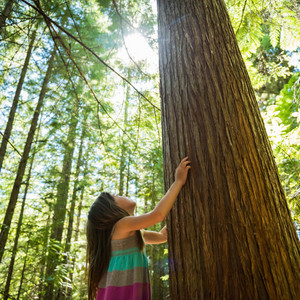
My daughter hugs every tree she sees when she's walking down the street.
And I want to know, Julius, do you feel a connection to trees?
I know you climb them, but have you ever hugged one, or how does being around a tree make you feel?
I know that they give me oxygen.
They basically keep us alive.
So for that, I'm grateful.
So I suppose, you know, I'm happy they're around.
I find it like, I don't know, I just kind of feel like I've slow down a little bit when I'm near a tree.
Trees do have a certain magic.
They can't talk like we can.
Except subpoena and those other trees right?
Well most trees can't talk and I can't get around but they're definitely alive We wanted to know more about what they're up to.
So we called David George Haskell He's a biologist at Sewanee the University of the South and he wrote a book called the songs of trees welcome, David Thank you.
It's a delight to be with you.
Is it true that trees use underground signals to communicate each other?
Absolutely, this is one of the revolutions in biology of the last few decades is that we used to think trees were solitary individuals, each doing their own thing, deaf to the world.
And now we know that they're engaged in this intimate conversation, both below ground and above ground, with other trees but also with other organisms, with the insects and then the bacteria and fungi in the soil as well.
So they're very chatty organisms. they are indeed communicating.
But of course not using a language as a human language, but using their own tree method of communication, which is mostly through the medium of chemicals.
Cool. So, can a tree tell when another tree needs help, like when it's being attacked?
Indeed it can. Now, whether the other tree is able to provide any help or not really depends on the situation.
But, if insects, for example, attack one tree in a forest, The other trees around it will learn of that attack and will will defend themselves Before any insects hit them and and they know this through a couple at least a couple of different means One is through airborne chemicals little aromatic molecules that drift out to the injured trees leaves And waft away into the air and the leaves around that injured tree then Receive those chemicals they smell them through their leaves Because the leaves, of course, are open to the air.
That's how they function.
They draw in air through little breathing pores.
And with that air comes these little alarm chemicals.
The other method is below ground.
It seems that chemicals are moving from one tree to another via a pathway that involves the tree's roots that are connected to fungi below ground that are then connected to more tree roots so that there's a whole hidden network of chemical conversation happening under the ground as well as in the air.
Why do trees communicate?
Because if they've got all these self defence mechanisms, what is the need of actually saying if so if some insects are attacking you like, why aren't they solitary figures?
So in this way, they're analogous to human communication.
Why do we talk to one another?
Partly, it's to learn things that are going to be helpful to us.
And through Through experiments monitoring the communication of trees and what they gain, people have found that trees, and not just trees, other plants as well, that are communicating one to another can protect themselves from drought.
They can deter herbivores more effectively.
They can get more carbon and nitrogen into their bodies.
They can receive advance warning of what's happening in the forest. Um, so do you think that some day people will be can learn to understand tree communication?
Like is there simple thing we could do to understand it?
I think people have been doing this for thousands of years trees Center and many of our important stories about meaning think about the Tree of the knowledge of good and evil or the tree under which the Buddha was enlightened we understand in our culture that trees are symbols of of meaning and understanding and wisdom, so we've been listening to them through culture and literature and poetry for many centuries.
Now science is catching up and teaching us new things about how trees can connect one to another.
I would recommend, and this has been my own practice as a biologist and as a writer, the best way to hear the stories of the trees and to connect into this communication is to pick a particular individual tree and return to it again and again, with all of your senses open.
What am I hearing here?
What am I feeling through my sensitive fingertips on the tree's trunk?
What can I smell here?
How is the water moving through this environment?
Returning to that tree again and again, befriending the tree, and the tree of course uses very different language than we humans, but it still has its own language, its own ancient interesting stories that we can connect to by opening all of our senses to its marvels.
Thanks for talking with us today, David.
Thank you, it's been a great pleasure.
TREE 'S UP! Trees start as seeds filled with starch. That starch feeds the tree until it can make a root and a sprout.
The root pushes down into the soil to find nutrients and water.
And the sprout climbs up above ground where it will eventually form leaves.
The leaves use photosynthesis to create energy from sunlight and air, which helps the tree grow even more.
Over time, the tree's bark will darken and harden and the tree will keep growing wider.
Trees grow blossoms and then fruit as a way to get animals to plant their seeds in new places.
And trees can communicate with each other by sending chemical messages through the air and underground.
That's it for this episode of Brain's On.
Brainzone is produced by Mark Sanchez, Sandan Totten and Molly Bloom.
Our Majestic Fellow is Mainika Wilhelm and we had production help from Bridget Asamoah and Christina Lopez, engineering help from Veronica Rodriguez, Ma 'Rade Campbell and Evan Perkins.
And special thanks to Sabina Cap, Diane Pater, Marley Feuerweker -Otto, Josh Holt, Vicki Krekler and Sam Chu.
Brainzone is a non -profit public radio podcast. Your support helps us keep making the show.
You can support Brains On and see our cool thank you gifts at BrainsOn .org slash donate.
Now it's time for the Brains Honor Roll.
Harriet from San Antonio, Texas, Emmy from Lincoln, England, Addy from Canada, Allison from Goshen, New York, Alec from Portland, Oregon, Ayla and Everly from Mars, Pennsylvania, Rowan and Dara from Bournemouth United Kingdom, Ashna from Melbourne, Australia, Ezra from Liverpool United Kingdom, Pia from Wamingie, Quebec, Jake from San Jose, California, Nora and Leo from Bronx, New York.
Josephine from Tallahassee, Florida.
Lina from Virginia.
Nyla from Tsawwassen, British Columbia.
Amato from Laredo, Texas.
Hart from Ridgeway, South Carolina.
Maca and Jack from Los Angeles.
Lydia from Bethlehem, Pennsylvania.
Elizabeth from Gainesville, Virginia.
Hugo from Minneapolis.
Arya from Provo, Utah.
Evelyn from Canton, Massachusetts.
Kassen from Boylan Springs, South Carolina.
Anders from Cambridge, Massachusetts.
Nya from Perth, Australia.
Danny from Cleveland.
Isla from Brooklyn, New York.
Sadie from Atlanta.
Sebastian from Los Angeles.
Caroline from Bloomington, Indiana.
Jasmine from Leo Minster, Massachusetts.
Ian from Maplewood, Minnesota.
Leo from New York City.
Corbin from Cumming, Georgia.
Jude from Panhandle, Florida.
Kayden from Toronto.
Beatrix from San Francisco.
Poppy from Los Angeles.
Kasper from Castello, Bronco, Portugal.
Bennett from San Marcos, Texas.
Yu Chiao from Shanghai.
Jack from Northborough, Massachusetts.
Gigi from Burlington, Vermont.
Anna from Conroe, Texas.
Georgia from Erie, Colorado.
Florence and Alder from Greenfield, Massachusetts.
Marco from Ferrara, Italy.
Ella Lauren from Los Angeles, Maya N .J.
from Lake Oswego, Oregon, Cameron from Claremont, Florida, Marius from Baltimore, Jackson from Parker, Colorado, Aishvi from San Diego, Nora and Deacon from Lucknow, India, Emma from Basel, Switzerland, Dorothy from North Kingstown, Rhode Island, Dominic from O 'Fallon, Missouri, Aidan from Fountain Hills, Arizona and Archer from Vicksburg, Michigan.
We'll be back soon with more answers to your questions.
Thanks for listening.