Hey, big news.
Planet Money is going on tour to promote our first ever book.
It comes out in April and we'll be celebrating in about a dozen cities.
There's a limited edition tote bag that is included with your ticket while supplies last.
Details, dates, and how to get your ticket at planetmoneybook.com.
The link is in the show notes.
This is Planet Money from NPR.
Wysina Williams still remembers the day she went to go watch a public housing tower near where she lived in North Philadelphia get knocked down.
I assumed that it was going to fall over.
So I don't know how, like, you heard dynamites like six times go off.
Then it was like, boom, boom, boom, boom, boom, boom, boom.
The tower was part of a development called Cambridge Plaza.
Wysina and some friends had walked over to see just what happened when you blew up a 14-story building.
We was like, oh, it's going to come down on us and all this other stuff.
No, actually it came down, but it came.
That's probably so much.
That's why they say so much smoke comes up, because it just like smashed itself down.
That demolition was part of this massive federal program started in the early 1990s called HOPE VI.
Congress wanted to do something to deal with all of these incredibly run-down public housing projects around the country.
HOPE VI provided money to demolish hundreds of those projects and, in a lot of cases, to replace them with newer and better buildings.
Wysina, she herself lived in public housing.
She grew up in a low-rise development nearby called the Richard Allen Homes.
What were the Richard Allen Homes like?
Depressing.
Like, we went to school and came home.
Because it wasn't safe to be out on the street.
So, let me use you.
And you had to come to Richard Allen.
You would have rolled past like, I'm not coming in there.
Or you was greeted, probably a gun to your car.
They probably would have thought you was coming to get drugs.
So it was petrifying, really.
And how well maintained were the buildings?
So we had lead.
The paint was chipping.
The RV color was brown.
The floor was brown.
The wall was brown.
You know, it wasn't, it just wasn't bright.
It wasn't happy.
So Wysina was thrilled when she and her mom and her son and her sister were allowed to move into a brand new home in Richard Allen, funded by Hope Six.
It was a relief.
It was peace.
Our windows open.
We have fresh air.
We control our heat.
I had my own space.
I loved it.
From 1993 to 2010, 262 different public housing projects around the country were knocked down and replaced with Hope Six money.
So think like Cabrini Green in Chicago, the Desire Housing Projects in New Orleans and yeah, the Richard Allen Homes in Philadelphia.
Beat up.
Old projects were knocked down and, in a lot of cases, replaced with public housing that was newer and safer and more connected to the neighborhoods that surrounded them.
But there wasn't enough funding to redo all of public housing in the United States.
Some folks got to live in newer, better buildings.
Others, they were stuck with the older, worse buildings.
And in that way, Hope Six created a kind of nationwide experiment.
This experiment.
It had the potential to change how we help people in public housing, but also how we help people in all these other kinds of low-income neighborhoods.
Our country is really segregated economically.
Hope Six tried to reverse that.
It tried to transform neighborhoods with really concentrated poverty into neighborhoods with mixed incomes.
And if that approach worked to lift people out of poverty, maybe it could become a model for poor neighborhoods all over the country.
But no one really knew whether that HOPE VI experiment actually worked.
Until now.
Can you just read the name of your study?
The title?
Creating High Opportunity Neighborhoods.
Evidence from the HOPE VI program.
Did you get a lot of evidence?
We did.
The evidence gatherer here, Harvard economist Raj Chetty.
Should people keep listening to this podcast to hear all the evidence?
Absolutely, they should.
I think the evidence is very compelling.
Thank you.
Wow, you really sold it.
That's like the worst trailer ever.
You should do it with a deeper voice.
Remember those 90s movies where it was that one guy who did all of them?
The evidence is compelling.
Hello and welcome to Planet Money.
I'm Keith Romer.
And I'm Greg Rosalski.
And all jokes and bad impressions aside, that evidence, it is actually really compelling.
Raj and his team got access to all this data for more than a million families in public housing across three decades.
And they are releasing their analysis of that data in a working paper today.
This podcast, it's hot off the presses.
This is big for us.
Today on the show what they found one of the clearest answers ever to this absolutely crucial question.
Can we help people rise out of poverty by improving the neighborhood where they live?
Regular listeners of Planet Money may recognize the name of our economist, Raj Chetty.
He's been on the show before.
Greg, you are something of a Raj Chetty super fan.
Yeah, I guess, Keith, some people have Tom Brady.
I have Raj Chetty.
Greg, I'm just going to play the tape of you greeting Raj when he came into the Zoom with us.
Well, if it is not the Beyonce of economics.
Hey there, Greg.
How are you?
So Raj is kind of an icon.
He leads this research group at Harvard called Opportunity Insights.
They do world-class research on really important problems.
You know they try to figure out what actually works to fight poverty, reduce inequality and make the American dream like a reality for low-income people.
And there is one big factor that shows up again and again and again in their work.
We found, through a series of prior papers, that the neighborhood in which you grow up, the block in which you live, the school you attend really matters for your life outcomes.
Probably their most famous research looked at what happens when low-income kids move to more affluent neighborhoods.
And we found that if you move at a younger age, especially to an opportunity-rich area, you end up doing dramatically better later in life.
If you have more high-income connections as you're growing up people who are in more successful careers, who have better jobs, etc.
You yourself are more likely to rise out of poverty.
Those younger kids who moved to better-off neighborhoods ended up being more likely to go to college and to earn more as adults, which obviously was a very promising result.
But Raj says it was a little hard to use what they learned as a model for generating upward mobility everywhere.
I think that you know, approach of desegregation and moving to opportunity has a lot of value but it's not scalable.
You can't move everyone to a different neighborhood.
All right, moving kids works, but it isn't scalable.
So what if you flip that idea on its head?
What if, instead of moving low-income kids to better off neighborhoods, you can move better off neighborhoods to those kids?
You know, maybe there's a way to transform poor neighborhoods themselves into places that help kids escape poverty.
And that's a question that led to this study, where we essentially analyzed the largest effort ever in the US to revitalize high poverty neighborhoods, which is the HOPE VI Neighborhood Revitalization Program.
Cope 6, that program we were talking about with Wysina before.
The idea behind the policy was not to just replace rundown old housing projects with newer housing projects.
It was to change the way public housing interacted with the cities that surrounded them, specifically to desegregate neighborhoods economically.
Yeah, the old housing projects had really separated low-income people from the rest of their community.
Those places were essentially islands that were cut off from the surrounding neighborhoods.
There was very little interaction between people living in those housing projects and the people nearby.
In the new HOPE VI projects, there was, by design, a mix of different kinds of housing.
Some public housing, some housing for people who made too much to qualify for public housing and some full-on market rate housing.
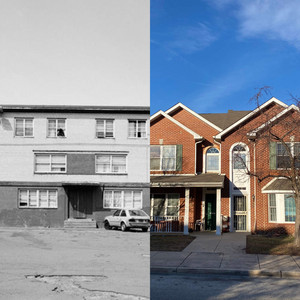
And you could see the change in the neighborhoods in this really physical way.
Wysina, the woman from the Richard Allen Homes in Philadelphia, she still lives there today.
She's actually the tenant council president.
And when I was down in Philly, she offered to take me on a tour.
We're going to get that out of the way because it's cold.
So I'm going to grab my coat, let them know what I'm about to do, and then we out.
Some of the buildings in the Richard Allen Homes were built during Hope Six.
Some of them were old ones that never got knocked down.
This part what we call the new, and then, when we get on Tiffin Brown, that's where the old is still at.
First, she took me to see one of the old buildings.
On both sides of the street were these three-story tall brick apartment buildings.
Wysina told me that back in the day, none of those buildings had doors onto the street.
Like it was just one long brick wall with a few windows for the length of the whole block.
You didn't have a door.
Your door was in the inside.
So it was kind of, it was like closed off to the street.
Yes.
Yes.
The old buildings, they were really isolated from the outside world.
To get inside you had to enter in through this courtyard that basically only someone from Richard Allen would even go into.
Like, I call it the pit.
Like, you were just in the middle of the pit.
It was almost like the old version of the Richard Allen homes was designed to keep people from the projects from interacting with anyone who wasn't also from the projects.
From there, Wysina walked me over a couple blocks to the new buildings that came in with Hope Six.
Two-story brick houses facing onto the street, each with their own front yard.
I mean, these houses have like a lot of space between them, right?
Like it's almost like we're in the suburbs a little bit.
Right.
I think they wanted to make it more like a family so the kids can come outside and play and do stuff that they wanted to do.
They made it like homes, like, you know, a neighborhood again.
Instead of being disconnected on its own island, the public housing in the new Richard Allen homes is open to the surrounding neighborhood.
It's connected to it.
And on blocks where there used to be just public housing for low-income people.
Now there's housing for people with different incomes.
It literally transformed the neighborhood economically.
So the question for Raj and his team was did HOPE 6 actually help to reduce poverty and improve upward mobility?
And to answer those questions, they got their hands on these massive data sets.
We studied more than a million families, followed them over decades and looked at how their own outcomes, their kids' outcomes, changed over time.
Adults did not benefit that much from HOPE. living in an area that was revitalized.
However, very importantly, kids benefited substantially.
Raj and his colleagues looked at the kids who grew up in the revitalized Hope Six developments and saw what they were earning as adults at age 30.
So if you grew up in the exact same place after it was revitalized through this program, in a mixed-income neighborhood with additional services, basically a better environment in many different ways, you ended up earning about 50 more if you grew up from birth in one of these places 50 more than if you had grown up in the exact same place pre-revitalization.
So that's an enormous change in kids' outcomes.
To be clear, that number is kind of an extrapolation.
So different kids lived in Hope Six developments for different amounts of time.
Some were there for only like a year, some for their entire childhoods.
And according to the team's calculations, the average kid who spent their whole childhood in a Hope Six development they would see a roughly 50 boost to their income.
Hope Six kids also went to college more often.
Incarceration rates for the boys who grew up there went down.
And those are pretty jaw-dropping findings.
But it was possible that they didn't have anything to do with making neighborhoods more mixed income or connecting public housing with the rest of their communities.
In other words, HOPE VI might not have been what caused these good results at all.
I saw some evidence suggesting I think including in your paper that the HOPE VI projects were much more selective in who was allowed into them.
What would you say to that concern, that these kids are just systematically different?
There's really kind of two main explanations for why we're seeing kind of gains for the children who grow up in the revitalized sites.
This is Matt Steger, one of the economists on Raj's team.
He says the first explanation was that, yes, Hope 6 was causing the good results.
A second explanation, which is the one you're hinting at here, is one of selection, in which the types of families that move into these revitalized public housing units may be different in ways that their kids would have done better in the long run, regardless of where they lived.
And to a lot of housing advocates we talked to for this story, this second explanation seemed really plausible.
In a lot of places, there was this whole screening process to get into the new HOPE VI developments.
Some people who had lived in the old housing projects simply weren't allowed to move into the new buildings.
And for Raj and Matt and the other researchers this presented a real problem because it wasn't random who moved into the new Hope 6 housing.
Economists call this selection bias.
It was possible that the reason kids in Hope 6 were doing better as adults was, like Matt said, just that they were always going to do better, no matter where they lived.
To get around this problem, the team went back to an idea from earlier studies, an idea about how neighborhoods shape the way kids' lives turn out.
The way that neighborhoods influence people operates through an exposure or dosage model.
In other words, what the literature on neighborhoods has shown us is that the influence that a neighborhood has on you is proportional to the amount of time that you spend growing up in that neighborhood.
The team had data on how long people lived in Hope Six developments as kids.
And it turned out, you saw a way bigger impact on the kids who were there for a long time versus just a year or two.
You could see that dosage idea in the data.
Each additional year that a child spends in one of these Hope Six revitalized projects increases their earning by almost 3.
So yeah, it looked like Hope Six caused better outcomes, but it could still be the case that families who stayed a long time in Hope Six were just different from the families who stayed a short while.
Yeah, maybe those families who left super quickly were somehow less stable.
And that was why their kids saw less benefit than the kids and families who stayed put.
And this is where they made this move in the research that is honestly just so clever.
I'm going to give it like official planet money tip of the hat.
Whoo, Planet Money tip of the hat.
That's a huge award, Keith.
So what they did is they went ahead and compared the dosage effect within families by looking at siblings who both lived in Hope Six housing, but for different amounts of time.
Consider a family that has an eight-year-old and an 18-year-old and they move into one of these revitalized public housing projects.
The younger sibling should earn more later in life compared to their older sibling, who only spends a year in the public housing project.
That's exactly what we find in the data.
Okay.
So yes, they were now pretty confident that what they were seeing in the data was real, that there was something about growing up in the new Hope Six public housing that made a big difference.
But to be able to use their findings to shape policy going forward, they really needed to sort of hone in on what was actually causing this improvement in outcomes.
Because if it was about just improving the physical housing itself...
You'd want to put all your money into that.
Or if it was about the whole mixing incomes idea, you know, just do that.
Or maybe it was about some third thing that they weren't even thinking of.
Basically, it wasn't clear what part of Hope Six exactly was causing the big difference in outcomes.
At some point Matt started explaining this puzzle to Carol Naughton, a woman he knew who ran a big housing nonprofit.
I remember talking to her and saying look, we find these big gains, but We want to go beyond just understanding that the program work and say something about why it works, so that we could potentially kind of scale up this type of intervention.
Carol's from Atlanta and she told Matt that she had noticed that not all hopesic sites in Atlanta were the same, that some of them did much better than others.
And in her experience it was the sites that were located near more economic opportunity, near more affluent areas, where there were some economic resources to tap into.
That that's where she thought that the program was most successful.
And Matt was like huh, what if we went back over our data and grouped Hope 6 developments according to how well off the neighborhoods around them were?
And so you know, out of that discussion, we took that you know back to the data and looked in the data and that's exactly what we found and turned out to be kind of a key turning point in our ability to figure out like what was actually going on in terms of driving the mechanisms.
So just to underline a little bit what Matt is saying here not all Hope 6 developments were created equal.
As far as this whole income mixing idea went,
If a Hope 6 development was near richer neighborhoods, the kids in public housing there tended to do really well.
If surrounding neighborhoods were poor though, the kids in Hope 6 development saw no gains.
It's only in cases where the kids who live nearby had better outcomes were from more affluent families do we really see meaningful gains of the program.
This strongly suggests that HOPE VI caused better outcomes, not because it improved the housing or got rid of lead paint or whatever.
It suggests that these new neighborhoods fostered more social integration between kids from different backgrounds.
When that crucial ingredient was missing, the HOPE VI kids did not see better outcomes.
And they were even able to show that the Hope Six kids really were interacting more with the more well-off kids.
They were more connected to each other on Facebook and more likely to live together as adults.
And that is what appeared to be central in driving the long-run gains in their outcomes.
So it's not the architecture.
It's like who you're interacting with.
Yeah, not the architecture per se that generated these gains.
Now, this is all pretty astounding.
Low-income kids do way better when they interact with or are friends with higher-income kids.
This is a crucial finding in their paper.
And it left us wondering, like, why?
So we asked Raj, why would these social interactions matter?
So that's actually something I want to drill down on.
And I realize this is in some ways beyond the scope of the paper, but it feels like a really present question, which is what are the possible stories for why that's occurring?
Yeah.
So three different mechanisms through which we think connections matter for kids' outcomes.
They don't have clear data on this, but Raj has some theories.
Theory number one is about how people get jobs.
If you're connected to somebody who's got a good job at a high-paying firm, you're more likely to get that job.
And so cross-class interaction just directly affects the internships you get, the career you might end up pursuing.
Theory number two is about information.
Information that you might get by, like you know, hanging out with your higher income friends or their families.
You get information from people who are exposed to different things.
If you live near somebody whose parents went to a college, you might be more likely to think about applying to that college.
You've at least heard of it.
Raj's last theory is the one he personally finds the most compelling, and it's about what kids think is even possible for themselves.
I think people's aspirations and what they try to achieve themselves are greatly shaped by who they're around, especially as they grow up.
I can say that from my own personal experience.
I grew up in a family of academics. certainly greatly influenced by that in my own career choices.
And I think you know.
Conversely, kids who have never had exposure to science, never had exposure to people pursuing higher education, pursuing business and so on, may just not see themselves.
They may not even know where to start in terms of pursuing those opportunities.
And so I think that's a really central reason that these kinds of interactions likely matter.
Now, there's a part of me that reads a study like this and is like, this is great.
We did it.
We have an answer now for how to reduce poverty, how to like cause upward mobility.
We're done.
But then it never seems to work out quite that cleanly in the real world.
So next we're going to talk about how we're actually doing as a country at putting the ideas from this study into practice.
And we're going to go back to Wysina, who raised her own son in a Hope Six development, to see what she thinks about the study.
All of that after the break.
OK, so there are a few things you need to understand about Hope Six, this program that really changed outcomes for kids who grew up in public housing.
The first is that it doesn't exist anymore.
Funding for the Hope Six program ended 14 years ago, in part because of some legitimate criticisms of how HOPE VI was implemented.
The biggest criticism was that it knocked down a ton of public housing that it didn't replace.
Almost 100000 units were demolished, but only 55000 public housing units were built back in their place.
Tens of thousands of families were functionally kicked out of public housing by HOPE VI.
Raj and Matt made it very clear that it would actually be a mistake to read their research as a recommendation to just resurrect Hope Six.
Our analysis definitely does not kind of endorse Hope Six as a program.
I think concerns around displacement should be taken very seriously.
And so if one was trying to understand whether HOPE VI is a good or a bad policy, you'd really want to think seriously about how to weigh the benefits that we're estimating in our paper against the kind of displacement of costs which we have not tried to quantify in any real way.
So yeah, Hope Six had some big issues, but it also integrated low-income kids with high-income kids and that had a really positive impact on their future outcomes.
Raj and Matt think that finding, it matters for a lot more than just public housing.
The country as a whole, it seems to be growing more and more economically segregated.
About half of low-income neighborhoods are just as socially isolated as Hope.
Six projects were prior to revitalization.
As part of their research, they built an interactive map that lets you zoom in on 1500 different neighborhoods around the country.
That could benefit from something like Hope 6.
These neighborhoods with concentrated poverty that could be better connected to more affluent neighborhoods nearby.
Ross says there are still federal programs that try to revitalize low-income neighborhoods, but they're underfunded and not designed as well as they could be.
I think we could be doing more in terms of housing policy to create opportunities.
I think we could be both spending money that we're already spending, which is 70 billion a year on various affordable housing programs, more effectively.
And we could potentially expand certain programs and design them better to improve outcomes.
And he says we could help low-income kids connect to higher-income kids in all these other ways too, through schools and sports and even the way we design mass transit.
The policy choices don't only have to be about housing.
But they have that same effect of creating that interaction.
That really seems to be the key mechanism through which Hope Six had an effect.
So...
How does all this look to someone who actually lived through it?
I asked Wysina, the woman who showed me around the Richard Allen Homes, what she made of this study.
Because she has this really interesting perspective on the changes that came with Hope Six.
She moved into a new Hope Six building when she was 19.
Her childhood happened in the old version of Richard Allen Homes.
She says almost all her friends growing up were from there.
But her son, he grew up in the new version.
Do you feel like your childhood was different from his childhood?
Yes.
How?
Educational-wise, living-wise, just growing up.
Huicina says her son always did what he was told.
He was kind of a rule follower.
He was really into Legos and electronics as a kid.
My son is a weirdo, and I love it.
When I say not street smart at all, but he loves taking that leap.
And she says he met kids from all over, including kids who lived outside of public housing.
And yeah, some of them had parents who were better off financially.
Do you think that that had any impact on his life?
Yes, I really do.
Wysina's son graduated from high school about a decade ago.
My son is 29.
18, he went to Penn State.
He was there for a year, then he moved on to a trade school.
All on his own.
I mean not saying me and his dad didn't help out financially, but him doing it himself, knowing what he wanted.
The idea that kids who grow up in better public housing in mixed-income neighborhoods that they would have a better chance of getting out of poverty.
Wysina buys it.
Well, yes, they will.
Because the atmosphere, the surroundings.
Because remember, you're coming from a mentality where you're caged in, where now you're not.
So yes, I do agree.
Yes.
They will make more.
They will succeed.
Yes.
Wysina's son turns 30 this year.
The age Raj's team looked at to see how Hope Six Kids' economic lives turned out.
Her son.
He's engaged, he's got a steady job driving a semi-truck and he's studying to get certified as an HVAC technician.
If you want to learn more about the study in this show.
Greg also wrote an amazing Planet Money newsletter about it that does an incredible deep dive on the research.
You can sign up for that at npr.org slash Planet Money newsletter.
Planet Money, we're also putting out a book and we're going on a book tour.
You can see us in person in April.
We're going coast to coast.
Details at planetmoneybook.com.
Today's episode was produced by Luis Gallo with help from Sam Yellow Horse Kessler.
It was edited by Jess Jang, fact-checked by Sierra Juarez, and engineered by Jimmy Keeley.
Alex Goldmark is our executive producer.
Special thanks to Larry Vail.
I'm Greg Rosalski.
And I'm Keith Romer.
This is NPR.
Thanks for listening.