This BBC podcast is supported by the UK.
Want to know how to become the richest person in the world?
Start with the latest episode of our podcast, Good Bad Billionaire.
We're telling the story of how Elon Musk amassed half a trillion dollars from his troubled childhood in South Africa to buying Twitter and launching rockets into space, with all the boardroom dramas along the way.
Find out how he did it on Good Bad Billionaire.
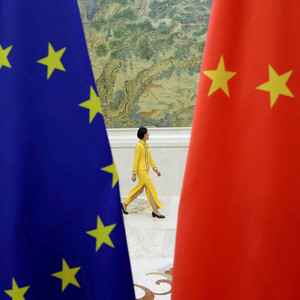
Listen wherever you get your BBC podcasts. trade between the EU and China under pressure.
Chinese companies have been disproportionately targeted.
They pass the burden on to the producers or the sellers in China, which are impossible to reach.
It's World Business Report from the BBC World Service.
This is Andrew Peach on the way.
Investigations into Chinese companies and tax on parcels.
We'll get the explanations and reaction.
Also today how YouTube is launching new subscriptions to watch live TV in the US and new computer vision technology, which means more of our household waste can be recycled.
The EU is looking at whether government subsidies give some firms an unfair advantage.
It's carried out raids at Temu's European headquarters in Dublin and is investigating the Chinese security tech firm Nuketech.
A Chinese business representative says the companies being targeted unfairly are all from China.
Lingling Lian is from the China Chamber of Commerce to the EU.
She told me a bit more about the impact that these investigations are having.
The FSR has had a very significant adverse impact on Chinese invested enterprises operating across Europe.
And according to a survey conducted by the CCCU this year with 205 Chinese enterprises and organizations, they report that 63 of the surveyed enterprises reported that their business operations have been disrupted due to FSR enforcement actions.
And these disruptions include loss of commercial opportunities, direct operational interferes and heightened compliance risk.
And furthermore, the China's Ministry of Commerce had estimated that the FSR enforcement has resulted in direct and indirect losses amounting to approximately 21 billion euros for Chinese enterprises.
And this data was concluded at the beginning of this year.
And we believe that the amount, the loss of the financial loss to now will be much bigger.
So 21 billion euros is a large amount of money anyway, and you think it's going to be bigger than that.
Some people listening to this will think this is only a body trying to enforce regulations.
So if businesses have nothing to hide, they have nothing to fear from it.
It's not exactly the case.
As I said, the loss that this associated.
For instance, our companies were forced to withdraw from the public procurement because of the investigation, even before the result was unveiled.
Because, first of all, the FSR procedures are so lengthy that they're usually longer than the ending date, the period of, for instance, the public procurement.
And one thing I want to emphasise that is about associated impact is indirect impact.
This will have really a huge impact on this potential commercial opportunities.
Is it true that the Chinese government does subsidise some commercial activity by Chinese companies which, of course, this is what's being checked for?
First of all, the subsidies by nature are not unlawful and they could be legitimate.
And the thing is that every country subsidizes its industries due to different priorities.
The EU subsidizes its agriculture sector by a really large margin.
And the thing is that we have, first of all, we have to make sure that, if there are subsidies in place secondly, are those subsidies really distorting the internal markets?
The thing is that the announcement from the commission usually just comes very vaguely, even at the first phrase.
We are not yet there to conclude whether the subsidies are distorted.
But the point is that all those things create this misperception of that there were unlawful subsidies available.
I mean, I hear what you say that they're hastily to deal with.
But all the EU says they're doing is checking on the scope of the subsidies, on the nature of them, checking they're reasonable, they're lawful, all of those things which you say they are.
But that's what they're making sure of.
And you admit the subsidies are there.
They do exist.
The thing is that the FSR is a little bit different of the subsidies.
It's called foreign financial contribution.
It covers much wider scope and actually the definition is actually wider and quite vague about what is a subsidy.
So this is the point of view.
And then we will take into account more elements than the traditional subsidies.
And that's the tricky part of this law, because it tracks a lot of, let's say, elements larger than subsidies.
And it also tracks back not only the subsidies received by the Chinese-invested companies in the EU, but it will track those subsidies back their parent companies in China.
Are you saying that Chinese firms are being singled out and that they're being investigated and looked into more than companies from anywhere else?
This is actually quite clear that FSR.
In this enforcement we found that Chinese companies have been disproportionately targeted.
We have, for instance, majority of the cases are all about Chinese companies.
And even in the same public procurement cases, only Chinese bidders were subject to scrutiny, but the other foreign bidders they were not.
That was Lingming Mian from the China Chamber of Commerce to the EU.
Now the EU Commissioner responsible told World Business Report, the Commission has carried out an unannounced inspection at the premises of a company active in the e-commerce sector in the EU under the Foreign Subsidies Regulation, which is there to enable the Commission to address distortions caused by foreign subsidies, allowing the EU to ensure a level playing field for all companies operating in the single market.
Now, also today, EU finance ministers have agreed to impose a three euro tax on small parcels.
It starts in July.
The aim is to tackle floods of cheap imports from e-commerce platforms like Temu and Sheen.
Most of these imports are from China.
So who's going to be paying the tax, the three euros per parcel?
Well, not the companies, according to Lingling Lian.
At the end of the day, it would be the consumers.
Actually, you know, take the cost unfortunately, because for those low-valued parcels, if you consider all the costs of transport and the costs and so on, and so on, I think unfortunately, most of the impact would be taken by the consumers' end.
Augustin Reyna is Director General of the biggest European consumer organisation, the BEUC.
So does he agree that European consumers will end up paying more when they buy online?
The idea is that this fee will have to be paid by the importer only. or the platforms themselves.
So today, it's not clear that the consumer will have to pay for it, because one can also assume that the platforms will decide to absorb this additional fee that's going to be charged to them.
Why would they absorb it rather than just passing it on to their customers?
Because of course, no one can dictate to them what price they charge.
Yeah, that's correct.
At the same time, one also needs to look at the business models of these platforms, in particular the Chinese platforms, which is to try to sell at the lowest possible price.
And what the EU is trying to do with this fee is basically to reduce the volume of parcels that are entering every day into the EU.
We are talking about 10 million parcels entering every single day.
And from a consumer perspective, beyond the price, there is also the question of product safety.
Because most of these products that are entering are not complying with European standards.
And that poses a risk to consumers, but also to retailers and SMEs in Europe that are trying to play by the rules.
So by selling at the lowest possible price and by adding this additional fee, then the platforms might lose some competitiveness towards European retailers.
Is it about standards?
Or is it just about giving EU retailers preferential treatment better access to the market?
It is about standards.
The reason for this is that we have been carrying out tests of products that are found on online marketplaces.
And we have identified that the products that come from China have a very high level of noncompliance.
So we are talking about toys that actually can harm kids because they have small pieces that can fall apart and then actually suffocate the kid, or textiles and clothing that contains chemicals like PFAS that are not authorized in Europe, while the same products or equivalent products will not have these chemicals when bought in a brick and mortar shop.
So we really see a big difference between the standards.
I'm just trying to work through the logic of this, though.
If you're saying the platforms are so big, they'll just absorb the three euros.
How will it prevent any of that?
That's why the fees are not the silver bullet.
This needs to come also with a reform of the market surveillance rules.
Basically making sure that these platforms are considered as economic operators or importers, so they can share the responsibility.
Right now, these platforms are actually off the hook because they pass the burden on to the producers or the sellers in China, which are impossible to reach.
So while the fees might have an effect on the platforms, the real deal will be with the reform of market surveillance.
So actually the platforms can be held accountable if they facilitate the entrance of non-compliance products into the EU.
Would you be perfectly happy...
If the items, the products being imported from China and elsewhere were of a higher standard?
Or is what you really want people to buy from retailers in the EU?
From our perspective, no matter where the products come from, they need to be compliant.
So it's not about having a protectionist approach.
It's about making sure that it's a level playing field for everyone.
But the reality is that compliance costs money.
Ensuring that your products obey the safety rules or that it does not contain illegal chemicals.
That costs money at the end of the day.
And clearly the business models of these charging platforms is to ensure that they can sell at the lowest possible price.
So, at the end of the day, whether they will be fully compliant with the European rules depends remains an open question.
And in that regard, I'm not necessarily optimistic that they will fully play by our rules.
But if they do so, well, the consumers will have more choices.
But right now, there is no choice between unsafe and a safe product.
That should not be for negotiation.
And consumers should not have to bear the responsibility when they base something online that it could harm them or their families.
That's Augustine Rayner from the BEUC.
We'll keep watching the simmering trade tensions between China and the EU on World...
Want to know how to become the richest person in the world?
Start with the latest episode of our podcast, Good Bad Billionaire.
We're telling the story of how Elon Musk amassed half a trillion dollars from his troubled childhood in South Africa to buying Twitter and launching rockets into space, with all the boardroom dramas along the way.
Find out how he did it on Good Bad Billionaire.
Listen wherever you get your BBC podcasts.
Business Report.
This is Andrew Peach on the BBC World Service.
And Chris Lowe is chief economist at FHN Financial in New York, live with us now.
Let's look ahead to next week Chris, first of all because we're going to get a whole glut of US data next week.
Yeah, that's right, Andrew.
It's exciting for us economists.
You know, it's been a dearth of data because of the government shutdown.
The shutdown itself lasted a month and a half, but the data backlog now is pushing two months.
Next week, on Tuesday, we will see two months of employment data, as well as the October retail sales report.
That's the first look at consumer spending in the fourth quarter.
And then we also get the consumer price index, the inflation report on Thursday.
So it's a ton of stuff to digest.
And I think, just to put it into perspective, looking back over the course of the year, We have Fed meetings here roughly every six weeks and the story has changed between every one because of the flood of data coming in.
But the last two Fed meetings in October and then the one we just had this week in December, the stance of Fed participants did not change.
And that's partly because, frankly, we've learned nothing new about the economy.
Right.
It's obviously a vital time of year for consumer spending in this run-up to the holidays.
Are we going to get any sense of how that's going from what comes out next week, or do we have to wait even longer?
Well, this is the beginning of it, right?
And in October it's fairly likely retail spending slowed down, because we do know, for example, we sold quite a few less cars and trucks in the US in October than we did in the third quarter.
But we also have some anecdotal evidence.
MasterCard, for example, tracks spending holiday weekend.
The Thanksgiving weekend is a huge retail time for us.
And spending was It was running 4.1% over last year.
Now 41 sounds pretty big, but bear in mind the year-on-year growth of retail sales before Thanksgiving weekend.
Well, it was running at 5% or 6%.
So, in fact, it does – suggest a slowdown.
And the Fed itself is banking on weaker consumer spending in the fourth quarter, partly because so much money was cut off during that government shutdown.
Let's talk about a recurring theme on this programme, and that's the valuation possible overvaluation of these huge AI tech firms.
Where's that discussion got to?
Well, it's beginning to get a little more nervous than it was.
Investors have been extraordinarily confident in this story.
The magnificent seven, the big seven stocks in the SP, which are dominated by AI, have led the market all year.
But, you know, a couple of stories this week are starting to cast a shadow over the sector.
One is the OpenAI story and the possibility that the huge investments they have made not yet paying off and perhaps a cash flow squeeze there soon.
They're looking for more money in the markets.
And then the other big story related to that is Oracle.
Oracle has had a very successful business model supporting computer-related services at companies.
They've made a huge AI investment, and that too is not paying off yet.
Investors are getting impatient and Oracle stocks sharply lower this week.
Tying it all up, this morning the Wall Street Journal saying that as much as 7 trillion has to be invested to bring AI up to what has been promised this year, and so far We're about 35 trillion into that.
So another 35 trillion to go.
That's an enormous amount of money when you consider the U.S. economy as a whole is $30 trillion.
So we're talking about almost a quarter of the economy being invested in just this one sector.
And the reason we keep coming back to it is this sort of juggernaut effect it could have on the whole US economy and rippling into the global economy.
Thank you very much indeed, Chris.
Chris Lowe, the chief economist at FHN Financial in New York.
Now, most things in our household waste that could be recycled... still aren't recycled.
The exact amount varies from country to country.
In the US, for example, it's about 20 according to the Recycling Partnership, which is an advocacy group.
That rate is so low for lots of reasons, but one of them is that it costs more to sort and process the recyclable materials than the market will then pay for them.
Amy Scott, from our US partners Marketplace, has been checking out the new technology that uses computer vision to more quickly and cheaply extract value from what we throw away.
In a hangar-like building in Louisville Colorado, outside Denver.
I'm standing in front of a giant conveyor belt, eight feet wide and above my head.
Standing on my tippy toes, I can see it's strewn with crumpled plastic bottles and cans and other scraps.
So that's our data, that's our fuel, but yes, that's garbage.
You know what they say about one man's trash.
Matanya Horowitz is founder and chief technology officer of AMP, a company that builds AI-powered recycling systems.
And this is the test lab.
It's going to be loud when he turns the system on, so Horowitz explains what I'm about to see.
First, this stream of garbage will pass under a pair of security cameras.
It's looking at the material, taking photos.
A computer trained on millions of images of trash will identify different types of recyclable plastic and then send a message to sort it accordingly.
What we do is we accelerate the material and then throw it off the end of a conveyor belt and it creates almost a garbage waterfall.
And so behind the waterfall we have a couple air jets, and the air jets just use a little puff of air to punch out the material.
That's the warning sound.
And then a few seconds later, the machine roars to life.
As the stream of waste pours down from one conveyor belt to another below the waterfall, some items get blown up into one of two compartments.
This is our double jet, so it's sorting two commodities at once.
So number one plastics are going on the bottom number two plastics which are milk jugs up top.
Kind of terrifying.
It's pretty strong.
It can move like phone books and things like that.
Scary to watch, but much safer and less tedious than sorting it by hand.
Sorting jobs at recycling plants are notoriously hard to fill.
Horowitz says this AI-driven system is also way faster.
If you or me were to do this sorting ourselves, we would do about 40 pics a minute.
And honestly, after an hour or two, we'll get pretty tired.
We probably won't be able to sustain that.
These jet devices, they'll do thousands of pics a minute.
And that means higher recovery rates at a lower cost.
For this demo.
AMP's system was just sorting plastic from material sent for testing from its facility in Cleveland.
But the technology can identify and divert pretty much anything from the waste stream.
AMP has also developed a process to convert organic material that would otherwise rot in the landfill and produce methane into something called biochar.
Think food scraps and greasy pizza boxes.
We put it through a process called pyrolysis.
It's basically the process they use to make charcoal.
The biochar can be used to make concrete or added to soil in agriculture.
And so this serves as a form of carbon sequestration.
AMP recently announced a new 20-year contract in southeastern Virginia to process solid waste for eight communities, with a guarantee to divert 50 percent of waste from the landfill.
30 percent in the form of organics and 20 percent in the form of recyclables.
That's Dennis Bagley, executive director of the Southeastern Public Service Authority in Chesapeake, Virginia.
He says the region's landfill was on track to fill up by 2060, with no available options for a new site.
This will extend its life by another 35 years and eliminate the need for separate curbside recycling.
I have a philosophy that Americans are inherently lazy and they don't recycle because it takes effort.
What this does is takes that element out.
So everybody becomes a recycler, whether you want to or not.
Whether there's a market for all that recycled material is another challenge.
So-called extended producer responsibility laws that several states have passed could help by shifting the cost of dealing with packaging after it's used to producers and requiring minimum levels of recycled content.
Colorado's program will help pay for a new recycling facility near Denver, opening next year using AMP's AI technology.
That was Amy Scott reporting from Louisville, Colorado.
YouTube TV is expanding the options it offers subscribers with more choice and flexibility, it says.
Ten different packages of channels, including one for sports, which will no doubt be really popular.
Will it mean lower prices?
Does it mean that YouTube is becoming the natural choice to access all live TV, as well as video content?
Maria Ruga Aguete is the research director at Omida, which is a tech research and advisory group.
I asked Maria where YouTube TV sits right now in the US TV landscape.
At the moment and worldwide, YouTube wants to be seen as the platform for creators, for YouTubers influencers, for the creative economy.
But in the US, they're an aggregator of channels.
So they have news, they have sports, they have reality, they have more than 100 channels competing with paid TV operators like Comcast, like Charter, at Omnia.
We just did a study which shows that in 2027, YouTube TV will be the number one paid TV operator in the US.
So while other paid TV operators are declining, consumers in the US are cutting the cord.
They're moving towards YouTube.
And this might hasten that because at the moment, YouTube in the US is offering 100 channels.
But what they're going to do is parcel them up into different bundles, which would presumably be a cheaper subscription than having all of them.
Yes, so you can select different options.
There is a YouTube-based plan that I think is 7299 a month, but then you can have YouTube TV with the NFL Sunday ticket.
They are announcing they're going to launch more sports packages.
So, yes, they're planning to grow more and more.
At the moment, this service is only available in the US, but nothing stops them to launch it in other countries, going forward.
And I guess it's going to make life harder for their competitors, for the other companies providing pay TV in the US and then potentially in the future, elsewhere.
For sure.
So in the US already, it's making life difficult to charter, to Comcast, to DirecTV.
All these three companies that they used to be leaders in pay TV in the US.
Now they're declining.
They're losing subscribers, while YouTube is winning subscribers year on year.
So I think they're going to end up the year with more than 9 million subscribers, 10 million in 2027.
But this is as a pay TV platform worldwide.
How many people are watching YouTube as a platform for creators?
Almost 3 billion subscribers.
So we're at the end of a week where there's been a lot of talk about Warner Brothers and Netflix and these other huge media companies.
But YouTube dwarfs them all, doesn't it?
YouTube is bigger than any of these players.
Exactly.
So many people will say, oh, but we cannot compare YouTube.
It's a free platform.
But, independent of what we want to call it, people are watching YouTube content on their TVs in the living room.
And of course, people will gravitate to whatever platform they like.
You know, I'm thinking about my teenage children.
They very naturally would go to YouTube for all kinds of video content.
Is there any reason to worry about it?
Is there any reason to worry about YouTube becoming too dominant?
I think there is a reason why we need to watch it closely.
I think regulators should pay attention to how quickly they are growing.
So when they said that in the US we need to be worried about the deal between Netflix and Warner, that's why I wrote a piece of research saying but one second the biggest video player at the moment is YouTube.
If we look also at mobile phones, what about TikTok?
What if one day TikTok wants to come into the TV as well?
Currently, I'm focusing on YouTube because it's already on the smart TVs.
So yes, I think we need to pay close attention to what YouTube is doing in the US and around the world.
And that's it from World Business Report.
From me, Andrew Peach, thank you for listening.
Want to know how to become the richest person in the world?
Start with the latest episode of our podcast, Good Bad Billionaire.
We're telling the story of how Elon Musk amassed half a trillion dollars from his troubled childhood in South Africa to buying Twitter and launching rockets into space, with all the boardroom dramas along the way.
Find out how he did it on Good Bad Billionaire.
Listen wherever you get your BBC podcasts.