Welcome to Spotlight Advanced.
I'm Colin Lowther.
And I'm Marina Santee.
Spotlight uses a special English method of broadcasting.
It is easier for people to understand no matter where in the world they live.
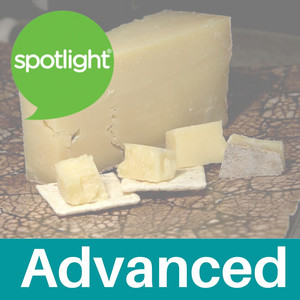
Cheddar For many people, the word is what they call all cheese products made from milk.
For others, cheddar describes a special kind of cheese.
Often it is found in yellow blocks at supermarkets.
Or it is sold as a product that has been cut into pieces.
These pieces are sold in plastic bags.
In the English-speaking world, it is one of the most popular cheeses.
But Cheddar is also a town in southeast England.
It is where cheddar cheese was first made.
The town gave this cheese its name.
But for a long time, people stopped making cheddar cheese in Cheddar.
The place that had been famous for cheese was now empty of cheese.
How did this happen?
Today's Spotlight is on this question.
It is about cheddar.
It is about the town that lost and found its cheese.
People have made cheese in cheddar for a very long time.
The land around the town is good for raising cows.
And the cliffs around Cheddar are home to many caves.
It is cool inside these caves all year.
So these are good for storing cheese.
These are also great places to age the cheese.
In this process, cheese makers keep cheese for a long time before selling it.
This gives the cheese a more complex taste.
Aged cheese is often more interesting than fresh cheese.
In these early days, cheese from cheddar was not much different from other cheese.
Cheese makers would use a similar process everywhere in the UK.
They used milk from an animal.
Then they added a substance called rennet.
Rennet separates milk into two parts.
One part is a solid called curds.
Another is a liquid called whey.
Cheesemakers took the curds and pressed them together.
They left the whey behind.
After some time, the curds would form a piece of cheese.
This is one of the basic ways of making cheese.
But many cheeses made this way still have a lot of whey in them.
This makes the cheese softer.
But more whey means that cheese will go bad more quickly.
In the 14th century, cheesemakers in cheddar found one way to solve this problem.
They created a process called scalding.
When cheesemakers scald cheese, they heat the curds to a very high temperature.
This pushes extra liquid out of the curds.
The result is a harder cheese that will last much longer.
They furthered this development with a process called cheddaring.
In cheddaring, cheese makers heap blocks of cheese on top of each other.
This forces even more whey from the cheese.
It also changes the cheese's taste.
Cheddaring makes the cheese taste sharper and it makes aging the cheese easier.
These special processes made people take note of cheese from cheddar.
It tasted different from anything else made in the country.
Paul Kinstet is a teacher at the University of Vermont.
He teaches about the history of cheese.
He spoke to the British Broadcasting Corporation about cheddar cheese's spread.
The great quality of the cheese caught the attention of wealthy Londoners.
They visited the famous caves of Cheddar Gorge and they ate local cheeses during their visits.
They told others the cheese from cheddar became famous from the 15th century on.
Soon, cheddar cheese became one of the most sought-after cheeses in England.
Cheddar became the cheese of the upper class.
King Charles I was an English king.
He ruled the country from 1625 to 1649.
During this time, there was a great demand for cheddar.
People liked it so much that the king decided only he and his court could order it.
The popularity of cheddar cheese continues to last until this day.
But the town that gave the cheese its name did not benefit from this popularity for very long.
Cheddar is a small town.
It could not produce enough cheese for everyone.
So other towns began to make their own cheddar.
People from England also moved to other countries.
They brought the secret of making cheddar cheese with them.
Places in the United States like New York and Vermont became famous for their cheddar.
Factories appeared.
These made cheddar cheese too.
Mass production meant that people could sell cheddar cheese all over the world.
Cheesemakers in cheddar could not compete.
The fame of its cheese grew.
The town did not.
But it was not competition that ended cheesemaking in cheddar.
Instead, it was a war.
During World War II, Nazi Germany attacked the United Kingdom.
The UK is an island.
It became difficult to get supplies from outside, so the food they had was limited.
During the war, the government created a rationing system.
This meant that everyone could only buy a small amount of food.
The government also took control over much of the food production.
The government bought all milk on the market and they made it into their own kind of cheese.
Many people called it government cheddar.
But it did not taste much like cheese from cheddar and it was not made in that town.
Rationing helped people survive the war, but it also destroyed small cheese makers.
Before World War I, there were over 3,500 small cheese businesses in the UK.
By the end of World War II, there were fewer than 100.
But cheese-making traditions did not die completely.
In the 1990s, small dairy farms began to make cheese again.
They returned to old methods.
Many returned to the places where people made cheese historically.
The cheeses they make cost more than industrial cheeses.
But for many, the price is worth it.
Cheddar is one place that saw a return of farmhouse cheese.
John and Catherine Spencer are two English cheese makers.
In 2003, they started the Cheddar Gorge Cheese Company.
The company tried to make cheddar in the way it was made hundreds of years ago.
They used milk from local cows.
They even aged it in the caves of the Cheddar Gorge.
Soon, the Spencer's cheeses began winning awards.
People began travelling to the place from which the famous cheese style came.
They began to enjoy this new cheese that tasted so much like the original cheese.
They found it interesting to see how much the flavour had changed over hundreds of years.
The changes were great.
Industrialization made cheddar cheese almost unrecognizable.
It made the taste less complex.
But without changing, many may never have tasted cheddar cheese.
Without traveling to places like America and Australia, it may never have found a great name.
Without its name, it may not have come back to cheddar at all.
In 2021, Catherine Spencer spoke to the British Broadcasting Corporation.
Cheddar might have remained a small West Country product, but it might well have disappeared, like many local cheeses have.
Its shift to a major global variety has created international recognition.
With that comes a desire for our product.
It is closer to the original cheddar that would have been made here hundreds of years ago.
But our success mirrors the success of cheddar as a cheese in all its forms.
Have you ever eaten cheddar cheese?
Are you willing to pay more money for small batch products?
Is there a type of food made in your community which many people want to buy?
We want to hear your thoughts.
You can leave a comment on our website or email us at radio at radioenglish dot net.
You can also comment on Facebook at facebook.com slash spotlight radio.
The writer of this programme was Dan Christman.
The producer was Michio Ozeki.
The voices you heard were from the United States and the United Kingdom.
All quotes were adapted for this programme and voiced by Spotlight Radio.
You can listen to this programme again and read it on our website at www.spotlightenglish.com.
This programme is called The Town That Lost Its Cheese.
We hope you can join us again for the next Spotlight programme.
Goodbye!