This BBC podcast is supported by ads outside the UK.
I've spent the last three decades trying to better understand money across the boardroom, the newsroom and the trading floor.
That's longer than most podcast hosts have been alive.
But even I've got questions.
Join me, Meryn Subset-Webb, every week for my show Meryn Talks Money from Bloomberg Podcasts, where I have in-depth conversations with fund managers, strategists and experts about how markets really work.
And join me for a separate episode where I answer listener questions on how to make those markets work for you.
Follow Meron Talks Money on Apple Podcasts, Spotify or wherever you listen.
Fuel shortage in Cuba.
There's an aging power grid.
Life in Cuba is difficult.
It's a third world economy.
I've spent two hours waiting for the fuel tanker to arrive and no sign of it.
It's World Business Report from the BBC World Service.
This is Andrew Peach on the way.
What impact will restrictions on refuelling aircraft have on Cuba's all-important tourism sector?
Also today, by what measure are Denmark and Finland beating the rest of the world?
And would you trust artificial intelligence to help you choose the right insurance?
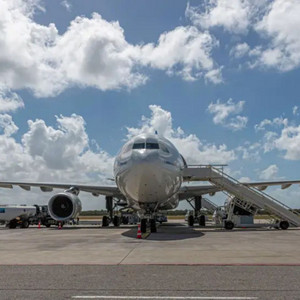
First, Cuba warning international airlines that jet fuel is no longer available on the island.
This is the latest sign of a worsening fuel crisis, with the US seeking to cut off Cuba's oil supply.
The Trump administration has imposed what is, in effect, an oil blockade, threatening tariffs against any country which supplies oil to Havana.
These people are already feeling the pain there.
Emilio Hernandez.
I'm Emilio Hernandez.
Two hours.
I've spent two hours waiting for the fuel tanker to arrive and no sign of it.
We don't know if it's coming.
And this is paying in dollars.
My name is Francisco Perez.
I've been here for five hours.
No tanker yet and no idea if it's coming.
They say it's coming, but who knows?
In Cuban pesos or foreign currency, whatever.
You just have to find a way to pay for it.
We have no other option.
Cuba is heavily reliant on tourism, so how big an impact will the aviation fuel restrictions have on one of its main sources of income?
Air Canada has already suspended passenger flights.
Germany is warning against non-essential travel to Cuba.
David Lee is the owner of a company which organises trips there for US citizens.
The situation has, in many respects, been deteriorating for some time.
So there's an aging power grid.
Life in Cuba is difficult.
It's a third world economy.
It's a struggling situation, certainly for the Cuban people for some time.
How that affects tourists, primarily, by the way, we cater to American travelers.
That's probably 85 percent of our client base.
So Americans are not allowed to travel to Cuba as quote unquote tourists.
There are a set of licensed reasons that Americans can travel there.
The two that we primarily use are the main one is called support for the Cuban people.
And really what that means from the US standpoint.
First and foremost, we have to ensure that the vast majority of money that our clients are spending when they're traveling to Cuba again because of this is it's an embargo destination is going to the people of Cuba, not the government of Cuba, because the US does not want us to be supporting that government.
Cuba's saying that international airlines won't be able to buy jet fuel and refuel when they're there.
Coming from the US, that may not matter, because you probably don't need to refuel.
Coming from further away, a different story.
Exactly.
That's exactly right.
And literally in 15 years, I have not seen a US jet refuel before flying from landing in Havana and turning around and flying back to the US.
In fact, they never spend the night.
The planes never sit in Havana or in any city in Cuba.
So they land, they turn around and fly back.
It's basically a 45 minute flight from Miami to Havana.
This makes Cuba more dependent on U.S. tourism than it doesn't stop tourism.
It just means that nearly all the tourism would be from from America.
Well, depending on how long this continues.
At this point, the only flights I've heard that have officially been suspended for now are flights from Canada.
And keeping in mind that it's a very different market, the Canadian market that most of their flights will fly from Toronto directly into Varadero.
It's very much a beach destination for most Canadians.
And Cuba has already announced that they're preparing for this.
They know that, in addition to not just because of the jet fuel situation, but lack of fuel and power supply for the entire island, they're consolidating and closing some of the beach hotels and keeping only a couple of them open.
So again from that market?
Yes, they at this point and they said the debt fuel situation at least the latest report is, it's going until middle of March.
They definitely have stated this date.
I believe it's March 11th, which may lead us to believe there's something we're not aware of right now.
Is there some source of fuel coming in in March that we're not?
You know again, this has not been reported, but they're saying it's a one-month situation of not having jet fuel.
The European airlines at this stage, what I had heard was they have other options.
They can land and refuel in some other islands like the Bahamas, etc.
And I did not hear whether or not at this stage they're going to either cut back routes or actually suspend.
So it may not make all that much difference by the sound of it.
Well, it's hard to say that, to be honest.
I think it makes a difference.
There's no question.
There's reality, right?
There's also the perspective that things aren't going well and we're already feeling this.
People are afraid.
Every day there's something new that they're reading in the news.
I am spending hours every day talking to current clients who have trips booked, groups that are coming soon, prospective clients, and having to answer these same questions that you're asking me right now and let people know it's safe.
The government prioritizes the tourist areas.
The Places that we have you stay have backup generators.
My team have gasoline in their cars.
The buses have gasoline.
You're going to have a great itinerary and a great experience.
And the flights are still going.
But if you're going somewhere and it's a trip and it's a leisure experience, just a little bit of fear can cause some people to make other plans or put things off.
Does it feel like something's got to give, like the current situation for Cubans is unsustainable?
Well, at the end of the day, if this fuel siege continues for too long, it's definitely unsustainable.
Something has to give.
The reports are that the...
Cuba can, from their own internal sources, supply 40% of their normal needs.
40% over the long term is certainly not sustainable.
And at some point something certainly would have to give or it could end up being some kind of a humanitarian crisis.
It's David Lee from the company Cultural Cuba.
Corruption is getting worse worldwide, according to Transparency International, with the average global score in its corruption perception index hitting its lowest level in more than a decade.
Let's get more on what the report says from our international business correspondent, Theo Leggett.
Well, this report assesses 182 countries and it's how they are perceived in terms of corruption or integrity.
So it's based on the responses of business leaders and other experts around the world, their feedback about what governments are doing, what people in public office are doing, and their impressions of the corruption that is existent.
So at the top of the ranking with the greatest number of points.
So the most reputable countries, if you like, are Denmark Finland, Singapore.
At the other end, you've got autocracies and countries where civil society is breaking down.
So at the bottom, you've got Venezuela, Somalia and South Sudan.
And the headlines, in a way, are being made by countries that are neither at the top or the bottom.
I suppose significant economies like the United States, the United Kingdom, whose scores are falling.
Yes.
Transparency International is particularly worried about what it calls established democracies, Western democracies, where corruption standards are not improving and are getting worse.
So, for example, if you look at the UK, it sits in 20th place, which is...
Not terrible, but not brilliant either.
It used to be in the top 10, but over the past decade, its performance has been deteriorating.
And Transparency International says this is because of things like record levels of political donations, troubling reports of people paying for access to politicians and MPs acting effectively as paid lobbyists on behalf of private interests.
So that's the UK.
The United States has also been falling back.
Transparency International says it hasn't had the chance to bring in everything that has happened over the past year since President Trump came into office for his second administration.
But it says there are serious concerns about public bodies being used to put pressure on journalists and NGOs, the politicisation of prosecutions and actions that could undermine judicial independence, all of which, it says, send out a dangerous signal that corrupt practices are increasingly becoming acceptable.
And are there lessons from say, Denmark as to what other countries could do if they wanted to rise up this table and have less perception of corruption in public office going forward?
Well, it's more what Denmark isn't doing, where you don't see the allegations of political donations, paying for public influence or pressure being put on the judiciary, or all these other things, these other flaws that are being cited in relation to other countries.
So Denmark is seen as something of a beacon.
But even with Denmark there are concerns, for example, about how MPs declare their outside interests and whether or not there are conflicts of interest in some of what politicians are doing.
But generally speaking, countries like Denmark and Finland, it's not so much what they're doing, it's what they're not doing.
That was our international business correspondent, Theo Leggett.
BP's profits are down after last year's drop in oil prices.
The company says it's responding by cutting costs and rating in spending to strengthen its finances.
Shareholders seem to be split.
Some say BP went too far into green energy.
Others say it's still too focused on oil.
Nick Mazan leads oil and gas strategy at ACCR, a shareholder advocacy and research organisation.
I think there's a little bit of an existential crisis for BP in many ways.
Like when you say that you aren't a good owner of renewables assets and they've said that they've gone too far too fast as it relates to their renewables business.
You really have to sort of sell a growth story to your investors.
And so if you're cutting off the opportunity for investing in clean energy, then they want to sell their story to investors that there is growth potential in the oil and gas business.
And that just might not be the case.
Live to Jennifer Snyder, financial advisor for Brighton Securities with us from Rochester, New York.
Jennifer, thanks for being with us.
What's your take on BP?
Yes.
So I think the biggest concern with BP it's not even so much.
Is it doing oil or is it doing renewables?
It's that it just keeps changing its mind about how much of each it wants to do.
I think There's always going to be a message for wanting to promote green energy.
Yes, we want this.
And we also know the reliability that we have on natural oil and gas.
It's just making up a mind and sticking to that plan to create profits for shareholders.
So I think it's more about the back and forth flip flop that's concerning them.
Let's talk about Spotify, the music streaming platform.
Its shares are up.
It's doing pretty well in adding new users.
Yes, everyone loves music all over the world, eternally desired by the human race.
And they tripled profits year over year.
And they did this by increasing prices and focusing on cost.
Best day ever in trading, up 15% today.
Coca-Cola forecasting modest growth with some concerns about demands for its products.
Coca-Cola is interesting.
The soda wars, they are they're taking them on.
Pepsi is definitely in the race there as well, but they are free to laze.
So we've got the snack side of things.
But it's really about the zero sugar superstar.
Coke zero sugar is jumping 13 percent worldwide.
So we need to focus on navigating global taxes for Coca-Cola and a health first world.
That's going to be a heavy lift for the new CEO that's coming in in March.
Let's focus on the car market.
And we've got some numbers from Ford and Honda.
And again, as we so often say on World Business Report, the numbers are disappointing.
Yes, Ford, $11 billion paper loss.
That's crazy.
But it's not because they're not selling cars.
It's this one-time accounting charge, as they also are ripping up their old electric vehicle plans and starting fresh.
Tying back to everything that you've been speaking on this segment tonight.
Essentially, it's the world's most expensive reset button.
OK, and Honda's profits are declining again because of tariffs and because of electric vehicles.
Yes, that is tough for Honda.
And of course, the increase in aluminum, steels, all of those things.
But I did find it interesting that the motorcycle has been kind of saving the company keeping the lights on.
And that has they sold 16 million in the last nine months, which Honda's not going anywhere.
Very interesting.
Jennifer, thank you very much indeed.
This is World Business Report from the BBC World Service with Andrew Peach.
Sri Lanka is a country long marketed as a tropical paradise.
It's still reeling from a cyclone, though, which hit in November.
The storm left a third of the island in ruins.
Hundreds of lives were lost.
Homes were destroyed.
Hundreds of thousands of people displaced.
So can Sri Lanka recover from all of this?
Here's my colleague Vishala Sripathma.
Cyclone Ditwer struck Sri Lanka without warning.
The sound you're hearing is floodwater rushing through ordinary streets.
Cars, furniture, even makeshift rafts carrying animals swept along in the current.
The storm left a third of the island in ruins.
Hundreds of lives lost, homes destroyed and hundreds of thousands displaced.
According to the president, it's the country's worst ever economic disaster.
Among those affected are tea plantation workers in the hills who've lost family members and now wonder how they'll survive with their houses gone.
My wife, son-in-law, daughter, mother-in-law, two grandsons are all dead.
I don't have any protection here.
They were all I had.
We have lost our land, house, everything.
Decades of civil war, a devastating tsunami 20 years ago and militant attacks in 2019 had left the economy fragile.
An uprising in 2022 was sparked by the rising cost of living and has led to a sense of permanent crisis in Sri Lanka.
In an attempt to recover, the nation requested a bailout from the International Monetary Fund.
Tea is one of Sri Lanka's biggest industries.
Dilma is one of the country's most famous brands, employing over 20,000 people.
Dilhan Fernando is its chief executive and one of the country's most prominent business leaders.
The primary impact was on the communities.
It was on the lives that we lost.
It was landslides.
It was the people who were displaced.
Where the packing and the export sector connected to tea was concerned, sadly, we had, I think, nearly 30 of our significant tea export businesses that were affected by floods.
And so that was significantly, or in some cases significantly, permanently damaging.
I would say, all in all, the impact was much more manageable than what we initially expected.
Sri Lanka had the fiscal space for the government to respond proactively in the way that it did.
More than two million tourists visit Sri Lanka every year.
It's a vital part of the economy.
Partham runs an eco-camping business in the hills.
I started this about three years ago.
It's a beautiful place.
The cyclone caused a huge loss to my business.
It is beyond description.
The destroyed building needs to be rebuilt.
The economy was only just finding its footing after the financial crisis.
Ahilan Katharagama from the University of Jaffna in northern Sri Lanka, explained to me what this disaster means.
We really need an investment to get the economy going.
And this is because Sri Lanka is in an IMF program with severe austerity conditionalities, which means the government is in a straitjacket, so to speak, where it cannot spend and can't spend what it needs to get the economy going.
The IMF has given an emergency loan of US$200 million.
But when you look at the big picture, This really does not bode well in terms of the rebuilding and reconstruction efforts.
Aylan Katheragama, an economist at the University of Jaffna, with a stark warning that Sri Lanka is not out of the woods yet.
For more on Sri Lanka from Vishala Sripathma, just search for Business Daily, wherever you get your BBC podcasts.
The US insurance company Insurify has launched what it says is the first insurance comparison app built on ChatGPT, letting consumers shop for cover by chatting rather than filling in forms online.
This announcement has rattled some investors, with shares in price comparison sites and insurance sites falling amid fears over the impact of artificial intelligence.
I've been talking to Keith Melnick, who's the chief executive of The Zebra.
That's an insurance comparison site in Austin, Texas.
I asked Keith how AI might be able to help when we're shopping for insurance.
I think there's really two big parts to the insurance shopping experience.
And one of them is the user experience, the interaction you're having with whatever site it is in terms of trying to get your information back and forth, and with the company, and then the content you're getting out of it.
User experiences have been garbage and the information is really pretty.
Held close to the vest by the insurance companies.
And I think AI helps make huge advances on both sides.
And I think what you've seen I mean the last couple of days especially is huge advances on that user experience side.
Access insurance.
That information and I don't just mean the tell me some information about the policy really getting down into what your rates are, and things like that.
That's still a really difficult part and AI will help with that, but I don't think it's quite there yet.
That's the key part, isn't it?
The reason that existing consumer experience might not be great is because it's complicated, because it depends on who I am, where I live, what my age is, what my gender is, all of those things.
And then you've got to try and match that against different sorts of policies on offer from all sorts of different companies.
That's why it's difficult anyway.
And at the moment, I surely can't do that reliably.
It's no different from I was a part of Kayak when we started at 2004.
And you had the same issues in the travel industry with the access to content and user experience.
The interesting thing there, though it was a juxtaposition, in terms of which one was the really difficult issue.
We got the access to the content through a company called ITA Software that Google eventually wound up buying.
But it was really the advances we made on the UI side that really differentiated and made Kayak a success.
This is the flip in terms of that.
So you're right.
That is the hard part.
And the thing I see a lot of hype right now in terms of what's going on, and it's justified.
Things are changing.
They're changing so quickly.
But if you go through and really use the new things that have come out, they don't really deliver on that consumer experience yet because you can't get all the way through to the hey, I found a policy, recommended policy.
Can I actually buy that?
Does it actually meet my coverage needs?
It's not going to change over the next 24 months.
It's going to change over the next three to six months.
But that's the interesting stuff that's coming.
I mean, I'm just trying to compare it with using AI to find out simple information online.
It's going to give you an answer pretty quickly and it's more than likely to be right.
But it could also be really quite wrong.
And when you're trying to insure your car, that could be the difference between being insured and not being insured.
I'd say it's not so much right or wrong.
You're going to get a generalized answer.
And insurance is a specific product, which is, you know, the zebra.
When I first came to the company, it was pitched as the kayak of auto insurance.
And it's really we're trying to be more you think about your local personal insurance agent.
You need to know the customer kind of at a personal level in what their specific needs are and how it matches up.
That's that's the key to all of this.
So, like I said, the answer you're getting now is not wrong, it's just too generalised.
On the flip side, this is bound to happen, isn't it?
We are bound to use AI because the incentive not only to improve the consumer experience but, of course, to make it cheaper for the provider to interact with their consumer.
That's inevitable development in insurance, as it is in so many other areas of life.
I think it's kind of inevitable because it's what the consumer wants.
I think you see that over and over in almost any market or marketplace.
What's been the reaction so far to this particular product that's been launched by Insurify?
It's put in heightened awareness for sure.
But I think there are several companies, both new and established, like ourselves, that are working towards the same sort of thing of getting this done.
You know again from Me at the Zebra.
I want to make sure that we are really delivering on that full consumer experience.
So somebody just doesn't go, hey, this looks cool.
And then they get to the end and they go, oh, that was really a disappointing experience.
This isn't living up to the hype.
I think that it's great the market's paying attention and consumers are paying attention to this.
But I think it's going to be different when you look back in a few months and go oh, this is the way this is supposed to work.
This is great.
And that's Keith Melnick, who's chief executive of The Zebra, which is based in Austin, Texas.
Now, the supply chains of gold and precious gems are notoriously difficult to track.
That can mean that human rights abuses and environmental devastation gets hidden.
One jeweller in London is bringing women together from regions scarred by conflict and repression to create what's called ethical jewellery.
More on this from my colleague, Bibi Swaby.
So which one's this one?
That's the lapis lazuli from Afghanistan, from this Badakhshan region.
Pure pigment.
Can jewellery ever be truly conflict-free?
Well, associations of women around the world are not only creating pieces with fully transparent provenance, but doing it in areas that have been marked by conflict or occupation.
Gems and gold.
The disproportionate value for something very, very small makes it a really difficult material to work with.
Because it can be smuggled, it can be moved very easily.
Pippa Small is a jeweller based in London.
She's devised a system that links all these networks, creating responsible, traceable supply chains for gold and silver, which in turn help their transformation into jewelry.
Jewelry which reflects the origins of the precious metals and the women who mined them.
We're really careful to work with small family-run mines, certified fair trade mines.
We work with the women panners.
The gold next goes to a refinery.
And from there, a local goldsmith where design collaboration starts.
Looking around, so there are many collections.
And I can see a tray with gold from Colombia.
They are sourced from a group of women panners.
So this means that there's none of the toxic chemicals that are often used with mining.
The women who pan this.
They are so conscious of not allowing in illegal gold miners because they want their grandchildren and great-grandchildren to benefit from this treasure in the rivers.
These pieces are made from gold from Choco on Colombia's Pacific coast, a place where gold has shaped identity, conflict and survival for thousands of years.
Much of today's mining is informal or illegal and often linked to armed criminal groups.
Carmen is a registered miner and member of the Women's Association for Artisanal Miners from Choco.
Mining defines our lives in a challenging and complex way.
I think that the woman miner is a fighting woman.
Illegal mining affects us deeply because we are exposed to gender-based violence, labour exploitation, the dispossession of our lands.
Many people will be wearing gold directly linked to this, but would never know of its bloodied past, which often disproportionately affects women.
PIPA's organisation also has a programme for women in Afghanistan.
Mara was part of that programme.
When women are excluded from education and employment, the whole community suffers.
Teaching, creating and serving my community gave back my dignity and a sense that my life has meaning beyond survival.
One thing all the women I spoke to had in common was a determination to continue mining and creating ethical jewellery.
And the colour, the blue, the bright turquoise.
That report from Mimi Swaby.
If you go online to bbccom, slash news more on a couple of the stories we've been talking about on the programme.
Spotify, and it's doing well.
The fact that the Swedish music giant saw some record user numbers.
Also those BP profits, what they might mean. bbc.com slash news.
From me, Andrew Peach, and the team, thanks for being with us on World Business Report.
I've spent the last three decades trying to better understand money across the boardroom, the newsroom and the trading floor.
That's longer than most podcast hosts have been alive.
But even I've got questions.
Join me Merrin's Hubset Web every week for my show.
Merrin Talks Money from Bloomberg Podcasts, where I have in-depth conversations with fund managers, strategists and experts about how markets really work.
And join me for a separate episode where I answer listener questions on how to make those markets work for you.
Follow Marin Talks Money on Apple Podcasts, Spotify, or wherever you listen.