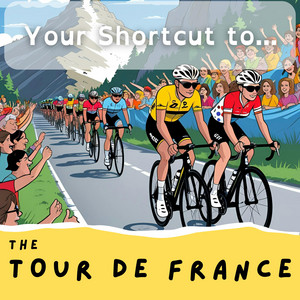
Squiz Kids acknowledges the traditional owners of the lands on which we podcast, the Turrbal and Combermerry people.
This is a Squiz Kids podcast. Your fresh take on what's happening in the world around you.
They've been racing it for more than 120 years.
It was started by a French newspaper to sell more copies and competitors peddled more than 3 ,000 kilometres across mountains, fields and cobblestones.
This is your Squiz Kids shortcut to the Tour de France.
The podcast where we cycle through the who, what, where, when, why and how of the big news stories.
I'm Kristy Kidgerino. And I'm Bryce Corbett.
Oh Bryce, what are you doing riding around the podcast studio in Lycra?
Well, Christy, I'm just training for next year's Tour de France.
I've got to work out my hill climbs, I've got to get my time trials right and waving to fans who come along to watch dressed as bananas.
Uh -huh, and you know the race is over 3 ,000 kilometres long, right?
What? Oh sure, yeah.
Piece of cake. As long as there are plenty of snack stops.
Today, we're going to race through what makes the event so famous, how it all works, and when the Tour de France and the Tour de France Femme, that's the women's race, have made headlines over the years.
So, strap on your helmet and grab your water bottle.
Let's roll. And listen carefully, there's that whiz at the end.
What? Imagine a race so tough.
It crosses mountains, covers thousands of kilometers, and takes three whole weeks to finish.
That's the Tour de France, the most famous bike race in the world.
Yes, it is, and it's so big that they use helicopters and drones to film it, and crowds line the road screaming encouragement.
Some dress in costumes, some camp out for days just to watch the riders fly by.
And it first started way back in 1903.
And it wasn't because people loved riding bikes up giant hills, but because a French newspaper called L 'Otto wanted to sell more copies.
It worked. And the race just keep growing bigger and bigger.
Yes, it certainly does, Christy.
And these days it's watched by millions of people.
And winning it is like winning the Olympics and the World Cup all at the same time.
So, why is it such a big deal?
Well, it's because it's really, really, really hard. It pushes riders all the way to their limits, physically and mentally, and the mountains are brutal.
A few of them are more than 2 ,500 metres high.
Oh, my gosh. Bryce, get prepared.
The weather can be wild and the crashes, well, unfortunately, they're just part of the race.
Yes, they certainly are, and it all just sounds crazy, Christy.
Three weeks of riding, but do they get any rest breaks?
How does it all work?
How? Okay, so it's not just one big race from start to finish.
It's actually broken down into 21 stages that they race over three weeks.
Now, each stage is like a separate race with different terrains, so there's flat sprint days, huge mountain climbs and even individual time trials.
And the riders are all in teams, right?
Correct. Each team has eight cyclists.
They all have different jobs.
The leader's the guy trying to win the whole race.
Then there's the domestiques, that's French for servants, and they help the leader by blocking wind, fetching water bottles and just protecting them in general.
Right. And then there's also the sprinters, who zoom at the end of the flat stages, and climbers, who power up those mountains.
Wow, sounds like a game of chess on wheels.
So much strategy involved.
And what about those famous jerseys?
Are they just handed out at the end of the race?
No, they're awarded after every single stage.
So, after the day's riding finishes, the organisers check the results and they work out who's in the lead in each category.
green. And then those riders get to wear a very special jersey in the next stage.
Right. Okay, then let me see if I've got this right.
There's a yellow jersey for the overall race leader, a green jersey for the best sprinter.
Yeah. A polka dot jersey for the king or queen of the mountain climbs and a white jersey for the best young rider under 26 years of age.
That's right. Right, well done, Bryce.
Now, the jerseys change hands during the races.
Different riders take the lead.
So it makes things really exciting to watch because each stage, absolutely everything could change.
And don't forget, of course, the Lantern Rouge, Christy.
That's the nickname for the rider who comes last in the overall race.
It means red lantern, like the light that you see at the back of the train.
But you know what, Bryce?
Bryce, even finishing last in the Tour de France and taking part in that final sprint, Dan Paris's Champs -Élysées, is a massive achievement.
Oh, yeah, absolutely.
Okay, so the jerseys are cool and the teamwork is epic, but with such a long history, Christy, when has the Tour de France made headlines over the years?
When? So, Bryce, the Tour has had its fair share of drama, especially with cheating.
eating. Let me guess, somebody snuck a rocket booster onto their bike.
You're actually not far off.
In 2016, a rider's bike was scanned by officials and they found a hidden motor inside.
Since then, the tours had to use x -ray machines and thermal cameras just to check bikes before and after stages.
But the cheating is not a recent thing.
You're right there because in the second ever race in 1904, some riders were caught taking train rides during the race.
Others had fans block the roads to stop their competitors.
So sneaky. And in more recent years some riders use performance enhancing drugs including Lance Armstrong who won seven titles but then had them all taken away.
But the Tour has changed a lot too especially with the launch of the Tour de France femme, femme of course being the French word for woman That's right, after years of campaigning, women finally got an official tour in 2022 Now it's shorter, it'll go for 9 days this year but it's just as tough just as exciting and absolutely spectacular.
It sure is and the 2025 Tour de Femme is on right now It's growing in popularity every single year which is great news for the sport It really is and there have been some really proud and very inspiring moments.
Especially for us Aussies like when Cadel Evans became the first Australian to win the Tour de France back in 2011.
Oh yeah, he worked incredibly hard over many years and finally took out the yellow jersey, heart of a lion and legs of steel.
That reminds me, can't stand around here all day chatting, gotta get back to training.
Off I go. And I'll grab the first date quiz.
Time for the quiz. This is the part of the podcast where you get to test how well you've been listening.
Question number one.
How many stages or days of racing make up the Tour de France?
Did you say 21? You would be correct.
Question number two.
Who is the polka dot jersey awarded to?
Meaning what does this person have to be best at?
Awesome listening if you remember that they are the best mountain climber Yes, that is awesome listening Question number three What is awarded to the rider that comes in last?
I'll take both the French or the English You can tell me that it's either the lantern rouge or the red lantern Well that's all we have time for today.
Thanks for joining us as we explored the who, what, where, when, why and how of the Tour de France.
Now get out there and have a most excellent day.
Over and out.