Hi, I'm Kitty Felde.
Our countdown continues as we look back at 10 years of podcasting on the Book Club for Kids.
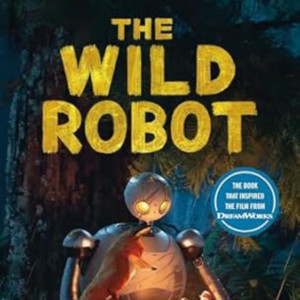
Woo -hoo! We are celebrating by counting down the top 10 episodes over the decade and today it is number six, The Wild Robot by Peter Brown.
Enjoy! It's the Book Club for Kids.
The Book Club for Kids.
It's the Book Club for Kids.
It's the Book Club for Kids podcast. Hi I'm Kitty Felde.
This week it's all about robots.
Our book is the Wild Robot by Peter Brown.
You could describe it as hatchet meets ET.
What would happen if a robot had to survive in the forest and adopts a baby goose?
Everyone already knows your name, Roz, but what's the Gosling's name?
I do not know. The robot looked at her adopted son.
What is your name, Gosling?
He can't name himself, squat loud wing.
That's our celebrity reader Congressman Scott Peters from San Diego.
The book raises all sorts of philosophical questions for students from Flora Henley Elementary School in Washington, DC.
I don't understand how the robots get smarter as they go because humans are not perfect and they create a robot, so I don't understand how robots can be perfect.
And Peter Brown tells us he started his writing career at a very early age.
Well, the first book I ever wrote in my whole life, I made when I was six years old.
This is the book club for kids, the podcast where kids talk about books.
We'll tell you how you can be on the show a little later on, but first, let's meet our readers.
Hello my name is Mariah.
Hello my name is Diana.
Hello my name is Donald.
Hello my name's Jamal, and we are in the fourth grade, and we are in Healy Elementary School in DC.
The title of the book is The Wild Robot, and the character name, the wild robot, the character name her name is Ross.
And the main ideal or like the point of view of this story is how this robot that got like came to our island but from a mistake because it was tornado and and she was the only one that survived because all the rest was broken.
She had lost her purpose and so her purpose when she was at the island was to take care of the geese because she had climbed a tree and broke their nest and fell on their parents and killed them.
It took us a really long time to read but it's a fun book at the end.
All the characters they really tried to help out Roz because Roz she was fun to go to the city and she was supposed to have a purpose to like help people with stuff and it was supposed to be like in the future type of.
I couldn't quite tell when does this book take place?
Is it taking place today?
in the future? I think it's taken place in the future.
At the beginning everybody was calling Roz a monster but then that's when Roz was helping everybody else.
Then that's when they stopped calling Roz a monster.
When she was on the island it wasn't really much things to do so she had lost her purpose but when she had Brightville she found her purpose to take care of Brightville.
and then that's when she went on an adventure and everybody in the forest had helped her out so talk to me a little bit about Brightville that's right so Brightville tell me a little bit about Brightville.
Brightville is a geese and his parents died so Ross had to take care of him and Ross had a friend named Lao Wing, and Lao Wing told him how to swim.
And then Lao Wing, he told Bright Bank how to swim fly, and when they fly north they had saw other robots, you know, like working for people.
So when Bright Bill had came back, he had told Roz that I think your purpose was not to be on this island.
I hear that scene from the book where our robot heroine is looking for motherhood advice from the animals in the forest. Our celebrity reader is congressman Scott Peters.
He represents San Diego.
Ordinarily the forest animals would have run away from the monster but they were awfully curious why she was carrying a hatchling on her shoulder and once Roz explained the situation the animals actually tried to help.
A frog pointed Roz up to the squirrels.
A squirrel recommended that she speak with the magpies, and the magpies sent them over to the beaver pond.
The ground grew soggier, the grass grew taller, and soon the robot and the gosling were looking across a wide murky pond.
Dragonflies buzzed through the reeds.
Turtles sunned themselves on a log.
Schools of small fish gathered in the shadows, and there, floating in the center of the pond, was an old grey goose.
A very good morning to you, the robot's friendly voice boomed over the water.
I have an adorable little gosling with me, the goose just stared.
I am in need of your assistance, said Roz.
Actually the gosling is in need of your assistance.
The goose didn't move, food, peeped the gosling.
Food, food! That tiny voice was more than the old goose could bear.
And she began gliding across the pond and squawking to the robot.
up! What are you doing with that hungry hatchling?
Where are his parents?
There was a terrible accident, said Raz.
It was my fault. The gosling is the only survivor.
If there was a terrible accident, why does your voice sound so cheerful?" The goose flapped her wings.
Are you sure you didn't eat his parents?
I'm sure I did not eat his parents, said Raz, returning to her normal voice.
I do not eat anything including parents.
Will you take the Gosling?
I most certainly will not, squawked the goose.
I can't take in every orphan I see.
You say this is your fault?
It seems to me that it's up to you to make things right." Mama, Mama, peeped the Gosling.
I have tried to tell him that I am not his mother, said the robot, but he does not understand.
Well, you have to act like his mother if you want him to survive.
There was that word again, act.
act. Very slowly, the robot was learning to act friendly.
Maybe she could learn to act motherly as well.
�You do want him to survive, don�t you ,� said the goose.
�Yes, I want him to survive ,� said the robot, �but I do not know how to act like a mother.
Oh, it�s nothing. You just have to provide the gossling with food and water and shelter, make him feel loved, but don�t pamper him too much, keep him away from danger, and make sure he learns to walk and talk and swim and fly and get along with others and look after himself.
And that's really all there is to motherhood.
By the way, my name is Loud Wing, said the goose.
Everyone already knows your name, Roz, but what's the Gosling's name?
I do not know. The robot looked at her adopted son.
What is your name Gosling?
He can't name himself, squat Loud Wing.
His bill is an unusually bright color.
It's actually quite lovely.
So, if I were his mother, I'd call him Brightbill.
But you're his mother, so it's up to you.
His name will be Brightbill, said Roz.
Let's talk a little bit about robots.
Is this the kind of robot that you have encountered in real life?
Are there robots you guys deal with that don't look like Roz?
Well, it's robots that don't look like laws but they still help us out every day.
Like vacuums you see one of them like robot vacuums. Like a Roomba that's what they call those things yeah.
What else what other kinds of robot do we want?
Like Siri or Alexa that also like give us information about like the world stuff.
It's like robots to help you out with surgery.
A robot that can travel place that they can travel places like a car.
Yeah cars are practically robots now.
Do robots have personalities because Raaz sure has a personality.
No real robots have personalities but the only reason why Raaz has one is because she didn't really have no purpose because she had landed on the wrong spot.
The only reason why she gained a personality is because like Bright Build like help her out and she helped out Bright Build and she like start to develop feelings because it says that in the story that at first she didn't have feelings but her computer brain and made her like develop feelings.
Do machines have feelings at all that you know about?
Well not really, but they can develop them if they really was made to.
Yeah they keep talking about artificial intelligence that suddenly machines get smart enough to figure things out and it seems like they have feelings.
And some people have a relationship like with a machine.
Like my first car was called Purnell, because I was a big Purnell Roberts, he was an actor, fan, and so that was the name of my car and I had a relationship with that car.
Is there any machine you have a relationship with?
My iPhone. Does your iPhone have a name?
Siri. Does it act like your mother, like your cousin, like your best friend in school?
mean, compare your relationship to Siri and your iPhone.
Siri is compared to my mom because every day my mom made sure I got my stuff.
I got my book bag. Make sure I got my coat on.
I got a relationship with my iPad my iPhone and my PlayStation.
Wow, is it different, all three of them?
Yes. Well my PlayStation is named Junior.
How come? Because I'm Jamar the first, so my place that has to be Junior and I don't know why I named my iPad this but I named my iPad Rose for some reason.
That makes sounds okay.
You never know. What's the personality there?
Does it actually have a personality that said I should be called Rose?
Well, yeah, because my iPad is like it really helps me out.
Like when I'm mad I just go on my iPad and I watch like a video, and it calms me down.
Now, we're talking all about electronics.
In the book, it takes place on, as you guys said, on an island where generally there isn't a lot of electricity or anything like that.
It's nature. And here is rozz, this thing of the future or of the present, that represents modern technology.
Is there a place you guys can go to get away from technology?
You can always go to the forest and have a camp out.
And another thing, when you was talking about artificial intelligence, I don't understand how the robots get smarter as they go because humans are not perfect and they create a robot so I don't understand how robots can be perfect.
Well you know, that's interesting because there's a whole bunch of science fiction out there about what happens when robots get smart And if it's humans that's programming them, then are they, yeah, are they programming mistakes into the robot?
Yeah they were programming mistakes because what if one day the robot get too smart and then they try to take over the world?
I wanna see you write that story.
I think that one way how a robot gets smarter like over time is like from, they learn from like humans like, they see their ways and actions.
They see what they do.
Could robots go bad if they're watching humans?
Yes, maybe because if a human is doing the wrong thing and a robot is watching them and the robot could do what they're doing.
But the only reason why robots copy down what humans do is because if they don't have no purpose, then what are they supposed to do?
Like Roz lost her purpose, but she found a new one, so she created her new purpose.
You guys got some questions for our writer, Peter Brown.
How did you come up with the Wild Robot?
Like the title? The idea for the Wild Robot came when I was actually working on a picture book called The Curious Garden, which is about nature kind of popping up in an urban city environment, you know, kind of an unlikely place for nature to be living.
And it got me thinking about the opposite scenario, what would be like something, instead of nature in a surprising place?
What would be something surprising in a natural place?
And you know for some reason my imagination leapt to a robot in the wilderness, out in a forest or something.
The last place you'd expect to find a robot is out in the wilderness, and that seemed like kind of an interesting idea.
I did a little doodle in my sketchbook of a robot in a tree, and that's where the whole idea started.
I just kept thinking about this robot in a tree.
Why would a robot be in the woods, and how would a wild animal react to a robot, and the questions kept coming so I started kind of researching and reading about robotics and artificial intelligence and I started reading more science fiction stories and before long I had kind of the early ingredients for a story about a robot in the wild who ends up becoming kind of wild herself and so the title the wild robot just really gets to the point and it seemed like a good title to me so it stuck.
Why did you specifically make this book about a robot?
This story had to be about a robot.
The whole idea that excited me was this artificial life form, this robot, living in a natural place, seeing what happens when these kind of two opposite things collide, an unnatural life form in a natural place.
So, I couldn't have told the story with a person or with an animal because those are living things in a natural place that—you know, we've read those stories before and I love a lot of stories about characters out in the wilderness, but I wanted to imagine what would happen to a creature that maybe is made of metal and you know computer parts and pretty Pretty traditional looking robot, you know What would how would it how would a robot react to the wilderness so it could only be a robot that was the whole concept What was your main purpose of like becoming a author of like these books?
Well, I came to writing through illustrating.
I always loved drawing pictures ever since I was a kid I drew pictures all the time, characters, and scenes, and worlds, that was my favorite thing to do, and so I studied illustration, and when I was at art school studying illustration, I took a class on children's books and realized that I'd always been telling stories with my little pictures, but if I was willing to also use words, I could tell even more interesting stories and really create characters with real depth to them and stories with real meaning.
And so I started studying writing, as well, and eventually I started publishing books where I was both the author and the illustrator which is kind of a combination of my two favorite things combining words with pictures to tell stories.
That's for whatever reason that's what I like to do.
When was your first time writing a book?
Well the first book I ever wrote in my whole life I made when I was six years old called The Adventure of Me and My Dog Buffy.
I had a real dog named Buffy at that time and it was sort of a silly adventure where my dog and I get lost in the woods and have to spend a night away from home together in the woods.
But then the first time I got serious when I was a little older, maybe in college, and I started thinking of myself more as a writer, I wrote some books in college just to kind of see if I could do this, see what my ideas were and see if I had any abilities.
And they were pretty terrible stories.
I wrote some picture books for fun, just kind of experimenting.
and you know, when was the first book I ever made was called The Inventor of Things?
and it was about this sort of like weird German guy who had flew around in a zeppelin in like a like a blimp kind of a thing and he was flying around the countryside solving people's kind of everyday problems by inventing weird little gadgets and stuff.
He had an assistant who was a penguin, you know some of that stuff sounds kind of fun but I'm telling you the story was bad So I learned a lot and I kept writing I eventually got better at it How long did it take you to make the wild robot?
I spent years making the wild robot probably I Mean maybe five or six years altogether now some of that time I was spending on other books and in my free time I'd sort of tinker with the wild robot and then at the end It was about two solid years of just working on the wild robot and nothing else We're not robots but, do we have a purpose also?
Everybody has a purpose in life but, everybody can't find it right now.
Do you know what your purpose is?
Yes, what is it? My purpose is to go to school and learn.
And then what? And then when I grow up, I get a good job.
My purpose is to be a good scholar in school and like be a good person and live my life feel pretty good and yeah be a good person.
My purpose in life is to like get all my grades to have perfect grades and then when I grow up I want to go to college to go to a good college and after that I want to have like a good life, have a good job that actually help me pay enough money for my life and for my kids and stuff if I have them.
My purpose in life is to get good grades then go to college and play college football and grow up to be a full player.
We come to the time when we need to ask the hardest question on planet earth which is what is your favorite book?
The Ivy of Olympia because like it's like funny and it's like certain things like what happened what happened to kids like to these days where they like get bullied or something so it like it's kind of like easy to understand like what the person is going through.
My favorite book is adult diary book.
I really like that book because like as some parts like funny like interesting like you can like get really into the book.
My favorite book is The Three Little Pigs.
My favorite book is Diary of a Wimpy Kid 2 because it's like what's happening in a kid life in a book and what might be happening in a real kid's life.
What about you, Congressman Peters, what is your favorite book?
My favorite book has always been East of Eden by John Steinbeck, both for its description of what was then for me a faraway place in California, but also the challenges of family and trying to do the right thing.
Whether you're destined to do the right thing or whether you do it by choice, but there's Great descriptions of pure evil and striving to do right that I've always found attractive, and now that you've asked me the question, I think I'll try to read it again.
Your turn, Peter Brown.
What's your favorite book?
I've been thinking a lot about books that made a difference in my life growing up.
One of my all -time favorites is called The Hobbit, which is pretty well known these days and was turned into a series of movies.
But when I was in eighth grade, I read that book, and I wasn't much of a reader back then.
But I love drawing.
I was drawing pictures of wizards and dragons and all sorts of fantasy scenes and then I heard about this book about wizards and dragons and fantasy story this fantasy story called The Hobbit, and I was like oh I should check this out and I read it and it just kind of blew my mind because you know I'd always thought that dragon and wizard stories were kind of silly and not very serious but here clearly this author, Tolkien, was a really serious writer and he made a serious work of literature about dragons and wizards like my favorite things you know it's so that book kind of opened my eyes and I
started taking writing a lot more seriously after that.
We'll have a list of everybody's favorite book at our website book club for kids org and you can be on a future book club for kids podcast just have your teacher, parent or librarian send us an email to kitty at book club for kids org and we will send out all the information.
This episode is funded in part by the Jack Kent Cooke Foundation, dedicated to advancing the education of exceptionally promising students who have financial need.
And by the Norah Roberts Foundation and the DC Commission on the Arts and Humanities.
Thank you. And thanks this week to our producer, Ilsa Setsiel.
Jonathan Jensen composed our theme with additional music from Charles Newman.
Emma Steinkelner designed our logo.
Thanks this week to writer Peter Brown and our celebrity reader, Congressman Scott Peters.
And thanks to our readers as well, Mariah, Zianna, Donald, and Jamal from Flora Handley Elementary School in Washington, DC.
We have a free newsletter for teachers, parents, and librarians, full of tips about how to turn kids into lifelong readers.
Sign up at the website, bookclubforkids .org.
And if you're looking for a way to talk to your kids about civics education, check out And there are other podcasts, the Fina Mendoza Mysteries.
It's an episodic series that follows the adventures of the 10 -year -old daughter of a Congressman who solves mysteries inside the US Capitol with the help of a big orange dog named Senator something.
There are teacher's guides, companion books, and a facts behind the fiction blog.
And you can find out more at that website, Chesapeakepress .org.
That's the Fina Mendoza Mysteries, winner of the 2024 Latino Book Awards.
I'm Kitty Felde. Thanks so much for listening.
Thank you.