We're number two. We're number two. Hi, I'm Kitty Felde.
And as we celebrate 10 years of Book Club for Kids, we are counting down our top 10 most listened to episodes over the past decade.
This week, it's number two, and it's a classic.
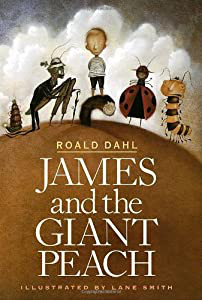
Raoul Dahl's James and the Giant Peach. Have a good time listening.
It's the Book Club for Kids. It's the Book Club for Kids.
It's the Book Club for Kids. It's the Book Club for Kids podcast.
I'm Kitty Felde. Coming up, Raoul Dahl's classic tale of insects and a monster-sized fruit.
James and the Giant Peach. Every one of these creatures was at least as big as James himself.
And in the strange greenish light that shone down from somewhere in the ceiling, they were absolutely terrifying to behold.
That's our celebrity reader, public radio superstar Cash Peters.
We'll also take you to Buckinghamshire, England for a visit to the Roald Dahl Museum to find out where the idea for James and the Giant Peach came from.
What it nearly was was James and the Giant Cherry for a very long time.
We'll also hear from a trio of readers from Equitas Academy in Los Angeles.
In almost all his books, the kids are the heroes and not the adults.
Usually the adults are like bad villains and stuff.
This is the Book Club for Kids, the podcast where middle school readers talk about books.
We'll tell you how you can be on the show a little later on, but first, our panel of readers.
My name's Sabine, and I'm 11 years old. My name's Robert, and I'm 12 years old.
My name's Dorothy, and I'm 11 years old.
And you guys go to what school? Equitas Academy.
Equitas Academy is a school where they teach us how to go to college, and our goal is to graduate from four-year colleges.
So we are tackling James and the Giant Peach, just in case somebody hasn't read the book.
Who wants to tell me what the book's about?
The book is about this little kid named James.
His parents died one day. His parents died by a rhino, actually.
It got out loose from a zoo, and it trampled them while they were on the streets.
It ate them. It ate them. It didn't just trample them.
It also ate them. And then James, since he had no parents, he had to go with his two horrible aunts. named Aunt Sponge and Aunt Spiker.
And describe them. Aunt Spiker was very skinny.
She was tall, and she was very mean to James.
Then Aunt Sponge, she was very fat and short, and she was also very mean to James.
Something that they did to James was they made him do all their chores.
Behind a bush that was nearby, this little man came by, and he asked James to come over to him.
Then the little man gave him this bag, and what was inside, there were these little green crystals, and he said that they were magical.
He had to drink them with water so something marvelous and peculiar could happen to him.
But he told him not to drop them or else the magic would be working on something else.
And of course he dropped them, Robert. What happened?
The worms escaped, and they went towards the peach, and then they soon reached the tree that the peach was on, got inside, and there goes your giant peach.
What an odd idea. I mean, I just think, you know, to have, I never would have thought of that, of just suddenly a giant peach.
I know. That's one of the reasons I really like the book, because he includes things that you would never imagine.
Like what? Like what, Dorothy? How do you call it?
His aunts both get squished by the giant peach.
And then he uses like harsh things to describe some of the things.
It's not what many authors might use in their books, like terrible dark things.
Well, he includes dark humor, which is like scary things that happens, but at the same time, they're also funny.
So they're not scary then to you guys? Not really.
So parents shouldn't worry that their kids are going to have nightmares about it.
Because it's funny. Yeah. Well, one thing that Roald Dahl does is he combines some facts with some fantasy.
So can you tell the difference? What was real versus... I mean, give me some examples, if you can, from what you guys know from what you learned in school is a true fact about stuff versus the kind of story that Roald Dahl tells us in James and the Giant Peach.
I learned that... Insects are pretty small, and in the story, because of the magic that the little crystals made, in the story the insects are the size of dreams.
Enormous bugs. What else? What else does he tell us?
Like insects, he tells us some actual stuff about insects in there.
Yeah, he tells us their characteristics.
So like the spider, when they tell her to spin the web, well, that's an actual characteristic a spider would have.
Or a worm, it's not one to describe it. They say that it's juicy and fat, so that's how a worm would actually be.
Speaking of insects, let's hear how Raoul Dahl introduced us to these larger-than-life bugs and the big misunderstanding that'd get them all off to the wrong foot with James.
Here's our celebrity reader, Cash Peters.
An insect is usually something rather small, is it not?
A grasshopper, for example, is an insect.
So, what would you call it if you saw a grasshopper as large as a dog?
As large as a large dog. You could hardly call that an insect, could you?
There was an old green grasshopper as large as a large dog sitting on a stool directly across the room from James.
And next to the old green grasshopper, there was an enormous spider.
And next to the spider, there was a giant ladybug with nine black spots on her scarlet shell.
Each of these three was squatting on a magnificent chair.
On a sofa nearby, reclining comfortably in curled-up positions, there was a centipede and an earthworm.
On the floor, over in the far corner, there was something thick and white that looked as though it might be a silkworm, but it was sleeping soundly and nobody was paying any attention to it.
Every one of these creatures was at least as big as James himself, and in the strange greenish light that shone down from somewhere in the ceiling, they were absolutely terrifying to behold.
"'I'm hungry!' the spider announced suddenly, staring hard at James.
"'I'm famished!' the old green grasshopper said.
"'So am I!' the ladybug cried. The centipede sat up a little straighter on the sofa.
''Everyone's famished,'' he said. ''We need food.''
Four pairs of round, black, glassy eyes were all fixed upon James.
The centipede made a wriggling movement with his body, as though he were about to glide off the sofa.
But he didn't. There was a long pause and a long silence.
The spider, who happened to be a female spider, opened her mouth and ran a long, black tongue delicately over her lips.
Aren't you hungry? she asked suddenly, leaning forward and addressing herself to James.
Poor James was backed up against the far wall, shivering with fright and much too terrified to answer.
What's the matter with you? the old green grasshopper asked.
You look positively ill. He looks as though he's going to faint any second, the centipede said.
Oh, my goodness, the poor thing, the ladybug cried.
I do believe he thinks it's him that we are wanting to eat.
There was a roar of laughter from all sides.
Oh, dear, oh, dear, they said. What an awful thought.
You mustn't be frightened, the ladybug said kindly.
We wouldn't dream of hurting you. You're one of us now, didn't you know that?
You're one of the crew. We're all in the same boat.
We've been waiting for you all day long, the old green grasshopper said.
We thought you were never going to turn up.
I'm glad you made it. So cheer up, my boy, cheer up, the centipede said.
And meanwhile, I wish you'd come over here and give me a hand with these boots.
It takes me hours to get them off by myself.
Cash Peters has his own podcast these days, The Life Quiz.
We'll have a link on our website, bookclubforkids.org.
Did you notice the language that rattled all?
Were there any... Tell me about... Like rattled or peculiar.
Those are really precise words that he uses.
And then it describes more interesting and you could imagine it more in your head.
Some other language things is that he makes it sound like the character's saying that, not like sort of a robot's voice.
So each character has a distinct voice. Yeah.
Well, for example, who's the most annoying voice in the book?
I would say the worm. The worm, okay. What do you think?
I would say the centipede. The centipede, the annoying centipede.
I would agree with Robert, the worm, how he exaggerates while they were going to put him on the peeps as bait.
He used like a voice that was all scared.
We wish we could talk to Raoul Dahl himself, but the author died a quarter century ago.
So we thought the next best thing would be to visit the little garden shed where he wrote James and the Giant Peach.
Izzy Mead is Learning Manager at the Raoul Dahl Museum and Story Center in Buckinghamshire, England.
That's about an hour outside of London. When Roald Dahl knew he was going to pass away, he told his wife, Lissy Dahl, that he wanted all of his archive material, so all of his letters, his manuscripts and so on, all to be kept together and not to be disseminated across the world and auctioned off, etc.
His actual words were, actually, don't give it to the Americans.
He wanted them to be kept in England. So Lissy decided to keep all his archive together, but then just down the road from them was a lot of dilapidated buildings and she thought this could be made into a museum so first of all it was created around the archive because that's the real treasure of the museum and then the museum grew up around it and it's basically using the archive in order to inspire a new generation of writers so it's learning from someone's life but it's not just about someone's life it's about how we can learn from it and how it can affect us now because Roald Dahl really wanted He didn't want a generation of Mike TVs from Charlie and the Chocolate Factory who watch TV all day or Matilda's parents who watch TV all day.
He wanted Matilda's who read and he wanted George's who invent marvellous medicines and things.
So he wanted children to be inventive. So the museum's taken that on as our mission and our vision.
The first two rooms are about Roald Dahl's life.
So we've got Boy, which is about his childhood, based on the book Boy.
And it tells us about his school days. We've got his school reports. which are quite interesting to read because he was quite naughty at school.
And it's also got lots of the tricks he used to play and how he was really inventive even from a young age.
For example, he used to tell his teachers he had appendicitis so that he couldn't go to school.
He didn't like school. So he was already making up stories.
And then we have Solo Gallery, which is about his adult life.
He had a really exciting life. He went to Africa.
He worked there for a few years and got fluent in Swahili. and saw lots of exciting animals like giraffes and crocodiles that he wrote about later.
And then he was a pilot in the Second World War and had an amazing time until he crashed in the desert, which meant he couldn't fly again because he had an injury to his back.
But instead of letting it get him down, he actually used it as a positive thing and wrote a story about it.
And then he found he loved writing. And that's really what kick-started his life.
We've got a mock-up of his plane and we've got his helmet and we make a big thing of it because it's really what started his writing.
The real treasure of Solo Gallery is Roald Dahl's writing hut, his original hut, because he didn't write in his house.
He used to write in his garden shed at the bottom of his garden.
You get to see his chair and his writing desk and lots of funny objects and things.
He was in his garden shed, and he looked out of the window at his garden, and he saw an apple tree in his garden, and he suddenly looked at the apple tree a bit differently, so he he had quite a funny thought, really.
If you're a writer, you have to have kind of funny thoughts.
And he suddenly thought, why do apples stop growing?
Like, how do apples know when to stop growing?
And then he thought, I could write a story about an apple that grows and grows and grows and doesn't stop growing.
And then as he started writing it, he started thinking, well, actually, an apple is a really boring fruit.
We eat it every day. I'm going to change it to an orange.
So he wrote this story about James and the Giant Orange.
And then he thought, actually, an orange is also quite a boring fruit.
I want to have it a more interesting shape.
And it became James and the Giant Pear for a long time.
And then he had lots of characters in the story.
They needed to live somewhere. So he thought, well, the pear needs a stone where they can live.
So it can't be a pear because it's a peasant to have a stone.
And what it nearly was was James and the Giant Cherry for a very long time.
And then eventually he thought, I want something bigger and juicier.
So he turned it into a peach. You can find a link to the Roald Dahl Museum and Story Center on our website, bookclubforkids.org.
Does this book seem, it was published in 1961, we said, does it seem old-fashioned or does it seem like a book that anybody could read like 50 years from now?
It seems like a book anybody could read 50 years from now.
It has like fantasy and kids would enjoy it a lot.
I also agree with Dorothy. I think, um, 50 years from now, kids would also still read it because right now it's almost half a century and we're still reading it.
Maybe kids could still have this same life like us 50 years from now and they'll still read this book.
It's still modern to us. What would have happened in New York if a giant peach appeared over New York City today?
How would the city and the country have reacted differently than it did in 1961?
They would have probably reacted as a terrorist attack because they wouldn't notice it was a giant peach.
You would probably think, shoot, it's a giant bomb.
So there's one sentence in here that makes people not happy with this particular book.
It's about cooking up the grasshopper, frying him up and eating him like a Mexican is the way they put it.
Now, I would say I'm probably with kids of Latino descent sitting here with me.
How does that strike you? Does that sentence, did it bother you?
Did it stick out? Half yes, half no. Half because if they intentionally put it to be racist, then it wouldn't be good because that's not really good or nice at all.
But I don't think he intentionally put it.
I think he just put it as, like, a joke or something to make his book more humorous.
I agree with Forfy. I think, like, Roald Dahlf didn't intend to put it, like, to hurt other people's feelings.
He just put it, like, there to, like, maybe make people laugh or make his book, like, funnier.
So compare this book to something else you've read.
What does this remind you of? This reminds me of other Roald Dahlf books.
Other all dog books, they're funny and they like have maybe a fantasy image like this book.
Which one is better? Is this better than Charlie?
Is this better than Matilda? Which one do you like better?
I think I like better Charlie and the Chocolate Factory.
Which one? I like Matilda better. Why? Because she has powers and everything.
And then I also like about Roald Dahl's book, in almost all his books, the kids are the heroes and not the adults.
Usually the adults are like bad villains or stuff like that.
Well, it seems like a lot of kids' books kill off the parents.
Anybody know why? I think it's because, like, a lot of books, they want to intend them, like, maybe for adventure and stuff.
So they kill out the parents because, like, the parents always, like, tell their kids to behave good, to stay with them.
So, like, I think they kill out the parents so they don't have to, like, be judging kids' lives.
They could do, like, what they want. Would you recommend this book to somebody else?
Yeah, I would recommend it to somebody else because they should read all the adventure that there is in it.
And I would think that they would enjoy it a lot.
I would recommend it to other persons too because this book has many good themes in it.
And so other people can learn from the themes in the book too.
What are some of the themes that they could learn from?
For example, they could learn about friendships.
In the book, James, he's always friendly with his insect friends, and he saves them from stuff.
So maybe in real life, people could help other, maybe their sisters or their friends, they could help other people too.
What is the one book you would tell me I have to read?
What's the book you absolutely adore? Oh, you're getting ready to say something, Sabine.
What's your favorite book? Well, my favorite book is Harry Potter and the Deathly Hallows, and I recommend it because Like, it's almost like James and the Giant Peach.
At the beginning, Harry Potter loses his family, and he's, like, sad.
I like that book because, like, it's fantasy, and I love fantasy.
Robert, what's your favorite book? My favorite book is The Road.
It's by Cormac McCarthy. Wait a minute. That Road is your favorite book?
It's pretty depressing, but I like it because it shows the bonding of father and son. and how they love each other throughout the whole thing.
How about Dorothy? What's your favorite book?
I like probably the book Savvy. I like it a lot because also like Sabine, I love fantasy books.
And then it teaches like a lesson. Do you think all books have to have lessons?
I always wonder about that. I don't think all books have to have lessons.
Probably there's just some books for entertainment, just to read for fun.
What books do you like to read for fun? My name's Julia.
And where do you live, Julia? In Spain. And what is your favorite book?
Magic Treehouse because they do lots of fun adventures with animals.
My name is Ben. I live in Swarthmore, PA.
My favorite book is Huckleberry Finn. He goes on a lot of adventures and that's where I like it.
My name is Natalie and I live in Spain. My favorite books are Judy Blume.
I like Superfudge and Tales of a Fourth Grade Nothing.
She has a great sense of humor and makes everything funny.
What's your favorite book? Want to be on the Book Club for Kids podcast?
Well, send us an email or record yourself on the Voice Memo app on your mom's smartphone.
Just give us your first name, the city where you live, the name of the book you love, and why you like it.
And email the voice memo to bookclubforkidspodcast at gmail.com.
That's bookclubforkidspodcast at gmail.com.
And if you are looking for a good book, we have lots of suggestions.
Just check out our website, bookclubforkids.org.
The website is also the place where you can find the free curriculum guide for this episode.
Just go to bookclubforkids.org and click on the curriculum tab.
And if you'd like some tips for getting your kid to read and additional learn-at-home resource ideas, just sign up for our newsletter.
Usually we send it out every other week, but we have stepped it up to every week, at least for the time being.
Thanks this week to our celebrity reader, Cash Peters, and Izzy Mead at the Raoul Dahl Museum and Story Center, and our readers from Equitas Academy, Robert, Sabine, and Dorothy.
Jonathan Jensen and Brandon Baker composed our theme music.
Emma Steinkeller designed our logo. Our producer is Ilsa Setziel.
We'll be back again next week with a brand new episode, The Epic Graphic Novel Amulet by Kazu Kibuishi.
Be well and keep on reading. I'm Kitty Felde.