This message comes from Greenlight.
Adults with financial literacy skills have 82 % more wealth than those who don't.
Greenlight's debit card and money app can change the course of your kid's financial future.
Start your risk -free trial at greenlight .com slash NPR.
Hey, short wavers, before we get started, quick little favor to ask, can you help us shape the future of short wave by completing a short anonymous survey?
It's a chance for you to tell us about what you like and don't and how we can serve you better.
It's an awesome responsibility, But I trust you and we want to hear from everyone whether you're a day one or brand -new listener Just go to NPR .org slash shortwave survey.
We'll also put a link in our show notes.
Thank you Okay onto our show You're listening to shortwave From NPR Hey, Gina, hey NPR science correspondent Jeff Brumfield Why are you darkening my doorstep to talk about one of my all -time favorite topics nuclear weapons?
testing and I got a question for you.
OK. When do you think is the last time the US tested a nuclear weapon.
I'm gonna say possibly in the late 70s.
They actually stopped a lot later than that.
They stopped in 1992.
Wow. And they've been pursuing a very different program based on science.
OK. And recently I got a very very unusual look at that program and all its facets and sort of how the US continues to verify its nuclear weapons work without having to set any of them off.
Are they thinking about testing again?
I would say the official answer is no, but there is more concern that the US or another country might soon test another nuclear weapon.
So today on the show, Jeff takes us on a rare trip to tunnels deep under the Nevada desert where America does science instead of nuclear testing.
I'm Regina Barber, and you're listening to Shortwave, the science podcast from NPR.
start. This message comes from Schwab.
At Schwab, how you invest is your choice, not theirs.
That's why when it comes to managing your wealth, Schwab gives you more choices.
You can invest and trade on your own.
Plus, get advice and more comprehensive wealth solutions to help meet your unique needs with With award -winning service, low -costs, and transparent advice, you can manage your wealth your way at Schwab.
Visit Schwab .com to learn more.
This message comes from Total Wine & More.
Summer's here, and whether you're hosting friends or chilling on the patio, they've got the season's best. Wines, spirits, beers, and all the cocktail fixings, all at the lowest prices.
Hosting a get -together this Memorial Day weekend?
Their friendly guides can help you find what suits your needs.
With the lowest pricing for over 30 years, find what you love and love what you find only at Total Wine and More.
This message comes from Charles Schwab.
When it comes to managing your wealth, Schwab gives you more choices like full service wealth management and advice when you need it.
You can also invest on your own and trade on Thinkorswim.
Visit shwab .com to learn more.
Okay, so let's start with like a little history on nuclear testing.
Like how did we get to where we are today where we're not doing it anymore.
You know, you think of nuclear tests and it's like a mushroom cloud over the desert, but that was actually just a very brief period that those aboveground tests were happening.
It was mostly in the 1950s and it stopped because of radioactive fallout.
The wind was carrying radioactive material much further than expected and it started showing up on fishing boats, in milk and baby teeth—places nobody wanted it.
So, in 1963, the world's nuclear powers signed a treaty to move testing deep underground.
And it kept going that way all the way until the end of the Cold War.
Which was, what, like the late 1980s, early 1990s?
That's when the Soviet Union collapsed.
Right, right. So, why did nuclear testing stop then?
I spoke to Hans Christiansen with the Federation of American Scientists.
He tracks nuclear weapons all over the world, and he says there were two big reasons.
The first was political.
It was very much an attempt to look around and see what can we do that makes it clear we're not just talking about the end of the Cold War, we're serious about it, we're willing to do some things.
But the second reason they could stop testing was actually technical.
It was this growing power of supercomputers.
They could now take these supercomputers and simulate nuclear testing in silicon.
You didn't need to do nuclear tests to do what you needed to do for the foreseeable future, which is to make sure that the nuclear weapons you have work, and if there's a problem, a glitch, you can fix it.
So you could still run tests, they were just on computers, not like an actual detonation of a nuke.
Yeah, and that actually takes us to the first stop on this whole nuclear testing road trip.
Okay. I traveled out to Lawrence Livermore National Laboratory in California, and I got to see their newest computer, where they do what they call the button -to -boom calculations.
It's inside a secure vault.
The computer is called El Capitan.
We named it after Yosemite.
There's a very prominent granite there and it's in California.
Terry Quinn oversees high -performance computing in Liverpool, and she showed us around.
Now this machine uses advanced processors, similar to those used for generative AI actually.
LCAP can do more than two quintillion calculations per second.
That's two exaflops for those in the supercomputing game.
Its only job is to calculate a nuclear weapon's detonation.
It used to be it might take them a week to do a calculation on how a weapon would detonate.
Now they can get it back by the end of the day or within hours.
That is game -changing, especially in this world where we have to move faster.
And this is what nuclear testing looks like today.
Making sure the weapons we do have work, but using supercomputers, right?
Like problem solved, like no more real -world tests.
Not quite. Okay, okay.
As you know, Gina, any good computer models still needs some real -world data to make sure it's grounded in reality.
And so, you know, nuclear weapons scientists have continued to collect data.
they're doing experiments in the same tunnels underground where they used to set up their nuclear weapons tests.
Now, this is not a place many journalists get to go.
But I asked and asked and asked very nicely.
And eventually, I and a few other journalists made it to Nevada, where they do this testing.
We stepped onto an old mining elevator...
All right, watch your step getting onto the cave. The elevator just drops into pitch blackness, nearly a thousand feet underground.
Here's what it was like at the bottom.
All righty, it sounds scary.
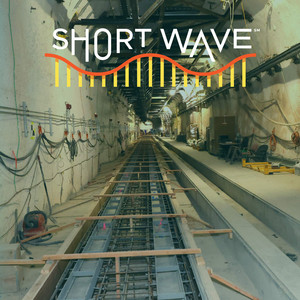
There's a long corridor that's been carved out of an ancient lake bed.
Pipes along the walls carry air, water and power.
Workers in hard hats are everywhere.
David Funk, who oversees work underground, leads us in.
How long have we had tunnels down here?
Oh, so the tunnels were dug in the 80s.
So this would have been a test shaft, potentially.
Yeah. This was designed to be nuclear test location originally, and now we do only sub -critical experiments in this location.
Sub -critical experiments.
That means experiments that simulate conditions inside a nuclear weapon without triggering a nuclear chain reaction.
That runaway chain reaction is what gives a nuke its incredible power.
These tunnels were originally built to contain nuclear explosions.
Then, in 1992, the U .S. officially stopped all testing.
The cold war had ended and the thinking was, nuclear testing could end too.
It would make the world safer.
But fast forward to today and nuclear weapons are back on the front pages.
Same goes for nuclear testing.
China, Russia, and America are all upgrading their test sites and that's why we're here, to see what U .S. scientists are up to underground.
Speaking of which, why do they still work down here?
We do this because it is secure, right?
So we can control the environment and we also are concerned about a potential breach of the vessel and so we want to do it in an environment that's controlled and we don't lose any of the plutonium into the environment.
If something goes wrong.
If something goes wrong.
We arrive at our first stop, a long, empty corridor that's just been dug out for a new experiment.
So this is where the Scorpius machine is going to reside.
The Scorpius machine...
it kind of feels like you're in a James Bond movie.
Funk explains it's actually a giant X -ray machine.
You guys are familiar with chest X -rays?
Scorpius is going to work in the same way.
It'll create extremely high powered X -rays.
The reason is we need higher energy X -rays to be able to look through plutonium.
Plutonium from America's nuclear weapons.
Much of it was made decades ago, and it's getting old.
The X -rays are used to take a look inside to see how well the plutonium would work if detonated.
Scorpius will cost 2 billion dollars to build down here.
We walk deeper into the tunnel network.
Some of the floors are still rocky.
They've just been dug.
Next stop an experiment that simulates a nuclear weapon.
It's called Cygnus and it's arguably the most secret scientific project in the U .S. government.
As a reminder, here we're going into no cell phones, any Bluetooth devices, smart watches, smart rings.
If you have them, you need to go in the locker over here.
Cygnus is a smaller version of Scorpius.
It fires x -rays of plutonium that's inside a spherical steel container about the size of a mini fridge.
Watch your step, Henry.
Tim Beller is directing the next test code -named Knob Hill.
So that is the Knob Hill vessel.
That's the actual vessel that we will use.
That's a three footer.
In a few months inside this vessel scientists will blow up a tiny quantity of plutonium using chemical explosives.
It's designed to simulate a nuclear detonation.
But again this test will be sub -critical.
The U .S. government says there will not be a runaway nuclear chain reaction.
Whatever rules they set, I ensure they happen here in Nevada Okay, so Jeff this gives like a real sense of what it was like to visit those tunnels and like Tim Beller Said is that the u .s. Is following these rules right?
But you mentioned there might be like a return to testing is that because scientists need to do like Another test they couldn't do with these supercomputers.
No, actually it isn't in fact Yeah, I heard again and again from nuclear weapons scientists on this trip.
There is no technical need to test right now OK, so if it's not scientific, it's not technical, why would America test again?
We'd start testing again for exactly the same reason we stopped testing.
And that's politics.
Nuclear weapons have a new role in the world.
You know, Russia is developing some wild new nuclear weapons designs.
China is expanding its nuclear arsenal.
And into all of this comes the Trump administration.
Now, Project 2025, which is sort of a conservative blueprint for the government, it says the U .S. should be ready to test another nuclear weapon if it needs to.
Trump's former national security adviser is gone further.
He's written that the U .S. should test another nuclear weapon.
Okay, so if the U .S. did resume underground testing, what would be the consequences of that?
First things first, we should say underground testing is safer than atmospheric testing, but that doesn't mean it's totally safe.
Here's Jamie Kwong with the Carnegie Endowment for International Peace.
Underground tests can also have environmental and humanitarian impacts.
You know, they're obviously not as severe as the atmospheric impacts, but they're still possible.
And historically, at least, testing has been done in some pretty marginalized communities, places in rural Nevada, rural Mississippi, the Aleutian Islands.
These are communities where the population just doesn't have that much political power.
But there's also another way in which the resumption of nuclear testing could hurt the U .S. strategically.
The U .S. has a technical advantage locked in by this moratorium on nuclear testing.
Because it undertook so many more tests during this Cold War period, it has loads of historical legacy data.
The US has more than a thousand nuclear tests under its belt now China only has 45 So if global testing resumes China's gonna learn a lot more from test 46 than the US will from its next test But I should say like, you know This isn't all up to Trump and the Trump administration in America China or Russia could decide it was time to do an underground test and if they did The US will be under a lot of pressure to test as well Ok, so Jeff I can see now that we could be at this precipice of a return to nuclear testing because we're at this like very unstable moment right now in the world, nobody
like no country wants to go first but if one country tests the other countries are likely to follow, right?
That's exactly it and you know if testing happens arms control experts worry it's gonna spark new kinds of research into other nuclear weapons and those weapons will get billed and we'll be right back in the middle of a nuclear arms race.
Jeff Brumfield, thank you so much for bringing us this story.
You're welcome, Gina, pleasure to be here.
This episode was produced by Rachel Carlson and edited by Burle McCoy.
Jeff Brumfield and Tyler Jones checked the facts.
Jimmy Keeley was the audio engineer.
Bet Donovan is our senior director.
And Colin Campbell is our senior vice president of podcasting strategy.
I'm Regina Barber. Thank you for listening to shortwave, the science podcast from NPR.
Support for NPR and the following message come from Edward Jones, a rich life isn't always a straight line.
Unexpected turns can bring new possibilities.
With 100 years of experience navigating ups and downs, Edward Jones can help guide you.
Let's find your rich together.
Edward Jones, Member SIPC.
This message comes from Greenlight.
Ready to start talking to your kids about financial literacy?
Meet Greenlight, the debit card and money app that teaches kids and teens how to earn, save, spend wisely, and invest. With Greenlight, you can send money to kids quickly, set up chores, automate allowance and keep an eye on your kid's spending with real -time notifications.
Join millions of parents and kids building healthy financial habits together on Greenlight.
Get started risk -free at greenlight .com slash npr.
This message comes from Mint Mobile.
Mint Mobile took what's wrong with wireless and made it right.
They offer premium wireless plans for less and all plans include high -speed data, unlimited talk and text and nationwide coverage.
See for yourself at mintmobile .com slash switch.
you