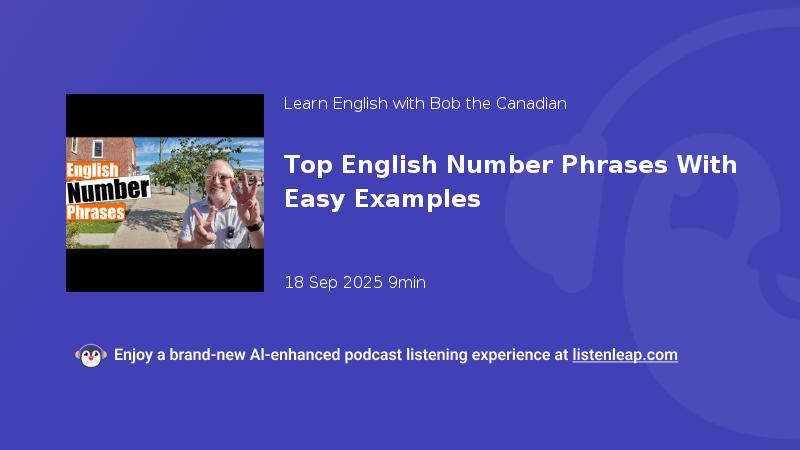
Well, hello and welcome to this english lesson about english phrases that have numbers in them.
The first phrase i want to teach you is the phrase to go 50 50.
We sometimes say to split something 50 50 or we'll say to go halfsies in my part of canada.
I'm not sure if that phrase is used everywhere in the world, but when you go 50 50 or when you go halfsies, it means two people are going to split something equally.
Here's a good example.
Let's say someone at work said, I think I might order a pizza for lunch.
You might say, hey, why don't you order an extra large and we can go 50-50.
We can go halfsies.
This would mean the person orders a pizza, you each pay for half and you each get half of the pizza.
So when you go 50-50, when you split something 50-50, when you go halfsies, it means you are buying something usually and then you are splitting it and each person gets an equal amount.
Before we go to the next English phrase with numbers in it though, I do want to thank Preply, the sponsor of this video.
If you're looking for an English speaking partner, there is a link in the description below to Preply a great place to find someone that can help you take your English learning to the next level.
And if you use the link in the description below, you'll get 50% off your first class.
The next English phrase with numbers in it that I wanted to teach you is the phrase to feel 100%.
When you feel 100%, it means you feel great.
It means you feel alive and energetic and you just feel awesome.
But we actually use this phrase quite often in the negative to describe when we're not feeling well.
A good example would be this.
If I woke up in the morning and I said to Jen, I don't feel 100%.
I might call my boss and say, hey boss, can I have a sick day today?
I don't feel 100%.
And my boss hopefully would say, you can take the day off.
So when you feel 100%, you feel amazing.
And when you don't feel 100%, you don't feel well.
Notice, though, I use two versions of the phrase.
Sometimes we say that we don't feel 100%.
We actually say the one.
And sometimes in English we say, I don't feel 100%.
That's the faster, more informal way to say it.
So if you feel 100%, you feel great.
If you don't feel 100%, it means you're not feeling good at all.
One of the cool things about living in a small town is that nine times out of ten you can find a parking spot.
When you describe something in English as happening nine times out of ten, it means that it happens quite often.
It means that it's pretty common.
So when I come to town, when I need a parking spot, I come to this parking lot because nine times out of ten I can find a place to park.
I can almost always find a place to park.
This clock behind me is very rare.
There are not very many of this type of clock.
It's very rare and it's very old.
In fact, I think it's an antique.
If I was to use an English phrase to describe it, I would say it's one in a million.
Basically, when you say something is one in a million, in English it means there aren't very many of them.
It means that they are very, very rare.
Trucks, though, are not one in a million.
Trucks that are loud are very common in this town, and it's making it a little challenging to get this English lesson done.
But this clock is old.
This clock is rare.
This clock is one in a million.
Another phrase we have in English is to give 110%.
When you give 110%, it means you give more than what's expected of you.
At work, if you give 110%, it means you work longer hours and maybe you work faster.
If you give 110 at the gym, it means you maybe use heavier weights or you run for a longer period of time so that you're training harder.
So in English, when we say that someone is giving 110, it means they're giving more than what's expected.
You would expect 100%.
110% is better.
Before we move on to the next phrase, I do want to take a minute to thank Preply, the sponsor of this video.
If you're looking for a real English tutor to help you get real results with your English learning, Preply is a great place to find one.
Maybe you're ready to take your English learning to the next level.
You're ready to give 110% with your English learning.
A tutor from Preply can help you achieve those goals and dreams.
Maybe you're planning to visit an English-speaking country.
Maybe you need to improve your English vocabulary for work.
Maybe you're going to be studying in an English-speaking country soon and you just want to improve your English a little bit before you go.
When you visit Preply, you can find someone who specializes in all of those areas.
If you use the link in the description below today, you'll get 50 off your first lesson and I'm sure you'll find a tutor that can help you do what you want to do.
So, if you want to improve your English learning, if you want to give 110, go to Preply, find a tutor and get started.
In English, we often like to rate things out of 10.
After seeing a movie that I didn't really like, I might say to someone ah, it was a 4 out of 10, or maybe a 6 out of 10 if I'm feeling generous, but it wasn't really good.
But if something is really good, I would describe it by saying it's a 10 out of 10.
I love pizza.
The pizza from this pizza shop, I would say, is a 10 out of 10.
If you asked me to rate that pizza, I would say it's a 10 out of 10.
The price is right.
It tastes amazing.
It's a 10 out of 10.
So in English, we often like to rate things out of 10.
A 3 out of 10 is bad.
A 10 out of 10 means it's awesome.
So the store behind me and many stores have a zero tolerance policy when it comes to getting angry or yelling at the workers.
In Canada and I think in every part of the world, it's not very nice to yell at people or harass them or get angry with them.
So they have a zero tolerance policy.
That means it's not tolerated at all, it's not accepted at all.
In fact, a lot of stores will have a little sign that says we have a zero tolerance policy towards harassment, swearing and just being angry at our workers.
So in English, when you have zero tolerance, it means zero, none.
You do not like that behavior, you do not allow that behavior, you do not tolerate it.
I feel like that's happened a thousand times today and I'm kind of happy now that there are so many dump trucks because I can teach you the phrase a thousand times.
When you say something has happened a thousand times you are exaggerating.
You don't actually mean that it happened a thousand times, but it has happened so often.
You exaggerate to emphasize how often it has happened.
In this town dump trucks have gone by a thousand times while I tried to make this English lesson and in fact another truck is coming by right now, so maybe I should include more than just dump trucks in that description.
So if you want to emphasize and exaggerate, you could say something happened a thousand times as I made this video.
Trucks went by a thousand times.
It In English.
If you say there is a million in one chance or a million to one chance of something happening, it means that it most likely won't happen.
As I record this segment, there's a million to one chance that I can do it without any large trucks going by.
It's possible, but I think it's a million in one chance or a million to one chance.
So far, so good.
There is a truck over there.
He's just not moving.
But if I finish this segment off with no trucks going by, I will be shocked because there is a million to one chance that that will happen.
I guess this is the million and one chance.
No trucks went by.
Behind me is the Royal Bank of Canada, and this bank is second to none.
When you describe something in English as being second to none, it means it is the best.
In Canada, we have five big banks.
And if you look at all of the banks, they all are really, really good.
But the Royal Bank is second to none.
This simply means it is the best bank in Canada.
It's run really well.
The customers are really happy.
Every year the stock price goes up.
Everyone just loves the Royal Bank.
So this bank is second to none.
In english, when you say something is second to none, it means it is the very, very best.
Well, thank you so much for watching this English lesson about English phrases that have numbers in them.
I do want to once again thank Preply, the sponsor of this video.
And let me use three number phrases to talk about Preply.
I think if you want to give 110 with your English learning, Preply is a great place to find a tutor.
I think Preply is a 10 out of 10 when it comes to an online platform where you can find an English speaking partner.
And I think Preply is second to none.
When I used Preply to help improve my French, I loved it.
Once again, thanks for watching.
If this is your first time here, don't forget to click that red subscribe button.
Give me a thumbs up, leave a comment, and I'll see you next week with another English lesson.
Bye.