Hello dear readers and subscribers.
In this week's video we'll be presenting 10 of the most iconic sculptures of the 21st century.
This video is part of our new article Great Art Since 2000, where we shortlist the greatest artworks of the 21st century, and today we start with a focus on sculpture.
The first work from this anthology is also its one deliberate exception.
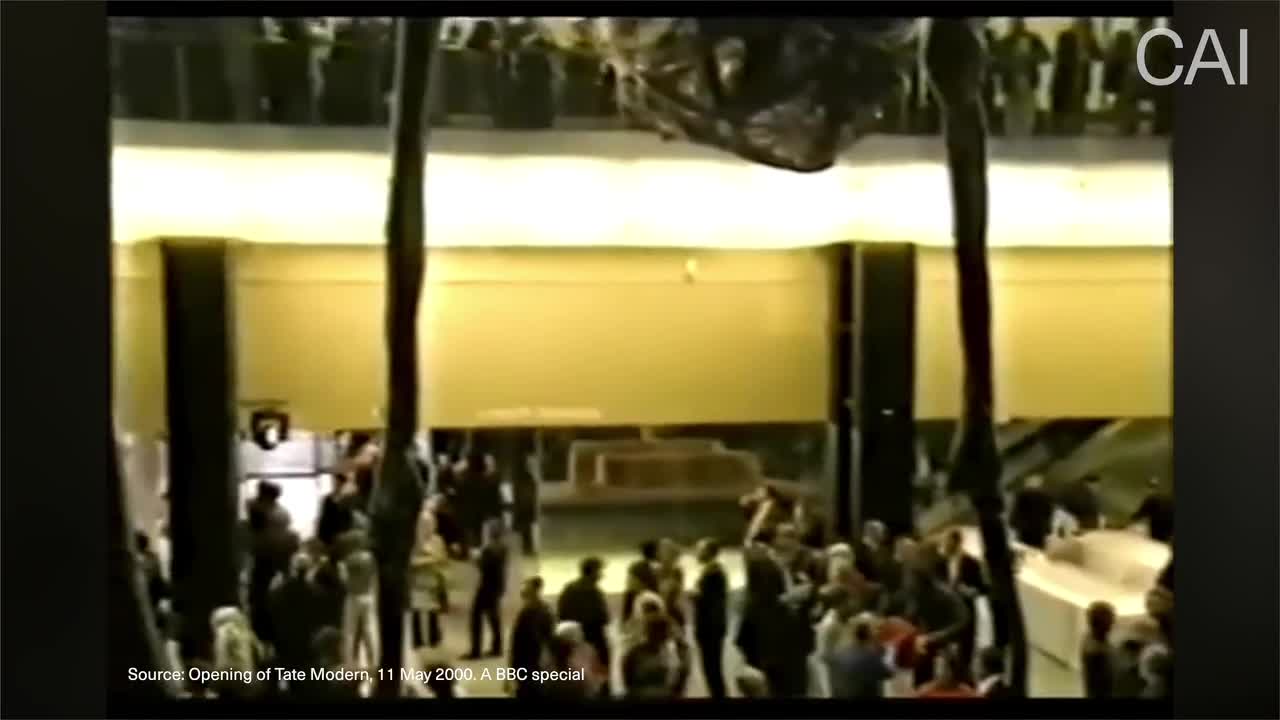
Maman was created in 1999, yet it marks a symbolic point of departure for art since 2000, having become the defining work of Tate Modern's opening in 2000 and setting the tone for culture in general in the new millennium.
The sculpture is Louise Bourgeois' largest spider.
Monumental, elegant, threatening and tender at once.
Its title Maman, the French word for mother shifts the work away from pure menace and fear towards protection and ambivalence.
That tension is what gives it such force, and is quintessential to Bourgeois' broader oeuvre.
Like a spider, my mother was a weaver.
My family was in the business of tapestry restoration, and my mother was in charge of the workshop.
Like spiders, my mother was very clever.
Spiders are friendly presences that eat mosquitoes.
We know that mosquitoes spread diseases and are therefore unwanted.
So spiders are helpful and protective, just like my mother.
Bourgeoise Maman appears as a misunderstood figure, a caregiver, labourer and bearer of psychic complexity and strength.
This is characteristic of her autobiographical practice, which deals with personal trauma, often associated with her abusive father and with a family held together by the strength of her mother.
The spider is a repairer.
If you bash into the web of a spider, she doesn't get mad.
She weaves and repairs it, arguably one of the most recognizable public sculptures of recent decades.
Anish Kapoor's Cloud Gate, widely known as The Bean, much to Kapoor's initial despair is made of 168 welded stainless steel plates, measures 33 by 66 by 42 feet, weighs 110 tons and is located in Millennium Park in Chicago.
Its highly polished exterior has no visible seams, giving the sculpture its distinctive mirror-like appearance, which reflects its direct surroundings while also transforming them through its shape a key strategy in Kapoor's practice.
The design was inspired by liquid mercury, which helps explain the sculpture's fluid and reflective form.
Its surface captures and distorts the surrounding skyline, the clouds above and the people who approach it.
Visitors can walk not only around the sculpture but also beneath its 12-foot high arch.
On the underside is the so-called omphalos, a concave chamber that multiplies and warps reflections.
In this way, Cloud Gate offers a more immersive visual experience, in which its reflective properties truly transform our experience of space form and environment.
Monahatum's hotspot is a large globe made of stainless steel and neon tube, tilted at the same angle as the earth and measuring 234 by 223 centimeters, or approximately the size of a tall person's height and arm span.
Its structure outlines the continents in red neon, bathing the surrounding space in a vivid red glow.
Delicate in material, yet intense in effect and seemingly dangerous.
The work derives much of its force from its fierce neon glow.
It appears charged with energy, as if the world itself were set ablaze.
The sculpture continues Hattum's ongoing interest in boundaries, conflict and contradiction.
The title refers to the term hotspot, meaning a place marked by political upheaval or war.
Yet hotspot suggests that such conditions are not limited to specific territories or contested border zones, as the light radiates far beyond its structure.
It presents the world as a whole as a site of tension and instability, echoing Hatoum's description of a world continually caught up in conflict and unrest.
Damien Hirst for the love of god was produced in 2007 and consists of a platinum cast of an 18th century human skull set with 8601 diamonds.
At the center of the forehead is a 524 carat pink diamond, bringing the total weight to 110618 carats.
Considering this exorbitant abundance of carrots, one can fully understand why his mother said for the love of god, what are you going to do next?
When hearing about his plants, which in turn inspired the title of the work?
Hurst takes the old memento mori tradition and pushes it into the language of branding and excess, turning mortality into something polished, theatrical and market-ready.
One could argue that this tension is precisely the work itself, as is often the case in his broader practice.
It is at once a reminder of death and a monument to wealth, vanity and perhaps overproduction.
Whether one sees it as profound or hollow, genuine or cynical, it quickly became one of the unmistakable images of 21st century art.
Pierre Igues' Untilt Ligender.
Frohe Nacht of 2012 combines a concrete cast of a reclining female nude, likely based on a sculpture by Max Weber from the 1930s, with a living beehive that gradually covers the figure's head.
Growing as a living mask.
The hive is formed by a gentle breed of bees that build wax and honey as they move between the sculpture and the surrounding area.
As a result, the sculpture is no longer fixed or inanimate, but lives, changes and interacts with its environment.
The sculpture Untilt gained further significance through its presentation as a site-specific installation at Documenta 13, where it was placed in an abandoned or untilt park in a hidden corner of the carousel.
There it appeared among other animal and organic life, including a dog with a pink leg named Human, which also featured in the artist's film Away in Untilt.
In this minimally prepared space, living and non-living elements were kind of allowed to unfold according to their own rhythms.
This reduction of artistic control and the decision to let the work live underscore, of course, the celebration and fascination of vitality.
Because after all, life is at the very center of his artistic quest.
Hugo Rondinoni's Seven Magic Mountains rise from the Mojave Desert 10 miles south of Las Vegas, as a colourful anomaly in the landscape.
The large-scale site-specific public sculpture consists of seven towers of vertically stacked limestone boulders, each standing between 30 and 35 feet high.
The stacked stones recall naturally occurring hoodoos, carns and even acts of meditative rock balancing, while their fluorescent surfaces give them an unmistakably artificial presence.
As such, Seven Magic Mountains brings together several recurring concerns in Rondinone's practice, especially his interest in natural phenomena and their reformulation in art.
It consciously positions itself in relation to the history of land art, not far from the sides of earlier works by artists such as Michael Heizer and Jean Tinguely.
Since opening on May 11 2016, the installation has drawn remarkable public attention, attracting roughly a thousand visitors each day and prompting efforts to keep it on view beyond its original two-year time frame.
Nearly a decade later, The fluorescent boulders still stand tall in the desert.
Simone Lee's Brick House is a monumental 16-foot tall bronze bust of a black woman.
The sculpture was first unveiled in 2019 as the inaugural High Line Plinth Commission in New York City, and a later edition was installed at the University of Pennsylvania in 2020.
Brickhouse belongs to Lee's Anatomy of Architecture series, in which he brings architectural forms from across Africa and the African diaspora into relation with the human body.
Here the figure's torso expands into a skirt-like form that resembles a clay house crowned with cornrow braids, ending in cowrie shells.
The figure brings together the body, architecture and cultural memory in a single form.
Its title refers to the expression for a strong black woman who stands with the strength, endurance and integrity of a house made of bricks.
She continues her broader exploration of how the body, but also society and architecture, shape and reflect one another.
Wangechi Mutus was created for the historic façade of the Metropolitan Museum of Art in New York, filling four niches that had remained empty since the building's completion in 1902.
The site-specific installation consists of four bronze sculptures, each larger than life and individually distinct.
The figures are at once humanoid and slightly celestial, with their own hands, facial features, ornamentation and patina.
Sheeted in horizontal and vertical coils that function like both garment and armor and marked by polished discs on their faces that allude to lip plates.
They bring together references from both Western and African art traditions.
In making these works, Mutu reimagines the karyatid, the sculpted female figure traditionally associated with bearing weight, whether in classical architecture or African royal objects.
Here, however, the figures are no longer burdened by that supporting role.
They are free-standing seated and self-possessed, occupying the museum's façade with authority rather than service.
Maurizio Catalan's Comedian of 2019, a real banana meant to be replaced periodically taped to a wall, has become one of the most widely circulated and controversial artworks of recent years.
First presented by Perrotin at Art Basel, Miami Beach in 2019, the work quickly became a viral sensation.
Its fame reached a new peak in November 2024, when one edition sold at Sotheby's New York for 52 million US dollars, or 624 million with fees, after a seven-minute bidding war.
As absurd as the work may seem at first glance, Catalan described it as a sincere commentary and a reflection on what we value playing within the system of the art market.
But on his own terms,
Cattelan reportedly spent about a year developing the concept, first experimenting with bronze and resin versions.
That would arguably align more closely with his broader sculptural practice.
Yet those versions felt unresolved until, as he put it, he realized that the banana is meant to be a banana.
Comedian may not have the same sculptural weight, technical refinement or visual power as his other iconic sculptures.
Precisely through its banality, Comedian became an unexpected and perhaps even unwanted icon.
One can almost imagine the artist grinning at the fact that this, of all his works, is the one that achieved such visibility.
The real authors of its iconicity are not Catalan nor Perrotin, but all of us, whose fascination and outrage, or even obsession, exposed our own complicity through the very mechanisms the work appears to mock.
If comedium is a sincere commentary and a reflection on what we value, then apparently we value spectacle and outrage.
So in the end, the comedian's joke seems to be on us.
We conclude with Tracey Emmons' The Mother of 2021, which is one of the most significant public sculptures by one of the most significant artists of the 21st century, permanently installed next to Munch Museum in Oslo.
The monumental bronze sculpture presents a kneeling nude woman facing the fjord, visible from afar over land and water.
Emin described the figure as sitting like a sphinx, waiting for the tide, looking out to sea.
At once vulnerable, erotic and protective.
The sculpture becomes a monumental image of femininity and motherhood, without losing intimacy.
The subject of the mother runs deep in Emin's work, a personal dimension that meets her long admiration for Edvard Munch, whose own mother died when he was still a child.
The mother is a central and recurring figure in her practice, bound up with love but also grief and the often complicated yet utterly powerful nature of the maternal bond.
Emmen underwent two abortions in the 1990s. the first of which was traumatic and nearly killed her.
And she lost her mother five years before completing this artwork and just two years before submitting the proposal for this public sculpture.
And by doing so, we opened and ended with a monumental oath to motherhood, absence and care.
Next time we'll be focusing on painting with 10 of the greatest, most iconic paintings of the past years of recent art history, and I also want to thank everyone for the many great conversations, comments and discussions in the comment section of our previous video, where we discussed whether or not it is still possible to create great art today and how that greatness, or rather iconicity, is being driven today with the critical reflections that i made about that in that video.
So thank you very much for watching.
Definitely have a look at that video.
Great art today.
Next, support us on patreon and please consider subscribing to stay posted for more contemporary art bye.