Imagine you're in empty space and you fire off a stream of electrons.
Well then, according to most physics textbooks, the only way to change how those electrons behave is by applying an electric or magnetic or gravitational force to them.
But most physics textbooks are wrong.
In the 1950s, two physicists came up with a clever experiment.
You could have electrons travel through a region with no electric or magnetic fields whatsoever and yet by flipping a switch, you could change their behavior.
The magnetic field could be just zero, and yet the presence of some quantity could actually lead to observable effects.
That wasn't supposed to happen, right?
This experiment split the physics community in two.
It made them question whether fields are fundamental or whether something that was supposed to be just an abstract mathematical tool was actually more core to reality.
This tool was first introduced in an attempt to solve one of the hardest unsolved problems in physics the three body problem.
That is, if you have three bodies and you know their initial positions and velocities, how will they move under the influence of each other's gravity?
It's a juicy, juicy problem which has occupied literary generations, hundreds and hundreds of years of incredibly ambitious, talented mathematicians, physicists and astronomers, and beyond.
The fact that this problem is so difficult to solve should at least be a little surprising.
Because if you have just two bodies, then the solution is easy to find.
In fact, the general case was already solved over 300 years ago by Newton himself.
But when Newton added a third body, well, that's when everything fell apart.
In the two-body case, the forces behaved predictably, always pointing toward the system's shared center of mass.
But with three bodies, this is no longer the case.
When you try to calculate the forces, they end up being extremely dynamic.
In addition to worrying about the magnitude of the forces, you also have to worry about their direction.
So you end up with this chaotic mess of vectors.
For the next hundred years, everyone who tried to solve this problem failed.
But what if there was some other way to approach it?
A way to simplify the math and not have to worry about these three-dimensional vectors?
Well, that's where Joseph Louis Lagrange comes in.
In the 1770s he was also trying to solve the three-body problem and he came up with a new approach.
It works something like this.
Say you've got a single mass, like a star.
Lagrange imagined assigning a value to each point in space around the star.
The value is determined by the star's mass and the distance from the star.
You can think of each value as a height, and if we then turn this into an altitude map, you can see how the star creates this sort of well.
What Lagrange had developed was the gravitational potential V, And what's important to note is that V is a scalar.
It has a magnitude, but no direction.
So the genius in Lagrange's idea is this.
At any given point, we can draw an arrow pointing directly downhill, where the size of the arrow corresponds to the steepness of the hill at that point.
We can repeat this process at every point, and if we then shift our perspective to two dimensions look,
What we've got is the gravitational field of the star.
Mathematically, we say that the gravitational field G is equal to the negative gradient of V.
So Lagrange had found a way to switch the problem back and forth between one of vectors and one of scalars.
And while adding up vectors is hard, adding scalars is a piece of cake.
To find the combined potential landscape of any number of bodies, you just add up their individual potentials and then you can always use that to get back to forces, if you want.
For a simple two-body system like the Earth orbiting the Sun, that combined potential looks something like this
If you look closely, you see that there are five points where the gradient is zero.
And so Lagrange realized the forces there are also zero, which means that at each of these points you could place a tiny third body and it would maintain a perfectly stable orbit.
That is, if it isn't disturbed.
These points are now known as the Lagrange points.
And while they didn't help solve the free body problem, Lagrange was developing more sophisticated tools.
In fact, he developed an entirely new way of doing mechanics.
But for that to work, he didn't just need the potential.
He needed the potential energy.
And the kinetic energy too.
I think when people hear potential, they think potential energy.
And while they're very similar, there is a subtle difference.
If you have the potential, that's basically the field corresponding to a single body, then it will have some potential field around it, which is described as p equals minus gm over... r where this is the mass of the sun but to get the potential energy we need to add in a second body so let's say that's the earth the potential energy let's call it u is basically just the potential times the mass of the second body so they're very similar but they're slightly different and the kinetic energy of the earth is simple that's of course one half mv squared So now we have everything we need to try this new method.
In fact, we made a whole video on this over a year ago.
But for now, all we need to know is that we can write down the kinetic minus potential energy to find what's known as the Lagrangian.
Then you sub that into the so-called Euler Lagrangian equation and out comes your solution.
For example, predicting the motion of a double pendulum by using the standard forces approach is infamously hard.
Because, as one pendulum is swinging, it provides the attachment point for the pendulum hanging below it.
And so that pendulum is in this moving reference frame as it's swinging.
But if you pluck the kinetic and potential energy into the Euler-Lagrange equation, then you can quickly get to a solution, at least numerically.
That's actually how we made this simulation.
I remember thinking, man, force is hard to get the right answer.
You can do it if you're good, and people who are good at mechanics can do it.
But with the Lagrangian approach you could just write down the energy, which is a scalar, not a vector, plug it into the Euler-Lagrange equation and you get the right equation to motion, and you don't have to be a good physicist.
But for all its usefulness, the potential wasn't enough to help Lagrange solve the three-body problem.
In 1887, mathematician Heinrich Bruns finally proved that the three-body problem is unsolvable.
There are simply too many unknowns and no way to simplify the problem to reduce them.
So the best we've got are computer simulations which compute the potentials from moment to moment and use that to predict how the system will evolve in time.
And so that's where we come to realize that the three-body problem is beautiful for what it's taught us, even though we now recognize that we can't actually solve for this exact problem, as many folks had hoped to do.
And in doing that, they merely gave us the machinery of modern mathematical physics.
So I'm pretty happy.
The potential helped simplify a wide array of problems.
For many physicists, it even replaced forces as their primary tool.
It became so useful that people started to wonder if other forces in nature might have a corresponding potential, starting with the electric force.
If you look at the formula for the electric force, you notice that it's remarkably similar to that for gravity, just with masses and charges swapped.
In the 1810s, Simeon Denis Poisson, one of Lagrange's students, also noticed this similarity.
And he realized that you can define an electric potential phi in a very similar way.
But there is one important difference.
And that is, while two masses can only attract, two charges can attract or repel.
So now, with the potential, you don't only get pits.
You also get hills.
But one force was much trickier to find the potential for, and that was the magnetic force.
And that's because magnetism is a fundamentally different beast from the gravitational and electric force.
Take a bar magnet.
We can draw the magnetic field it produces.
It looks something like this.
Now, at first glance, this looks very similar to the electric scenario where we have a positive and negative charge.
But this picture doesn't look at what's going on inside the magnet.
So if we reveal what's inside, then you see that these lines actually continue, but now they point from south to north.
So magnetic field lines are actually loops.
They don't have an origin or endpoint.
And that fundamentally changes things.
So physicists needed a new way to describe the magnetic potential.
The breakthrough came in the 1840s from an undergraduate student named William Thomson.
His day job as an undergraduate was to learn as much fancy calculus as possible.
And then when he learned all that, he invented more.
Thomson found that the mathematics of his day was unable to describe the relationship between a magnetic field and its associated potential.
So he came up with an entirely new function, a curl.
To see how this works, imagine the arrows of this vector field are like currents in a liquid.
If we were to place a paddle wheel right here, it would start to rotate rapidly counterclockwise.
As Thompson defined it, this spot has high positive curl.
At this spot, it would rotate clockwise, but not as rapidly, so it has lower negative curl.
And here, the current pushes on it equally in both directions, so it wouldn't rotate at all.
This spot has zero curl.
Thompson realized that the magnetic vector field B could be defined as the curl of some other vector field, the magnetic vector potential A.
Now, even though they're both vector fields, it turns out that A is often much easier to work with than the magnetic field itself, much like the other potentials, V and phi.
Thompson was showing, there was a kind of underlying mathematical structure one could use.
That would streamline the calculations.
But even Thompson thought this was a kind of device, a helpful device, and not a substitute for like the real physics.
Decades later, Thomson was elevated to the House of Lords for his contributions to science, where he received a new title, Lord Kelvin.
With Kelvin's latest addition, there were now three fundamental equations relating the potentials to their respective fields.
Thanks to each of these, you could now solve problems much easier.
And so, ever since professional physicists often use potentials instead of forces or fields to solve the problems they're working on,
Potentials even show up in some of our best physical theories of the universe.
But that raises an important question.
If potentials pop up everywhere, then do they actually represent anything physical?
That is, can they have a direct influence on reality?
Well, to most physicists, the answer was a resounding no.
Take the gravitational potential of a single star, for example.
We could just add 10 to each value of the potential, and this would shift the overall landscape.
But the change in landscape from one point to the next remains the exact same.
So the field is the same as the one we had before, and the force an object would experience at any point would remain unchanged.
In fact, we can add any constant, 10, 100, a million, and the field doesn't change.
And so the forces an object would experience going around it also don't change.
There are an infinite number of ways we could write the gravitational potential for any gravitational field and get the system to evolve in the same way.
And the same is true for electricity and magnetism.
The value of the field, and thus the force, is fixed.
But the value of the potential is arbitrary.
So from this, most physicists concluded that potentials can possibly have any physical significance.
It must just be a trick that makes the math easier.
But most physicists might be wrong.
In 1942, 23-year-old David Bohm was hard at work on his thesis in particle physics when one day he received an unexpected visit.
Robert Oppenheimer, who was David Bohm's PhD advisor, wanted to bring him squarely onto the new Manhattan Project efforts.
This was a life-changing opportunity.
Bohm would be working side by side with some of the top minds in physics.
But there was a problem.
The project's military director, General Leslie Groves, had to approve Oppenheimer's recruits.
And when he ran a background check on Bohm, he didn't like what he saw.
He briefly joined the American branch of the Communist Party when he was in California.
By his own recollections, he quit pretty quickly because he got bored.
He said, these people just sit around talking all day and don't do anything.
Even so, Groves deemed Bohm a security risk and banned him from working on the Manhattan Project.
But things got even worse.
Just as he was about to finish his dissertation in Berkeley, the topic was then classified.
He did not have clearance, so he couldn't even work on or even write up his own dissertation.
So Oppenheimer had to certify that Bohm had done good work.
And in 1943, in wartime, that was sufficient for Bohm to actually get a PhD.
After the war, Bohm became an assistant professor at Princeton University, but fear surrounding his communist sympathies followed him wherever he went.
In 1949, he was brought before the House Un-American Activities Committee for questioning.
While Bohm was under investigation, Princeton let his professorship lapse and even after he was acquitted, the university refused to reinstate him.
It seemed that Bohm was destined for obscurity.
And so Oppenheimer gave him a firm recommendation, leave the country and start fresh somewhere else.
Oppenheimer was no stranger to political persecution, and he didn't want Bohm to suffer the same fate.
So Bohm took the advice.
His journeys brought him to Brazil and then Israel.
And though he was free from the political pressures he had felt in America, he still found himself an outcast.
Many of Bohm's academic peers were put off by his more unorthodox ideas, including his radical interpretation of quantum mechanics and his new theory of human consciousness.
But there was one student who was enthralled by Bohm's approach, and that was Yakir Aharonov.
He was, first of all, extremely, extremely bright and also very nice personality.
So it was beautiful to interact with him.
When Bohm relocated once more, this time moving to the University of Bristol in England, Aharonov chose to come with him.
And it was there in Bristol in the 1950s that Aharonov and Bohm stumbled upon something huge.
For a long time, I was thinking more and more deeply about the interpretation of quantum mechanics.
It wasn't to solve any problem.
It was just curiosity.
According to quantum mechanics, at the smallest scales, particles behave like waves.
And this behavior is governed by the Schrodinger equation.
The solution to this equation is called the wave function Psi.
If you take its modulus squared, you get the probability density of finding a particle at a given point at a given time.
The left side of this equation tells you how the wave function changes over time and space.
And the right side tells you that this change depends on H, what is known as the Hamiltonian.
It's basically just the total energy of the system.
In the case where we have both an electric and magnetic potential, the solution to the Schrodinger equation looks something like this
Where this is just a constant, and this term describes the complex phase.
It looks complicated, but it's actually quite easy to get a feel for it.
So let's plot it in two dimensions for an electron moving to the right.
The different colors here represent the different phases and you can see how the phase evolves over time and space.
Thank you to Richard Beheel for inspiring this approach.
Now, if you look closely at the original phase term, you see A and phi, the magnetic and electric potentials.
So watch what happens if we add a magnetic vector potential that points in the same direction as the electron is traveling. you can see that the wave stretches out.
So now the phase changes more slowly over space than it did before.
And if the potential points the other way, then now the wave gets more compressed and its phase changes faster over space.
And a similar thing would happen if you change the electric potential phi.
Now, this by itself, I think, wasn't shocking to most physicists.
Just as you would always use the potentials to make the math easier, that's also why you use it in the Schrodinger equation.
But really, what's responsible for these, you know, even phase changes, were still the fields.
But you spoke to Aharnov.
Yeah.
And that wasn't his take.
No.
If you look at the Schrodinger equation, you can't just replace the potential phi with the electric field E.
Why not?
You're losing information.
Okay because remember, you can define any number of potentials for a specific electric field, because you can pick an arbitrary height, but that information is lost when you go and swap it out for the electric field.
There's another way to think about it.
Okay, this is getting real.
So if you have an expression like 5x squared plus 5, you'd think you could just write this as the integral of 10x.
Right, because the integral is 5x squared plus C C, right?
C is a constant, so it includes 5, but it also includes any other number.
But importantly, C is not, or at least not in every case.
So you lose this specificity when you go from a potential to an electric field.
And Aharonov wasn't comfortable with that.
So he thought, what if every quantum system was actually influenced by the potential and not by the field?
So it's the potential that shows up in the Schrodinger equation.
So it is what influences wave functions.
He had to find a way to prove that what we're observing is always because of a potential and not because of the field.
How do you do that?
Complicated.
See, Aharonov had to design an experiment that would send a particle through a region where there's no electric or magnetic field.
But there is a potential.
In such a setup, if the phase of the particle's wave function started changing slower or faster, that had to be the direct result of the potential itself.
Because there are no fields,
But that's where you run into a problem, because there's no way to directly measure the phase of a particle's wave function.
So how do you devise an experiment that can yield a measurable result?
Well, Aharonov enlisted the help of his mentor Bohm, and together they came up with the following theoretical experiment
It starts with a beam of electrons, which is split into two.
In the middle of these two beams is a tightly coiled wire known as a solenoid.
Now, solenoids have an interesting property.
When you run a current through one, it produces a strong magnetic field inside the coil and a very weak field outside the coil.
The longer the solenoid, the weaker the field in the surrounding space.
For simplicity, Aharonov and Bohm imagined a setup with an ideal, infinitely long, solenoid one where the magnetic field outside the coil is exactly zero.
After traveling on opposite sides of the solenoid, the electron beams are redirected back towards each other by the researchers.
And here, at this point, they intersect.
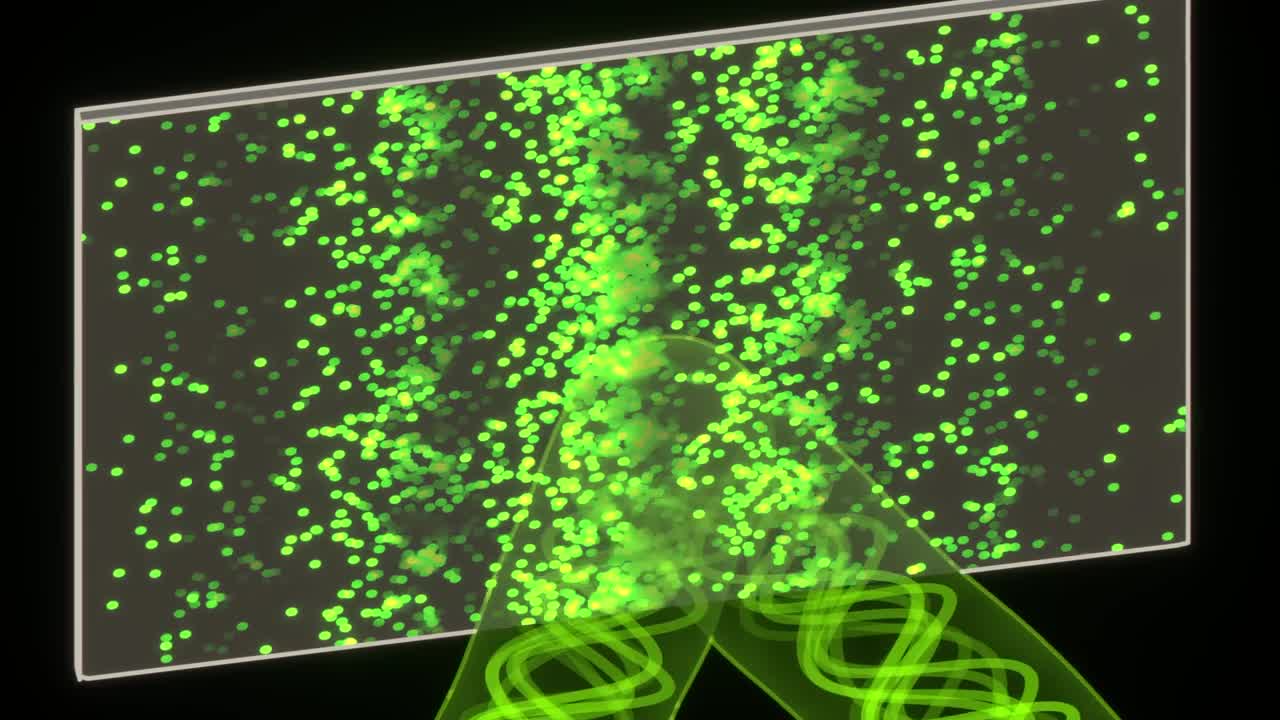
Now, since electrons behave as waves, the waves from the intersecting beams overlap and produce an interference pattern bright fringes with gaps in between them.
The exact pattern depends on the phase of each of these waves.
When the solenoid is off, there is no magnetic field in the region.
The electrons are traveling through and there is no magnetic potential.
The phase of the electrons changes in the same way across both beams, regardless of whether they pass above or below the solenoid.
And so you get an interference pattern that looks like this.
But when the solenoid is turned on well, there is still no magnetic field because it's confined entirely within the coil, but there is a magnetic potential.
That may sound strange, but remember, the magnetic field is the curl of the magnetic potential.
The curl of the potential can be zero in some region, even when the potential itself is not.
And that's exactly what's happening here.
Now, take a closer look at the vector potential.
In the space, the upper beam passes through the potential points in the opposite direction as the beam, so here the phase changes faster.
But below the solenoid, it points in the same direction as the beam, so the phase changes slower.
If the phase truly depends on the potential alone and not the field, then the phases of the two beams should evolve differently.
So as a result, the interference pattern should shift when the solenoid is on versus when it's off.
The magnetic field could be just zero, and yet the presence of some vector potential could actually lead to observable effects.
That wasn't supposed to happen, right?
What I love about this story is that it reminds me that individual people can challenge entire paradigms.
For nearly 200 years, many of the smartest minds in history all believed that potentials were nothing more than mathematical tools.
But then, two outsider physicists came along and defied that interpretation.
Confident in their approach, they took on the entire scientific establishment.
That same belief in the power of the individual is what motivated me to partner with Planet Wild.
Many of us can feel helpless when we look at the huge problems facing the Earth today.
Deforestation, plastic pollution, and the extinction of entire species.
The easy solution is just to wait around and hope someone else will do something about it.
Planet Wild gets boots on the ground to actually protect our planet, and they make it easy for anyone to join the cause, which is one of the reasons I became a member.
Another reason is that every month, we as a community fund new projects to clean up oceans, rewild forests, protect endangered species and raise awareness.
You can think of Planet Wild as crowdfunding for nature.
My favorite part?
I get to see the impact of my contributions through outstanding monthly videos which are published right here on YouTube.
Take this, for instance.
This is a Planet Wild mission in Mumbai.
It's a scalable technology that stops plastic at the source, preventing 10 tons from reaching the ocean every month.
Planet Wild invested over 100000 in this, and that money didn't come from governments or corporations.
It came from ordinary people like you and me.
You can sign up for whatever amount feels right for you and cancel any time.
The first 150 people to sign up using my code VERITASTIUM1 will get their first month paid for by me.
Just scan this QR code or click the link in the description.
If you're interested in the science behind their projects, then go check out their YouTube channel.
I'm leaving the link to the plastic cleanup mission in the description.
And now back to the mystery of the potential.
Aharonov and Bohm published their findings in 1959, and the reception was mixed.
Even Niels Bohr, one of the founding fathers of quantum mechanics, found it impossible to accept that a particle could be influenced by a potential in the absence of any force.
But some physicists supported Aharonov and Bohm.
Richard Feynman wrote, Feynman included himself in that statement.
He later wondered why he had never noticed the effect.
Physicist Viktor Vyskov had a similar response.
The first reaction to this work is that it's wrong.
The second is that it's obvious.
Ultimately, there was only one way to settle the debate.
Someone had to actually do the experiment.
The first to try was a colleague of Aharonim and Bohm's at the University of Bristol, Robert Chambers.
Chambers' experiment largely followed the setup Aharonov and Bohm proposed, with one notable exception.
An ideal solenoid would have to be infinitely long, which is physically impossible.
So instead Chambers used a tiny needle-like piece of iron, about a millionth of a meter thick and 500 times as long.
When this iron whisker was magnetized, it produced a magnetic field that was strong within the metal itself but negligible outside of it, as well as a magnetic potential in the surrounding region of space.
To get a baseline interference pattern, Chambers fired two beams of electrons around an empty region of space.
Then he added the magnetic whisker.
When he fired the beams again, the interference pattern shifted.
It seemed that Aharonov and Bohm were right.
But critics were unconvinced.
Maybe a stray field was responsible for the effect, not the potential.
And that's throwing no shade on their colleague who did these cool experiments.
It's like, it's hard, it's really hard.
And so it went for several decades.
Experimentalists repeatedly tested the Ahirana-Bohm effect, but each trial had flaws that left the result open to debate.
Until.
In 1986, a team of Japanese researchers led by Akira Tanimura came up with a new way to do the experiment.
See, they used a tiny donut-shaped magnet to make their magnetic field.
With a perfect torus, all the magnetic field is contained within the loop.
Outside it, it's absolutely zero.
And as an added layer of protection, the team also coated the entire magnet in a layer of superconducting niobium, which would block out any leaking fields.
Now.
Previous experiments relied on turning a magnetic field on or off, but Tonomura's team took on a different approach.
In their case, the magnet is always on, but because of its unique shape, the potential outside the torus is different from the one in the center.
It points towards us on the outside and away from us on the inside.
The team realized they could take advantage of this.
They started by firing off an electron beam which was actually wide enough to be treated as two separate beams.
Part of it traveled along through empty space and functioned as the control, whereas the other part washed over the entire torus.
What's important here is that the beam is wide enough so that part of it passes around the torus and part of it passes through.
Then, at the end, a biprism deflects the electron beams toward each other.
They intersect, and this is where they create an interference pattern.
Now, think about what this interference pattern should look like.
Well, for starters, there should be a shadow of the torus, so we can fill that in.
But the rest?
Well, it depends on whether the Aharonov-Bohm effect is real or not.
If it's not real, we'd expect to see an interference pattern that looks something like this, where the pattern outside the torus and in the center match up.
But if it is real, then the electrons that traveled through the center would have experienced a different potential, which would have shifted their pattern by half a phase.
So that should look something like this.
Now, here are the results from Tanumura's experiment.
You see these are the interference fringes inside and outside the magnet.
And then, if you follow, what is a peak outside, the torus lines up with a trough inside the middle and then it's a peak outside again.
And that's exactly what they predicted.
This is exactly what they predicted.
So it's real?
It's real.
Only the Tanumura experiment was really the final proof, experimentally.
And yet, soon a new debate emerged.
The effect is real, sure, but how should we interpret it?
What is it really telling us about the nature of the universe?
Today, physicists largely fall into one of two camps.
The first camp claims that potentials aren't just mathematical conveniences they can influence physical reality.
This is the perspective initially favored by Aharonov and Bohm.
As they wrote in the abstract of their paper, contrary to the conclusions of classical mechanics, there exist effects of potentials on charged particles even in the region where all fields vanish.
Some take this position a step further.
Since the potentials show up in the Schrodinger equation and the fields do not, they argue that the potentials are more fundamental to physics than fields are.
Richard Feynman supported this idea.
He wrote, A is as real as B, realer, whatever that means.
I mean, I kind of like that interpretation, but something about the potential bothers me, and that's the fact that you can set the potential at any arbitrary height.
It can be plus infinity, it can be minus infinity, anything in between.
So wouldn't that change, you know, how the potential actually influences the wave function?
This bothered me too, so much so that I actually ended up asking a professor about this.
But it turns out it can't.
It knows it's not just the potential that's entering the observable, it's the line integral.
So it's only A that enters, it's not the magnetic field.
B vanishes, it's only A, but it's not A alone.
It gets a little technical here, but, you know, if I pull up, you know, As one does.
As one does.
A flip chart.
Now we can actually run this.
So if you look at how the potential shows up, then what's measurable is not the phase directly, but it's the phase shift.
Call it delta theta.
Then the phase shift is the line integral of A over the path or dotted with the path.
So you get this.
Now you can imagine, okay, let's add a constant to this.
And if our setup is roughly, you know, we start here.
One electron beam goes like this and the other one goes like this, and these are symmetric, then the potential here will point, let's say, in this direction, but here it will point in that direction.
Let's say instead of a, we do a plus c, some constant.
Then when we're taking the path this way, we'll be adding that c, and we'll be dotting it with dx.
But because that path is the exact same.
When we go this way, We just subtract it, so it cancels out.
So the potential yeah, it does show up, but in such a way that all the arbitrariness of the potential it cancels out perfectly.
Okay.
It's a geometrical quantity involving A that has taken care of, for which all that residual ambiguity has literally cancelled out.
The potentials being physical might sound strange, but the second interpretation is even stranger.
Physicists in Camp 2 maintain that potentials really are just mathematical objects and the fields are responsible for the effect.
But in Tonomura's experiment, the magnetic field was completely confined within the solenoid.
For this interpretation to be true, its supporters are forced to assert that fields can act non-locally.
That is, a field can influence things outside the region of space where the field itself exists.
Many physicists find this idea difficult to swallow.
I think the idea of saying that these fields act non-locally undoes the reason why we have field theory right.
The great triumph of field theory, which has served us so well for more than 100 years, is this notion, stubborn notion, that local causes yield only local effects.
And yet, Aharonov's own perspective has shifted from camp one to camp two.
Where we promised the article, We call this the effect of potentials.
When you use potential and use the Schroeder representation, it looks as if everything is local, but it's misleading because that's local.
While non-locality remains a controversial idea, a sizable portion of physicists do side with Aharonov.
And the debate continues to this day.
I maybe have a third interpretation.
Good.
And I would love to get your thoughts.
And if it's bad, please tell me honestly.
Okay.
So we did this other video about particles essentially exploring all possible paths all at once.
And so right now we're saying either the potentials are real or fields are acting non-locally.
But what if there's a third option, where the fields are still local and it is the fields that are affecting the change, but rather it's the particles that are exploring all possible paths all at once?
You could potentially even have some quantum tunneling effects going inside an area where there are fields.
You know, as the electron or the wave function at least, explores all possible paths, gets influenced by those slight bits where the wave function is inside the field.
I actually don't think that's ridiculous, Caspar.
That's how that's for a strong ringing endorsement.
I think there's a lot to that.
Okay.
If we could think about these things as it is indeed the quantum phase that's being affected.
Yeah.
We can describe that phase in terms of quantum mechanical path integrals.
I think that's a perfectly reasonable way to frame it.
So yeah, I'd buy that.
That's awesome.
I'm pretty sure this isn't the complete answer, but one thing which would be cool is if someone else takes this idea, you know, or maybe it gets inspired by it and they're like, actually that doesn't work, but here is how it does work.
And now we're closer.
That's right.
That would be the best possible outcome.
Well, the best possible outcome is you're just right.
But the second best possible outcome is that that nudges the community more broadly to ask new questions of familiar material.
That's right.
One new question the community asked was, is there also a gravitational version?
In 2022, researchers at Stanford tested this.
A simplified version of their experiment works something like this.
They shut up ultra-cold rubidium atoms into a tube-shaped vacuum chamber, at the top of which was a tungsten mass.
Now, atoms, like electrons, are also governed by a wave function.
So they split each rubidium atom's wave function into two distinct packets and they launched them to different heights.
One was sent really high and got close to the mass, whereas the other didn't.
And then when the two collided at the bottom, this created an interference pattern.
And when they let this interfere and accounted for all other effects, they could clearly see the phase shift as predicted by Aharnov and Bohm.
So it seems like the gravitational Aharnov and Bohm effect is real.
If the results hold up the scrutiny, this is a huge finding.
Because it suggests that the electromagnetic and gravitational potentials can influence reality at the most fundamental scale, even when all the fields are exactly zero.
So does that mean that most physics textbooks are wrong or need updating?
Don't throw out all the textbooks.
They're beautiful.
We learn a lot.
But that doesn't mean we're done.
And we should be open to surprise.
And just because things haven't changed in, let's say, 200 years roughly between say, Lagrange and Aharna Foam, they still could change right.
And they can sometimes change in beautiful and surprising and very powerful ways.
I read somewhere that the reason you decided to do the AB effect was that you didn't really think potentials were something.
That was just a mathematical tool, like most scientists believe.
That is correct.
I was very ignorant, luckily.
Sometimes it's good not to know too much.