Grownups, Wondery Plus subscribers can listen to Wow in the World early and ad-free right now.
Join Wondery Plus in the Wondery app or Wondery Kids Plus on Apple Podcasts.
Hey, Wowzer fans, Mindy here.
And before we start the show, I gotta let you know that this November, with a special new episode featuring our friends at Circle Round and Terrestrials on Radiolab for Kids,
And don't miss when Elmo from Sesame Street stops by Wow in the World to make us all belly laugh on November 24th.
Oh, but that's not all, Reg.
On December 1st, we are sharing our 250th episode of Wow in the World with all of you.
We think this one is going to be music to your ears.
Literally.
Did I mention it's a musical?
And if you're a member of the World Organization of Wowzers...
Oh boy, do I have a surprise for you.
You can listen to our 250th episode early with me and other members from around the world on Saturday, November 22nd, at 7 pm.
Eastern.
That's right, we are throwing another listening party.
Join us as we dance along to our new songs.
React to the episode with other members in the chat and more.
Grownups.
If you want your wowzer to join this members-only listening party, you can sign up to become a member today at Tinkercastcom.
Slash wow.
Already a member?
Well, you can find the link and password to join the event when you sign in at Tinkercastcom.
Slash wow.
That's it.
It's going to be a November to remember.
But for now, let's get on with the show.
Woo!
Carry out your pencils and a fresh sheet of parchment, for Tinker Class is about to begin.
Hello Wowzers and welcome to Tinker Class, a hands-on crash course in Fun 101 for the science seekers and inventoritos of tomorrow.
I'm Mindy.
And I'm Guy Raz.
And for the next three weeks we'll be leading you through week-long projects to get you thinking and tinkering, just like the scientists we feature on Wow in the World.
And for these projects you'll need some junk found around your home, a bunch of curiosity and some untamed imagination.
So let's get started.
Our project this week was inspired by our Wow in the World episode...
And while you're listening, you might want to write down questions and ideas that come to mind, because they might become helpful when we get into the tinkering later this week.
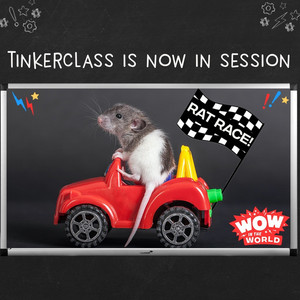
And then meet us back here tomorrow for day two of this week's Tinker Class, when we'll take what you learn from this episode and use it in a project that might just have you creating a Mindy 500 motor speedway of your own.
But before we get to that, please enjoy as Wow in the World presents Rat Race.
Enjoy!
And remember to meet us back here tomorrow for day two, so that we can get this week's project party started.
And grown-ups.
If you'd like a printable to go along with these free daily project prompts, visit Tinkercastcom slash membership to find out more.
Thanks for tinkering with us.
Now go forth and keep on wowing.
3, 2, 1, ignition.
Good morning, grown-ups. in the morning on K-W-O-W 97.3, The Know.
Yeah, where we play new hits and old farts.
Here's a new track from the elevator music sensations, The Elevates.
It's called You Lift Me Up.
Literally.
Oh, yes.
New music from The Elevates.
Mindy?
Mindy, you're driving.
What?
Oh, man.
These blackout sunglasses mixed with your elevator music just really lull me to sleep.
Look out!
We're getting a report that says traffic is backed up on Highway 1000.
Get out of the way!
Oh, boy.
You know what that means.
Peanut butter and traffic jam sandwich giveaway.
That's right.
The 10th person to call the studio and say, I'm stuck in a traffic jam and I'm hungry.
We'll get a peanut butter and jam sandwich.
Yeah, now we go live to a traffic update from our snoop in the sky, Dennis.
Dennis?
Hi.
It's me, coming to you live from the traffic copter.
And I've got to say, the traffic up here looks fantastic.
Completely clear skies, nothing in our way.
Dennis, no, man.
You're supposed to tell us what the traffic looks like on the highways, not in the sky.
Oh, oh, oh, oh, oh, oh.
Well, in that case, it's awful.
Cars everywhere.
People are honking.
And yelling... Oh, yeah, sounds like it.
Ooh, there's one car that looks to be the cause of all the traffic.
It's heading north towards the junkyard.
Oh, something just broke off of it.
What?
Oh, man, there goes my door.
Uh... What was that?
There goes the engine.
Well, lucky for you, Mindy, it looks like we made it to the junkyard just in time.
Woo-hoo!
Wait, were we coming here to drop off your car before it...
Are you calling my new vehicle a piece of junk, Guy Raz?
Well, several pieces of junk, actually.
Where did you even find this thing?
I made it.
You made it?
Yeah, with my 3D printer.
You see, I had been on the hunt for a new ride that had the comfort of a school bus mixed with the style of a minivan and the speed of a Ryder lawnmower.
Huh, and you couldn't find anything already built? built that met that criteria?
Nope.
So I had to print my own.
Look, it even has a waffle maker in the glove compartment.
Well, despite the fact that it falls apart every time you touch it, I'd say you tried your best.
Yeah, well...
Hey, at least the radio still works.
What?
It's a real rat race out there today.
Who do you think would win in a rat race?
Master Splinter or Pizza Rat?
Sure, definitely Pizza Rat.
That rat knows how to use public transportation.
Actually, dude, get a load of this.
Have you heard that scientists have taught lab rats how to drive?
What kind of cars do they drive?
Mercedes Benz?
I don't get it.
Kill me.
Wait, do you think that's true, Mindy?
What?
That rats can now drive cars for science?
Oh, yeah.
In fact, I was just reading about this.
So these researchers from the University of Richmond in Virginia built these little, teeny tiny cars out of clear plastic containers, gave them to a mischief of rats and taught them how to drive.
Wait, did you say a mischief of rats?
Oh, yeah.
A mischief is what you call a group of rats.
Or maybe a group of mischievous Mindys.
Anywho, this is actually the reason I drove you to the junkyard today.
So we're not here to drop off your homemade car?
No way!
We're going to drag this baby back to the laboratory of bad ideas, so I can reprint all the parts that fell off.
Oh.
But now that I've found my calling in life... Which is?
Building cars!
Oh, right.
I'm going to build... bunch of tiny race cars for rats and turn my basement into the Mindy 500.
You mean the Indy 500 Motor Speedway?
No.
How did I let you drag me into this?
I didn't drag you, Guy Raz.
I drove you.
Remember, the engine fell out.
Okay, let's get this over with.
What are we looking for here?
Okay, let me just check my list here.
First thing we'll need is three Tons of aluminum.
Uh, I feel like maybe you're going a little overboard on the aluminum.
Oh, Guy Raz, when have you ever known me to go overboard on anything?
Well, where do I begin?
Don't answer that.
Next, we'll need 400 pounds of copper.
Ooh, how about those copper pipes over there?
Oh, perfect.
Where should I dump these copper pipes, Mindy?
Uh, in the trunk.
Are we seriously going to drive this car back to your gingerbread house?
Uh, gingerbread mansion.
Oh, right.
Next, we'll need 672 bowls of fruit hoops.
Can't we just pick them off the walls of your gingerbread mansion?
Well, I guess it is kind of due for a renovation.
You know what?
Yes, we can pick the fruit hoops off the indoor kitchen gazebo.
OK.
Anything else on your list?
Uh, oh, 33 garbage patch doll toy cars.
You know, I remember the year I got a garbage patch doll for my birthday.
I was five years old and she came with a little tiny pantsuit just like mine.
Identical right down to the elbow patches and sensible shoes.
Let's play with care and restraint.
Oh, come on.
We've got to look. check off here.
Right, right.
33 garbage pack doll cars.
Uh, is it okay if they're a little broken and sticky?
Yeah, we're in a junkyard.
I'm just gonna strip them for parts.
Sorry.
I could only find 24.
Eh, that'll do.
And let's see here.
The final item on my list is 33 rats.
Oh, no.
I am not going on a hunt to find a whole mischief of rats.
Aw, I'd never ask you to do that, Guy Razzi.
Phew.
Thanks, Mindy, because I thought... Because the rats are going to find you.
What?
Ah, Mindy, I... I filled your pockets with ham.
This is way more than 33 rats, Mindy.
Now, we need all of you rats to line up single file and hop into the back seat one by one.
And no funny business.
Mindy, there's one climbing into the driver's seat.
There's a rat behind the steering wheel, Mindy.
Don't worry, Guy Raz.
The engine fell out, remember?
Oh, then how are we going to get back to your gingerbread house?
Mansions?
Mindy, you have a broken car with no engine.
And a working radio.
Coming up next, we prank call a fax machine.
Uh, hello?
Yeah, it's 1994 calling.
Anywho, it's going to take me at least a day to put a new engine in this baby, so I just texted my sleigh cats.
They should be here to pick us up right about now.
Debbie, Donna, Pam, Miss Dixon, Carol, Cheryl, Janice, and Steve.
Slay cats and rats?
Hey, Roz, help me dump all this junk in the trunk.
Three tons of aluminum.
400 pounds of copper pipes.
24 garbage patch doll toy cars. and a mischief of 33 rats.
Get in there, get in there.
Guy Raz, you ready to kick it?
You know what?
It's a little crowded in there.
Maybe I'll just call an uber to come pick me up.
An uber?
Reggie!
Last one to the gingerbread mansion is a pigeon egg.
Play Cats, you know what to do.
Now Debbie, now Donna, now Pam and Miss Dixon.
I'm Carol!
I'm Cheryl!
I'm Janice!
And Steve!
Okay, Reggie, well, I've never flown you without Mindy.
I guess, um, here I go?
Whoa!
Hey, Mindy, what took you guys so long?
Reggie and I landed about 30 minutes ago.
I even had time to pick all the fruit hoops off the gazebo in your gingerbread house.
Mansion!
You do realize, your sleigh cats pulled your car right through your front door and now it's broken into a million tiny crumbs.
I know.
I trained them to do that.
Now, who's ready for the Mindy 500?
Uh, what do you want me to do with these fruit hoops?
Oh, just bring them down to the basement.
We'll need them soon enough.
Follow me, everyone.
What about the sleigh cats?
Oh, I'm paying Dennis to walk them.
Okay, come on, kitty cats.
Debbie, Donna, Pam, Carol, Cheryl.
Ah, Steve.
Ow.
I was getting to you.
Thanks, Dennis.
See you in three hours.
Come on, Guy Raz.
Let's get downstairs.
Walk, walk, walk, walk, walk, walk.
Ladies and gentlemen, rats and one pigeon.
Behold, the mingo.
Whoa, Mindy, this is an exact replica of the Indy 500 motor speedway.
Just look at this racetrack.
Incredible.
Yeah, I 3D printed the entire brickyard track.
And once we build these tiny rat cars, we can turn the greatest spectacle in racing into the greatest spectacle in science.
Speaking of science, you mentioned earlier that researchers at the University of Richmond trained lab rats to drive.
Yeah, and I was so inspired by their research that I decided to try out their experiment on my own Mindy style.
Of course you did.
Okay, so first things first, we need to build 33 tiny cars just like the researchers did.
Okay.
Only they built them out of plastic containers and we're building them out of parts from garbage patch doll cars.
And what about the three tons of aluminum foil that you had me drag through a junkyard?
Oh yeah, just like the researchers did, I'm using the aluminum foil to build the floors of the cars.
And the 400 pounds of copper pipes?
So you're just going to chop them up and then twist them into tiny steering wheels, okay?
You want me to bend copper pipes into tiny steering wheels?
Wearing wheels for rat cars?
Just do your best, Guy Raz.
Okay.
And while you handle that, I'll be stripping these garbage patch doll cars for parts and building the bodies of the ratmobile.
Okay.
That should about do it.
33 Tiny Cars.
Copper steering wheels.
And 33 tiny rat mobiles to put them in.
Oh, wow, Mindy.
Okay, now it's almost time for the rat race to begin.
Guy Raz, will you call the rats over here and tell them to strap into their seatbelts?
Oh, uh, sure.
Um, hey, you rats.
Um, we built you tiny rat mobiles and, uh... Whoa, whoa, whoa, whoa!
Now, before we get started, allow me to explain how these rat mobiles work.
In order for these cars to move, they need electricity.
Got it.
So I replicated or copied the way these scientists at the University of Richmond built their rat cars.
OK, but how does the electricity part work?
Well, the car has a battery that is connected to the floor of the car, which is made out of aluminum.
Wait a minute.
I think I'm starting to figure this out.
When the rat stands on the aluminum floor, a small amount of electricity starts to travel up its body.
Yeah, you're on the right track.
And so the rat is sort of acting like an electrical wire when it touches the copper steering wheel.
Exactoritos, Guy Raz.
Once the rat touches the steering wheel, it will allow the electricity to travel from the battery through the rat's body to the copper steering wheel, which will Which will make the car move.
You know it.
And as their ratmobiles move forward down the racetrack, they'll be able to steer them in different directions.
Wow, I knew that rats were smart.
I mean, they're famous for finding their way out of mazes, but driving their own cars?
I have to admit, I never saw that one coming.
Or that one.
Oh, rats!
Hit the brakes!
Hit the brakes!
Back to the starting line for you, buddy. rat almost ran me over, Mindy.
Now, rats, listen up.
To compete in this rat race, you must complete four laps around the track.
First rat to cross the finish line will get to dive into a pool of all-you-can-eat fruit hoops.
You know, Mindy, fruit hoops do contain a lot of sugar.
Guy Raz, fruit hoops are exactly what those researchers used to entice the rats in their experiment.
The sugar is for science, Guy Raz.
On your marks, get set... Whoa!
Look at them go, Mimi!
And hey, look!
There are other rats cheering them on from the stands!
Are they wearing little foam cheering collars?
Yeah!
Yeah!
Go, rats!
I'm so nervous!
I'm so nervous!
This is so exciting, Mimi!
I...
We do?
And, folks, it looks like we have a winner.
Our champion of this year's Mini 500 just crossed the finish line at a blazing 230 miles per hour.
Unbelievable!
If you blinked, you missed it.
Behind the wheel of neon green car number 10, it's Danica Rattrick!
Did you say Danica Rattrick?
Gyros, tell our champion what she's won!
Well, Danica Rattrick, you have won yourself an all-you-can-eat deep dive into a pool of fruit hoops.
Ms.
Rattrick, any words for your adoring fans?
Danica Rattrick would like to thank her fans for cheering her on today.
She also says that before the race began, she was feeling stressed and anxious.
But that all melted away the second she started driving.
Congraturitos, Danica Ratrick!
Now go get those hoops!
Wait a minute.
Is this what the researchers noticed about the lab rats as well?
That they become more chilled out and relaxed behind the wheel?
Actually, yes.
What they discovered was that, when they compared the driving rats with the non-driving rats, The driving rats had higher levels of a stress-busting hormone known as DHEA.
And by hormone you mean a chemical substance made in one part of the body that acts like a messenger to other areas in the body.
Exactoritos, Guy Raz.
That DHEA hormone was telling the brain that everything was cool as a cucumber.
So how were they able to find this out?
Well, they studied the rats... you know.
Uh, yeah, what?
You know, they're... They're what, Mindy?
They're poop, Guy Raz.
They studied the rat's poop.
They examined the rat's poop?
Anything for science.
I'll say.
But I have to wonder Mindy, what are these researchers hoping to do with this new discovery?
I mean, are we going to start seeing rat Car dealerships popping up on every corner, because there are a lot of rats out there and getting them all driver's licenses could take years, actually centuries.
And No no no no no no, Guy Raz.
It would be impossible to give every single rat on planet Earth its own car.
So then what?
Pack them onto buses?
Let them take turns driving?
No, Guy Raz.
These researchers are hoping to use what they learn from the rats to help us humans.
Go on.
Okay, so hear me out for a second.
See, rat brains and human brains aren't really all that different.
I mean, we both have a lot of the same areas and some of the same chemicals in the same places, but of course our brains are much, much bigger.
So rat brains can serve as pretty good models of the human brain?
Well, yeah.
I mean, they're at least a good starting point for researchers.
And by discovering that rats could not only learn to do something as complex as drive a car, but that driving the car actually helped the rat to feel less stressed and more chill, then maybe, Then maybe learning and doing something new could do the same for us humans.
You know it.
Next, these researchers are planning to study how in the world these rats are even able to learn how to drive and
Why in the world it lowers their stress levels?
And the answers could lead to a new scientific discovery that might help to keep us humans mentally healthy in stressful times.
Guy Raz, do you think they're going to have to search for that stress-busting DHE hormone in human poop?
Because I just... Nope.
Stop right there.
Oof.
It's Bongo and the Big Toot on K-W-O-W, The Know.
Did you install radios in the rat mobiles?
Whoa-ho-ho!
Big day at the Mindy 500 Motor Speedway.
We got rats driving cars!
Look out!
Yeah, that's right.
We now go live to race day down in the basement of Mindy's gingerbread mansion.
Dennis, what can you tell us?
Dennis?
Hi, it's me, Dennis, here at the Literal Rat Race.
I've been granted an exclusive interview with the winner, Miss Rattrick.
Ah!
Steve!
No!
Get out!
Ow!
Steve!
I walked you for two hours!
Well, well, it looks like we lost our connection.
Coming up next on Bongo and the Big Toot music from the Rat Pack, Modest Mouse and Rat Dog on KWOW The Noon.
Wow in the World will be right back.
Grown-ups, this message is for you.
Hey, grownups, it's Mindy and Guy Raz here from Wow in the World.
Mindy and I have some brand new Wow in the World toys out in the world just in time for the holidays.
Made for the kids who love science and for the ones who don't yet.
From our 100 experiments, that wow kit to the telescope and astronomy kit, our wow in the world toys help your wowser learn about their world through play plus.
You can hear exclusive audio content from me and guy ross to help your wowser discover even more wows grown-ups.
Give the gift of wow and wonder this holiday season with our latest wow in the world toys, designed with your curious wowser in mind.
You can shop our wow in the world toys at tinkercastcom slash toys.
That's tinkercastcom slash toys.
That's it back to the show.
Hi Mindy and Guy Raz.
My name is Caleb, and I live in Tom's River, New Jersey.
My wow in the world is black holes eat galaxies.
That's so cool.
Bye, Mindy and Guy Raz.
Hi, Mindy and Guy Raz.
My name is Zaya, and I live in Tacoma Park, Maryland.
My wow in the world is that the temperature in outer space is negative 27042 degrees Celsius and negative 45475 degrees Fahrenheit.
Say hi to Reggie, Grandma G-Force, and Dennis for me.
Ahoy there.
Bye.
Love your show.
Hey, Mindy, I was.
My name is Elliot from New York City, and my wow in the world is that some people can hear their eyeballs moving.
Crazy.
Goodbye.
Hi, Mindy.
Hi, Guy Ross.
My name is Shaina.
I live in San Francisco, California.
My wow in the world is that a hummingbird can flap its wings 80 times in one second.
Say hi to Dennis and Reggie for me.
Bye.
I love your show.
Hi, my name is Quindy.
I live in Tuscaloosa, Alabama.
My...
Wow in the World is.
Out of Pluto's 248-year orbit, 20 of those years are spent closer to the sun than Neptune.
Hi, I'm Indian Guy.
I'm Javier.
And I'm Mira.
We live in Stillwater, Minnesota.
Our Wow in the World is that penguins poop so much that it can be seen from outer space.
Bye-bye.
Say hi to Reggie for us.
Hi.
Hi, Reggie.
Hi.
Love your show.
Love your show.
Hi, Mindy.
Hi, guys.
My name is Matias and I'm from the Dominican Republic, and polar bears are the biggest carnivores on land, because grizzly bears are omnivores.
The end.
End of messages.
Thank you so much for hanging out with us this week on Wow in the World.
And to keep the wow rolling, check out this week's scientific conversation starters at our website wowintheworldcom.
And grownups.
There you can find more info on how your kids can become members of the World Organization of Wowzers shop, our wow shop.
Upload photos and videos to us and check dates for our upcoming live events.
That's wowintheworld.com.
Our show is produced by Jed Anderson.
Who provides the bells, whistles, and silly characters.
Say hello, Jed.
Hello.
Our show is written by me, Guy Raz, and Thomas Van Kalken, who also provides silly characters.
Tom?
Hello there.
Thanks also to Jessica Bode, Anna Zagorski, Rebecca Caban, Kit Ballinger, and Alex Curley.
Meredith Halpern-Ranzer powers the wow at Tinkercast.
Our theme song was composed and performed by The Pop-Ups.
For more on their three-time Grammy-nominated all-ages music, find them at thepopups.com.
And grown-ups, you can follow Wow in the World on Facebook, Instagram, and Twitter at wowintheworld.
And our email address is hello at wowintheworld.com.
And if you're a kid with a big wow to share with us...
Call us at 1-888-7WOWOW for a chance to be featured at the end of the show.
Also, if you haven't already done so, please subscribe to Wow in the World on Apple Podcasts or wherever you get your podcasts.
Yeah, leave us a few stars, a review, or just tell a friend about the show.
Thanks again for listening, and until next time, keep on wowing.
Jinx!
And before you go, tell us about yourself by filling out a short survey at wondery.com slash survey.