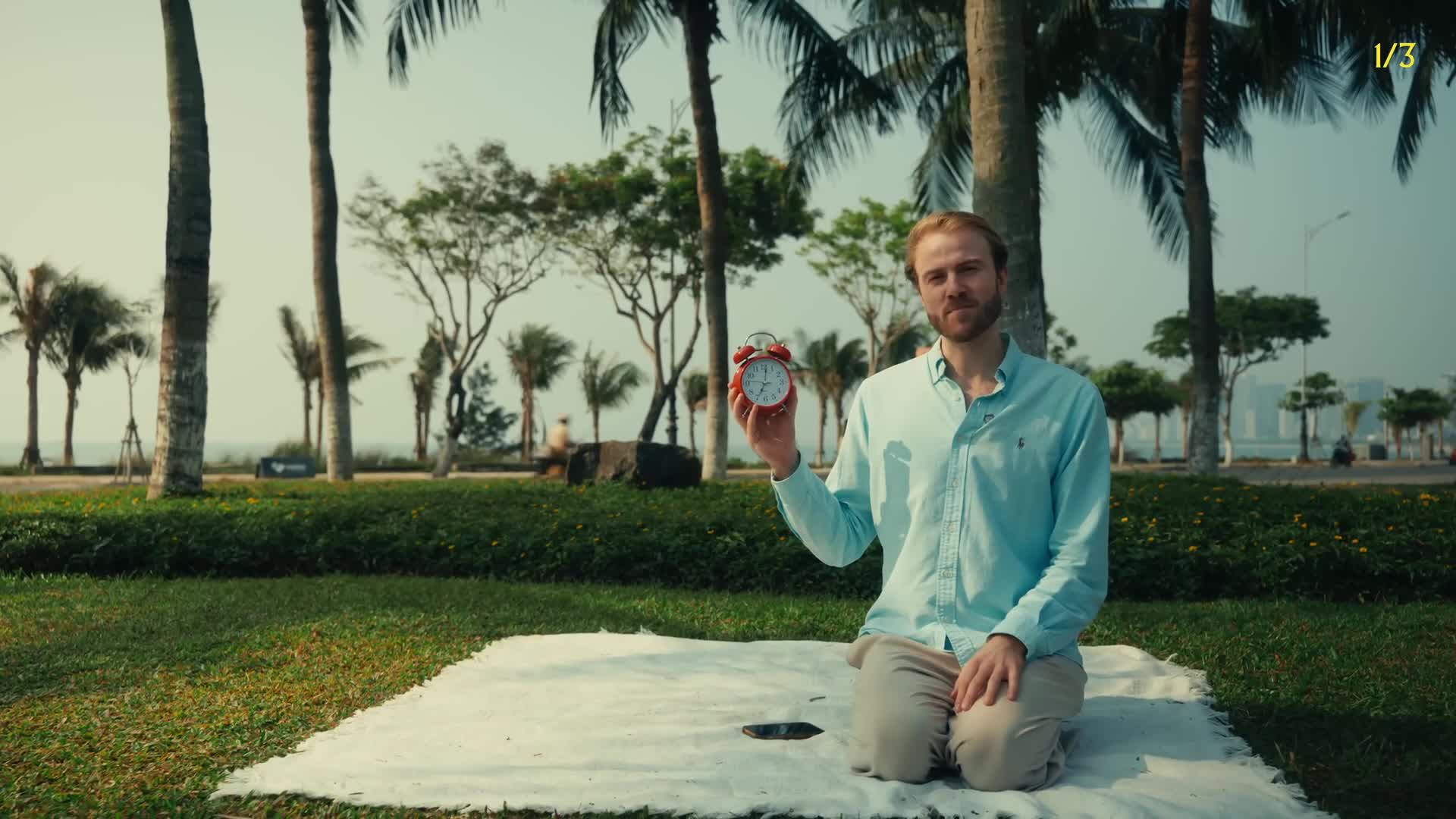
In England, we don't say 6.30.
We say half six.
We don't say, wait a minute.
We say, one sec.
In this video, I will teach you everything you need to know about time.
What other ways can we say, what time is it?
Well, it depends on the situation.
For example, if you're at work, you might say, Luigi, do you know what time it is?
If you're asking a stranger in the streets, you would say, Excuse me, have you got the time?
And if you're asking a close friend or a family member, you might say... What time is it?
Got the time?
It's seven o'clock.
Or is it?
Actually, it's more natural to just say it's seven.
And at seven, I like to... Do the horse stance for five minutes.
Read a book for five minutes.
And finally, meditate for five minutes.
Oh look!
It's seven fifteen, or as British people say, quarter past seven.
Now I'm going to show you a simple way how to tell the time in Britain.
On the right of the clock, we say past.
On the left of the clock, we say two.
Halfway round, we say half.
And by the way, these are called hands.
Big hand, little hand.
So, right now, it is five past seven.
Five past seven. now it's ten past seven, quarter past seven.
Fifteen minutes later, it is half seven.
Fifteen minutes later, It is quarter to 8.
And remember, on the left side of the clock, it's 2.
So it's 15 minutes to 8.
It's quarter to 8.
Now it's 10 to 8, 5 to 8, and 8 o'clock.
Morning.
Morning.
In real life conversation it's more common to hear British people saying morning instead of good morning.
Morning is less formal and more friendly.
Now, what am I having for brekkie?
Brekkie is slang for breakfast.
For brekkie, I'm having a croissant with mulberry jam and butter.
I'm having an oat milk latte in a mug with a little biscuit on the saucer.
There is also a silver teaspoon.
I'm grabbing the handle and picking it up.
Now I'm taking a sip of my latte.
Jay, have you got the time?
Mm-hmm.
It's half eight.
And at half eight, I love... to write.
They say that writing helps you think clearly.
I like to write in the morning as a nice and gentle way to start the day.
I usually free write and today I'm going to write about my environment.
I'm surrounded by greenery.
The trees are covered by plants and the air smells fresh.
I can hear the sound of chimes tinkling in the wind.
The sun is lighting up the pond, the frog is cooling in the shade.
I feel happy to be in this moment.
Now I think it's time for croissant.
Oh look, it's quarter to nine.
So once i have cleared my mind, once i've written down in my journal, i like to dive in to my work.
But what am i working on?
Well, I'm actually talking to myself.
I'm currently chatting with Jai, who is an AI version of me who sounds exactly like me.
And I'm talking with him to improve how he sounds, to make his accent sound even more like mine.
Recently, I also improved how Jai gives you feedback in even more detail.
Finally, I built a role play exercise so that you can practice speaking in any scenario that you want.
In a cafe, at a job interview, or any custom scenario that you choose.
Hey Jay, what does it mean when people say it's just gone 12?
When people say it's just gone 12 o'clock, it means it's a little bit past 12.
Now, I've finished working on Sprout and the time is 11.56.
It's coming up to 12.
It's getting on for 12.
It's almost 12.
We call 12 noon or midday.
Midday is more conversational.
And at midday, I like to do my favourite thing.
Ah, nap.
Other ways to say nap are to have a kip.
Kip is very British and it can be a verb or a noun.
You can kip or you can have a kip.
You can also say a cat nap or a power nap, which both mean a quick nap.
What day is it?
What date is it?
This is the calendar.
These are the days.
Sunday, Monday, Tuesday, Wednesday, Thursday, Friday, Saturday.
And these are the dates.
The first, the second, the third, and the fourth of April.
Day and date sound very similar, so let's make sure that we don't confuse them.
Hey Jay, what day is it today?
Today, it's Saturday, Mario.
It's the weekend.
It's the 25th of April.
And remember, Mario, and you, We don't say the 25 of April, we say the 25th.
The 25th.
Got it?
Good.
And if you look at the calendar, you can see that day one is the first, day two is the second and day three is the third.
So if we say the first, do we say the eleventh?
No.
It's the eleventh, twelfth and thirteenth.
English is weird.
Speaking of weird, we're not as weird as those Americans who put the month first.
In England, we write the day the month, and then the year.
Now, I have a question for you guys.
If your phone died for an entire day, how would you spend your time and why?
Would it be a good thing or a bad thing?
Let me know in the comments and let's start a conversation with each other.
Now it's time for some trendy British slang.
Here are five of my favourite slang words in British English.
And the first one is to faff. to faff about, to faff on, or to faff around.
And this means to waste time.
Here's an example.
Chang, stop faffing.
Flight's in two hours.
Chop, chop.
The next slang word is to crack on.
Crack on, which means hurry up.
Here's another example.
We're still late.
Crack on.
Thank you.
The next slang word is stupid o'clock.
Stupid o'clock means extremely early or extremely late.
An inconvenient time.
Here's an example.
You look knackered.
Oh, Luigi.
I was up until stupid o'clock last night.
The next slang word is yonks.
We can also say donkey's years.
And these mean a very, very, very long time.
Here's an example.
Monopoly.
It's been yonks since we played this.
Should we play?
Slang word number five is now and then.
Now and then means occasionally.
Here's an example.
I usually have coffee at home, but now and then I like to enjoy it in the sun in a cafe.
Now, it's time for you to practice what you learned in this video by talking to Jai.
Jai sounds exactly like me.
He will ask you questions, give you feedback and help you reinforce everything that you learned in this video.
Just click the link in the description and sign up for seven days free.
Time is our most valuable asset.
We can waste it or use it wisely.