Ted Audio Collective.
You're listening to Ted Talks Daily, where we bring you new ideas to spark your curiosity every day.
I'm your host, Elise Hugh.
How do we preserve our cultures, our family histories, and our larger histories with each progressive generation?
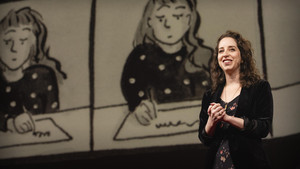
New Yorker cartoonist Amy Kurzweil confronted this question by engaging in a sweeping AI art project.
She discusses how she used AI to help her travel through time, and after the talk sits down with me to expand on her ideas.
I really enjoyed our conversation, so stick around, it's all coming up after a break.
Like Ted Talks? You should check out the Ted Radio Hour with NPR.
Stay tuned after this talk to hear a sneak peek of this week's episode.
And now our Ted Talk of the Day.
I love being a cartoonist because I can travel anywhere.
I can visit historical artifacts and make improvements.
I can voyage to mystical lands and solve problems.
I can bring objects to life, and I can make those objects think and talk, and I can send those objects wherever I want them to go.
I became a cartoonist to travel through space and time.
And I became a graphic memoirist because the place I wanted to go was the past.
I come from a legacy of dramatic stories and lost characters.
My grandmother, Lily, on my mother's side, was born in Warsaw, Poland, the oldest of four sisters.
She was 13 in 1939, when Nazi bombs raised her home, and her family was sealed to starve inside the Warsaw ghetto.
Eventually, her father encouraged her to slip through a hole in the wall, and she survived the Holocaust on her own, hiding her Jewish identity.
This is the subject of my first book.
I wondered, what did my grandmother's lost home and lost family look like?
Her parents, her grandmother and her sisters.
They are all gone without a trace.
My father's parents were luckier.
They were also Jewish, and they both fled Austria at the start of the war.
My father's father, Fred, was a pianist and conductor.
In 1937, the year before the Nazis marched into Austria, he was 26, and he conducted a magnificent choral concert at a music hall in Vienna.
A wealthy American woman in the audience was so impressed with his performance that she later agreed to sponsor his visa to the US.
So music saved his life.
But three decades later, Fred died of heart disease.
I never met him. While alive, Fred meticulously preserved the documents of his life, a response to the threat of erasure he fled in Europe.
And for decades after his father's death, my father continued this preservation project.
This is the subject of my second book.
You might know my father, Ray Kurzweil.
As an inventor and futurist, you should also know that he's a person with an extraordinary sense of humor.
And although he's dedicated his mind to the future, his life is full of the past.
My father has worked for decades on natural language processing, and several years ago, he realized that if we married AI with my grandfather's writing, we could build a chatbot that writes in my grandfather's voice.
Back in 2018, this seemed very sci -fi.
But rather than ushering in our demise, this project helped me realize that AI could actually help us ward off annihilation by animating the legacies of our families and our cultures.
I wanted to talk to my grandfather because he, like me, was an artist.
I wondered, could I get to know him?
Could I even come to love him, even though our life spans didn't overlap?
So I got involved. This chatbot needed language from my grandfather, as much as could be found.
So I, with some assistance, set about finding his words and transcribing them.
This was a selective chatbot, meaning it responded to questions with answers from the pool of sentences that Fred actually wrote at some point in his life.
The more examples of Fred's writing we could find, the more dynamic the experience of chatting with the bot would feel.
Sometimes this transcription task proved challenging.
But the more time I spent with the symbols of my grandfather's life, the more easily I could decode them.
Finally, after much anticipation, I sat down to chat with this new intelligence, an algorithm commanding over 600 typed pages of letters, lectures, notes, essays and other written documents from the grandfather I never met.
When I asked about Fred's dreams, he told me about the challenge of keeping his new orchestra afloat.
When I asked about Fred's anxieties, I learned about the stress of being a new father while working so hard.
When I asked about the meaning of life, Fred wrote about the joy of working with other musicians in pursuit of beauty, and he wrote about the highest aims of art.
I asked again about the meaning of life because isn't that really the best question for a robot?
And Fred's second answer was much simpler but even better.
Some of these answers felt familiar to me.
I remembered seeing them in the archive, but the words gained impact through surprise and the roleplay of conversation.
I could identify patterns in my grandfather's life and patterns across generations because I was also an artist trying to make it in New York City, and I also believed the meaning of life is art and connection and love.
I had wondered if this project would feel like a resurrection.
But rather than bringing my grandfather from the past into the present, it felt like I was the one time traveling, visiting him for a moment at different points in his life.
And this kind of time travel didn't feel like sci -fi.
It felt like the kind of imaginative travel I do when I'm cartooning.
When I'm cartooning, I'm always thinking about how I could possibly represent a person fully.
And the answer is I can't.
Similarly, I know how many aspects of my grandfather can't be captured by digital text alone.
There's all those quivers in his handwriting and what they denote about the sensations in his body.
There's his body, how it moved and how it felt.
There's his music and all the ineffable aspects of his performance.
And of course, there's everything he thought but didn't write down.
What would we have to do to be able to capture all of this?
I may fail as an artist to fully represent a person's constantly evolving complexity, but I can ask what features of a person are essential to who they are across the lifetime.
The puzzle of personal identity is one of our oldest philosophical questions, so I'm not here to solve that one for you.
I'm just a cartoonist, after all.
I do believe that we are more than our bodies, that the projects and impressions we leave behind are a part of our essential selves.
And I think AI has a special role to play in the mission of memory.
I did not come to see the chatbot of my grandfather as replacing my grandfather.
I came to see it as one way to interact with his legacy.
As somebody who has spent their whole life trying to document people, I can assure you that people are much bigger and weirder than any one depiction or any one moment in time can possibly evoke.
And I can also assure you that people don't just disappear when they die.
AI swirls our conception of time and space.
It can remix and extend our identities.
Our own digital archives are growing beyond belief, and we need a framework for understanding technologies of representation.
So I offer you mine.
Just like the comics I've drawn about the characters in my life, these technologies are animated portraits.
They are one part of our true immortal selves.
Seen this way, AI -like cartooning and all good artistic endeavors could help us appreciate the vastness of humanity, if we let it.
Thank you. APPLAUSE That was Amy Kurzweil speaking at TED 2024, and I'm so thrilled I got to speak with Amy not long after she got off stage at the conference.
So here's my conversation with Amy recorded on -site at TED 2024.
How is this AI -driven chatbot project different than the other work that you've done?
I guess it's safe to say I've never been a part of a project, anything like that before.
I'm a cartoonist. So I document people and my own life, and my family has been a big part of both my books.
And this AI chatbot is sort of another character that I'm writing about.
So I mean, I didn't...
I'm not an engineer.
I didn't program this chatbot of my grandfather's.
But I did collect the data that went into this chatbot.
So we have this ginormous archive of all of my grandfather's writing, and I played a role in collecting and transcribing his words.
And those were fed into this algorithm that became the chatbot of my grandfather.
But what I came to realize is that this chatbot that animates my grandfather's voice is very similar to the work that I do as a creative artist, because the chatbot is all about making choices.
What can we fit into this algorithm?
And as an artist, you're always making those kinds of choices, like what aspect of my memory is relevant to this scene, and how is that going to build this character?
And so the journey for me in documenting the process of building the chatbot was coming to see the chatbot itself as a work of art.
And so that analogy has been really meaningful for me, because I think in the future we're going to need those kinds of frameworks for understanding technologies of representation.
What do you think that AI can do for the future of just archival work in general?
I think that's an amazing place for AI to go.
I mean, I always talk about the future of the past.
So archives are overwhelming.
They're full of documents.
We don't always know how to understand those documents.
For example, in the archive of my grandfather's things, there's his passport, which has a bunch of stamps on it.
And I needed to talk to a historian to actually understand what all those stamps meant.
And the story of those stamps is the story of how my grandfather fled the Nazis.
It's where he went.
It's what he couldn't bring with him.
And there's all this information that I need other information in order to understand.
And so I feel like the future of AI helping us navigate archives is giving us access to contextualization so that we have a helper in translating the past and making it relevant to the present.
Did you have any misgivings about this project along the way?
And if so, what concerns did you have?
Yeah, I think that a lot of the misgivings, parallel misgivings, I have about documenting life and memoir in general.
This question about public and private, what information is mine alone?
What information is mine to share with a small community?
And what information is mine to share with a larger community?
And as a memoirist, the choices that you make are often, I'm going to share the things that feel appropriate to share publicly, but I'm going to share them in a way so that there's some blank space in the story so that people can bring themselves to it.
And that's a principle in storytelling and a principle in comics called closure where you give people something relatively simple and they fill in the gaps with their own experience or their own identity.
I think in a chatbot, you have to think about what the parallel might be.
So what information is appropriate to include in a publicly available chatbot of a historical figure that's going to be really different than what you might include in a chatbot of a beloved family member that's only for the family.
And these are all questions that people are going to have to think about and they're not new questions, actually.
They're just in a new format.
Have other people been replicating what you've done?
There are other people who have been working on these kinds of projects.
One of the earliest cases is this company that then became Replica, created this chatbot that was called Romanbot.
This young man named Roman passed away tragically.
He was quite young and his text messages were collected and fed into an algorithm.
This was around the same time that we were working on our chatbot and people could talk to it.
And it was made publicly available and it was this kind of public memorial to this young man.
So there's people doing very similar things.
Yeah, it reminds me of a Black Mirror episode, a very famous one.
Somebody loses their loved one, they lose their boyfriend, and they're able to recreate him through the vast troves of his text messages and photos and all those things.
I know that episode very well.
I'm sure you do. I'll be right back, it's an amazing episode.
It's a vision of this kind of technology that is very different than the direction I think it will actually go in.
But I think the episode is meant, as all sci -fi is meant to do, is meant to caution us away from ways of formulating technology that lead us into mistakes.
And I think the mistake that's being made in that Be Right Back episode is that the character is creating something in a kind of Frankenstein way to recreate him and have him play the role in her life that he used to play.
And I think one of the reasons why thinking about these kinds of technologies as art is that it puts a frame around the experience and labels it as virtual.
And we engage with the virtual world all the time in life.
We're always thinking about memory.
Our dreams are meaningful to us.
The past is memorable to us.
And we access the past through technology and through the imaginative exercises we do when we look at a photograph or we look at a video.
And so Martha, in that episode, makes the mistake of giving it a Frankenstein body.
Though AI, we have seen here at TED, AI is now moving into synthetic and physical forms.
They've put it into fish, for example.
Exactly. So I don't mean to suggest that we can't give AI a body or give it a physical form, but I think we still need to have a conceptual frame around it as this is a virtual character and this is a virtual experience.
And that doesn't make it less important.
I actually, as an artist, think virtual experiences are sometimes more meaningful than real experiences.
So I have to ask then if you could describe your initial feelings of engaging with the chatbot version of your grandfather's data.
Yes. This is documented in my book, Artificial.
It was a mixed experience, which people can read about.
It makes in the sense that I was very aware of the boundaries of this technology because the technology was so rudimentary at the time.
People need to remember this was 2018 and it's like a totally different world now.
But when I first chatted with this character, it was like I was aware of all the seams.
And so I was thinking a lot about the AI and how it was working.
But then I would have these certain moments where a hand would reach out of that messy AI experience and just draw my attention to something that my grandfather actually said because the way our chatbot worked is it was comprised of sentences that my grandfather had actually written down.
I'd ask a question and it would offer me up something in a really unexpected way.
That was my grandfather's voice and it would prompt this insight into his character and I'd make some connection with my own life.
And in his case, a lot of the archive was full of him either looking for a job, explaining in letters to friends the stress of his life as an artist.
And there were other things in there, too.
But it was really meaningful for me to see how often that came up.
This theme of this is who I am, I'm looking for work.
Even when I would ask a question that wasn't quite getting at that.
And that's part of the limitations of the technology.
And I actually think the limitations are as interesting as what this technology allows you to do.
So again, it's like all art just serves as a spark for our own intuitions and our own realizations.
And it was meaningful for me to notice that in my grandfather because I'm an artist and I've had a lot of the same struggles as him.
Applying to a lot of the same schools that he was applying to as a professor.
The balance between love and work and the way that you might articulate that to a colleague, that you're stressed and you want to work on your creative work, but really you have to do this other thing for money or you have to take care of some family member.
And it was just meaningful for me to be like served up those kinds of answers all in a row.
That helped my connection to him sink in, I think.
As we've spent so much of this moment in society talking about AI and its potential, it seems like art and artists are the last area where AI will do better than humans.
The idea of AI doing better I think is a framework I want to complicate because I feel something AI might help us appreciate is that art is not a competition.
Like these sort of values of better or worse actually don't make that much sense in art.
And I think art is really meaningful because it's about process and it's about connection.
And I think that AIs can excel at craft, but that's not a replacement for human artists because we're interested in human connection and art is a vehicle for human connection.
And we also might be interested in virtual connection with virtual characters, but I don't think we're going to stop wanting to have human connection through artistic practice.
I do think the crisis of AI artists is a market crisis.
It's a crisis of work for money being taken by machines and often that's a way that human artists make a living.
How are we going to have artists continue to make money if they don't have that kind of work to do?
It feels like it's possible that AI could create such a market crisis for people in media and people in the commercial arts that it would explode the system and something else could be born from it where we actually are directing more philanthropic energy towards what we might all call real art.
Disruption can so often lead to innovation and ingenuity and creativity.
That would be a cool utopia.
I don't know how likely that is to pass, but I think it's possible that AI could mess up these marketplaces so much that we really do need to sit and think about a different model for these things.
All right, Amy Kurzweil, thank you so much.
Thank you. Pleasure to talk to you.
If you're curious about TED's curation, find out more at TED .com slash curation guidelines.
And that's it for today.
TED Talks Daily is part of the TED Audio Collective.
This episode was produced and edited by our team.
Martha Estefanos, Oliver Friedman, Brian Green, Autumn Thompson, and Alejandra Salazar.
It was mixed by Christopher Faizi -Bogan.
Additional support from Emma Tobner and Daniela Balleraso.
I'm Elise Hugh. I'll be back tomorrow with a fresh idea for your feed.
Thanks for listening.
Subscribe or listen to the TED Radio Hour wherever you get your podcasts.