This is Planet Money from NPR.
Dallas Taylor, host of one of my favorite podcasts, 20,000 Hertz.
Would you like to say hello?
Hey Kenny.
Dallas's show, if you're not familiar, covers all things sound and sound design.
That's right.
And he and I are going to play a little game here in part to prove a point, we have agreed to surprise one another with a video that we're currently very into from the internet.
Dallas, since you're the guest here, you want to go first on this?
I would love that.
Any setup that we need to know?
Yes.
So I got this video from Instagram from a friend of mine.
Okay.
And I'm a child of the 80s.
I am too, yes.
And the point of it is to connect the dots between the voice of Shredder...
From the Teenage Mutant Ninja Turtles.
From the Teenage Mutant Ninja Turtles.
And the voice of a very popular actor from a really popular sitcom.
So what I'd like for you to do is while you're listening to it, try to figure out who this voice is.
And then we'll take it from there.
All right.
Three, two, one.
I must congratulate you.
So that is the voice of Shredder.
I recognize it.
But you're saying this is a famous person I should know?
Yes.
So I'll play a little bit more.
You passed your test with flying colors.
Do you know how... So here it is from the show that you should know him from.
To have a son who can't swim.
Wait, is it Uncle Phil?
It's Uncle Phil.
It's Uncle Phil from Fresh Prince of Bel-Air?
Is Shredder?
The voice of Shredder is Uncle Phil.
Get out of here.
I will destroy my enemies, the turtles, and then the world will tremble before the Shredder.
Okay, $100 a ball.
Did you not know this either?
No.
Oh my gosh.
And I was a huge Ninja Turtles fan.
This is very cool.
And a huge Fresh Prince of Bel-Air fan.
Never put two and two together.
That's a very good one.
Okay, so for mine, this is something that I found on Reddit.
And just a little bit of background.
So there's a popular trend where people will post videos of themselves at potlucks.
You know, I'm Kenny and I brought seven layer bean dip cut to...
I'm Dallas and I brought ambrosia salad, right?
Like this is, okay.
So what I have is a video by a content creator named Shay who acts like a judge in what they call the potluck courtroom.
So Shay cuts themselves into those other potluck videos, rendering judgment on each dish.
Okay, ready?
Yes.
I'm Celeste and I brought cheesecake croissants from Costco.
You didn't make that .
25 years in the hole, no parole for you and your lawyer.
Next.
My name's Rudy and I brought root beer floats.
You about to float with the fishes because we about to give you the pirate's burial.
Whoop the plank.
And who's that?
Add her too.
Give her the thumbscrew.
Just because.
Good night.
The Thumbscrew Dallas.
It is a real punishment, apparently, like a real 17th century torture thing.
Wow.
So, yeah.
Now, part of this was to share what we're interested in, but...
I think astute listeners will perhaps notice that, even though Dallas, you found your thing through Instagram.
Correct.
I found my thing through Reddit.
They both shared the same sound at the very end of our videos, which is this. the TikTok Sonic logo.
The TikTok Sonic logo.
And the backstory to this audio logo is what today's episode is about.
Because not very long ago, TikTok found itself with an interesting problem.
Its users were making videos that were going viral on TikTok but then also spreading to other places like Instagram and Reddit.
And if you are TikTok, you're thinking like...
Wait, no fair.
Our users made this content.
We need a solution.
Right.
So basically, what they were trying to do is how do we effectively place an ad on other platforms to let people know that hey, you should come over to our platform because this stuff is really fresh?
And Dallas, you are a professional sound designer in addition to hosting 20,000 Hertz.
You did not make the TikTok Sonic logo, but you have made these in the past for other companies.
And I'm curious, in your opinion, how effective has the TikTok done? boom-bling sound thing, Ben?
I would say that this is the most effective Sonic logo of the past 10 years for sure.
Well, cue the music.
Hello and welcome to Planet Money.
I'm Kenny Malone.
And I'm Dallas Taylor.
In recent history, it is a tale of guerrilla marketing and the power of sonic suggestion.
Also, it is the story of how sound designers even come up with a sound like this.
Stay tuned.
There is a hidden animal in that sound effect.
Also. it is not enough for companies to just have an amazing logo anymore.
The McDonald's golden arches, for example.
Iconic of course, but I'm willing to bet that you can also easily identify McDonald's from this.
It is going to take weeks to get this out of my head, Dallas.
I resent you for having me play this.
Well, that's the intent.
And this is what the industry refers to as a Sonic logo.
It's super important that you're going to have a Sonic logo that really can become an earworm, easily remembered, potentially even sung or hummed.
This is Afrik Lennon, who spent almost a decade at a company called Massive Music.
She worked there alongside Roscoe Williamson and the two of them helped design this kind of Sonic branding.
Sonic branding has become more and more popular in the last decade.
I would say from smart speakers.
The rise of streaming.
The rise of podcasting.
This is Planet Money from NPR.
Hey, wait a second.
I know that sound.
Do you have notes on it, Dallas?
Oh, notes on your Sonic logo.
I'm glad that you don't use the very obvious cash register from the 1930s cha-ching sound.
So thank you for not doing that.
You're welcome.
So that's a little bit of background about Sonic branding, Sonic logos.
And I'm going to let Dallas take it from here.
Around 2020, TikTok was already huge with over 700 million users.
And one of the things that made TikTok so popular was how easy it was to add music to your videos, but they didn't have a sonic identity.
At the time, Massive Music was already consulting with TikTok.
So when TikTok wanted a sonic logo, Afrik and Roscoe wanted that job.
It was actually a six-month pitch process.
Pretty grueling, I have to say.
Culminating with the final pitch right after Christmas.
So it meant a lot of the team working through the Christmas holidays.
But yeah, we were pretty proud of the pitch that we did and we won the project fair and square.
TikTok knew that they had already captured the Gen Z market, but they wanted to broaden their appeal.
They didn't want to skew too young in terms of how this Sonic logo should appeal to people, because at the time there was a big drive to engage older users.
They also wanted the sound to be as joyful and inviting as possible.
In our stakeholder interviews with the brand, somebody described TikTok as the last sunny corner of the internet.
It's the last place where you can really express that joy and creativity.
And so for TikTok, it was really important that the sound expressed this kind of welcoming nature and the sense of almost safety on the platform.
But of course, there's a fine line between sunny and irritating.
We also needed it to be a sound that could survive a huge amount of exposure and not tire, and not become annoying or jarring.
Finally, they wanted a sound that TikTokers could engage with themselves.
We wanted to create something that could become known, loved and embraced, and even remixed, by the community.
To meet all of that criteria, Roscoe and Afrik went through thousands of iterations.
It's got to be in the 2000 plus.
Early on, they focused on the onomatopoeia of the name TikTok.
It felt natural to think about the sound logo as this kind of two-beat structure.
So we did some really early experiments with, like looking at what we could use around the house, in the office, everyday objects that might give you that TikTok sound.
I mean, even with your mouth, you can kind of go.
Here's an early version.
And again.
So there's a tick on the front, which is this percussive sound.
And on the back.
This is where we were going through a phase where we were trying to integrate UGC sounds.
UGC stands for user-generated content.
In this case, it was sounds from people's TikTok videos that they cleared for use.
To me, this one sounds a bit like someone saying, ow.
And that led them to an idea that was even more out there a logo that would actually change depending on where and when you heard it.
We did think at one stage of this kind of like ever-evolving Sonic logo.
I think we called it Never the Same Twice.
And it was this idea that how were we going to define a sound of a brand that's constantly leaning into changing trends and musical trends, and that was why we landed on that.
Each version of the logo would use a different user-generated sound.
But as long as there was a tick and there was a tock, you would always know it's TikTok.
For the initial tick sound.
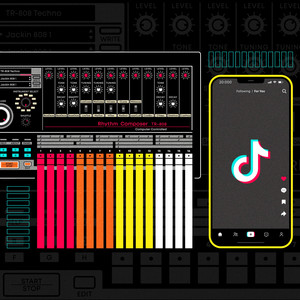
They liked the idea of using a kick drum from the iconic 808 drum machine.
It's a homage to a lot of the hip hop music and bass music that became synonymous with the platform early on.
In this never the same twice idea, the 808 would stay fixed.
But on the back end, you have different UGC sounds coming through and changing.
For instance, maybe something like this.
But quite quickly, we realized that we needed something a little bit more consistent.
What TikTok really needed was something that could really be more of a fixed asset and become this iconic association with the brand.
So the idea of a constantly changing logo was cut, but they kept rolling with the 808 kick drum.
Here's another early version.
This is a very blown out 808 on the front and then sounds like another UGC on the back end, which probably didn't make the cut.
I think it might be like a hyper-processed UGC dog bark.
Oh yeah, the dog bark.
Yeah, from what I remember.
If it sounds like they're being a little coy right now, just don't forget that dog bark.
After hundreds of iterations, they started to hone in on something a bit more melodic.
Getting closer.
So you probably recognize the motif, the melody on the back end. but it's a different timbre, right?
So that sounds like a toy piano timbre.
And the front hit, I think that might even be like an 808 reverse.
But for whatever reason, we just don't feel like that had the right cut through on the front end and the back end wasn't bright enough.
Remember, these are only a few of the thousands of sounds that African Roscoe went through.
Each of these examples represents hundreds of slight variations on the same logo.
There's a point in this process where you're literally going insane because you know you're just listening to two second clips of audio and you know your mind is kind of coming out of your ears.
There was this point and we're in this sort of pit of despair like are we ever going to find the right sound.
And then suddenly it just kind of popped out.
And it was like everybody on that call from our side was like, hey, let's listen to that again.
That version featured a monstrous overblown 808 kick.
We have the tick, the first beat, which is this iconic sub-bass sound which, for us, is a nod to the musicality of the platform.
But it also functionally acts as a divider between music on content, right?
What we found when we were stress testing this, which is when we're putting it at the end of lots of different content with lots of different music, is it really nicely acts as this kind of divider between whatever music precedes it and then the chord at the end?
After that 808 kick, there's a bright ascending chord.
This tied back to the idea of the last sunny corner on the internet.
The second half of the sound logo, we wanted to instill this sense of joy, which is where this kind of ascending melody came from.
The timbre of the sound is a layered sine wave and a marimba.
Layered.
Now a marimba isn't a shocking choice, because for the past couple of decades, brands have been in love with them.
We all know the marimba from music and media and commercials.
It's very successful, but for good reason.
It's warm.
It cuts through, right?
Alexa, play a lullaby.
The chord they chose was also very intentional.
The chord is the E major 7th chord.
A major 7 chord is made up of the root, a major 3rd, perfect 5th, and a major 7th.
The seventh note, it adds that unusual flavor to the chord.
It's kind of used in jazz and R&B and sometimes in hip-hop and pop.
Tell me that you're coming.
It just gives that texture to the chord.
That kind of is a sense of wonder.
Afrik and Roscoe were convinced the E major 7 was the perfect chord, but they got some pushback.
There was a prominent stakeholder in the project that was like, it's got to be E major.
E major's a bright, happy chord.
Here's an E major.
The difference between these two chords is the fourth note.
In the major, that jazzy seventh is swapped out for a higher octave of the root note.
Here they are back to back, E major seven, E major.
And here they are in the full logo, E major seven, E major.
And again.
African Roscoe felt really strongly that the E major 7 was the way to go.
To prove it, they did some consumer testing and compared the two versions.
We put them into testing in a number of key markets for TikTok.
But actually, the results were really interesting because that resolved e-major. came through as actually a little bit more childish, which is something that TikTok was actively trying to kind of move away from.
They wanted to age up their brand sound.
And so interestingly, the unresolved.
So the E major, seventh chord actually came through as more appealing and more recallable.
In the end, everyone at TikTok was on board.
Having that objective audience data really helped to kind of get it over the line and convince some of the stakeholders.
After thousands of iterations, consumer research and a final debate about a single note Africa and Roscoe finally had their perfect logo.
Behind the scenes, they started calling it the Boom Bling.
It was made up of a bass hit and an ascending chord.
But there's actually one other sound in there, underneath the cord.
It's really easy to miss, but here it is on its own.
Does that ring any bells?
It is actually the dog bark.
Yep, that's the same dog bark from one of the earlier versions.
That is a mistake.
That is something that we left in by accident.
You know, 2,000 logos later, your mind's jelly.
And so it was baked in there.
It wasn't until afterwards where you're like, oh, that's in there somehow.
And then the logo got signed off.
And we were kind of like, okay, should we take this out?
And then when we took it out, the logo just didn't have the character.
So they left it in.
And that dog bark became the accidental final ingredient.
Finally, TikTok had their sound.
So that's the end of the story, right?
Not even close, because that logo was just one part of a much larger sonic strategy, a strategy that involved some highly unusual covert tactics.
We actually started doing this before the launch of the Sonic brand.
And we started seeding them onto the platform, kind of like incognito.
That's coming up after the break.
Now in 2022, Afrik.
Lennon and Roscoe Williamson of Massive Music had helped create a Sonic logo for TikTok.
Yes, that.
But before it went out into the world, before TikTok users knew anything about any audio branding, massive music helped TikTok pull off one of the sneakiest, perhaps devious, rollouts I have ever heard of.
For that story.
You have to know that when a company like TikTok pays for a sonic brand, they will often get much more than just that little sound logo.
They'll get a whole suite of sounds and music that feel like they're part of a holistic identity.
There will be chord progressions, melodies, motifs.
There will be bits of sound design.
So it's an extension of a sonic brand into music.
Oftentimes, a company like Massive Music will take all of those elements and stitch them into a single song for the company.
Yeah.
Here is the blueprint song that they made for TikTok.
And this little ditty, this like blueprint song, was the key to the very sneaky marketing story that we're about to tell you.
And again, I will let Dallas take it from here.
Once Massive Music had made this single Blueprint song, which is one song containing TikTok's entirely new sound identity, they started to remix it into a batch of short songs that were around 10 to 15 seconds each, which they called Sonic Stickers.
This sticker is called Boom.
The next sticker is called What?
And this one is named Aww.
These sonic stickers were added into the library of sounds that TikTokers could add to their videos.
But the idea is that we would start to seed them into the platform itself for creators to work with.
We actually started doing this before the launch of the sonic brand, kind of like incognito.
Yeah, we launched them under an alias, which was Sonic Collective.
In other words, they used these stickers as kind of a Trojan horse to introduce people to these new branded sounds.
And we started to see, like, people start to create content with them and pick them up.
And sure enough, people did start to pick them up.
Hi, my name is Mike, and I'm a tracer.
I'm a sucker for graffiti art.
Check out what my boy Chris did.
He did a painting with my name.
These are $1.25.
Then, once the Sonic brand launched, they announced that these Sonic stickers were actually official.
TikTok sounds.
And people didn't realize they were already kind of engaging with the sonic identity until it fully launched.
These sonic stickers are still being used today.
Can you do it?
I think now we're up to about 30,000 bits of content created using these sonic stickers.
So it's very much a living, breathing sonic identity.
POV being a no-detector artist.
You're done in one click.
Normally it's tough to get people to actually engage with a Sonic brand, so this Sonic sticker thing is pretty brilliant.
But the real slam dunk has to be the way that TikTok has used that boom-bling Sonic logo and integrated it within the ecosystem of the entire internet.
On TikTok, if a creator allows it, you can download their videos to your phone.
And whenever you do, TikTok will automatically add that Sonic logo to the end of the video.
The same thing happens when you repost a TikTok video on apps like Instagram or YouTube.
So wherever it goes after that, the Sonic logo is baked in so people will know where it came from.
When I hear the boombling on another app, I feel like I'm consuming TikTok content.
It's almost like TikTok embedded a mini version of their app inside their competitors.
Yo, is that what I think it is?
A box from Amazon on John's, on Ron John, on LeBron, on crayons, on a swan drawn on spawn on Milan, on Milan.
Now, the other social media apps don't have a meaningful Sonic logo.
YouTube does, but the only time I hear it is when I open YouTube on my television.
But TikTok's strategy has meant that their sound is heard all over the place, especially by people who are not TikTokers.
After the logo launched, the results of that strategy quickly became clear.
They did a study about three months post-launch.
How many people could spontaneously recognize the sound without any context of the brand?
And just three months after launch, actually like over 50, so one in two were able to recognize the sound, which is just pretty astronomical for a new sound logo brand.
Normally it can take years.
The TikTok Sonic logo is the most rapidly recognized Sonic logo of all time.
And so for us, we were kind of blown away when we heard that.
We were like, okay, well, we've done our jobs.
Looking back, it's hard to believe that TikTok was the first social media platform to add a Sonic logo to their videos.
It's one of those things that just seems so obvious in hindsight.
But that's what happens when you treat sound as both a science and as an art.
I originally studied chemistry at university and then I got into playing in bands and parents were like what are you doing with your life?
And when I found Sonic Branding, it was a kind of perfect blend of science and art, really.
My background is also scientific, studied biomedical science and then specialised in neuroscience of music and sound.
I'm obsessed with understanding how music impacts people, the mind and behaviour.
But I've always been a musician, a singer, so Sonic Branding.
It really is that blend of science and art that excites me and gets me up in the morning.
Okay, Kenny Malone, back again with a very fun update on this, because about two years after TikTok released their Sonic ID, Instagram released its own Sonic ID.
Now, apparently the Instagram version of this has been around for more than a year.
And I will admit I have never heard this, but I promise we tested it.
And the Instagram Sonic logo does seem to show up at the end of the video when you download someone's reel.
So, okay, how does it compare?
Well, for the 100th time, here is the TikTok Sonic ID.
And here, making its Planet Money debut, is the Instagram Sonic ID.
Yeah, here it is again. love to hear your thoughts on that.
Send those along to planetmoney at npr.org.
For more stories about sound, be sure to follow 20,000 Hertz wherever you get your podcast.
And Dallas, you want to take the credits.
Take it away.
20,000 Hertz is produced out of the sound design studios of DeFacto Sound.
This episode was written and produced by Nicholas Harder.
It was story edited by Casey Emmerling and Andrew Anderson.
With help from Grace East.
It was sound designed and mixed by Brandon Pratt.
The Planet Money adaptation of this episode was produced by James Sneed.
It was edited by Jess Jang.
Alex Goldmark is Planet Money's executive producer.
I'm Kenny Malone.
I'm Dallas Taylor.
This is NPR.
Thanks for listening.