The House of Representatives has approved a White House request to claw back two years of previously approved funding for public media.
The rescissions package now moves on to the Senate.
This move poses a serious threat to local stations and public media as we know it.
Please take a stand for public media today at GoACPR .org.
Thank you. You're listening to LifeKit from NPR.
Hey, it's Marielle.
You know, I try to be understanding when it comes to bugs.
Just because they look scary doesn't mean they are.
And just because they annoy me or interrupt my life in some way doesn't mean they shouldn't exist. I draw the line at ticks, though.
Ticks can leave me alone.
They are jumpy, crawly, biting insects that want to suck your blood, and they can cause Lyme disease and lots of other problems for people.
On this episode of Life Kit, how to deal with ticks.
I talk to NPR health correspondent Ping Huang about where ticks live, how to avoid them, and what to do if you find one on you.
This message comes from the Nature Conservancy.
People from all walks of life depend on nature.
For the food they eat, the water they drink, and the air they breathe.
for strengthening their communities, powering their livelihoods, and safeguarding their health.
Nature is common ground for everyone, and uniting to protect nature can help solve today's challenges and create a thriving tomorrow for future generations.
Discover why at nature .org.
Decades ago, Brazilian women made a discovery.
They could have an abortion without a doctor, thanks to a tiny pill.
That pill spawned a global movement.
helping millions of women have safe abortions regardless of the law.
Hear that story on the network, from NPR's Embedded and Futuro Media, wherever you get your podcasts.
These days, there is a lot of news.
It can be hard to keep up with what it means for you, your family, and your community.
Consider this from NPR as a podcast that helps you make sense of the news.
Six days a week, we bring you a deep dive on a story and provide the context, the backstory, and analysis you need to understand our rapidly changing world.
Listen to the Consider This podcast from NPR.
listen to the planet money podcast from NPR.
Hi, Ping. Hey, Mariel.
All right. So ticks, what are they?
So ticks are this kind of flat bodied bug.
There's a bunch of different kinds that are in the US, like more than 80 of them, but there's only about a dozen that actually cause health problems in people.
So generally speaking, ticks go through this life cycle where they hatch from eggs, they crawl around as larvae, they become nymphs, and then they become come adults that mate and lay more eggs.
And one critical thing for humans is that they need a full blood meal to get to each of their next stages.
A full blood meal. What does that mean?
Is that all they eat, blood?
I mean, they definitely need what's in blood to sort of like get them to mature through their life cycle.
And so that's why they bite us.
Although people who research ticks actually say that humans are not what they're looking for.
We are not their most preferred blood meal.
They tend to prefer deer, dogs, mice, other rodents, other animals in general, but they're also not that picky.
So if humans happen to be in the way, we're going to get bit.
Wow. Now I feel a little insulted, but okay.
Well, you and maybe around 31 million people a year in the US who do get bit by ticks, that's according to the CDC.
But in terms of what we're talking about, in terms of diseases, what's also useful to know is that not every tick bite causes problems, but some of them do cause serious ones.
So it helps to know what to do when you do get a tick bite and also when to worry about them.
Yeah. What do we need to worry about when it comes to ticks?
What diseases do they carry?
So here in the US, Lyme disease is the big one.
That's the most common and well -known of the tick diseases.
There's almost 90 ,000 cases that get reported each year, although actually that's probably underreported.
There's probably more like half a million cases each year.
So Lyme disease is a disease that's caused by a bacteria.
And a lot of people can get treated with antibiotics and recover pretty quickly, but some people do experience prolonged chronic symptoms like fatigue and body aches and brain fog that can last for quite a long time.
It varies with different people, but it can be quite awful.
And the ticks carry a bunch of different pathogens.
They carry toxins, bacteria, parasites, viruses, you know, anything from Rocky Mountain spotted fever to anaplasmosis, Powassan virus, and even alpha -gal syndrome, which is an allergy.
It makes you allergic to red meat.
And these problems can range from like pretty mild to pretty serious.
And generally speaking, together they form a pretty big public health problem.
them. Takeaway one, at least 31 million people are bitten by ticks in the U .S. every year.
And unfortunately, ticks can cause a wide range of medical issues when they attach to us and feed on our blood, most commonly Lyme disease.
Okay, so where do we have to be worried about exposure to ticks?
Ticks tend to prefer tall grasses, the edges of forests, like piles of leaves or wood, stone walls, things like that.
They've been found all over the U .S. in every state.
You know, they've been found in urban parks in Texas, around beach shrubs in California, under porches in Arizona.
And they tend to prefer, like, shaded areas with high humidity.
Even at the beach? I didn't realize that.
Yeah, they have found them, you know, in the sort of scrub brush around the edges of the beach in California, for sure.
And then what about around the country geographically?
which are the regions that tend to have more ticks?
Yeah. So the CDC kind of breaks it down into three regions, like the North, the South, and the West. And the North is definitely the place where there are the most tick bites.
That encompasses the Northeast, the Mid -Atlantic, and the Upper Midwest. And it's a high risk area for Lyme.
About one in five people in the North get tick bites every year.
You know, it's also a place where the ticks tend to carry a lot of the the bacteria that causes Lyme disease.
So that's carried by black -legged ticks, which are also called deer ticks.
And around 60 % of adults in the North and the Northeast area carry the bacteria that causes Lyme disease.
And then what about the South?
So this is the area that encompasses like the Central and the Southeast US.
And this is second to the North.
More like one in 10 people report tick bites each year in this area.
And Lyme is much less common here, although there are still some cases.
One interesting thing that I learned in my conversations was that one of the reasons that there might be this regional difference between the north and the south is actually that the ticks themselves behave differently in these areas.
So in the north, you've got like the same species of ticks, but they tend to climb to the top of like a leaf pile or tall grass, like they tend to kind of get up there and sort of reach their arms towards humans.
But the ones in the south actually tend to stay like very close to the ground and the soil and the dirt, which makes so I'm less likely to cling onto a human leg or a human arm.
All right. And then the last region is the West, right?
I feel like I haven't heard about too many problems with ticks in the West, or I don't think about it as much when I go there.
It's a place where tick bites are the least common, for sure.
You know, there are about, like, one in every 20 people report getting bitten by a tick each year.
Takeaway two, you can find ticks in lots of places.
Tall grass, piles of leaves, shrub brushes, bushes also piles of wood and structures like stone walls.
Most tick bites in the U .S. happen in the Northeast, Mid -Atlantic, and Upper Midwest. There are also ticks in the South, but they're less common. And they exist, but are far less common in the West part of the country.
So what can we do to try to avoid ticks?
Yeah. So the first thing that is helpful to think about is prevention, because if you can prevent getting a tick bite, you can prevent getting a disease from getting a tick bite.
So you're most likely to encounter a tick if you spend time outside.
So one of the things you want to think about is the clothes that you're wearing.
So it's recommended that you wear long sleeves and long pants.
You can tuck your shirt into your pants and your pants into the socks if you can stand it.
And this just gives ticks less exposed skin to get onto.
Another thing that the experts highly, highly recommend is having an outdoor or outfit that you pre -treat with permethrin.
So this is an insecticide that you can spray on your hat, your shirt, your pants, your socks, your shoes, anything that you're wearing on the outside.
And that is really helpful because permethrin actually kills ticks on contact.
So that is a very effective way to prevent them.
Another thing that's also recommended as a second line of defense is covering any exposed skin that you have with a good EPA recommended bug repellent, something with Picardin or DEET in it, that'll cut the risk even more.
And then also just sort of being aware of your surroundings.
So if you're going hiking, you'll want to stick to the center of the trail instead of the edges where, you know, the ticks are more likely to be hanging out in the grasses and the shrubs along the side.
Are ticks more prevalent in the summer, or is this a year -round problem?
So it depends on where you are, but in the places where there there are the most ticks.
Spring and summer are the times of year where you want to be the most careful.
So it's generally considered like April, May, June, July, August are the months where you're going to want to be super careful about getting bitten, especially by the nymphal ticks because of that life cycle.
Like I said, the smallest ones are the ones that tend to bite humans and be the hardest to sort of spot and take off.
And so people are at like particular risk in those summer months when they're tiny tiny little ticks that are crawling around and trying to bite you I think a lot of people know to take precautions if they're going on a hike in the summer especially right that they should wear those long pants and tuck them in to their shoes but I guess I just wonder how careful you need to be I mean like there are going to be situations where you're out in just shorts and a t -shirt or a bathing suit and you're around grass grass, but if it's like a mowed lawn, is that less risky?
It tends to be less risky.
Like, I think it's kind of like the wild like fields and tall grasses that are probably the most risky.
You know, if someone's got a yard that they're maintaining pretty regularly, if they're cutting down the grass, especially if they're spraying their yards with like tick repellent or insect repellent, like that's really going to cut down your risks there.
But you know, the ticks are kind of wherever they get picked up and dropped off.
And so if it's an area where animals are coming through, you know, cats or rodents, there's a chance that there could be ticks there as well.
Takeaway three. Try to avoid getting bitten by ticks in the first place.
One way to do that is to wear long sleeves and long pants and tuck your pants into your socks.
Experts also recommend having an outdoor outfit that you pre -treat with the insecticide permethrin.
And you can spray any exposed skin with an EPA recommended bug repellent.
Also avoid frolicking through any tall grass or shrubs and if you're hiking, stay on the trail.
Should you be doing a tick check when you get home from being outside and what does that entail?
Yeah, absolutely. I mean this is pretty critical especially in the spring summer seasons where ticks are at their height.
So one thing to think about is that ticks tend to kind of start at the bottom and crawl up.
And then wherever they hit resistance is where they're most likely to stop and bite.
So you're going to want to check your whole body for ticks, especially places where there's a cuff or an elastic, like the bottom of your pants or the bottom of your shorts or where your underwear meets your leg crease or your arm creases or a bra strap or something.
And so you just want to sort of be extra careful around those areas.
And you also want to do this pretty quickly.
Generally speaking, like the longer a tick latches onto your body, the more likely it is to spread some diseases.
And so a good rule of thumb, if you want to sort of think about, you know, coming in from the outside, it might be helpful to like, A, throw your clothes in the dryer, because putting them on, you know, high heat for 10 minutes will kill any ticks that are kind of still crawling around on them.
And then then you want to jump in the shower, which will wash any ticks off you and also give you a chance to check all those places on your body that might've been covered with clothes that, you know, now you can check for ticks.
What about in your hair or on your scalp?
I would think that they could also get stuck in your hair, you know, if they can kind of crawl all the way up your back and into your head or if they get dropped off of a tree into your hair.
So yeah, definitely consider your hair somewhere that, uh, somewhere that you would want to check for ticks.
I feel like you you need a buddy here, a buddy and maybe a handheld mirror.
Yeah, that would also help you for sure.
Because some of those ticks can actually be quite small.
And so you want to be super, super careful about where they might be biting you.
Let's talk about what they look like.
Because when I've done these tick checks, sometimes I'm like, is that a freckle?
You know, it's hard to know.
I haven't, luckily, I actually haven't seen one in real life.
So I've been like, are they the a size of a pencil eraser?
Are they the size of a sesame seed?
Like, how big are they or how small do they get?
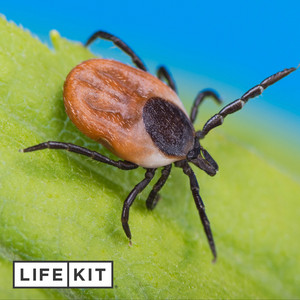
Yeah. Lucky you. I have found ticks on myself and it is not the best. But they are, they tend to be like really, really small, flat oval bugs.
They don't have wings.
And the nymphs and adults that are the most likely to bite you, they each have eight legs.
And, you know, of the size of them.
It really depends on what stage they're at.
So Becky Eisen, who's a tick biologist at CDC, told me this.
People are often surprised by how small these critters are.
So if you can picture an everything bagel, an adult is about the size of a sesame seed.
So the little white seeds on there.
And then the nymphs are about the size of a poppy seed.
So those tiny tiny little black seeds.
So they're often difficult to find, particularly those really small nymphs, which is probably helps to explain why so many human infections are associated with nymphal bites.
Becky is specifically talking about deer ticks, which are the ones that carry Lyme, but, you know, Lone Star ticks can be a little bit bigger and dog ticks can be much bigger than that.
A poppy seed though, I don't like that.
The thing with ticks, at least with most ticks is that like they need to crawl onto you, latch onto your skin.
And in many cases, they actually need to like eat a while, like maybe a few hours to even a few days before they can, as one expert described it to me, spit enough of an infectious dose into you to make you sick.
There's a couple exceptions to that.
Things like Powassan virus can be transmitted very quickly, but with something like Lyme, it can actually take maybe one of two full days of feeding before four, they can actually get you sick.
So one of the main things that experts about this say is if you find a tick on you, don't panic.
Just get it off as soon as you can.
Don't wait to go to the hospital or the ER.
Just grab a pair of tweezers.
If you have them, grab the tick as close to your skin as you can and just pull it straight out and make sure that you get the mouth parts of the tick out too.
That's the part where it's latching onto you.
Takeaway four, if you're If you're spending time outdoors in nature, do a tick check the same day.
You're looking for a small, flat bug that could be as small as a poppy seed.
Pay special attention to the areas where the tick might have met resistance as it crawled up from the ground, so things like pant creases and cuffs, and then check the parts of your body that were covered, too.
Use a handheld mirror to get a better view, and ask a friend to check your scalp, moving your hair aside to look.
If you do find a tick on your body, don't panic.
organic grab a pair of tweezers and remove the full bug from your skin make sure to get its mouth pincers too okay and then what do you do with it well you should not flush it or throw it out right away as gross as it might be to find that tick on you because there's some information that it would help you to collect in order to sort of understand like what your risk is so you can try to take a really clear picture of it you can submit that to some experts to get some consult try to figure figure out what kind of tick is it?
What life stage is it in?
And that information will help you and also a doctor if you actually do seek some medical care, figure out what your risks are.
Yeah. How would you figure that stuff out if you're not seeing a doctor?
Yeah. So there are some really good resources online.
There's one called Tick Encounter from the University of Rhode Island, which has this field guide on their website where there's pictures of ticks at different stages.
And also if you kind of look at that and you're like, I'm not sure what what this is, you get stuck, you can actually submit a picture and they'll consult with you and tell you what they see in terms of like what kind of tick it is, how long it's been feeding on you, and you know, depending on where you picked it up, what you might be at risk at.
And then the CDC also has this thing called the Tick Bite Bot on their website, which will walk you through a couple of questions like how long was it feeding on you, what symptoms do you have, and that can also help you figure out whether you should go see a doctor or not.
How do you know if you should go go to the doctor after you find a tick and you pull it off of you?
In one specific case, it will be useful to seek a doctor pretty quickly.
And that's if you are in an area where Lyme disease is prevalent, and you find a deer tick that's been feeding on you for a while, so it's engorged.
So in that specific instance, you can get antibiotics that will help prevent the disease.
So you would want to go see a doctor as soon as you can after you find that tick on you, preferably within 72 hours of getting a bite, and get a dose of post -exposure prophylaxis.
So just some antibiotics that'll help reduce your chance of actually getting Lyme disease.
But otherwise, you should wait and see if you have symptoms. So generally speaking, like tick -borne diseases don't show up right away.
So if there's a little bit of redness on your skin after a bite, that's just a hypersensitivity reaction.
The CDC says that that wouldn't actually require a visit to the doctor.
But if over the next couple days and weeks you start getting some symptoms like aches or pains or a fever or especially a rash, you'd want to go see a health care provider right away.
And then it would be helpful at that point to tell them that you got a tick bite and where you were when you got it.
And again, that'll help them figure out what you might be at risk of and what tests they want to run on you.
Takeaway five. If you remove a tick from your body, take a good photo of it and consider holding onto it to show a doctor.
And if you're looking for help identifying a bug, like is this actually a tick and what kind is it?
You can submit a photo to the University of Rhode Island's tick encounter website.
They also have field guides with photos you can use as a reference.
If you are in an area where Lyme disease is prevalent and you find an engorged deer tick feeding on you, see a doctor within 72 hours so you can take an antibiotic.
Otherwise, you're going to wait and see if you have symptoms. Those can include aches and pains, fever, a rash, fatigue, and swollen lymph nodes, among other things.
I mean, given that it's peak tick season and people can get bitten without realizing it, should you also see a doctor if you develop symptoms like this and bring up, you know, I just went hiking.
Yeah, you should. Because, you know, if you don't find a tick on you, there's still a chance that it bit you, it fed on you, and it just kind of dropped off without you noticing.
So it's very possible to get a tick -borne disease without even realizing that you were bitten.
All right. Well, Ping, thank you so much for this.
I found it super helpful.
Yeah, you're welcome.
I hope you never get a tick bite in your life.
Same. All right, it's time for a recap.
Takeaway one, ticks feed on our blood.
And unfortunately, they can cause a wide range of medical issues when they attach to us, most commonly Lyme disease.
Takeaway two, you can find ticks in lots of places, including tall grass, piles of leaves, shrub brushes, piles of wood and structures like stone walls.
Most tick bites in the U .S. happen in the Northeast, Mid -Atlantic and Upper Midwest. but they can happen all over the country.
Takeaway three, one way to protect yourself from ticks is to wear long sleeves and long pants while you're out in nature.
Experts also recommend having an outdoor outfit that you pre -treat with the insecticide permethrin.
And you can spray any exposed skin with an EPA -recommended bug repellent.
Takeaway four, if you're spending time outdoors in nature, do a tick check.
You're looking for a tiny bug with eight legs.
And takeaway five, if you do pluck a tick from your body, take a good photo of it and consider holding onto it to show to a doctor.
If you're in an area where there's a lot of Lyme disease and you find an engorged deer tick on you, see a doctor within 72 hours to get that antibiotic.
Otherwise, wait to see if you have symptoms. If you do have symptoms and you haven't found a tick on you, talk to a doctor, especially if you've been hiking recently or spending a lot of time in tall grass.
For more Life Kit, check out our other episodes.
We have one on how to learn how to swim as an adult and another on how to have more fun.
You can find those at npr .org slash LifeKit.
And if you love LifeKit and want even more, subscribe to our newsletter at npr .org slash LifeKit newsletter.
Also, we love hearing from you.
So if you have episode ideas or feedback you want to share, email us at lifekit at npr .org.
This episode of LifeKit was produced by Claire Marie Schneider.
Our visuals editor is Beck Harlan and our digital editor is Malika Gharib.
Megan Cain is our senior supervising editor I'm Mariel Segarra.
Thanks for listening.
Pop Culture Happy Hour, NPR's easy breezy, laid back pop culture podcast has brought you the best in culture for the past 15 years.
That means we spent the last 15 years talking about what exactly?
Bad reality TV, actually good Marvel movies.
Actually awful Marvel movies.
Reboots. Pop music.
Prestige dramas. Netflix slop.
That's 15 years of buzzy pop culture chit chat.
And here's to many more with you along for the ride.
Listen to Pop Culture Happy Hour on the NPR app or wherever you get your podcasts.
You know those things you shout at the radio or maybe even at this very NPR podcast?
On NPR's Wait, Wait, Don't Tell Me, we actually say those things on the radio and on the podcast. We're rude across all media.
We think the news can take it.
Listen to NPR's Wait, Wait, Don't Tell Me wherever you get your podcasts.