NPR. There are only a few ways to grow an economy.
There's population growth. You can accumulate more capital, more machines and office blocks.
But in the long run, you'll eventually reach limits.
One of the most important ingredients for long-term growth is better technology.
And one area where innovation is happening fast right now is in medical technology.
Yeah, entire new therapies are being developed, whether it's new treatments for food allergies or CRISPR for gene editing.
Each week, it's as if we're getting news about GLP-1s like Ozempic helping out in all kinds of areas seemingly unrelated to obesity.
Like, did you know one study suggests it could fight breast cancer?
I only just learned this. You know, sooner it's going to be faster to list what GLP-1s can't do.
But today we're going to spotlight three medical advances that may have flown under the radar.
This is The Indicator from Planet Money.
I'm Darian Woods. And I'm Waylon Wong. Today on the show, medical advances.
As the federal government cuts science funding, we take you on a tour of the economics of health technology.
We visit the University of Florida, a Japanese multinational, and a Chinese startup. with no fees or minimums on checking accounts.
What's in your wallet? Terms apply. See CapitalOne.com slash bank for details.
Capital One NA. Member FDIC. All right, we're going to go through three recent medical innovations and each will be on a stage along the pipeline. early research, recent approval, and mass deployment.
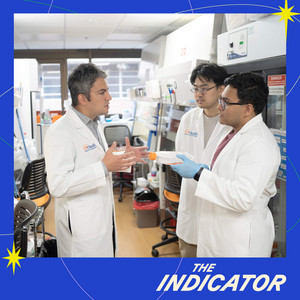
First, early research. Elias Sayre is a pediatric oncologist and a physician scientist at the University of Florida.
He and his team just released a paper on a cancer vaccine.
We think this is a groundbreaking discovery.
Cancer vaccines work a little differently than regular vaccines.
You take them after you've been diagnosed with cancer. and it trains your body's immune system to destroy cancerous cells and stop them growing.
If you can educate the immune system to fight someone's cancer, that immune system is always there.
Just like when it protects us against a virus and remembers it, it can do the same thing for cancer.
So there's so many advantages for not just treatment, but long-term care.
Cancer vaccines is this whole promising field of research.
A lot of trials are using mRNA technology. mRNA vaccines work by getting your body to produce proteins that the immune system then learns to fight.
By the way, they do not change your DNA.
Yeah, important clarification. mRNA vaccines do not genetically modify you.
So there are trials going on all over the world, but Elias's findings are special.
His team made an mRNA vaccine that could fight a tumor.
But unlike the other vaccines, they didn't have to formulate it to attack a specific tumor.
They made kind of a universal generic vaccine that could be a first treatment in the future for all kinds of cancers.
I'm hoping in the next three to five years, we've created a new paradigm for care.
Wow. Your hope is for an FDA approval essentially in three to five years.
Yes. Wow. That timeline might be optimistic given how mRNA research is under attack.
Earlier this month, the Secretary of Health and Human Services, Robert F. Kennedy Jr., cut $500 million from mRNA vaccine research.
Because this cut was focused on infectious diseases, Elias doesn't think his work is affected directly.
But he's still trying to figure out what this all means.
There are a lot of threats to what we're doing right now in terms of whether we can sustain this or not.
Honestly. Next up, for an innovation that just achieved FDA approval, we turn now to a Japanese biotech company called Fuji Rabio Diagnostics.
From concept to approval, Fujirebio Diagnostics spent a little less than two years working on a blood test for Alzheimer's disease.
It was, in my career, the fastest we've ever done anything.
Diana Dixon is the vice president for clinical and regulatory sciences at the company.
She says the FDA was particularly engaged with them because Alzheimer's is so serious.
Right now, 7 million Americans are affected by this disease, and we expect that to double within our lifetimes.
One big problem at the moment is figuring out if someone with memory problems actually has Alzheimer's.
It's a very, very tough disease to diagnose.
Only 100% sure way to know is after someone passes away and their brain has buildup of this plaque, amyloid plaque.
About 15 years ago, doctors started using brain scanners on live patients and then spinal taps to find evidence of that amyloid plaque.
But those are expensive and require specialists.
And, you know, spent several years of research with blood biomarkers to really see, can we do this?
Can we get a blood test? to replace or add to some of these tests that are hard to get to?
And the answer is yes. The blood test isn't perfect.
There is always the potential for false negatives and false positives.
But along with other signs, it can give patients and their families a clearer picture of what's happening earlier.
So now that they have approval, Fuji Rabio Diagnostics is onto the commercialization phase.
They're getting the blood tests out into the world.
And just because someone makes a breakthrough and it's approved doesn't mean that the medical solution is widely available or affordable.
Take our third health innovation. Exoskeletons.
These are basically wearable robot suits that can make you stronger or walk faster.
It could be an extension just for your arm or a brace-like device just for walking.
Matt Ford lives in the UK, where he specializes in writing about historical weapons and armor.
He has the autoimmune disease rheumatoid arthritis, which damaged his joints and is now eroding his muscles.
He didn't want to do a spoken conversation because of the way it affects his lungs, so we interviewed him over email.
Matt says that on his worst days, he's mostly confined to his bed.
On good days, he can walk, but not without pain and exhaustion.
For a big day out, he uses a wheelchair, but says that's not without its problems, like stairs, uneven surfaces, and the strength needed to propel it.
Earlier this year, he saw an ad on social media showing an exoskeleton from a Chinese startup called Hypershell.
The HyperShell looks kind of like bionic bike shorts.
It's these battery-powered braces that help lift your thighs while you're walking.
Matt says it was about $1,000, a lot of money for him, but still way cheaper than other devices he's seen.
He decided to take the plunge and ordered one straight from their website.
Two weeks later, it arrived. After strapping it on with a heavy tap of haptic feedback, like a big phone vibration, the device prompted him that it was ready. we had a colleague read out how he described first using it.
It feels a little like being a puppet, though you're in control at all times.
The motor amidst a whir with each step. I then proceeded to walk around my house and garden testing the settings with a huge grin on my face.
That sound you're hearing is Matt using the Hypershell.
He says it's replaced his wheelchair, which is now gathering dust in his garage.
He uses the exoskeleton for family walks, long museum visits, and shopping trips.
Now, exoskeletons aren't new. Some version of robotic assistance has been around since the 1960s.
But what's changed is how compact they've gotten and how much the price has come down.
Matt says he's excited to see how exoskeletons continue to progress.
The type of innovation seen in exoskeletons is quite different to the mRNA cancer vaccine tests in a lab or the blood tests for Alzheimer's.
This reveals a pattern with innovation. All along the chain of innovation, you have different institutions involved with different incentives.
For the fundamental research that Elias is doing with cancer vaccines, that might be the kind of research where one company would struggle to recoup all its investments.
So it makes sense that the government and universities and philanthropies fund that kind of work.
Exactly. And then you have the specific blood test for Alzheimer's that a big multinational like Fujirebo Diagnostics can support, patent, and monetize.
And when it comes to the consumer-facing electronics of Hypershell, a private company has the nimbleness and incentives to be responsive to consumers. to source cheaper parts that can bring down costs.
All along the health innovation pipeline, each of those players have a role in improving living standards and our economy.
This episode was produced by Cooper Katz-McKim with engineering by Robert Rodriguez.
Voiceover was done by Greg Hards. It was fact-checked by Cyril Juarez.
Kate Concannon edits the show and The Indicator is a production of NPR.