Grownups, Wondery Plus subscribers can listen to Wow in the World early and ad-free right now.
Join Wondery Plus in the Wondery app or Wondery Kids Plus on Apple Podcasts.
Hey, Wowzer fans, Mindy here.
And before we start the show, I gotta let you know that this November, with a special new episode featuring our friends at Circle Round and Terrestrials on Radiolab for Kids,
And don't miss when Elmo from Sesame Street stops by Wow in the World to make us all belly laugh on November 24th.
Oh, but that's not all, Reg.
On December 1st, we are sharing our 250th episode of Wow in the World with all of you.
We think this one is going to be music to your ears.
Literally.
Did I mention it's a musical?
And if you're a member of the World Organization of Wowzers...
Oh boy, do I have a surprise for you.
You can listen to our 250th episode early with me and other members from around the world on Saturday, November 22nd, at 7pm Eastern.
That's right, we are throwing another listening party.
Join us as we dance along to our new songs.
React to the episode with other members in the chat and more.
Grownups.
If you want your wowzer to join this members-only listening party, you can sign up to become a member today at Tinkercastcom.
Slash wow.
Already a member?
Well, you can find the link and password to join the event when you sign in at Tinkercastcom.
Slash wow.
That's it.
It's going to be a November to remember.
But for now, let's get on with the show.
Woo!
We have everyone here.
Grandma G-Force, Thomas Fingerling, Dennis, Reggie.
Presents!
Talk louder!
Okay, I'd just like to thank everyone for joining me for what is sure to be a very exciting day in the laboratory of bad ideas.
Now, before we get started, I'm just going to run down the checklist to make sure that we have everything we need.
Okay.
First item, boo-boo beanie boppers.
Check!
I brought my entire collection.
Oops, guess I still got a few ripped ones in here.
Okay, thank you, Dennis.
Next thing on my list, a first aid kit.
Here you go.
Uh, no, that is a rusty box of dangerous tools.
Oh, right, you are.
What was I supposed to bring?
Ugh.
I'm also looking for two cases of diapers.
Was anyone able to acquire the diapers?
Well, I was thinking maybe we could just, uh, poop our pants.
Poop our pants?
You know, for fun.
G-Force, for the last time, quit trying to get us to poop our pants.
I'll poop your pants, Fingerling.
Oh, yeah.
No, no, no.
No one is pooping their pants.
Grandma G-Force, did you forget the diapers or yes?
Well, it depends on who's asking.
I'll take that as a yes.
Okay, we can probably just wad up some tissues instead.
Okay, now, next item, responsible human.
Now, who was signed up to bring the responsible human?
Huh?
Responsible human?
Say what?
Hey, everyone.
What's up?
Oh!
Responsible human!
I see one!
Some kind of a robot.
Uh... Guy Razzi!
You're just in time!
On time?
For what exactly?
For the laboratory of bad ideas.
Guy Raz.
We are going to be recreating a science experiment that I just read about in the journal Psychological Science.
Psychological Science, huh?
So I'm guessing that this is an experiment involving the human brain?
Exactoritos, Guy Raz.
Human brain?
Mindy, you didn't say anything about bringing a human brain.
Well, I brought my human head.
Could be a brain in there.
The only thing I got in my head is a bird's nest.
Okay, Roz, not just the human brain, but human baby brains.
Say what?
Now, where do you expect to get baby brains?
Especially at this hour.
Oh, how about baby carrots?
They got brains everywhere.
I know.
Let's call Baby Einstein.
No, everyone.
We're going to get the baby brains from babies.
What?
Oh, my.
Well, it's going to be hard to get them out, but I got all day.
And good thing I brought this rusty box of tools.
You're taking the brains out of babies?
No, I'm not taking the brains out of babies, Guy Raz.
Phew.
I'm babysitting the babies.
What?
Now, don't worry.
As usual, I've got everything out of control.
This morning I hung these signs all over the neighborhood offering free babysitting in the laboratory of bad ideas.
Let me see that.
Free babysitting in the laboratory of bad ideas.
Unlicensed.
Unexperienced.
Uninsured?
Mindy, aren't you telling me that parents and caregivers are gonna take you up on this offer?
Well, you tell me.
Thank you, thank you, thank you, thank you, thank you.
It's so hard to find a center this time of day.
And don't forget, he doesn't eat gluten.
I'll be back in a few hours or days.
Thank you.
Bye-bye.
So, Guy Raz, it turns out that after people read the word free, they forget to read everything that comes after it.
Binky is for only at nap time.
Okay.
Just a little unintentional behavioral science experiment.
I see.
Now, little Franklin here is lactose intolerant.
I'm just going to drop and dash him late for a meeting.
Okay.
Oh, boy.
Dump your babies in the lab and we'll take care of the rest.
Okay, bye.
Love you.
Hey, little baby.
You like hot peppers?
Or how about a rusty hammer?
Mindy, this one's leaking.
Ah, Reggie, do something.
Boy, are you putting that binky in the wrong end of the baby.
That's because someone forgot diapers, Grandma G-Force.
Oh, snap.
Mindy, what is going on here?
There must be a hundred babies in your lab.
You know what?
Let me just, uh, close this door so I can explain myself in peace.
Uh Okay, as I was saying Gyro, I offered free babysitting today because I wanted to recreate a science experiment that was recently conducted by a team of cognitive science researchers at the Johns Hopkins University in Maryland.
Cognitive science.
So the study of the mind and how it works.
Exact Doritos, Guy Raz.
And in this case, baby minds.
Mindy!
Whoo!
Quick, the babies, they need snacks.
Do you have any snacks in here?
Uh, yeah, there should be a few snack bags of exploding ants in the closet.
Uh, closet, okay.
Uh, oh, here we go, got them.
Thanks, Mindy.
Oh, but check the expiration date.
Those were from like three seasons ago and I'm pretty sure they've been banned by the Food and Drug Administration.
What?
Yeah, okay, sure, I'll check whatever you said.
Okay, who wants snackies?
Ah, no, get back, babies.
Why are your little fingernails so sharp?
Uh, are you sure you really thought this through, Mindy?
Yes, of course I'm not sure I really thought this through, Guy Raz.
Now, where was I?
Uh, right.
You were telling me how you planned to recreate a cognitive science experiment with all the babies you uh collected.
Oh, yes.
Okay, so, have you ever heard of the term...
Unconscious bias, Skyroz?
Oh, sure.
Unconscious bias are the thoughts and feelings we have for certain things that influence how we make decisions, even when we're not aware of it.
Yeah, for example, for no reason at all, I always ice my gingerbread mansion with red frosting, when yellow frosting or green frosting would make it cave in just the same.
See?
You're unconscious or unaware of why you choose one frosting over another, when they'd all fail you just the same.
Exactly.
And scientists have known for a long time that people, namely grown-ups, spend their whole lives making all kinds of decisions based on their unconscious biases.
Oh, right.
Like that time.
You spent 30 minutes in the grocery trying to decide between snack bags of exploding ants or exploding aunts.
Yeah, well, in the end, there was really no question.
I mean, everyone knows that exploding ants are far superior to exploding aunts.
But Mindy, they're essentially the same snack.
Exploding aunts is just a store brand of exploding ants.
Also, exploding ants are shaped like ants, and exploding aunts are all shaped like my Aunt Mojo.
Just crunchy little parent sisters with bowl haircuts.
Also that, but you'd never know it in a blind taste test.
The two snacks taste exactly the same.
You just prefer exploding ants now because you picked it.
And that's your unconscious bias.
Hey!
Hey, you two!
Quick question.
Do babies have knuckles?
What?
What?
Yes, babies do have knuckles, but they do not have kneecaps.
At least not until they're like two or something.
Got it.
Uh, why are you asking, Dennis?
Oh, no reason.
Hey, Tommy.
Yeah?
The babies have knuckles, but they don't have knees.
They don't have knees?
Yeah, something like that.
Now, where were we?
Uh, we were talking about how you have an unconscious bias for exploding ants.
Oh, right.
So I've always assumed that I chose exploding ants over exploding ants because I like them the most.
But maybe the reason you like exploding ants the most is because you chose them.
Which would suggest that I don't like exploding ants because I don't choose them when given the option.
Exactly.
Wow, I didn't even realize I did that.
Well, that's why it's called unconscious bias, Mindy.
It means we're not even conscious or aware that we're making these choices.
And we as humans do this all the time without ever thinking about it, whether it's a favorite brand of toothpaste or ketchup or socks.
Wow, and I guess it's probably a good idea to be aware that we even have unconscious biases, so that we can check ourselves before we let them get in the way of how we see other people.
Exactly.
Which brings me to the reason.
I've got a thousand screaming babies in my laboratory of bad ideas right now.
Yeah, I was wondering when you were going to get to that.
Guy Raz.
Knowing that we humans make unconsciously biased decisions all day, every day, the researchers in this study set out to discover when.
When we start to choose certain things over others without really even thinking about why.
And so that means they started at the beginning?
They started at the babies, Guy Raz.
Ah!
Step into my lab.
No way.
There is no way I am going in there.
There are babies in there.
Anything for science?
Anything for science?
Yes.
Hey, babies!
Wow, Mindy, you're a real baby whisperer.
Hey, did you hear that?
It said goo-goo-guy-guy.
I think it likes me.
Hey, man, its personal pronoun is she.
Oh, oh, my apologies, Ms., uh, baby.
Oh, aren't you a cute little one?
Yes, you are.
You're a cute little baby.
Where did those teeth come from?
Oh, sorry.
Those are mine.
All right, baby G. Time to give me back my teeth.
Anywho, is everyone here ready to recreate an experiment from a scientific study?
Yep.
Okay.
Well, I guess.
Okay, great.
Before we get started, I want everyone to know that we are going to recreate an experiment where researchers set out to discover when human beings start to show unconscious bias.
What did you say?
Unconscious pilots?
Unconscious bias or randomly preferring one thing over another, especially when the two choices are.
Pretty much the same.
Okay.
So for this experiment, the researchers chose babies.
See, babies are at a stage of life where they don't get to make a lot of choices in the first place.
Huh.
So when researchers set out to discover when a person begins to develop unconscious biases...
I guess exploring babies seemed like a natural place to start.
Bingo, Guy Raz.
And for their experiment, the first thing that the researchers did was invite a bunch of babies into their lab.
Well, I hope they invited a bunch of babysitters, too.
Wait, babysitting?
Well, no one told me we were going to be sitting on the babies.
Now I'm just going to sit right here on this one.
No, no!
Don't sit on the babies!
Yes, everyone, please do not sit on the babies, okay?
We need them for the experiment.
And also, we should probably return them to their families in the same shape we got them.
What was that, Guy Raz?
Oh, nothing.
Just talking to myself.
Oh, okay.
Well, as I was saying, the researchers invited a bunch of babies into their lab...
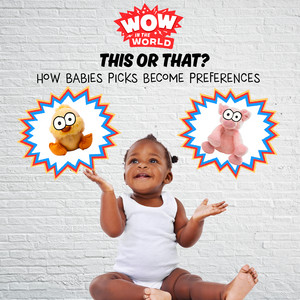
And then they gave each baby the choice of two equally bright soft, colorful toy blocks to play with.
Okay.
And for our experiment, instead of blocks, we are going to give each baby the choice of two equally bright soft, colorful boo-boo beanie boppers to play with.
Oh boy, this is the part I've been waiting for.
Okay, babies.
Line up single file and I will hand each of you two boo-boo beanie boppers.
No, no, no, no, Dennis.
You've got to place each pair of boo-boo beanie boppers far apart from each other, letting the babies crawl to the ones they prefer.
You know, so they can make a random choice of which one they want.
Oh, got it.
Uh, quick question here.
Is it possible we have too many babies for this experiment, Mindy?
I'm guessing that the researchers in the study tried this with one baby at a time.
Yeah, I might have gone a little overboard with the babies.
Maybe just a little.
Anywho, after the babies each made their random choice of which toy block they preferred, the researchers took that toy block away.
Taking toys from babies?
Who's going to be able to do that?
Thank you.
I'll take that.
No, give it to your baby.
But just as the researchers took that first toy block away, they presented each baby with a brand new toy block or, in our case, Boo Boo, Beanie Bopper.
Don't cry, babies.
Here's another Boo Boo Beanie Bopper for you, and one for you.
And one for you!
And one for you!
And a new boo boo beanie bopper for you!
Then the researchers allowed the babies to choose either the toy that they didn't play with the first time or the brand new toy.
Okay, you little pooflets.
Now you got two boo-boo beanie buffers again.
Well, take your hat, baby.
And what did the researchers observe, Mindy?
Well, pretty much the same thing we're observing right now, Guy Raz.
Mindy, it looks like most of the babies are choosing the new toy rather than the toy that they didn't pick the first time.
Well...
I'll be.
And that's exactly what the researchers observed as well.
In fact Dr Fegenson, one of the lead researchers in this study.
She said that it was almost as if the babies were saying hmm, I didn't choose that object the first time.
I guess I just didn't like it very much.
What?
Excuse me?
Wait a minute, did that baby... No, you must be hearing things.
So this would suggest that, when it comes to unconscious bias, babies are just like adults, in the sense that they tend to like things they choose better than the things they don't choose, even if they don't really know why.
Yep, and even when they just make a choice randomly between two things that are basically the same.
But what if the element of choice were taken away?
What would happen if we chose the boo-boo beanie bopper for each baby to play with?
Well, the researchers actually did this in some follow-up experiments.
Oh, yeah?
Yeah, and for those experiments, the researchers chose the toy for the babies.
Then they later took that toy away and gave the baby a new toy to play with.
And what did they discover?
Well, they discovered that when they didn't give the baby a choice, the baby didn't really have a strong preference or feeling for either toy.
So for unconscious bias to exist, the person must be able to make a choice.
Which suggests that we like things because we choose them and we dislike the things that we don't choose, even when those two things are basically the same.
And it all begins at the earliest stages in life, when we're making our first random choices as babies.
Exactoritos, Guy Raz.
Wow, so what's next, Mindy?
Well next, the researchers want to explore what happens when babies have too many options to choose from.
You know, choice overload.
Having so many choices that you can't decide at all.
No, I mean, what's next for this experiment in your laboratory of bad ideas?
No, that's my boo-boo beanie.
No, it's my boo-boo beanie bopper.
No, that's my boo-boo beanie bopper, Thunderling.
No, G-Force, it's my boo-boo beanie bopper.
Oh, it's mine.
Here we go again.
It's my boo-boo beanie bopper.
Actually, they're all my boo-boo beanie boppers.
I brought them from home.
Well, I guess we should probably release these babies back into the wild.
You mean into the arms of the parents who brought them here?
Yeah, that's what I said.
All right, fella.
I'll trade you five of these here babies for one boo-boo beanie bopper.
Whoa!
Five babies?
Might get 20.
20!
We got 20 babies.
Dig it down, dig it down, dig it down here.
Do I hear 25?
Bubba-da-dub, bubba-da-dub now.
25 babies here.
Dig it down, dig it down, 25, dig it down, 25.
Going, going.
Hey!
Sold to the pigeon in the back for 25 babies.
Dennis!
What?
You think I could have got more?
Wow in the World will be right back.
Grown-ups, this message is for you.
Hey, grown-ups.
It's Mindy and Guy Raz here from Wow in the World.
Mindy and I have some We'll be right back.
Our Wow in the World toys help your wowzer learn about their world through play.
Plus, you can hear exclusive audio content from me and Guy Raz to help your wowzer discover even more wows.
Grownups.
Give the gift of wow and wonder this holiday season with our latest Wow in the World toys designed with your curious wowzer in mind.
You can shop our Wow in the World toys at Tinkercast.com slash toys.
That's Tinkercast.com slash toys.
Wow in the World.
Hi, thanks for calling Wow in the World.
After the beep, get ready to record.
Hi, guys.
My name is Seamus, and I live in Amarillo, Texas.
My reality is that the big thing happened 13.7 billion years ago.
Try to watch it for me.
My name is Hope.
I'm from Winter Garden, Florida.
My wow is that babies have more bones than grown-ups.
Hi, Dennis.
Hi, Eddie.
Hi!
Hi, Thomas.
What's up?
Hi, my name is Hattie, and I am from San Francisco.
And my wow in the world is that scientists think that Saturn will... eventually lose its wings.
Say hi to Thomas Fingerling.
Gnarly.
And Baby Bee for me.
I'm the baby.
Someone change my diaper.
Hi, my name is Hank.
I live in Dallas, Texas.
My role in the world is that your skin is the biggest organ in your body.
Say hi to Reggie for me.
Bye. world.
My name is Anderson and I live in Columbus, Ohio.
My wow in the world is that dinosaurs evolved into birds.
Hello Mindy and Guy Wads.
My name is Samantha and I live in Swansville, Ohio.
My wow in the world is that people with sickle cell anemia have resistance to malaria.
Say hi to for me.
Ahoy there!
Bye!
Hi, Mindy and Guy Ross.
My name is Owen Kaufman.
I live in Charlottesville, Virginia, and I'm 11 years old.
My wow in the world is that, due to the human population being so low there, Wyoming has more cows than people.
Bye, Mindy and Guy Ross.
I love your show, and say hi to Reggie for me.
Hi, Mindy and Guy Ross.
My name is Jeanette and I live in for growth california, and my wow is that the planet uranus was originally called george.
Say hi to reggie grandma g-force.
Oh yeah dennis howdy, thomas fingerling and the flake hi.
My name is chloe.
I'm from florida and my wow in the world is that the one dog sniff buds it's just not for fun, And they tell if the dog's a girl or a boy and what they've been eating.
And I have two pugs.
A puggle and a pug.
Milo and Daphne.
Bye!
End of messages.
Wow in the World is written by Mindy Thomas and Tom Van Kalken, with help from me.
Original sound design and music editing is done by our senior producer, jed anderson, and tyler tholl.
You can also hear jed anderson and the voices of dennis thomas fingerling, reggie and many of the other silly characters you hear on our show.
Jessica bode keeps our facts straight as our fact checker, and meredith halpern ranzer powers.
The wow at Our theme song was composed and performed by three-time Grammy nominees, The Pop-Ups.
Find them at thepopups.com.
Special thanks to the rest of our team of tinkerers, including Anna Zagorski, Rebecca Caban, Kit Ballinger and Henry Moskal.
To keep the wows rolling, visit us at tinkercast.com.
There you can learn more about becoming an official member of the World Organization of Wowsers.
Learn more about upcoming events.
Shop our shop and pick up a copy of our new number one New York Times bestselling book, The How and Wow of the Human Body.
Grownups, you can follow Wow in the World on Facebook, Instagram, and Twitter at wowintheworld.
And our email address is hello at tinkercast.com.
And if you're a kid with a big wow to share with us, call us at 1-888-WOW for a chance to be featured at the end of our show or an upcoming episode of Two What's and a Wow.
Thanks again for listening and until next time, keep on wowing!
Wow in the World was made by Tinkercast and sent to you by Wondery.