Welcome to Spotlight.
I'm Colin Lowther.
And I'm Alice Irizarry.
Spotlight uses a special English method of broadcasting.
It is easier for people to understand, no matter where in the world they live.
I hate a song that makes you think that you are not any good.
I hate a song that makes you think that you are just born to lose.
No good to nobody, no good for nothing, Because you are either too old or too young, or too fat, or too thin or too bad looking, or too this or too that.
Songs that make fun of you on account of your bad luck or hard travels.
I will fight those kinds of songs to my very last breath.
I will fight them to my last drop of blood."
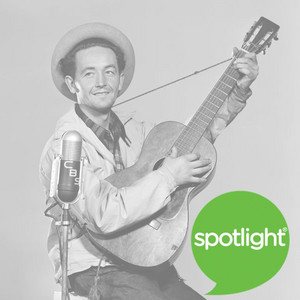
Woody Guthrie was a songwriter from the United States.
He spoke these words on a radio program in 1945.
Guthrie's method for making music was special.
He wrote about what he experienced in his life.
The words in his songs were like the dust of the road.
But the simple words and sounds displayed a truth – that Woody Guthrie was as real as they came.
This kind of simple honesty made Guthrie's songs special.
It changed American folk music forever.
Today's Spotlight is on Woody Guthrie.
Woody Guthrie was born into dust.
In the 1930s, The world faced the Great Depression.
This terrible economic downturn hit the United States hard.
Rich men threw themselves from buildings because they were depressed over all they had lost.
But the situation was worse in the Great Plains.
Years of too much farming had left the ground too worn out to grow good crops.
Three years of little rain left thousands of kilometers of empty land.
Huge windstorms blew through these empty fields.
These were the perfect elements for human tragedy.
They were the elements for the Dust Bowl.
The Dust Bowl transformed the Great Plains.
Parts of Texas, Oklahoma, Nevada, New Mexico and Colorado became unlivable.
The winds carried thousands of kilograms of soil, blowing great clouds of black dust into the air.
These storms, called black blizzards, could bury people in their homes.
Even breathing the air was dangerous.
Avis D. Carlson was a writer for the New Republic newspaper.
He compared these storms to bad dreams.
The bad dream is deepest during the storms.
But on the few bright days and the usual grey day, we cannot forget it.
We live with the dust, eat it, sleep with it.
We watch it take our things, and our hope of things.
It is becoming real.
The hope of spring turns into a story of the past.
The bad dream is becoming life.
Like thousands of others from Oklahoma, The Dust Bowl pushed Guthrie from his home.
With little money and little hope, he wandered the United States.
He left his children and wife behind.
He earned his meals by playing music and painting signs.
Sometimes he found work on farms.
But most nights, when he went to bed, his stomach was empty.
All he had were the people he travelled with and his guitar, his favourite instrument.
Guthrie's travels made him distrustful of people with wealth.
By the time he reached California, he was already writing songs that praised working people, such as his song about the farmer labour train.
His experiences in California made this feeling stronger.
He joined thousands of other people fleeing from the Dust Bowl called Okies.
The name Okies came because so many of them had left their farms in Oklahoma.
The Okies thought that they would find jobs in California.
But people there did not have much work either.
Many Californians distrusted these new travellers.
They did not give the Okies jobs.
The Okies were made to feel less than human.
Guthrie's most famous songs speak to these experiences.
This Land is Your Land is his best-known song.
Most of the song describes the beauty of the United States of America.
The sands of Guthrie's America shine brightly.
Its forests stand tall and mighty.
But after each part or verse of his song, Guthrie returns to the same idea that the United States belongs to all of its people.
He sang This land is your land and this land is my land, from California to the New York Island, from the Redwood Forest to the Gulf Stream waters.
This land was made for you and me.
Even though Guthrie had difficult experiences, he loved his country.
He enjoyed its beauty.
But he also saw where it was not perfect and where it could improve.
He criticised and protested through songs and humour.
But every song he wrote, every sound he played, came from a deep love of the place he called home."
Guthrie's songs soon made him famous among the Okies.
And he met people interested in recording his songs.
He ran a radio program in California for several years.
He played many of his new songs on the program.
Guthrie's words often got him in trouble.
Guthrie was not a communist supporting that kind of government system, but his songs expressed Sympathy for the commonest.
Someone fighting for the common, ordinary people and seeking to help with their problems.
These ideas were common among workers during the Dust Bowl.
During the Dust Bowl.
But as time passed, People in the United States became suspicious of Guthrie's political views.
Guthrie lost his job at the radio station in 1939.
He continued writing and singing, but it became more difficult to find people to listen to his music.
Guthrie also seemed to be unable to stay in place for long.
He had grown up traveling.
The road was part of him.
He spent years moving from one side of the country to another.
One year he was writing songs in the Pacific Northwest.
Another year?
He was in New York City playing with a group called the Almanac Singers.
He was married and divorced several times.
Guthrie grew successful even though he moved so much.
But he did not have the same kind of success as modern recording artists would have.
He travelled instead of collecting wealth.
Experiences seemed more important to him than building a life in one place.
He did not plan for old age.
Old age came to Woody Guthrie sooner than most.
He was born with Huntington's disease.
This disorder of the brain attacked his memory and intelligence.
He grew difficult to live with and difficult to care for.
By 1965, the disease had robbed him of his speech.
He died two years later, unable to write or sing a word.
But others like Guthrie would soon take up his voice.
Bob Dylan is a famous musician.
Dylan won the 2016 Nobel Prize in Literature with the words he wrote for his songs.
But when he was younger, Woody Guthrie was his favourite artist.
Musicians like Johnny Cash, Bob Seger and Bruce Springsteen all credit Guthrie among their early musical influences.
His style of honest speaking continues to shape American folk music today.
Woody Guthrie was an important folk artist.
What does folk music mean to you?
What does it sound like for you?
Who are the folk singers in your community?
You can leave a comment on our website at www.spotlightenglish.com.
You can also find us on YouTube, Facebook, TikTok, and X.
You can also get our programs delivered directly to your Android or Apple device through our free official Spotlight English app.
The writer of this program was Dan Christman.
The producer was Michio Ozaki.
The voices you heard were from the United Kingdom and the United States.
All quotes were adapted for this program and voiced by Spotlight.
This program is called, This Land is Your Land – The Woody Guthrie Story.
We hope you can join us again for the next Spotlight program.
Goodbye.