Welcome back to a new video everyone.
Today we'll be learning polite English to sound respectful and confident anywhere you go.
At the end there will also be real speaking practice to use what you learned today.
This video is part of my 3000 most common English words series, designed to help you understand up to 95 of spoken English.
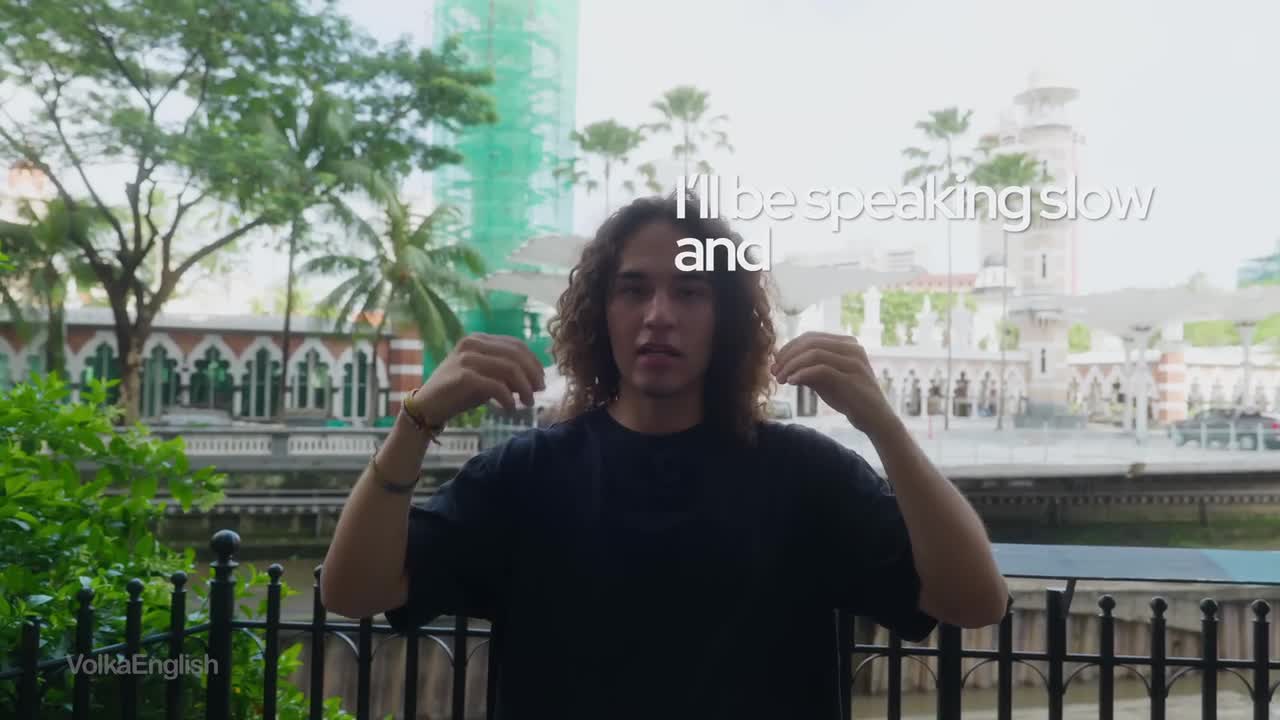
I'll be speaking slow and clearly, so make sure you watch the whole video to get the most out of it.
Vulnerability.
Up these stairs.
Polite phrases.
Son, did you clean, don't you think?
Example conversation.
Tower.
The note for me.
You already had one.
Eyes. to create.
Let's get started.
Excuse me.
Sorry.
Please.
Thank you.
No worries.
You're welcome.
Could you?
Would you?
May I?
I appreciate it.
These phrases make you sound instantly more polite when speaking English, and we'll be using every one of them today.
Let's go.
So we are going to be learning polite phrases and how to talk politely in English.
Can you please take a video of me looking at this mosque?
Of course.
You can also take a picture too once you're done, please.
Thank you.
How does it look?
Looks super good.
You took a video and a photo.
Thank you.
I appreciate it.
You're welcome.
Would you like a photo?
I would.
Okay.
So that is one short example conversation using polite English.
Usually you want to be polite when you ask for things in English.
So I was asking Leon to take a photo and a video of me here.
And then once he did that, I said, thank you.
And then I offered him a photo as well.
That's just a nice thing to do to exchange that service.
But let's continue walking down this way.
So now I'm walking up these stairs and we are going to go to Do you know what that area is, Merdeka?
It's like a palace.
I think it's like an old government building.
So it's like a square.
There's a big grass area where they hold events.
Like a park.
Exactly.
Yeah, so that's where we're heading to right now.
And today is very sunny.
Super sunny out.
Yeah, I can see you're covering your face from the sun.
Did you put on sunscreen today?
I did put on sunscreen, but the sun is in my eyes, so I'm kind of using my hand as a makeshift hat to cover my eyes.
But now the sun isn't in my eyes anymore, so I don't need to put my hand over my eyes to create shape.
That was water.
I thought that might have been bird poop that fell on me, but it was just water shade.
There was a dangerous area back there for bird poop right yeah, we weren't recording.
But we were walking and a big piece of bird poop fell right beside us and i was like, oh my gosh, i do not want to get bird poop on me first thing in the morning.
Oh, here is lucking coffee.
Let me know if you guys are from china.
This, i believe, is a chinese coffee.
Oh, look at the cat.
The cat is just chilling.
Yeah, I believe this brand, Luckin Coffee, is from China.
Let me know if you're from China.
I've never had it before.
Should I get another coffee?
We can get a coffee on the way back or you can grab one right now.
It's up to you really because I think we might walk back this way.
I don't drink that much coffee, so one is enough for me.
You already had one.
I don't drink coffee.
I just drink water.
But let's keep going.
If you want to get my 3000 most common English words PDF to help you understand up to 95 of spoken English with real, clear definitions and examples organized by CEFR level and topic, then check out the link in my description to get it.
So this is that mosque.
This is not a mosque.
It's like a palace would be the closest thing.
So kings used to live here or royalty.
I believe so.
Don't quote me on it, but it's across the main mosque, which we saw on the way over here.
Yeah.
But right now the royalty lives closer to where we're staying on that mountain that we see.
I actually was watching a YouTube video and apparently there are like dozens of royal families in Malaysia.
There's like one for every province or something.
And then there's like a main king.
Yeah, and every like couple of years.
I don't know how it exactly works, but the main king changes like it changes between each family like main position, which I think is like super interesting.
So there are like a lot of royals in Malaysia, but it's super beautiful, like the architecture, like the brick, and I like how it's all like a lighter color.
But I think it looks too clean, don't you think?
Like, I believe this is an old building, but it doesn't feel like it.
Everything's freshly painted and the bricks are freshly washed.
I don't know.
I don't mind it, to be honest.
The color is nice and it just looks just clean.
Yeah, I've never seen bricks this light, if I'm being honest.
It just looks really clean to me.
Like, it doesn't look fake.
If the bricks were like those deep orange bricks, I would not like it.
But this color is quite nice, actually.
Like those ones over there?
Yeah, that, I don't like the color of those bricks personally, but this, this is nice.
Look at this tower.
It has a spiral staircase, right?
Yeah, that would be cool to go up there, honestly.
So this is a simple, polite framework when speaking in English.
Attention, request, reason, thanks, and exit.
Only five steps.
So the first thing you want to do is get attention politely.
You can do this by saying phrases like, excuse me, sorry, or hi, sorry to bother you.
The second step is to make the request.
Some common phrases are could you, would you, can you, and may I. Could you help me?
Would you take a photo of me?
Can you tell me where this is?
May I sit here?
Those are some example sentences.
Step three is to add a reason.
This makes you sound softer.
Some example starter sentences are I'm not sure, I'm trying to, I'm a bit lost.
So I'm not sure where to go.
I'm trying to find the entrance.
And then finally, I'm a bit lost.
Usually people want to help you if you show a little bit of vulnerability.
For example, by saying, excuse me, I don't know where to go.
I'm a bit lost.
Can you help me?
That's a good example sentence.
And step four is to say thanks.
After they've helped you, it's important to say thank you and to be polite.
Some examples are, thank you.
Thanks a lot.
I appreciate it.
And I really appreciate it.
My favorite is, Thank you, I appreciate it.
And the fifth step is to exit politely.
Whether they help you or not, it's important to still be polite when you leave.
So if they don't want to help you, you can say no worries or no problem, or that's okay, or have a nice day.
So an example sentence is no worries, have a nice day or that's okay, don't worry about it.
And then you can just go ask another person for help and hopefully they help you.
Now, if someone asks you to do something and you can't, you can refuse politely.
For example, you can say sorry, I can't not right now, sorry maybe later, or I'd rather not sorry.
Those are four examples you can say to politely refuse someone's request.
Okay guys, now we're going to go through three shadowing practice scenarios.
The first one, me and my brother will speak.
And the second two, I will speak and you will read the yellow caption and speak back to me.
Excuse me, could you take a photo of me please?
Sure.
Thank you.
I really appreciate it.
No worries.
The photos look really good.
Thank you.
I'm glad.
Have a nice day.
Hi, sorry to bother you.
I'm a bit lost.
Could you help me?
Could you tell me where the entrance is, please?
Thank you very much.
Bye.
Now you guys go first.
Sorry, not right now.
You too, bye.
Now let's talk about some common mistakes.
The first one, give me something, blank.
Give me can sound too direct with strangers.
Use could you or can I instead.
For example, could you help me?
Or can I have this please?
The second, I want.
I want is okay with friends but in public with strangers it can sound very strong.
Use I'd like or could I have.
For example, I'd like a coffee please or Could I have a coffee please?
Or may I have a coffee please?
Those are all a lot softer and more polite than simply saying I want a coffee.
Third common mistake, you must.
You must sounds like an order.
Use you should for advice or could you for a request.
For example, could you speak slowly please?
Or you should try this place.
However, there are circumstances where you must make sense and it's honestly better to use.
For example, if something is so good and you say to someone you must try this restaurant because it's so good.
In that case, it's fine because you are just talking about how good the restaurant or that place is.
You must try it.
But if it sounds like an order, you must try this.
You must go there.
You must do this.
Then that could come off as rude and it sounds like you're ordering them.
But if you're using it more to express how good something is or you must try this, then it's okay.
It just depends on how you say it.
And one final tip you can add to make it sound even more polite is to add please at the end.
This makes it sound more polite and softer.
For example, could you help me?
Please.
Could I sit here?
Please.
Now let's practice the pronunciation of some difficult words.
The first word, excuse me, excuse me, excuse me.
The second word, would you, would you, would you, would you.
Would you help me please?
Would you help me please?
The third, could you?
Could you help me?
Could you help me?
The fourth, appreciate.
Appreciate.
I appreciate it.
Now I will ask you three questions and I want you guys to answer out loud.
How can you ask someone to take a photo for you politely?
Excuse me, could you take a photo of me please?
Second question, how can you ask someone for directions politely and give a reason?
Hi, sorry to bother you.
Could you help me find the entrance please?
I'm a bit lost.
The third question, how can you refuse someone politely?
Sorry, not right now.
If you guys like this video and you want to see more videos like these where it's a mix of talking to the camera but also live comprehensible input vlogs, then let me know in the comments.
If you're serious about becoming fluent in English, I've built a full speaking shadowing and pronunciation course you can follow step by step.
You get instant access to over 60 video lessons right away, and I add three to five brand new lessons every week to keep the content fresh.
And you're not just getting videos.
You also get an exclusive ChatGPT prompt to help you master the pronunciation of any word, plus a step-by-step structure to follow so you know exactly how to practice and get the most out of every lesson.
Inside we train pronunciation, accent, rhythm, and natural speaking.
So you stop hesitating and start speaking with real confidence.
Now here's a sneak peek at what you get the moment you join.
So I wouldn't take legal action.
Came down to heat.
Already so cranky.
Jeans and one hoodie.
Click the link in my description to join.
We are going to be learning polite phrases and how to talk.
One short example conversation.
I'm walking up these stairs.
Covering your face from the sun.
Did you put on sunscreen?
Put my hand over my eyes to create shape.
So one is enough for me.
You already had one.
Too clean, don't you think?
Look at this tower.
As a spiral staircase.
A little bit of vulnerability, for example.
My favorite is, thank you, I appreciate it.
And if you want to get these t-shirts, check out volcaenglish.com.
And remember guys, you will become fluent in English.