This is Eric Glass.
On This American Life, we specialize in compelling stories from everyday life.
I was like, wow, you've literally just died and came back.
And the first thing you ask is, do you need any money?
Your Life Stories, really good ones in your podcast feed, This American Life.
Hey, it's Eric Abaris.
A quick word before the show to talk about this year, and all the different kinds of stories you heard on Planet Money.
This year, we brought you stories about inflation, disinflation, stagflation, skimpflation, dynamic pricing.
What is Teemu? Banking apps, rum taxes, the main potato war of 1976.
So many stories about so many different things.
Semiconductors? And the one thing they all have in common, AI, trade fraud, is we work really hard on each of them.
International shipping, so that they make you smarter and they're fun to listen to.
Tiny soda cans, zombie mortgages, why flying sucks, and another edition of Planet Money Summer School.
So this is the time of year when we say, hey, if that stuff was useful to you, if you made us a part of your day, in the car, on the train while you were doing dishes, chip in and help keep us going.
Your support matters so much that NPR basically invented an entire new product that we will give you to incentivize your donation.
We're talking about NPR plus.
Maybe you're already a plus supporter.
If so, thank you. If you're not, and you sign up today, you get perks for more than 25 different NPR podcasts, sponsor -free listening to all of them, and bonus content for some of our biggest shows, including this one, and exclusive access to special Planet Money merch in the NPR shop.
You get all that as a thank you for investing in NPR and our work at Planet Money.
So go to plus .npr .org to sign up, plus .npr .org.
That link is in our episode notes.
And thank you. This is Planet Money from NPR.
A while back, I went down to Southern Louisiana, just a few minutes' drive from the Gulf Coast, to meet up with a guy named Wendell Curall.
Howdy, howdy. Wendell.
Good to meet you. Alexei.
Okay. Where's home again?
Santa Fe, New Mexico.
Santa Fe, yeah. It's a lot wetter down here.
It is the opposite.
Okay. Our land over here was brought here by water.
That's how wet it is.
Wendell's in his mid -70s, got a shock of white hair and twinkly green eyes.
He was born and raised here in Cajun country, grew up in a French -speaking household of shrimp fishermen and oil rig workers, and hearing him talk, it's clear how proud he is to be from this place.
You know, the Midwest is the nation's breadbasket.
South Louisiana is a seafood platter.
Arguably more delicious than a breadbasket.
I know it. You don't hear people traveling to Milwaukee for the tremendous meal.
Sorry, Milwaukee. But delicious as it is, Wendell explains.
This part of the country is also in the middle of this kind of slow -moving existential crisis of biblical proportions because of where it sits on the edge of the ocean.
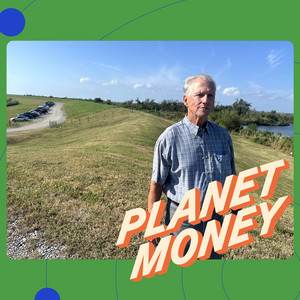
Wendell and I are standing on the spine of a massive grassy ridge line, a kind of fortress wall dividing the land from the water.
On one side we can see little houses in neat rows.
There are gumbo restaurants and shacks by the side of the road selling fresh shrimp.
You look to the left and you see a regular town, streets, you know, pretty typical of trees.
But you look to the right, the landscape is mostly water.
On the other side, open water stretches to the horizon.
It's speckled with little tufts of land and marsh, a few far -off oil tanks.
Wendell tells me it's a watery no man's land.
And a war between the open ocean and the people who live on Louisiana's southern coast.
Because this part of the country, he says, was formed over the course of thousands of years by sediment, carried here on the Mississippi River.
But man -made engineering over the last century has changed the river so much that sediment isn't building up anymore.
And southern Louisiana is actually sinking back into the Gulf.
And Wendell says that is putting the people who live here closer and closer to the frontlines of hurricanes.
The big picture is that the land is sinking and open water from the Gulf keeps increasing, so there's less to slow down any wave action.
Now, the reason I came to visit Wendell is because he's spent almost his entire professional life, over 40 years, working with the federal government to build the thing we are standing on.
To build a system of levees, a last line of defense against those hurricane force waves.
We're standing on a kind of grassy knoll mound here.
And that's what a levee is, it's just like a ridge.
But it's an artificial ridge, it was made by man.
A typical levee is a very intentionally constructed pile of dirt covered in grass or gravel that holds the water out.
Wendell's levee, as it's come to be known in these parts, is basically a giant ring, 48 miles long, protecting this community of over 10 ,000 people.
Now, a levee can seem like a deceptively simple piece of technology, but Wendell explains that building and maintaining them in the right way is essential.
For decades, Wendell headed up a local government agency.
He worked hand -in -hand with the federal government in order to build this levee to very specific standards.
Because if waves spill over the top, they can erode the levee from behind.
If wild hogs root around in them, they can create places for the waters to break through.
I mean, every day of the year I think about what could cause a problem for this levee.
Everything from having Ormond Diller's stick holes in it, to people riding too many horses or having cows on it.
Anything that takes away the resilience of the levee, we gotta stop.
And the resilience of the levee is really at the heart of this story.
After Hurricane Katrina hit Louisiana nearly two decades ago, it caused a massive rethinking of how these levee systems should be built.
And in the wake of that, Wendell decided to take a gamble, a gamble that put him at odds with his partners in the federal government.
He decided that the best thing he could do to protect his community was to go rogue.
The way I looked at it is that, man, I'm not gonna sit on my hands with money in the bank.
We don't want money in the bank, we want money on the bank, okay?
Because you flood from a hurricane, your city's destroyed.
Hello and welcome to Planet Money, I'm Alexei Horowitz -Gazi.
And I'm Mary Childs.
A couple decades ago, Wendell Curall found himself at a fork in the road.
On one path, he could stay within the framework the federal government had laid out to build these hurricane defenses.
And on the other, he could create his own path, building his levees as high as possible, as fast as possible, in a race against larger and larger storms.
And he knew his decision could mean life or death for over 10 ,000 people.
Today on the show, what the story of Wendell's levy can teach us about how the federal government calculates and manages the risk of natural disasters.
And how those calculations can look a lot different to the people staring straight into the eye of the storm.
This message comes from Grammarly, 231.
That's the average number of apps used by many companies.
This leads to a lot of context and tab switching, which can drain employee focus costing your company.
Grammarly can help, because it uses AI that works in over 500 ,000 apps and websites.
Join over 70 ,000 teams who save an average of $500 ,000 per employee per year using Grammarly.
Go to Grammarly .com slash enterprise to learn more.
...supporting public media.
Learn more at plus dot NPR dot org.
Wendell Curall was fresh out of college back in the late 70s when he first started thinking about what kinds of fortifications it might take to protect South Lafourche Parish, the place he calls home.
Growing up in southern Louisiana, the specter of hurricanes hung over everything.
Over the last century and a half, whole towns here have been decimated and ultimately abandoned after flooding from hurricanes.
Wendell's own great grandparents had to resettle after a hurricane in 1893 flooded their town and killed half the population.
So when he heard about a job leading the South Lafourche Levy District, it felt like a way to serve the place that he loved.
The Levy District was this local office with a mandate to help the federal government build hurricane protection around the community.
When I took the job, I said, look, this is life and death for people.
I have to tell myself from the beginning, people can die.
You've got to make sure you do the best job possible.
And one of the first things Wendell learned about the job was that it entailed a close partnership with the part of the federal government that builds these levy systems, the Army Corps of Engineers.
The Army Corps is part of the U .S.
military, and it oversees this very specific system, partnering with local communities in order to build the country's defenses against hurricanes.
There are hundreds of people like Wendell all around the country working to build not only levies, but also flood walls and pump stations — all sorts of infrastructure meant to mitigate natural disasters.
To hear the story of how this branch of the military got put in charge of the nation's flood protection, we called up Heath Jones.
He's the emergency manager for the Corps' New Orleans district.
And apparently something of a Star Wars fan.
Heath, can you hear me now?
I can. Great. Is that R2 -D2?
That's my text phone.
Let me turn my damn phone off so it — it is.
Heath says the Army Corps of Engineers was founded to help build forts during the Revolutionary War.
Their logo was actually a little castle?
Yes, and because for a long time the Corps trained the majority of the country's engineers, by the late 1800s they were tasked with helping to clear and tame the Mississippi River.
Their job was to help bring all the products of America's burgeoning breadbasket down to the Port of New Orleans and out to the rest of the world.
And by the late 1920s the Corps was also drafted into building systems to fight floods.
The 1927 flood was the big driver for the flood protection on the Mississippi River.
The Great Mississippi Flood killed hundreds of people and caused an estimated billion dollars in damage — nearly a third of the entire federal budget at the time.
It became clear that some sort of national system was needed to try to prevent these disasters, so Congress put the Army Corps in charge of preventing floods along the Mississippi.
That project, through a series of diversions and levies, set us up in the flood control business and have been building those projects ever since then.
By the mid -1960s, a series of devastating hurricanes pushed Congress to expand the Army Corps' mandate to include hurricane flood protection.
And that is how we got the system that Wendell was walking into when he first took the job.
And here is how the system is set up.
If a local community like South LaFouche finds itself facing repeated flooding, they can lobby Congress to have the Corps come in and solve it.
And then the Corps has to decide, well, does it make economic sense to protect this community?
Harsh, but building flood infrastructure can get really expensive, and communities around the country are competing for these resources.
So they've come up with this system that basically sets out to answer this one fundamental question.
Will it cost the federal government more to try to prevent flooding in this specific area?
Or will it cost more to try to deal with the damages after the fact?
Because when a major disaster strikes, some huge portion of the costs will fall to the federal government.
That could be in the form of temporary housing or food for people who have been displaced, or money to repair basic infrastructure like the power grid or drinking water supply.
Or it could come in the form of federal flood insurance, which often pays out over a billion dollars in claims a year.
So what the Army Corps has to figure out first is how much the damages in this particular area would be if it were hit by a major storm.
They do this, Heath explains, by conducting a sort of economic census.
They'll take a place like Wendell's community in South Afouche and tally up the number of structures.
First, all the homes.
But it's not just houses that are flooding.
I mean, if there are, say, oil refineries in the area, or if there's seafood production happening or agriculture, you know, in case of South Afouche, there's a lot of sugarcane fields out there.
The Corps then compares the estimated cost of repairing damages to houses and businesses against the cost of a slate of potential engineering solutions.
If it's a rural area with low population density, they might suggest elevating individual buildings.
We say, hey, that house is not safe up to this level.
And we'll go raise it on pylons, essentially.
So you're basically putting the houses on stilts?
Yep. But if the value of homes and businesses is high enough, they may propose building something bigger, like a series of levees.
And at the end of all of this, if the Army Corps determines that the costs of one of those solutions would generate a positive return on investment, meaning if the cost of prevention would be less than the cost of repairs and response, they will often propose that solution to Congress.
And that is exactly what happened to Wendell's community in South Afouche.
Back in the mid -1960s, the Army Corps determined that it would be worth the estimated initial $5 .5 million in federal investment to build a system of levees around this part of South Louisiana.
Congress approved the plan, they appropriated the funds.
By the mid -70s, ground was broken on the levees.
And in 1980, Wendell Curall accepted the job as general manager of the levy district, where he immediately threw himself into learning as much as he could.
If you read Xin Su, the Chinese general, well, to me, everything's about, everything's football.
Okay? And so you learn about the enemy, so I want to do everything about hurricanes and everything about levees and everything about the engineering that goes through it.
Now, Wendell's job as the head of the levy district was to partner with the Army Corps to build this massive ring of levees around his community.
He had to raise funds every year to keep construction going, because the way this system was designed, local organizations like his were responsible for paying around 30 percent of the costs of any Army Corps project in order for the feds to pick up the rest.
So Wendell lobbied the state legislature for funds.
He convinced big landowners to donate their land.
And occasionally, he had to appropriate private property in the name of the public good.
People were not always happy.
He was sued by angry landowners and companies.
Yeah, I've been cursed at, I've been threatened a couple of times.
And that's not too bad.
But one time, I knew this guy was not totally stable and threatening.
And that concerned me a little bit.
But Wendell powered through this incremental bureaucratic and occasionally threatening process.
And by the early 2000s, nearly three decades after breaking ground, thanks to Wendell and the Army Corps, there was now a dirt fortress around his community, reaching as high as 13 feet.
And then a few years later, a storm hit the Gulf Coast that changed the way almost everybody had been thinking about the levy system.
We're talking, of course, about Hurricane Katrina.
New Orleans is called the big bowl.
When Katrina breached the levees that held the water back, the bowl was swamped.
The scene is nothing short of apocalyptic.
Eighty percent of New Orleans, including much of downtown, is underwater.
...are now lowering huge sandbags to start repairing one of the levy breaks that caused all of the flooding.
I mean, I love New Orleans.
I remember driving into the city at night with no lights.
To not have any lights, and then just drive around.
I mean, no people before people could start coming back.
It tears at your soul.
The failure of the New Orleans levy system took the country by surprise.
And the Army Corps took a lot of the blame for having allowed it to happen.
In the aftermath, the Army Corps decided to do a major rehaul of all their levy construction requirements, focused on beefing up their structural integrity.
And so the Corps just wanted to make sure everything was done by the leather, dot the i's, cross the t's, and do it to our standards or nothing at all.
Because that had happened.
So Katrina, the kind of levy failures that happened during Katrina?
Changed the way the Corps office worked.
The Corps changed their specifications for how thick the levees had to be.
Wendell says they started requiring heavier and more expensive clays that often had to be transported from further away.
And for local levy districts like Wendell's, those changes meant that building new additions to their levies would cost way more money.
Dirt is still dirt cheap, but when you move it 20 and 30 miles, it gets very expensive.
Hurricane Katrina pushed Wendell's priorities in a different direction.
Places in Mississippi had seen storm surges as high as 28 feet, way higher than any point in his levy system.
So while the Army Corps was focused on structural integrity, Wendell's main concern was with elevation.
He became sort of obsessed, even developed a personal motto.
Elevation is the salvation to inundation.
Elevation is the salvation to inundation.
In other words, Wendell felt an almost religious conviction that he needed to build as high as he could as quickly as possible.
Because every year they weren't adding height to the levy, they were taking on more and more risk.
And here Wendell faced a choice.
He knew that he could continue his partnership with the Army Corps.
The Corps did want their levies built higher as part of their design rehaul.
But Wendell also knew all of the red tape that would entail.
He'd have to ask for a study, wait at least three years.
And even if Congress approved the funding, given the Corps's new standards, it might just be too expensive.
We're not going to spend our money in the bank and fix one problem and spend so much money we can't do our other problems.
It's just calculated risk the whole time.
For Wendell, going through the Army Corps might ultimately lead to a sturdier levy, but it would be slow and costly.
And he knew every year that he wasn't adding height to the levy was leaving his community vulnerable.
It could mean the difference between surviving the next major storm or not.
So Wendell cooked up a second option, a way to start adding elevation faster and cheaper.
The South Lefouche Levee District could build the levies higher themselves using the old standards.
They could build their own elevation for their own salvation and avoid the Army Corps' red tape and high costs.
Wendell brought the idea before his colleagues at the Levee District.
They agreed. But Wendell faced a big obstacle right out of the starting gate.
Without the Army Corps' backing, he would no longer have access to those sweet, sweet federal dollars.
So he needed to figure out a way to fund all that new construction.
And the strategy that he came up with was kind of controversial.
He wanted to convince the citizens of South Lefouche to pass a new 1 % sales tax.
In a place, he says, where people do not generally like new taxes.
So Wendell went on the offensive, courting the local press, giving talks at libraries and town halls, and making TV ads, imploring the citizens of South Lefouche to help him protect them.
They were facing a potentially biblical flooding event here.
Though he says the tone of the ads was anything but sensational, it was more PBS documentary than Armageddon.
We need your help to pass this big tax for today and for a chance of a great future.
I'm voting yes for the levee tax, because I'd hate to see any amount of floodwater in my home.
There was no shiny buttons or big sales pitch.
No fireworks. None at all, because it's not about getting attention, it's about just getting the facts across.
Please go to our polls and support you at every district.
We're definitely controlling our own destiny with this tax.
Vote yes. Yes. For your protection.
And when it finally came to the day of the vote, Wendell's no nonsense approach appeared to have done its job.
When the tally came in, the new tax had passed by 82%.
And with that new funding, plus some money from the state, Wendell had enough financial fuel to begin elevating the levee.
Now Wendell says he and his colleagues did reach out to the Corps to try to get permits for their new levee plan.
He knew that there could be big consequences if the Corps didn't approve the project.
As part of the federal government, they just had much more legal and financial firepower.
They are part of the Army.
That's what I'm saying.
They had big guns in us.
Okay? I'm not a fool.
I may look like it.
I may act like it, but I'm not.
But after a couple of years without approval from the Corps, Wendell says he told his engineers to ask for it one more time.
And if they don't give it, start building.
And we'll see if they stop us, they stop us.
If they don't, we've got more protection.
Wendell did not get approval, and in the late 2000s he and his team started building their levees higher anyway.
The Army Corps was not exactly happy with this.
They wanted to make sure this piece of federal infrastructure was working as it should.
The integrity of their whole system depended on it.
They worried that Wendell's obsession with elevation might make his levees vulnerable to toppling over.
They told them that if he kept building higher without permission from the Corps, they would have to remove his levee system from a program that covers the cost of repairs if they're damaged by hurricanes.
At one point, they sent a cease -and -desist letter.
Despite this pressure from the federal government, Wendell kept building.
He knew it could mean his levee district would have to pay millions of dollars if the levees were significantly damaged.
But Wendell had that different calculation.
He saw his job as doing everything he could to prevent his community from getting washed away.
So he says they could worry about repair costs later.
And then FEMA, the Federal Emergency Management Agency, announced they would be desertifying the South LaFouche levee district.
That meant that flood insurance premiums throughout the community could rise.
So in addition to the taxes that the citizens of South LaFouche were paying to build and maintain the levee, some were taking on even more of the costs because of Wendell's decision to go rogue.
Some people were angry.
One person even put up a billboard by the side of a busy road that thanked Wendell for quote, screwing the levee and the people.
Still, Wendell kept building like he was in a race against time.
It is a race because every season I got a new hurricane season coming and nobody knows what's behind the curtain.
You know, is it a tiger or a lamb?
You don't know but you better act like it's a tiger, okay?
You have to act like it's a tiger.
By the end of 2020, Wendell and his colleagues had managed to build their levees as high as 18 feet in some places, though there was still this central question hanging over the whole project.
Would it actually hold up under hurricane force pressure?
Would elevation really prove to be the salvation to inundation?
Or would deviating from the Army Corps' regulations turn out to be a disastrous gamble?
After the break, the tiger of a storm that Wendell had been worrying about finally pounces.
And we learn whether Wendell's wager paid off.
Consider this is a daily news podcast and lately, the news is about a big question.
How much can one guy change?
They want change. What would change look like for energy?
Drill, baby, drill.
Schools. Take the department education closer.
Healthcare. Better and less expensive.
Follow coverage of a changing country.
Promises made. Promises kept.
We're gonna keep our promises.
And consider this, the afternoon news podcast from NPR.
Lately on the NPR Politics podcast, we're talking about a big question.
How much can one guy change?
They want change. What will change look like for energy?
Drill, baby, drill.
Schools. Take the department education closer.
Healthcare. Better and less expensive.
Follow coverage of a changing country.
Promises made. Promises kept.
We're gonna keep our promises.
On the NPR Politics podcast.
On the TED Radio Hour, don't you hate it when leftover cilantro rots in your fridge?
I have to tell you, cilantro is like my nemesis.
Food waste expert Dana Gunders says that's just a hint of a massive global problem.
Food waste has about five times the greenhouse gas footprint of the entire aviation industry.
Ideas about wasting less food.
That's on the TED Radio Hour podcast from NPR.
This message comes from the Kresge Foundation.
Established 100 years ago, the Kresge Foundation works to expand equity and opportunity in cities across America.
A century of impact, a future of opportunity.
More at Kresge .org.
Do you remember when you first caught wind of this storm that seemed like it might be a big problem?
It happened the same day as Katrina, 29th of August.
16 years after Hurricane Katrina, in 2021, the storm that Wendell Kirill had been worrying about, the reason he and his team had been scrambling to build his levy higher and higher, started gathering strength off the coast of Louisiana.
Tonight, Hurricane Ida slamming into Louisiana as a powerful Cat 4 storm, sending fierce winds of up to 150 miles per hour and surging waters.
Hurricane Ida is still miles away, but this much water this early is not a good sign for the city.
As the storm picked up steam and started heading for the coast, Wendell did what he often does in the hours before a hurricane.
Making preparations and checking the TV, hoping to hear the storm wasn't headed to LaFouche Parish.
I do this channel changing, waiting for somebody to say some good news.
You know, keep on, please, somebody, see something, you know, that's not going to come here, you know.
But at the time it got close, that thing just headed, I mean, right for the parish line.
I couldn't tell what was going to happen.
As Ida made landfall, Wendell and several of his coworkers at the levy district decided to wait out the worst of the storm at the local hospital on the third floor.
They actually brought rescue boats along with them in case they needed to make their escape by water.
Wendell says they spent hours hunkered down, listening to the wind ripping across the hospital roof and wondering whether his levies would be a match for the rising waters.
I mean, you get so disoriented because when the storm's hitting, it's so dark, you don't know if it's day or night.
And I almost complete track of day and night, complete track of it.
And I'm looking into the darkness and little tiny pieces of leaves are hitting on the glass, getting ripped.
I tell the guy, I say, look, no matter what happens, if we can see grass on the ground tomorrow, which means floodwaters didn't come in, it's a good day.
Nothing else matters.
At some point that night, Wendell says the winds died down enough for him and his team to get out onto the roads and inspect the levies and the pump stations.
And the first signs were promising.
But it wasn't until the next day that he was able to actually see green grass on the ground to see that his levies had managed to keep the floodwaters out.
When things calmed down, I mean, it really hit me that, wow, I mean, you couldn't ask for us to have been more successful.
We couldn't have been more lucky.
We couldn't have handled a worse storm than this.
This was pretty much closer to the worst that this system can take.
The storm surge had risen several feet above where Wendell's original levies had stood.
In some places, the waves seemed to have reached within just a foot of spilling over the mounds, even at their new height of 18 feet.
If Wendell hadn't rushed their construction the way he had, he says it's likely the whole community would have sustained major flooding.
And I guarantee you, if we had listened to the Corps and done everything that they wanted us to do, our levy would have been four to five feet lower than it was for Hurricane Ida and we would have lost people's lives.
Wendell says the magnitude of all this didn't really hit him until a couple weeks after the storm.
By that point, people who'd evacuated had returned and had started picking up the pieces and assessing the damage from all the wind and rain.
And as he drove into his neighborhood, he noticed a dozen or so people standing around talking.
I see the crowd, and I'm just going to drive by.
I didn't think anything about it, but they flagged me down and said, Wendell, thank you, it all worked.
And what'd they do?
Clapped. They gave you applause.
How did it feel to hear that?
Unexpected. It was unexpected, he says.
Wendell still gets choked up thinking about this moment even a few years later.
When you build a project this big, there's so many people that are involved in getting this done.
So many people clap for me.
It's for everybody.
When you ask folks like Heath Jones at the Army Corps of Engineers about the story of Wendell's levy, it's clear they can't exactly sanction what he did.
How do you think about the that kind of trade -off that he made by going rogue in this way?
Now, you know you can't ask me that question, right?
I'm not sure what the exact motivation for Wendell to do to things, but I got to imagine funding was of the biggest driving factor about why he did the things he did because our standards are not cheap.
And so with limited resources that Wendell had at his disposal, I think he went and did what he thought was right.
And in turn, we had to do what the law requires us to do.
And we're not going to be on the hook for a system that was modified that was not done to our standards.
At the end of the day, we just got to remember there's hundreds of thousands of people that live behind these risk reduction systems that we build.
The Army Corps' risk analysis, Heath says, just has to keep this much bigger picture in mind.
There are hundreds of Wendell's working in their system.
And the best way to fulfill their mandate of protecting lives and property is to make sure they adhere to the best of their ability to the designs the Corps' engineers have determined to be the safest, at least likely to fail.
Heath says that doesn't mean that Wendell's levy didn't do its job.
Unlike several neighboring communities, the structures within Wendell's levy were mostly spared from major flooding during Hurricane Ida.
And no lives were lost, which is not a bad outcome.
And he says there's a good chance this levy will get back into the Army Corps' system.
We would absolutely welcome South Lafourche's levy district back into the program if they do the work that was originally required to get those permits and make sure that they're up to our standards.
OK, so Wendell's levy has not been permanently excommunicated from the Army Corps of Engineers' system.
Absolutely not. Absolutely not.
Wendell's levy district and the Army Corps may have been at odds about how exactly to build the levy higher, but they're still fighting a common enemy.
And no one from either side has lost sight of that.
As for Wendell Curall himself, he is retired now, though he still visits the levy from time to time.
He still proselytizes the need to build higher, still believes that elevation is the salvation to inundation.
But he is clear -eyed that everything he and the Army Corps have done is fundamentally a temporary fix, to a problem that only seems likely to get worse as southern Louisiana continues sinking back into the Gulf, and as bigger, more powerful storms come ashore.
It's not solving everything.
It's minimizing the loss of life and the loss of property.
Minimizing. You don't control God.
Our levy is at 19 feet, or whatever height it is.
God wants to throw 23 feet at us.
He doesn't. Okay? You don't control that.
All you can do is, what can you afford to build and how well can you build it?
And do the best you can with that.
With the resources you have.
Yeah, that's really the whole game.
This episode was produced by Emma Peasley and edited by Jess Jang.
It was factored by Sierra Juarez and engineered by Gilly Moon.
Alex Goldmark is our executive producer.
Special thanks to Ricky Boyett, Josh Howe, and Rachel Road.
And a huge shout out to journalist Katie Thornton who wrote an excellent piece about Wendell Curell and the Guardian, where we first learned about this story.
I'm Alexei Horwitz -Gazi.
And I'm Mary Childs.
This is NPR. Thanks for listening.
You might have heard this song on TikTok blow up this summer.
I'm looking for a man in finance.
Trust fund. Six five.
There I was. On It's Been A Minute, we're asking the big questions about dating.
Like, is it okay to date with money in mind?
And what are we really looking for from a man in finance?
To find out, listen to the It's Been A Minute podcast from NPR.
It's cuffing season.
The cold months where we might look for a warm somebody to cuddle up to.
But dating isn't always warm and fuzzy.
And this year there were so many big debates about how we love.
On It's Been A Minute, our cuffing season series will help you answer some big questions.
Like, what is the ick really about?
Or is it okay to date for money?
To find out, listen now to the It's Been A Minute podcast from NPR.
What are the best albums of 2024?
Find out on the latest episode of NPR's All Songs Considered.
There's a lot of people who could sing that exact line and I would be like, you're under arrest.
But she pulls it off.
Download new episodes of All Songs Considered every Tuesday wherever you get podcasts.