What's the matter?
Oh, Squeaks says he's reading about some really yucky creatures.
He can't believe some of these animals even exist.
But Squeaks, just because something is a little bit gross to us doesn't mean it doesn't belong in the natural world.
Some things are beautiful, like butterflies.
Some things are unusual, like the creatures you're reading about.
But maybe I can convince you that the unusual things are beautiful too in their own way.
I know you're skeptical, but let me show you.
Let's see, dung beetles are pretty odd.
They make huge balls of poop and roll them around yeah, but they have great reasons to do that.
Let's talk about it.
Hi everyone, jesse here, i hope.
Hi squeaks.
What's going on Whoa?
No way!
You saw what?
That's amazing!
Squeaks was just saying that he saw a really strange insect today.
He said it was a black beetle that was pushing a big ball of dirt.
Do I know what it is?
Well, I think I do, and you're never going to believe it.
The insect you saw was a dung beetle.
Dung beetles are, well, they're a kind of beetle.
Like other insects, beetles have six legs and two pairs of wings.
But beetle wings are kind of strange.
One pair is hard and sturdy, and it covers the back part of their bodies like a shield.
Then, underneath them is a second pair of wings that the beetles flap to fly around.
Beetles are one of the biggest groups of animals.
There are more than 350,000 kinds of beetles around the world.
That's right, Squeaks!
That's a huge number!
Now, beetles in general are cool, but dung beetles are especially cool.
They're a specific kind of beetle and they live all over the world, on every continent except Antarctica, and most of them are pretty small, not more than a few centibeners long.
Dung beetles come in all kinds of colors, from black to shiny green.
And they have body parts that you can use to tell them apart from some other beetles.
Like, they have horns on the front of their heads.
Dung.
Beetles use these horns to fight each other for things like food or to fight over a mate which is someone they want to have babies with.
Dung beetles also have strong wings, which they use to fly around looking for, well, again.
And finally, dung beetles have really strong legs.
In fact, they're some of the strongest animals in the world for their size.
I know, Squeaks, I haven't forgotten about that ball you saw your dung beetle pushing around.
Do you have any ideas about what it was?
I'll give you a hint.
It wasn't dirt.
Hmm.
Mud is a good guess, but mud is just wet dirt and soil.
I'll give you one more hint.
Think about why dung beetles might be called dung beetles.
Exactly!
That ball you saw the beetle pushing was made of dung!
And dung is just another word for poop.
When a dung beetle is flying around looking for food, it usually isn't looking for seeds or fruit, which are foods lots of other animals eat.
Instead, it's looking for poop from bigger animals, like cows.
When a dung beetle is exploring, it might come across a big pile of poop from a cow.
And when it finds one, it will take some of that poop, form it into a nice round ball and then roll it away.
Oh, great question, Squeaks!
Because you're right!
Touching poop isn't something we should do because it has all sorts of germs that could get us sick.
So what are dung beetles doing with cow poop?
Well, lots of things!
Once they have a dung ball, they roll it over to the tunnels where they live.
And once they're there, they might bury the ball to save it for later.
Or a female dung beetle might lay her eggs in the ball, kind of like how birds lay their eggs in nests made of sticks and grass.
But the biggest thing dung beetles do is eat that poop.
They suck the liquids out of the dung ball, and that's their biggest source of food.
I see your point, Squeaks.
Eating poop isn't something we should do.
It's not good for humans.
Or robot rats.
But dung beetles have been doing this for millions of years, so they don't get sick from it.
In fact, they get all sorts of good nutrients from the poop.
Nutrients are things like vitamins and minerals that help living things grow.
If you've ever heard about vitamin C in oranges or calcium in milk, those are nutrients.
Your body uses those things to help build bones and muscles and to keep your whole body healthy.
And animals like cows and dung beetles need nutrients, too.
Animals like cows get their nutrients from eating plants, like grass.
But sometimes, their bodies aren't able to get all the nutrients out of their meals.
So some of those good vitamins and minerals travel straight through their bodies and end up in their poop instead.
And that's when dung beetles show up!
By eating poop, They get all the nutrients the bigger animals missed out on, and that keeps them healthy.
They actually depend on the cows to poop so that they can get their food.
This is also why female dung beetles lay their eggs in poop.
When the eggs hatch, little larvae crawl out of them.
They crawl right onto the poop so that they have a meal waiting for them as soon as they're born.
Wow, thanks for asking, Squeaks!
I'm so glad we got to talk about dung beetles today!
So you see, dung beetles are just being responsible parents for their young.
Squeaks wants to learn about other kind of gross animals that are really cool too.
Let's see.
I know, slugs are slimy, and they're sometimes totally amazing.
Like one that can make its own food using the sun, kind of like a plant.
This spinach we picked from our garden looks so yummy.
It's gonna be great in our salad later.
Hey Squeaks.
Have you ever wondered why we need to eat food like salad to fuel our bodies, but we never see plants eat?
Well, that's because plants can use sunlight to make food inside them.
And they do it by using green leaves like this.
Right?
But do you want to know what's even cooler than that?
There's an animal that can last a whole year without eating anything, because it also has this superpower.
It can make food inside its body with light, too!
The animal is a special kind of slug called the emerald alicia.
Here, let me pull up a picture.
It's pretty, right?
I think it kind of looks like a leaf.
Which seems right, since it sort of acts like one, too.
Now, most slugs are small, squishy animals that you might see sliming their way across plants or the ground.
But we wouldn't find this slug on one of our hikes or in our garden.
These slugs actually live in the ocean!
That might seem weird, since ocean water is salty, and slugs on land hate salt.
People even put salt on their plants, like lettuce or cabbage, to stop slugs from eating them.
But sea slugs have been living in the ocean for a long time, so they don't mind the saltiness.
And that's great, because living in the ocean is what gives these slugs their superpower.
Oh, good guess, Squeaks!
They don't use the salty water to make their food, though.
Instead, they get their superpowers by eating something else that lives in the ocean.
Something called algae.
Algae are related to the plants that grow on land.
They're kind of like their cousins.
But they live in the water, and they come in all kinds of shapes and sizes.
They can be really big.
Some kinds are as tall as trees.
Or they can be super tiny, smaller than you can see with your eyes.
But a whole bunch of them together can turn water green, like in a pond.
Yeah, algae are awesome!
And here's a really important thing to know about them.
Just like the plants on land, algae can use sunlight to make their own food.
To do that, both plants and algae use tiny little compartments inside them called chloroplasts.
Chloroplasts are kind of like sun-powered machines that make food.
And they happen to be green!
In fact, they're why leaves and algae are green.
Each leaf is packed full of these little machines.
And since sea slugs eat algae, can you guess where I'm going with this?
Exactly!
Since sea slugs eat algae, they also eat their chloroplasts.
And then, they can use those little machines to turn light into food.
I know, right?
Can you imagine if we could become sun-powered by eating salads?
That would be awesome.
But sadly, we can't.
When we eat foods that contain these little green machines like our spinach leaves, our stomachs just break them into smaller pieces.
But that's not true for emerald alicea slugs.
They can take these machines from the algae they eat and keep them running.
So after eating some algae when they're young, they get their superpowers and can make food with light.
Then they can keep making their own food for up to a year, though sometimes they have a little algae snack before then to get some more chloroplasts.
I agree, Squeaks!
They are pretty amazing slugs!
Well, I don't know about you, Squeaks, but I'm getting pretty hungry.
Do you want to go pick some tomatoes to add to our salad?
It won't feed us for an entire year, but it will calm my rumbly tummy.
Awesome, we're gonna head to the garden.
Wouldn't it be amazing to have chloroplast squeaks?
Whenever you get hungry, you just go outside and play.
Yeah, I think these slugs are just incredible.
Now, some yucky things really are pretty inconvenient for people, like getting itchy head lice and having to stay home from school.
If that ever happens, there's no need to worry.
We can fix those head lice in no time.
Hi Squeaks, how's it going?
Oh, I'm doing all right.
I'm really glad my head isn't itchy anymore.
Oh, well actually, I had head lice last week, but it's gone now.
Lice are little tiny bugs that like to live in people's hair, and they're really itchy.
Don't worry!
Head lice can't make you sick and it's really unlikely that you'd get head lice, because they don't jump from person to person or from person to robot rat.
The only way you'd get it is if we shared a hat, a hairbrush, a pillow or anything else that touched my head.
I remember not too long ago I tried on my friend's cool hat and it turned out she had had head lice.
So I bet that's where I got it from.
Anyone can get head lice, and it doesn't mean they're dirty or don't shower enough.
Lice actually have an easier time living on clean hair.
It's not as slippery, so it's easier for them to grab onto.
The only thing head lice are interested in is your scalp, the skin underneath your hair.
All head lice want to do is bite your scalp so they can feed off your blood.
Ick, I know, they're a little like mosquitoes that way, since they feed off your blood, too.
But unlike mosquitoes, which can bite pretty much anyone, kids get head lice more often than adults, mainly because kids share hats and brushes a lot more often than adults do.
So what exactly was going on in my hair?
Let's take a closer look.
A louse, which is the word for one lice, has six legs, with claws on each leg.
They use these claws to hold onto your hair.
Lice are pretty tiny, about the same size as a strawberry seed or a sesame seed.
When a louse first gets into your hair, it lays eggs, called nits.
The louse also makes something a lot like glue, which makes the nits stick to your hair.
Weird, right?
Then, after about eight or nine days, the nits hatch.
These young lice are called nymphs.
After about nine to twelve more days, the nymphs grow up and become adult lice.
Most people don't start itching until two to six weeks after they get lice though, and some people actually don't itch at all.
But it's definitely important to get rid of the lice.
Not only is it kinda icky and pretty annoying, but also if you scratch too much, You could hurt the skin on your scalp and even get an infection if the skin breaks open and germs get in.
Sometimes people can mistake other things like dandruff or dirt for head lice.
So the first thing to do is be sure you have lice by talking to an expert.
A nurse or other lice expert will look closely at your scalp.
They might comb through your hair with a fine-tooth comb that can catch the lice.
They might also use a special light called a blacklight, which glows a kind of dark purple and helps you see the lice more easily.
If you do have lice, they might recommend you use a special shampoo that helps get rid of the lice.
Usually, they say you should use the special shampoo again a little over a week later.
Because even if the shampoo gets rid of all the lice that are alive, it might not get rid of all the nits, the lice eggs.
So when those nits hatch, the shampoo can get rid of the lice that come out before they have a chance to lay even more eggs.
Cool fact!
A lot of these shampoos are made from the chrysanthemum flower.
It has chemicals in it that will kill lice.
You may not need to see a doctor or nurse, but you should definitely tell an adult if your head is itchy and they can decide.
If you have lice, you may be able to treat it at home by combing your hair with a special comb or using a special shampoo, or doing both.
You'll probably also need to wash your bedsheets and any clothes you wore in the last two days in hot water.
And if you have a favorite stuffed animal who doesn't?
It will probably need to go into the dryer just to make sure it doesn't have any lice either.
And that's pretty much it!
So Squeaks, I sure am glad that I got my head lice taken care of.
When you're experiencing something weird like itching, it's always good to tell someone.
And it's also good to know that it's really nothing to worry about.
Having head lice definitely isn't fun, but they're also pretty harmless and there are ways to get rid of them.
Sometimes it's nice to be all warm and comfy at home, right?
Ooh, Squeaks, that reminds me!
Some of the least warm and comfy places are home to some of the most unusual and coolest creatures around, like cave fish and even
Don't tell Sam I said that!
These creatures have amazing adaptations to help them live in dark, scary caves.
Just watch!
Sunscreen?
Squeaks, I don't think we're going to need sunscreen.
Oh, hey everyone!
Squeaks and I just got an invitation to go visit Sam the Bat and his whole family in the cave where they live.
We're just thinking about what we might need to bring.
That's what I mean, Squeaks.
Sam lives in a cave, so sunscreen isn't going to be very useful.
Well, Squeaks, maybe we'll need a snorkel and flippers, or maybe we won't.
Caves seem like they might be all the same, but actually there are lots of different kinds of caves.
Some caves can be wet, and others can be dry.
Caves are a kind of a habitat.
A habitat is a place where living things make their home, like forests or coral reefs or almost any place on Earth.
Caves exist all over the world, and lots of different animals live inside them.
That's right!
Some animals, like bats, sleep in caves during the day and come out at night.
But other animals live so deep inside, they never come out to the surface at all.
Let's look at some examples of animals that live their whole lives inside of caves.
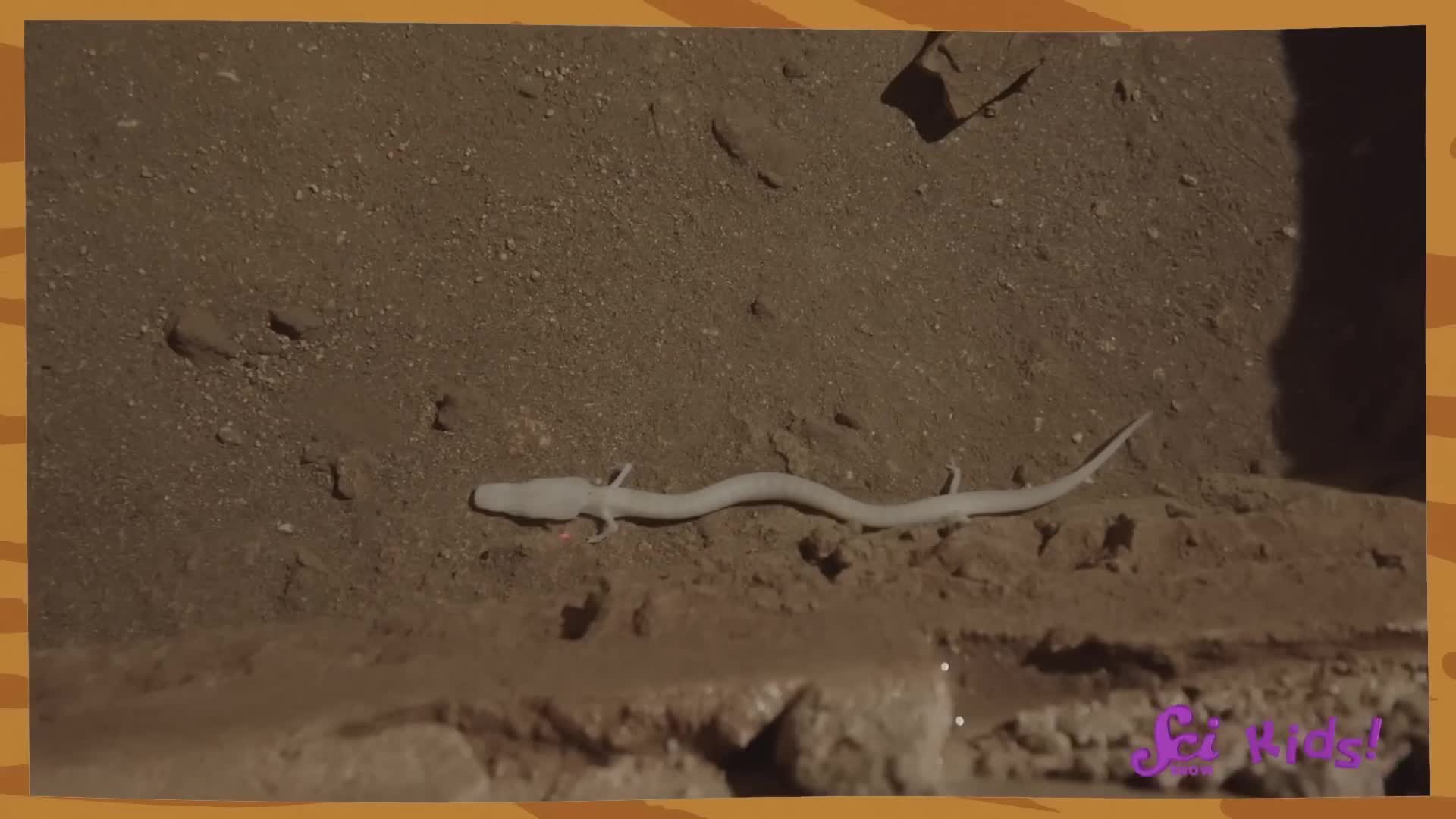
This is an alm, a type of salamander from Europe.
A salamander is a creature that looks like a lizard, but is actually more like a frog.
This is a Mexican tetra.
It's a type of freshwater fish.
Some can live in rivers on the surface, but many of them live in caves.
And this is a pe'epe'e maka'ole, or kawaii cave wolf spider.
It lives in Hawaii.
All of these animals have caves as their habitat.
Animals who live in the same kind of habitat often share the same characteristics.
Can you see anything these three animals have in common?
That's right, they don't have any eyes.
That's because they don't need to use their sense of sight as much as they need their other senses.
A sense is how living creatures know things about the world around them.
When you see or hear or taste, you're using your senses to learn about your environment.
Try this.
If you can, turn off the lights in your room, or just close your eyes really tight.
Don't worry, Squeaks.
It's gonna be just a second.
I'll be right next to you the whole time.
Okay?
Ready?
All right.
Pay attention to your other senses.
What can you hear?
I can hear my breath and a little wind outside.
And we can hear each other.
I can also feel the temperature around me and I can touch the table in front of me or feel my way around if I need to walk.
What about you?
What can you notice around you?
Okay, let's put the lights back on.
Yeah, that was fun!
We can learn a lot about our surroundings even without sight.
People and other animals that live in habitats where there is lots of light find it useful to be able to see.
But we know that cave habitats are very dark, just like when we turned off the lights.
Animals are adapted to the habitats where they live.
This means they can have different body parts or other characteristics that make it easier to live in their environments.
So animals that don't need to be able to see because they live in deep dark caves also don't need eyes as much as they need their other senses.
Even though they can't see, the animals still need other senses to help them find food, move around, and escape predators.
What do you think they can use to sense things in their environment?
Right, they might smell if another animal is nearby, or the spider or the alm might use their legs to feel where they're going.
They are really cool squeaks.
Maybe when we get to Sam's cave, he'll know an alm that we can visit.
We better finish getting ready.
See how amazing cave animals can be?
And here's the thing, Squeaks.
When we overlook things just because they're small or yucky, we're passing up the chance to learn more about them.
Lots of people used to think that bugs didn't have brains.
But one really smart scientist figured out that bugs, too, can be brainiacs.
Oh, look.
There's a honeybee heading towards a flower right now.
It looks like our cameras are working!
Oh, hi there!
Squeaks, and I set up some cameras in the garden so we can record the bees visiting our flowers to gather nectar.
Good spot, Squeaks!
That bee does have pollen on its legs.
Remember, bees help the flowers by carrying pollen from one flower to another, which the flowers need to make seeds.
In return, the flowers make nectar.
The bees collect this nectar and take it back to their hive, where it gets made into honey.
And that honey is an important food for them.
So by making nectar, the flowers help the bees.
In fact, nectar is so important that bees will fly several kilometers each way to get their fill.
That's tens of city blocks, so like crossing town.
That's a good question, Squeaks.
How do bees find their way home from so far away?
Well, the short answer is they remember where things are.
So they remember where different flowers are, which ones have lots of tasty nectar and how to get home to their hive.
Bees do have to remember quite a bit.
Still, people didn't think that bees could remember things or even think at all.
Who figured that out?
Well, I think it's time I tell you the story of Dr Charles Henry Turner, the scientist who changed how we think about the way bugs think.
Charles Henry Turner was born just after the end of the American Civil War in 1867.
As a boy, he loved learning, and his parents encouraged him to read and study as much as he could.
He graduated top of his class in high school and then went to school for biology.
Biology is a kind of science.
There are a lot of different kinds of science and most of them end with -ology, which means to study or look at and think about really deeply.
When scientists go to school, they choose one of these "-ologies to become experts in.
And Charles Henry Turner chose to become an expert in biology, which is the science that studies living things.
It was at this school, the University of Cincinnati, where he began conducting experiments on bugs.
After graduating, he continued his experiments, all while teaching science at high schools and even one college.
But he really wanted to become a professor at a big university.
That way, he could get help from the school to do bigger and better and more expensive experiments.
So he earned an even more advanced degree, a doctorate, in zoology, which is the study of animals.
That made him qualified to become a professor, but when he applied for the position at the University of Chicago, they wouldn't hire him because of the color of his skin.
You see, Dr Turner was black and for a very long time many universities wouldn't hire black professors, even if they were perfect for the job.
Sometimes, this even happens today.
Squeaks says that's discrimination.
The unfair treatment of a person or group of people because of things like the color of their skin.
And you're right, Squeaks.
It is wrong, and I bet Dr. Turner did feel really sad and disappointed.
He worked really hard and it was really unfair that he didn't get to follow his dreams just because of the color of his skin.
Discrimination is really harmful for everyone.
Like in this case, not only did Dr Turner not get the career he wanted and earned the university missed out on hiring a great teacher, and lots of students didn't get to learn from a really amazing scientist.
Dr. Turner ended up continuing to teach at high schools.
Still, he didn't give up on his experiments.
Even though he didn't have as much help as he would have as a professor, Dr Turner managed to do an astonishing number of experiments.
You see, when scientists finish a round of experiments, they write up something called a research paper, which explains what they found.
Getting these papers published is a big accomplishment.
And Dr. Turner published more than 70 research papers over his 33-year career.
That's more than many professors at that time.
Well…
Some of Dr. Turner's most famous experiments were about bees, like the ones in our garden.
Back then, scientists wondered if bees could see in color.
Dr. Turner wanted to find out, so he came up with a really smart way to test eyesight.
First he put honey in differently colored boxes around a field and watched to see what the bees that lived near the field would do.
You're right!
Bees are attracted to sweet smells because they know it will lead them to sweet foods like flower nectar.
Honey smells and tastes sweet, so those boxes were kind of like flowers to them.
And that was the idea.
Once the bees figured out that they could find food in the boxes, they started visiting them regularly.
Then Dr Turner started putting honey in just the red boxes and watched to see what the bees would do next.
And just like that, many of the bees started only visiting the red boxes and completely ignored the other colored boxes.
Exactly!
That meant the bees could see in color, because they could tell which ones were red.
But it shows something else, too.
You see, Dr Turner kept really detailed notes of everything he observed and he watched those bees a lot.
So he knew that once a bee had discovered a honey-filled box, it flew straight to and from it, which means it was remembering where the food was.
And then, once he stopped putting food in the other colored boxes, the bees stopped going to them and started visiting red ones instead.
So they learned and remembered that red boxes had food and other boxes don't.
And that's not something scientists at the time thought bees and other bugs could do.
Most thought animals were essentially programmed, like machines.
They didn't think bees or other bugs could change their mind or learn something new.
But Dr. Turner's clever experiments clearly showed they could.
After his work, scientists started doing more experiments like Dr. Turner's.
And his techniques and methods have inspired scientists ever since.
His experiments even inspired whole new fields of science, like behavioral psychology, which is a study of how brains control what we do.
I think that's a great idea, Squeaks.
What better way to honor Dr. Turner than by doing some of our own bee experiments?
There are so many things about bees that I'm curious about.
Like, I wonder what flowers bees prefer.
What do you wonder, Squeaks?
That's a good question, too.
Do they like flowers better in the sun or in the shade?
Squeaks says he wants to be a scientist who studies unusual animals.
I think that's a great idea.
You might just learn something amazing.
Thanks for joining us.
If you want to learn more with me, Squeaks and all of our friends, be sure to subscribe and we'll see you next time here at the fort.