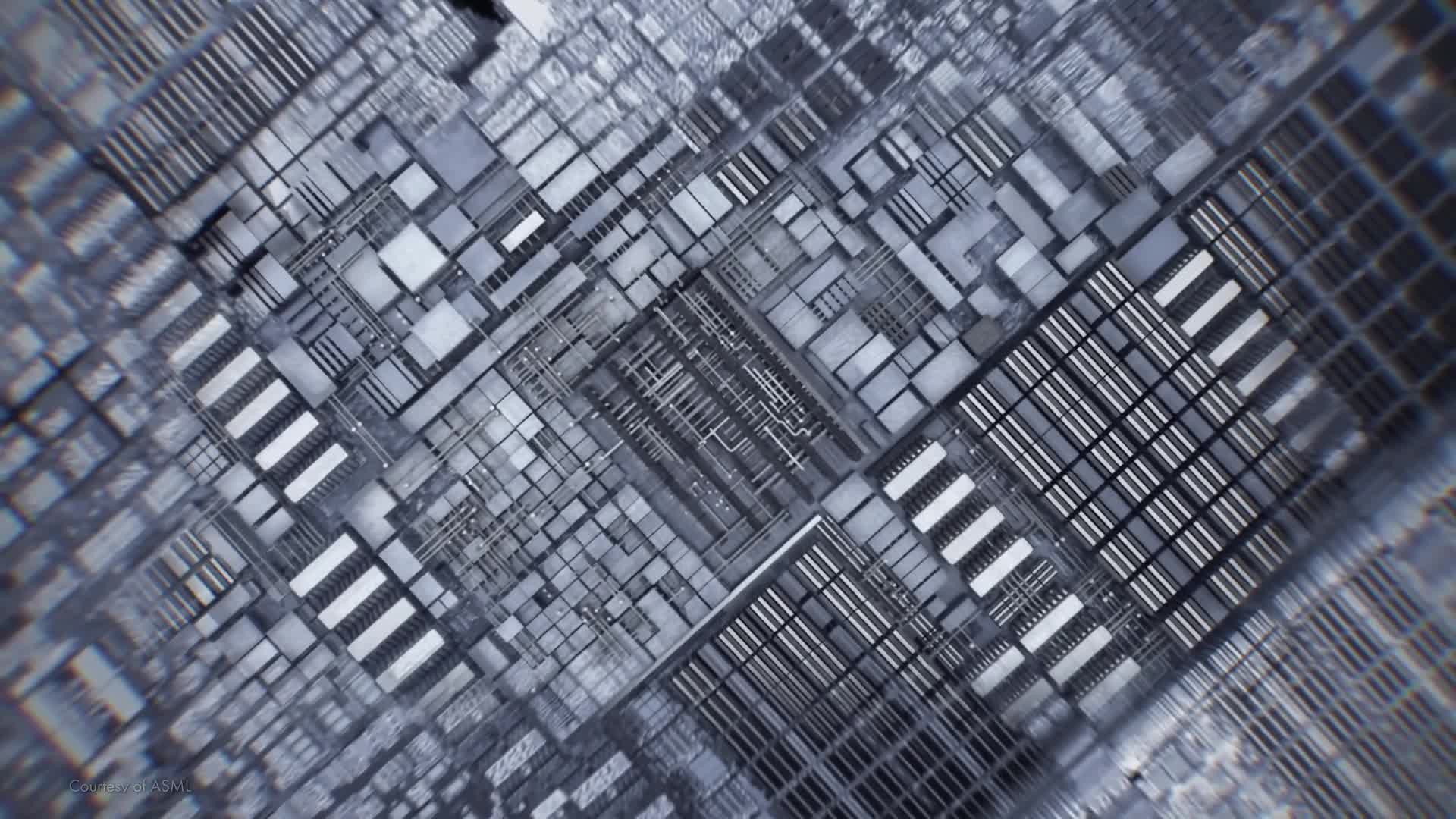
This is a microchip.
When you zoom in, you find a nanoscopic computing city.
Skyscrapers hundreds of layers tall with hundreds of kilometers of wires connecting everything.
And at the very bottom is this.
Transistors.
Billions of them.
They are the ones and zeros of our computer.
The chip works by whizzing electrons from transistor to transistor.
And the smaller you can make those transistors, the less the signals have to travel, so the faster they can compute.
Plus you can fit more transistors into the same area, resulting in a much more powerful chip.
So for over 50 years transistors got smaller and smaller and the number you could fit on a chip doubled every two years.
This became known as Moore's Law, named for Intel's co-founder, Gordon Moore, after he noticed the pattern back in 1965, and it's been one of the main drivers of the tech industry.
But around 2015, progress came to a screeching halt.
And we might have never gotten past it if it wasn't for a single company that makes these machines, the machines that saved Moore's Law.
Holy!
This is a video about the most complicated commercial product humanity's ever built.
That's insane!
It costs a whopping 400 million dollars, and it is so bizarre that I want to introduce it to you with a thought experiment.
Imagine you are shrunk down to the size of an ant.
And you're given a laser that's strong enough to melt through metal like butter.
Next, a tiny droplet of molten tin, roughly the size of a white blood cell, is shot out in front of you around 250 kilometers per hour.
And your task is to hit this not once, not twice, but three times in a row, in 20 microseconds, with your little laser.
Well, that is exactly what this machine does.
It hits one tiny tin droplet three times in a row, heating each one up to over 220,000 Kelvin.
That's roughly 40 times hotter than the surface of the Sun.
And it doesn't just hit one droplet.
It hits 50,000 droplets every single second.
How often do you miss a laser shot?
We don't miss them.
What?
You do 150,000 laser shots a second and you don't miss one.
Exactly.
The same machine also contains mirrors that might just be the smoothest objects in the universe.
If you scale one up to the size of the Earth, then the largest bump would be no thicker than a playing card.
On top of that, it is able to overlay one layer of a chip perfectly on top of another and never be off by more than five atoms.
And this is all happening while parts of the machine whip around at accelerations of over 20 Gs.
For 30 years, almost everyone thought that actually building this machine was impossible.
And yet it exists.
There is only one company in the world that can make it.
So what is this company?
And what is this impossible machine they've built?
This video is sponsored by Brilliant.
More about them at the end of the show.
Now, just as a quick aside, the makers of this machine didn't actually sponsor this video.
We just thought that the science and engineering here were so cool that we had to make a video about it.
So let's jump straight in.
To make a microchip, you start by taking silicon dioxide, usually from sand, and purifying it into ultra-pure, nearly 100 silicon chunks, which is then melted down in a special furnace.
Next, you lower a small seed crystal into the vat.
Silicon atoms attach to the crystal, extending its structure.
Then you slowly raise the seed crystal while rotating it.
And this results in a large single crystal silicon ingot.
This is where the seed crystal would be.
And then you pull it out.
Can I touch it?
Yeah, you can.
It seems like you would not be able to hold this from here.
Yes.
The ingot is then cut into wafers with diamond wire saws up to 5000 of them, after which each wafer is carefully polished.
Next, it's coated with a light-sensitive material called photoresist.
There are different kinds, but in a positive photoresist the areas exposed to light become weaker and more soluble.
So if you shine light through a patterned mask, you can selectively weaken parts of that coating.
Then you rinse the wafer with a basic solution to wash away the exposed photoresist, leaving the design imprinted.
So now you can actually turn this pattern into physical structures.
This is often done by etching into the uncovered silicon by using either chemicals or plasma.
And then you deposit a metal like copper to fill in those etched lines.
As a last step, you wash away the remaining photoresist, and now you've made a single layer of the chip.
We've simplified this cycle down to the main steps, coat, expose, etch, and deposit.
It repeats for every single chip layer.
And depending on the chip, there could be anywhere from 10 to 100 layers.
The bottom layer is the transistors.
This is the most complicated layer requiring hundreds of steps that all need to be perfect.
The higher layers are a little easier.
These are the metal wires that carry signals and power.
By the end, the completed wafer can have hundreds of chips, which are then cut into separate pieces, packaged and put into products.
But by far the hardest and most crucial step in the process is where you shine light through the mask and onto the wafer.
This is photolithography.
And that's because this step determines how small you can make the features.
At first, it seems simple.
Light passes through the openings and it gets blocked by all the rest.
But as you try to print smaller and smaller features, the gaps in the mask start to approach the wavelength of the light.
And that causes problems.
And we can actually show it because I happen to have a... This is a mask, this is a reticle.
A reticle or a mask carries the design of one chip layer.
This reticle is filled with microscopic lines and gaps around 670 nanometers across.
And if I take like a laser pointer, so this is a red laser.
If I shine it through it, then you see this here.
The laser has a wavelength of around 650 nanometers.
When light hits the reticle, its wavefronts bend as they pass through each gap.
So each gap sends out waves that spread out and overlap.
Now, let's just look at the light from these two gaps.
When the peaks of one wave line up with the troughs of the other, we say that the two waves are out of phase and they cancel each other out.
So you get dark spots.
And when the peaks line up with the peaks, the two waves are in phase.
They add up and you get bright spots.
You get interference, right?
And you get a diffraction pattern.
Now, diffraction is inevitable.
So instead of fighting it, designers actually use it to get the patterns they want.
They kind of work backwards from the eventual pattern they want on the wafer and they design the slits so that diffraction will occur in such a way that it creates the pattern that they want.
You see three dots.
The middle dot, that's the original one.
That's the zero order.
And then on the left and the right, you can see the first and the minus first.
Now, in order for us to have this image resolved on the wafer, you need to capture the zero and the first and the minus first order.
The smaller you make the features, the larger this angle alpha between the zero and first orders becomes, so the larger your lens needs to be to capture the light.
The size of the lens is described by the numerical aperture, or NA for short, which is just the sign of this angle.
So the larger that is, the smaller the features you can print.
But there is a hard limit to how large your lens system can be.
When this angle is 90 degrees and your numerical aperture is 1, or your lens would have to be infinite.
Fortunately, there is one other thing we can change.
This is a red laser.
And a red laser has a wavelength of 650 nanometers-ish, I would say.
And if I take a green laser, and this one has a wavelength of 532, then you can see that the green dots are closer spaced than the red dots.
That's because the light from the two different gaps doesn't have to travel as far to match up in phase again.
So the orders end up closer together.
So with a smaller wavelength, you can print smaller patterns using the same lens.
All of this is captured by the Rayleigh equation, which determines the smallest feature size or critical dimension.
But since there's a limit to how much you can increase the numerical aperture I mean to one over time the only way to keep making smaller and smaller features is by using shorter and shorter wavelengths.
So this is exactly what happened up until the late 1990s, when the industry settled on 193 nanometer deep UV light.
This was the light that was used to make all of the most advanced chips right until around 2015.
But by that point, scientists had reached the limit to how small they could make the features.
And Moore's law was about to run into a brick wall.
So a radical change was needed.
A change that had been brewing for around 30 years.
All the way back in the 1980s, Japanese scientist Hiroki Noshida came up with a crazy idea.
Why not use much shorter wavelengths, like X-rays of around 10 nanometers?
In theory, that should allow you to print much smaller features.
But you quickly run into a problem.
X-rays at these wavelengths have enough energy to eject electrons from their atoms, so most materials absorb them.
But unlike medical X-rays, which have wavelengths shorter than one nanometer, these are still long enough to interact with air, so air absorbs them too.
That meant that Kinoshita's setup had to be in a vacuum.
But even worse, he couldn't use lenses to focus the light, because the lenses would absorb it too.
So it seemed like this idea would never work.
But around 1983, Kineshita stumbled on a paper by Jim Underwood and Troy Barbee.
Their work focused on special mirrors that could reflect X-rays with a wavelength of 448 nanometers.
So Kineshita was intrigued.
Curved mirrors can focus light just like lenses do.
If he could figure out how to make these special mirrors for the wavelength he was using, then this could be another way to do photolithography.
The mirrors work something like this.
When light crosses from one medium to another, say from air to glass, it bends or refracts.
Some of it goes through and part reflects back.
How much gets reflected depends on things like the angle, the light's polarization and, most importantly for us, the difference between the refractive indices of the two media.
The larger that difference, the more light is reflected.
And Underwood and Barbie used that principle.
They made a super thin layer of tungsten less than one nanometer thick, thin enough that x-rays could pass through without immediately being absorbed.
When x-rays hit the layer at a specific angle, the tungsten reflected less than 1%.
Then they carefully tuned the layer thickness so the path length of the transmitted x-rays was only one quarter of its wavelength.
Then they added another layer, this time out of carbon.
It has a higher refractive index than tungsten for wavelengths of 4.48 nanometers.
The X-rays hit the boundary and a little bit more reflects.
But this time the phase is inverted, or it's changed by half a wavelength.
This happens when any light moves from a lower refractive index to a higher one.
Now, by the time this new reflected wave reaches the tungsten boundary, it has traveled another quarter of its wavelength, for a half wavelength in total.
So the two phases line up and the waves interfere constructively.
Underwood and Barbie kept doing this trick for a total of 76 alternating layers, so that in total, they could reflect back much more of the X-rays.
Now, they only managed to reflect around 6 of the light, but it was a proof of principle that you could reflect x-rays.
So Kinoshita saw the possibilities.
He got to work and after around two years his team designed and built three tungsten carbon curved multilayer mirrors to reflect 11 nm light.
And with it he managed to print lines 4 microns or 4000 nm thick, proving that, at least in theory, X-ray lithography was possible.
A year later, in 1986, he went to present his findings to the Japanese Society of Applied Physics.
Proud and excited, he explained his setup and showed his image.
But to his horror, the audience refused to believe it.
Unfortunately, The audience was highly skeptical of my talk.
Kinoshita was devastated.
He later said, Nobody believed that this was a viable way forward.
And unfortunately, the reaction was at least somewhat justified.
First, this light isn't naturally produced by anything on Earth.
The closest natural source is the sun.
We had to basically build an artificial sun here on Earth.
Most scientists, including Kineshita, produced X-ray light using a particle accelerator or a synchrotron.
It gives an enormous amount of power.
It's as big as a soccer field.
You can fuel a whole fab.
The problem is if the light goes out, the whole fab goes out.
So each machine needed its own power source.
But even if you could produce the light, you'd need to make incredibly smooth mirrors to actually focus and print those tiny features.
You would need the smoothest objects in the universe.
Okay, so I got a football and I've got a bouncy ball and a cobblestone street.
Now, what do you think is going to happen when I drop them?
The football basically bounces straight up, but for the bouncy ball, it just shoots off to the side.
And that's because the surface is relatively flat for the football, which is much larger, but it's super rough for the bouncy ball.
And a similar thing happens with mirrors.
If the surface is super rough compared to the size of the wavelength, then the light scatters randomly.
Now, it might look smooth, but if you zoom into a mirror, you find something that looks like this.
You find all these crazy bumps and now to measure the roughness, what you do is you take the average of these bumps and that will give you your mean line.
Now, for a normal household mirror, the average height is about 4,000 silicon atoms.
But for Kinoshita's mirrors, which not only needed to reflect X-ray light, which has a hundred times shorter wavelength, but also needed to minimize scattering, you know, so that all the photons make it onto the wafer.
It needed to be way more smooth.
It needed to be atomically smooth.
In fact, the average bump could only be about 2.3 silicon atoms thick.
If one mirror would be the size of Germany, the biggest bump would be about a millimeter high.
But Kinoshita refused to give up.
However, my belief did not change.
And soon help would come from an unlikely place.
Across the Pacific, around 70 kilometers east of San Francisco, is Lawrence Livermore National Lab, a lab that was born out of the Cold War, heavily funded by the US government, and built for one purpose and one purpose only nuclear weapons.
The lab was founded by the inventor of the cyclotron.
Ernest Lawrence and the father of the hydrogen bomb, Edward Teller.
And over its lifetime, they designed over 10 fusion-type nuclear warheads.
So part of their research focused on what happens inside nuclear fusion reactions.
Fusion reactions released a lot of X-ray light, light that they had never been able to capture and analyze.
But now, using those special multilayer mirrors, there was a chance.
One of the scientists tasked with making this work was Andrew Hoverlock.
And within a few years, he and his team used multilayer mirrors to reflect some X-ray light.
But then, in 1987, Andy got a visit from a professor from Cornell.
He was very impressed with the technologies that we developed and he looked at me at the end of the day and said this is all very interesting and very neat and stuff, but his words and I'll remember it to the day I die was can you do anything useful with this stuff?
This was the day before a christmas shutdown in 1987 and i was so inflamed by that that comment that i went home and for the next 10 days i wrote up a multi-page white paper.
He applied these mirrors to lithography, to print chips using x-rays.
Around five months later, andy presented his findings at a conference but, like inoshida, it was not the response he was hoping for.
It was extremely negative.
That was the low point of my career.
I was literally laughed off the stage and I kid you not.
Every person who I looked up to in the field.
They were listening to my talk and they came up to the microphone and told me basically why it wouldn't work, how stupid an idea it was.
Later that week I flew back and the following Monday my boss asked me, how did it go?
And I looked at him and I said, I will never speak of it again.
But then, three days later, he gets a phone call from someone named Bill Brinkman from Bell Labs.
So I walked over to my boss and I said, I just got this phone call from a guy named Bill Brinkman.
You know who he is?
And my boss's eyes popped open and said, yeah, he's the executive vice president of AT&T.
And I said, well, he just called me and asked me to fly out to New Jersey and give a talk.
The response from my boss said it all.
He basically said, well, you gotta go.
At Bell Labs, Andy found fellow believers.
And it couldn't have come at a better time.
Over the past 30 years, the US government had invested billions of dollars into national labs to maintain the country's technological edge during the Cold War.
But by the late 1980s the Cold War was slowing down and all these labs were sitting on research that had commercial potential.
So the government encouraged the labs to partner with US companies to turn that research into products and to stimulate the economy.
And the government would then supply seed money.
And so Bell Labs partnered with Endys Labs and two others to keep developing X-ray lithography.
And by 1993 the first international conference for X-ray lithography was held in Japan near Mount Fuji.
In the opening address, Kinoshita said that as long as we do not lose the desire that has sprung from within us, technology will steadily advance from the micro to the nano, to the pico.
They even gave the technology a new name, Extreme Ultraviolet Lithography, or just EUV.
But then in 1996, the US government cut funding for the project.
This spelled disaster for the big chip companies like Intel.
The industry estimated that the 193 nanometer lithography tools would fall behind Moore's law by 2005.
But there were no other alternatives.
So Intel Motorola, AMD and other companies got together and invested 250 million to keep it going, making it the largest investment ever by private industry in a Department of Energy research project.
By the year 2000, the labs had produced this, the engineering test stand.
It was the first fully functioning EUV prototype.
It produced 98 watts of 134 nanometer EUV light, which was then reflected by eight mirrors, from the source to the mask, to the wafer.
It could print 70 nanometer features and it proved that EUV could work.
It was a milestone to get the engineering test stand to work.
It demonstrated to people like Intel that good engineering will get us there.
And it seems like you've got the prototype.
Shouldn't be too hard to then commercialize it.
That's what they thought.
But the prototype had a major flaw.
It could only print about 10 wafers per hour.
And to make EUV economically viable, it would have to print hundreds of wafers per hour 24-7, 365 days a year.
The main reason output was so slow was because the light reflected off of eight mirrors and the reticle, which is also a mirror, just with the design imprinted.
Traditional masks that allow light to pass through don't work because well, they absorb all the light.
Each mirror had a reflectivity of around 70%, which is close to the max.
But after 9 bounces, you're only left with 4% of the light.
Which means that out of every 100 photons, only 4 make it to the waver.
So you might think, just use way fewer mirrors.
But that only works up to a point.
When you focus light with any optical system, you always get some distortion.
For example, rays that pass through the outer edges of most lenses focus light slightly different from those near the center.
This is called spherical aberration.
And normal cameras correct for this and other aberrations by using multiple lenses.
And a mirror system is no different.
You need to have a certain amount of mirrors before you can say I have my aberrations under control.
In reality, the systems of today have six mirrors.
That helps a little, but after reflecting off six mirrors and the reticle, you're still only left with around 8 of your light.
So they needed to drastically increase the source power to at least 100 watts.
Now, to most companies, that tenfold increase seemed impossible.
Even people who worked on the engineering test set noted that, while EUV technology itself is a done deal, there were six zillion engineering challenges to make it a fab line reality.
And so, one by one, American companies walked away from developing a full UV lithography machine.
That left just one company, ASML.
ASML, which used to stand for Advanced Semiconductor Materials.
Lithography is located in a small, nondescript town in the Netherlands.
It spun off from Philips back in the 80s with little more than a shed and a barely working waver stepper to its name.
But Philips also gave them people Jos Benshoop, ASML's first researcher, and Martin van den Brink, who would eventually become ASML's CTO and EUV's greatest champion.
And he's really like the Steve Jobs of lithography.
And he saw EUV coming.
ASML had joined the US EUV consortium earlier, and now it became their task to find a way to commercialize EUV.
They would work together with their German partner Zeiss, where Zeiss would take care of the mirrors and ASML would focus on the light source.
One of the first decisions when making any lithography system is deciding which wavelength to use.
In the early days, anything between 5 and 40 nanometers was explored.
The thing is, you need to find a source and you need to find optics that reflect the wavelengths.
So you have to look for the combination.
Underwood and Barbie had already made mirrors that could reflect light of around four nanometers.
And since that wavelength is so small, it seems like the obvious choice.
But the maximum reflectivity for those mirrors was only around 20%.
So, after hitting six mirrors and the reticle, you're just left with 000128 of the light, which is way too low.
Fortunately, further researchers also looked at two other pairs, silicon and molybdenum, which had a theoretical maximum reflectivity of 70 for wavelengths around 30 nm, and molybdenum and beryllium, with a theoretical maximum reflectivity of 80 for wavelengths around 11 nm.
So, the choice seemed obvious, right?
I mean, pick the shorter wavelength and the higher reflectivity.
But it turns out that beryllium is extremely toxic and it's also difficult to handle, so scientists focused on silicon and molybdenum instead.
To make the mirrors, Zeiss used a process called sputtering.
A target of coating material is bombarded with either plasma or ions, causing atoms to be ejected.
Fly off and stick to the mirror.
This is a messy process, so the layers end up having bumps and gaps.
There was a nice trick that actually the team in the Netherlands perfected.
With ion beam.
You just shake it a little bit until the atom falls in the hole where it needs to be, and then it's all flat.
With the mirror design locked in, ASML needed a source for that specific wavelength.
So it was 13.x.
The next good question is, what's the x?
Now you look for the source.
So there are basically three ways to generate EUV, to build a sun on Earth.
The first method which early researchers used was the synchrotron, but it was quickly rolled out because each machine needed its own source.
The other two methods are based on the same principle.
When an electron recombines with an ion, the ion drops to a lower energy level and it releases that excess energy as a photon.
And if you choose the ion just right, then that photon will have exactly the wavelength you need.
Now, there are two ways you can create those ions.
The first is you take a metal, heat it up until you get a metal vapor and then you apply a strong electric field across it.
This causes free electrons to knock into nearby atoms and ionize them.
If you then turn off the electric field, the electrons recombine with the ions and produce light.
This is discharge-produced plasma.
That's the concept we used first because of its relative simplicity.
And we quickly got it to a few watts.
We wanted to get 100 watts and we struggled forever.
So you couldn't scale it?
We could not scale it.
They needed a drastic change.
So they switched to the second method.
This method uses a high-powered laser to hit a target material, creating a plasma that's more than 220000 degrees Celsius hot.
The electrons have so much energy that the nucleus can't hold on to them anymore, and up to 14 electrons escape their orbits.
After the laser shuts off, the electrons and ions recombine to produce light.
This is laser-produced plasma, and it was the only method that seemed scalable.
In fact, this was the same method that the engineering test stand used.
A 1700 watt laser fired into a stream of xenon gas to produce 13.4 nanometer light.
But Xenon had a big problem.
The conversion efficiency, that is, the ratio of usable light to the amount of power you put in, was terrible.
It was only around 0.5%.
That's because, while Xenon does emit light in the 13-14nm range, there's much more light released around 11nm, so most of the energy went into making light that the mirrors couldn't reflect.
Plus, the laser didn't ionize all the atoms, so leftover neutral xenon atoms would strongly reabsorb some of that 134 nm light.
So ASML started looking at another material, tin.
Now tin has a much higher emission peak, around 135 nanometers, which results in a 5 to 10 times higher conversion efficiency than xenon.
But just like xenon, neutral tin atoms also absorb EUV light.
So they came up with a crazy idea, to shoot one tiny tin droplet at a time.
But to get the required power, you would have to make and hit thousands of droplets every second, all of which have to be the exact same shape and size.
But it turns out that you can't instantly make thousands of tin droplets that are the exact same.
So they found a workaround.
To make the droplets extremely pure.
Tin is melted and pushed through a microscopic nozzle by high pressure nitrogen.
This nozzle vibrates at a high frequency, breaking the stream into tiny droplets.
These droplets are irregular in size shape, velocity and distance, and the whole process is chaotic.
That's like our magic sauce is how do you modulate that tin jet so it forms the droplets we want and that they're stable?
I think we found some paper that described this process and it was sort of eye-opening to me that it seems like all the droplets actually come out irregular out of the nozzle.
But then, before they reach the side where they get hit by the laser, like the little irregular droplets, come together to form these perfectly spaced, perfectly regular droplets that are about the same size and shape and all traveling at the same velocity.
That feels like magic to me, Jason.
Yeah, it's exactly that.
It's how do you take a long stream of a tin jet that wants to break up into all these irregular droplets and force onto it that it's going to collapse into a single droplet and then happen again and again, and again?
You also don't have that many variables to play with.
You've got the pressure with which you push out the tin and the frequency of the nozzle.
Yeah, it seems like a hard problem to solve.
There's not a whole lot of variables to play with.
And so mastering that modulation of the jet is how we make the droplets.
But these droplets not only have to be identical, they have to be moving incredibly fast.
What will happen is if the next droplet that's coming down the line is too close, then it'll actually get disturbed and mess up the next plasma event.
So we have a requirement, which is both that we make 50000 droplets per second, but also that they're traveling extremely fast.
By 2011, their laser-produced plasma source reached 11 watts, which was more than double what they managed with their previous source.
But they were still limited to just 5 wafers per hour.
So they needed to increase the power, and fast, because they promised they'd hit 60 wafers per hour by the end of 2011.
Unfortunately, this new method had a major flaw.
Now the problem with the TIN issue.
You hit the droplet, you generate EUV with a very decent conversion efficiency.
Where does the TIN go?
Because, like 30 centimeters away, you have this atomically flat, very beautiful, very expensive mirror from our friends at Zeiss.
And in the early days, we would coat the thing within like this.
These machines need to run for a year.
You're putting liters of tin through this plasma event, And a single nanometer of tin if it was to land on that collector mirror, you'd have to take the collector out of commission.
We need to keep it almost perfectly clean for a year.
Yeah, how do you even approach that?
So our main tool here is the hydrogen gas, actually.
They filled the chamber with low-pressure hydrogen.
This slows and cools the tin particles down.
And even if some tin makes it to the collector, the hydrogen pulls it off to form a gas called stenane.
This way, the machine cleans the collectors while it's running.
But that hydrogen gas also gets hot from all those tin explosions.
So they need to keep flushing new cooler hydrogen into the system, while flushing out the stenane and hotter gas.
But they had to get the pressure and the flow rate just right.
I mean too little hydrogen and the mirrors would get too dirty.
But too much hydrogen would not only absorb too much EUV light, but it would also cause the system to overheat.
But the question is how much heat is there, how much energy is being deposited into the gas?
And we were stumped for quite some time.
If you look at a ev light source, what you'll see is that it's it's kind of like a globe of like purplish red light, and you kind of ask yourself, like why is that happening?
So we bought an ultra fast camera.
What we realized is that after every plasma event, there's a shock wave that goes propagating out into the hydrogen gas.
And it's extremely repeatable.
And you think to yourself, there must be like an explanation for this.
And there's this formula, the Taylor Vandermans et al formula that explains point source explosions in an environment and like say, a nuclear blast out to like supernova.
So I took this formula and it like exactly describes the data.
It's just fantastic.
We're seeing these tiny little supernovas happening in our vessel 50000 times a second.
And is that a fair way to think about this, like creating mini-supernovae?
Yeah, it's actually pretty similar.
It's almost very similar to a Type Ia supernova.
It turns out where you kind of have an object that just fully evaporates and explodes apart.
And when all that energy goes into the hydrogen gas, it produces a shock wave, a blast wave that comes flying out, which is basically the same thing if you look up in the night sky.
There are these remnant supernovas that you can see coming from space.
Using those energy calculations, they discovered they needed to flush the hydrogen at incredibly high speeds, around 360 kilometers per hour.
That's more than a Category 5 hurricane, even if those speeds are at low density.
But 2012 came and went, and they still didn't have enough power.
In fact, by 2013, ASML just reached 50 watts by shooting 50,000 thin droplets per second.
But this increased power came at a price.
Because more power means more heat.
Heat that ends up slightly shifting the mirrors, resulting in misaligned light and misaligned chip layers.
So SAIS built a nervous system directly into the optics, robot-guided sensors that constantly measure the exact position and angle of each mirror, down to the nanometer and the pico-radiant, which is absolutely insane.
So how accurate do we need to control this mirror?
Now one of the things you can do, a thought experiment, and I can place a little laser on the side of this mirror.
Then we go all the way to the moon and we put a dime here.
So then this light travels all the way here.
And then with the accuracy, I can control this mirror.
I can decide whether I point to this side of the dime or whether I point to this side of the dime.
What?
That's crazy.
So you can see that the pointing accuracy is also in pico-radiance.
That is something very extreme.
This allowed them to control the light even when the power increased.
While Zeiss was doing a stellar job with the optics, ASML was still struggling with the power source.
The problem was that the tin droplets were too dense, meaning that most of the emitted EUV light was still getting reabsorbed by the neutral atoms before it could ever reach the collector mirror.
The way we blasted the droplet was so not enough light, too much debris.
To make matters worse, they could see that about 10 years from now they would need a new generation of machine, a high NA EUV machine, essentially one with a larger optic system that could print smaller features.
So what did they do?
They decided to double down and invest in the next generation before they even got the current one to work.
The most doubtful period was in the beginning.
So I started to work on this in 2012.
By that time, EUV was not working.
And there was this crazy idiot working on the next generation, where we could not even make the EUV light in the first place.
Not only are you all in on EUV, you're doubling down even before you know if EUV is going to work.
But to keep funding the development, they needed money.
And lots of it.
So they turned to the very people who needed this technology.
ASML reached out to its main customers.
Okay, you want this technology for the next generation of chips.
Well, you need to make us able to invest more by investing in us.
Intel invested around $4.1 billion, and Samsung and TSMC invested another $1.3 billion combined.
So they can keep the research going, but with no product to show.
Customers were running out of patience.
We were crucified at every conference that the promises we made last year we were unable to live up to.
And he said, this is what you showed two years ago.
This is what you showed last year.
This is what you're telling me this year.
So why would I believe you?
They were getting desperate.
But this was, I think, about 2012 or 13.
We were struggling to get the EV power up.
And Kinoshita visited us and took him to dinner in a small town nearby.
And across from the restaurant was a Maria Chapel.
And now, you know, science, we have come to the limits of science.
Let's call for defined intervention.
So we went to the chapel.
So Kinoshita, just to be safe, lit three candles for the three suppliers that were pursuing EV technology at the time.
And lo and behold and I have the data to prove it there is a very strong correlation between us lighting the candle and power going up.
It's not a causal effect, but there is a strong correlation.
The big idea was instead of hitting the droplet once, hit it twice.
One shot to hit the droplet and it expands in like a pancake shape.
And then, only then, have the second shot, the more powerful main pulse where you evaporate the pancake and turn it into a plasma.
This was a major breakthrough.
By changing the target from a droplet to a pancake, you got a larger surface area for the laser to vaporize, but without the cost of adding more debris or neutral atoms.
Because now the tin is vaporized all at once.
By 2014, they finally managed to hit that coveted 100 watts mark.
But improvements in multi-patterning with 193 nanometers now meant that EUV would only be useful if the source reached at least 200 watts and made 125 wafers per hour.
The source went from 100 to 200.
But as the industry moved on, nobody waits for you.
They find other solutions.
We had to catch up.
So it was a moving goalpost.
One of the problems was how do you perfectly time the laser so you hit each of these droplets?
So the analogy is a bit like a golf ball that you need to land in the hole 200 meters away.
Not like land on the green not bounce and then get in the hole, but like land in the hole every time.
That's the level of precision that we need to deliver the droplets.
Those droplets are traveling through this maelstrom of hydrogen flow.
The speeds are tremendously high.
It's like shooting golf balls through a tornado.
And then right when it lands at the hole, that's when it needs to get hit by the laser.
So in order to basically track the droplets, for that we use laser curtains.
And we can sort of look at when does the droplet pass through a laser curtain.
Those scattered photons tell us basically when and where is the droplet and then importantly, tells us when to fire the laser.
So we actually have to take into account how long will it take for the light pulse to hit the droplet after we send the pulse.
Now by 2015, they were getting closer and closer to that coveted 200 watt mark.
When all of a sudden the ASML board members got summoned.
This was one of these decisive moments where our customers were really thin on patience.
Martin and all the board members were summoned to Korea to show 200 watt.
And they were really fed up with it.
You know, you either show it now or you go away.
And when they entered the plane, the experiment was still running.
Okay.
When they exited the plane, they had the first result demonstrating.
This is how close we came.
With the source power up.
There was one final problem that had to be solved before they could begin manufacturing their machine.
See, while the hydrogen gas did protect the collector mirror from debris, it wasn't perfect.
All the intense, high-energy photons and hydrogen ions zipping around deteriorated.
A very special top coating on the collector.
So they still had to clean the mirrors every 10 hours, which is terrible for productivity.
Martin van den Brink asked for updates every day on their progress.
But then one of the engineers noticed that every time they opened up the machine the mirrors suddenly seemed cleaner, that he kind of chimed in and said oh wait a second.
Whenever we opened up the machine, oxygen comes in and our problem is solved.
Couldn't we think of a way to add just a little oxygen to our system and make sure that the collector stays clean longer?
And so they started experimenting with the amount of oxygen that was needed in the vacuum.
And they finally got to this point.
Okay, if we add so much oxygen, we'll keep the collector clean for longer.
With this fix, ASML's machine could run continuously for much longer, and it finally became commercially viable.
By 2016, orders started pouring in, and now all of the most advanced chips need ASML's machine, making them perhaps the most important tech company in the world.
ASML's first commercial machines had a numerical aperture of 033 and could print 13 nanometer lines.
These are called the low NA machines, and ASML still makes them.
But the machine that Jan's team started working on back in 2012 was the next generation, which had a larger optic system so they could print even smaller features.
This is the high NA machine with a numerical aperture of 055, and we get to see their latest version up close.
How much is the machine?
We always say north of 350 million euros.
And you can actually buy it, right?
You can if you want.
If I had the money, I could buy it.
Yes, you could.
How many people have seen this before?
We really limit the amount of people that get to go inside the clean room.
ASML's machines are built in a super strict clean room.
In any cubic meter there can be no more than 10 particles only 01 microns large and nothing bigger than that.
A speck of pollen is around 20 microns, and extremely fine sand is around 10 microns.
To put all of this in perspective, hospital operating rooms, which have to be extremely clean, only allow a maximum of 10000 particles per cubic meter that are 01 microns wide.
It's so unfair how much better Marc looks though.
In his white suit, I feel like a little smurf.
Okay, so we're going to go through the air showers.
So you're gonna have to do it as I do.
Okay.
So this is brushing down all the particles that are still on us.
Yes, so this is like super clean air blowing us.
Clean?
This place is huge.
It's huge.
It's insane.
I've been in a clean room a couple times before, but it's nothing compared to this.
Are there any secret areas here where almost no one has access to?
I can't tell you.
Great answer.
Okay, so this is the total system.
This is it?
This is crazy.
Look how big it is.
This is the most advanced machine humanity's ever built.
It's taken many, many years, decades of development, many billions of dollars all to get this humongous beauty.
So this is the first HNA machine?
Yes.
So if you saw pictures on the internet or whatever, That's this machine.
So the very first lines ever printed at 8 nanometers and stuff, that was this machine.
The smoothest object on Earth?
Yeah, it's all in here, yeah.
Wait, so let me see if I can figure this out.
This is the light source.
That's where they make the extreme ultraviolet?
Yes.
And then the laser must come in from there?
Yeah, let's take a look at the laser.
In fact, we got to see just how the laser and light source work.
I think we're entering the laser system here.
Mark's just making sure I think that we can actually film here.
We're not catching anything we're not supposed to.
Oh, wow.
This looks dangerous.
Now, the laser system is covered by all of these brown cabinets, but here is a model version.
A carbon dioxide laser of just a few watts enters this amplifier, where it bounces around until it's roughly five times its original power.
It then goes through a total of four different amplifiers to bring the final laser up to 20000 watts, which is four times stronger than lasers that cut through steel.
Over here, we have the amplifiers that generate this powerful laser beam.
And then it basically comes out and this is part of the beam transport system where it's brought to the machine.
So this pipe here has the big laser beam.
And this has a mirror?
Yes.
Then the pulses travel to the light source module.
It kind of looks like a transformer or like a, I don't know, like a spaceship.
There's so many wires going everywhere.
Don't touch this.
Holy crap.
This is pretty big, huh?
This is insane.
And this is just a light source.
This is just a light source.
Are you getting this comparison shot?
So you need all of this just to make a UV light.
Just to make the light.
Yes.
That's incredible.
Can we do a little walk around?
We can do a little walk.
Let's go.
So basically, this is the heart of the source.
Can I stand on here?
If you're below 137, you can.
I think I am.
And so the tin droplets are coming in from the left.
Yes.
Then we're shooting the laser from here?
Yeah.
Okay, it explodes.
And then the light goes out there.
One improvement from ASML's first EUV machine to their newest one is the number of pulses that hit the droplet.
The first prepulse still flattens the droplet into a pancake.
But now there's also a second prepulse that further reduces the density.
It basically turns it into a low-density gas.
It verifies it.
And then the final pulse essentially ionizes all of it.
So for basically the same power coming from the drive laser, they get even more EUV light.
Now, if they want even more light, then the only way to do that is by hitting more droplets.
And that's exactly what they did.
Our most recent EUV light sources that we're shipping right now, which are around the 500 watt level, we increased the rep rate up to 60000 times per second.
And then we have a roadmap that's going to go to 100,000 droplets per second.
We've actually now already demonstrated this 100,000 droplets per second in the lab.
So it's not an if, but a when.
Crazy.
The three pulses that we use to make the pancake to blow up the pancake a little bit and then to evaporate the pancake.
The first two pulses, they would be coming in through this pipe here.
And then the main pulse with the big laser the laser beam would be delivered through this pipe here.
Both the high and low NA machines shipping out right now use free pulses and eventually they will hit more droplets per second.
But the light source is just one small part of the full machine.
After bouncing off the collector mirror, the EUV light moves to the illuminator.
A set of mirrors shape and focus the light before it hits the reticle.
The reticle is the top half, and this module is built in a separate facility and installed later.
Next, the light goes into the projection optics box, which is a set of mirrors that shrink the light down.
The HiNA machine can shrink the pattern eight times in the vertical direction and four times in the horizontal direction.
The mirrors are also much smoother still.
If the low NA's mirrors were the size of Germany, the tallest bump would be about a millimeter.
But if the high NA mirrors were the size of the world, the tallest bump would be about the thickness of a playing card.
By the combination of both of these improvements, ASML was able to increase the numerical aperture from 033 to 055.
And finally, the light hits the wafer.
In order to print around 185 wafers per hour.
The reticle whips back and forth at accelerations of over 20 Gs.
That's over five times the acceleration of a Formula One car.
And this is some actual footage of what that's like inside this machine.
And notice that this is not sped up.
But the crazy thing to me about this machine isn't how fast the reticle moves or even how small it can print, but it's just how insanely accurate it needs to be.
The most any two layers can be off, which is called the overlay, is one nanometer.
That's five freaking silicon atoms of precision.
That's insane.
So typically what we do as system engineers is that we make a budget.
So we say, hey, you get, let's say, a nanometer.
And we divide then the nanometers to smaller fractions.
The nanometers total.
It's not like your group gets a nanometer.
You get a nanometer.
You get, no, no.
You get a nanometer in total.
Yes.
So you have to fight for your part of the nanometer.
It's kind of cool to realize that every smartphone nowadays has a chip that is made with a machine that was actually put together here.
So that's a cool thought.
Take a look at this.
It's pretty massive, huh?
So big.
So do you cover it up?
Yes.
At a customer's app, it will be looking like a big white box.
I like it better like this.
Yeah, me too.
It's funny you need such a big machine, so much infrastructure, to make the tiniest things we can make at scale.
It's inversely proportional.
Yeah, the smaller you want to go, the larger everything around it becomes.
After the machines are assembled, tested and approved, they are disassembled to ship all around the world.
5,000 companies supply 100,000 parts, 3,000 cables, 40,000 bolts, and 2 kilometers of hosing.
ASML ships their Hyena machine in 250 containers, spread out over 25 trucks, and 7 Boeing 747s.
Despite all the doubt and setback, EUV finally made it to manufacturing level, three decades after Kinoshita's first images.
But even when almost the entire world didn't believe it would work, there were some people at ASML who knew that it was going to work all the way back in 2010.
Around 2001, we said, let's do EUV.
And then we run into many challenges.
2010, we installed the first system at a customer, so it was installed in Korea.
There it was.
This thing I had been pursuing for 13 years was now standing at a customer producing wafers.
This for me was a moment I realized, yes, we made the right bet.
Years later, Jas ran into the man who helped install that first machine.
He's now a professor at a renowned institute.
And I shared the story about my relief and how great we made the decision.
And Hanko said, yeah, yeah, yeah.
He said, when you left, when you flew out after Christmas, the thing broke down.
And it took two months to get back up again.
And they almost fired me for making the wrong decision.
We had some ups and downs along the way.
But again, once I saw the system installed in a customer FAB, I knew we had done the right thing.
This was 2010.
The first phone that came out was 2019, so we still had some hurdles to resolve, but we kept going.
Now I have spent several months working on this video and thinking about it and it still feels absolutely impossible.
The more I think about it, the more I think those people 40 years ago that said it was impossible.
They had a point.
It's completely unreasonable to think that you could make this artificial sun in a lab, that you could make these mirrors that are this smooth and that you could get the required overlay accuracy.
The reasonable thing is to think that none of that is possible and to point out all the problems with each of them.
Which reminds me of this quote.
The reasonable man adapts himself to the world.
The unreasonable one persists in trying to adapt the world to himself.
Therefore, all progress depends on the unreasonable man.
Imagine if Andy and Kinoshita and all the others had been reasonable.
We would have none of this.
In fact, imagine what the world would be like if everyone on it was reasonable.
It would probably be extremely boring.
Probably most of the technology, most of the things you enjoy on a daily basis wouldn't be here.
In fact, you probably wouldn't be watching this video.
Because just about all the technology we have nowadays would seem completely unreasonable even just 200 years ago.
And so I really think that to a large extent, we owe our lives to those unreasonable people.
And maybe, at least to me, it's a reminder that it's good to be a little unreasonable, at least in some of the big parts of life.
Changing the world is difficult.
It took overcoming thousands of obstacles and over 30 years to get EUV to work.
But big breakthroughs usually start in the same way.
That is, you learn, you explore some related ideas, you try to apply them in some new ways and then you build skills to take on bigger and bigger challenges.
Bit by bit, you gain knowledge.
And that's where today's video sponsor Brilliant comes in.
Brilliant helps you excel in math science and computer science with visual interactive learning that's personalized for you.
It's an incredibly powerful way to reach big learning goals mastering math for class or contributing to the next big technological breakthrough.
On Brilliant.
You learn by doing a method that research has shown to be far more effective than just passive learning.
It starts you at the right level, based on your background designs, practice sets and reviews customized for you, and then it helps you advance at your ideal pace.
There is always something new to discover on Brilliant.
Want to better understand optics after watching this video?
Well, their scientific thinking course is a great place to start.
Helps you think like an engineer by showing you how to break down large concepts into smaller, more understandable pieces.
Whether you're conquering fundamental math, algebra or calculus, diving deep into algorithms, exploring material science or understanding the physics that will take us beyond EUV.
Brilliant will help you get there.
And if, like me, you've resolved to learn more in the new year, then Brilliant is a great way to actually make that resolution stick.
So to learn for free, go to brilliantorg slash Veritasium.
Scan the QR code on screen or click the link in the description.
Brilliant's also given our viewers 20 off an annual premium subscription which gives you unlimited daily access to everything on Brilliant.
So I want to thank Brilliant for sponsoring this video, and I want to thank you for watching.