Hi, Rebecca Shear here. Before we get to our story, exciting news.
Circle Round is going back on tour. with live recordings across the united states our first stop Sunday, October 5th in Parker, Colorado at the Pace Center.
And Circle Round Club members are invited to a special post-show meet and greet with me and composer Eric Shimalonis.
Get your tickets at wbur.org slash circle around and click on events.
We're announcing more tour stops soon, so stay tuned.
We look forward to circling around with you live.
WBUR podcasts, Boston. Have you ever gotten angry?
It's natural to feel angry sometimes. It can even be useful. since our anger can tell us when things aren't fair or right.
What matters is what we do with our angry feelings so they don't get out of control.
In today's story, we'll meet an animal who lets her anger get so out of control.
She turns things upside down. I'm Rebecca Shearer, and welcome to Circle Round. where story time happens all the time.
Today, our story is called The Upside Down Tree.
Versions of this tale come from parts of Africa.
Thank you. Some really great people came together to bring you our story, including Alonzo Bowden.
Public radio fans, you'll recognize Alonzo as a regular panelist on Wait, Wait, Don't Tell Me, the weekly NPR news quiz.
He's also been the grand prize winner on NBC's Last Comic Standing and has his own comedy special heavy, lightweight.
So circle around everyone for the upside down tree.
🎵 🎵 The tree, known as the baobab, can be very old.
Some baobabs have been around for over thousand years.
The baobab tree can also be very tall. often stretching higher than two telephone poles end on end. and its hollow trunk can be so wide around you could cram dozens of people inside.
But one of the most interesting things about the baobab are its branches.
They're all twisted and gnarled. So when they lose their leaves, they look like a wild mass of roots sticking up into the air. as if someone had actually planted the tree upside down.
So it's no surprise that the baobab is sometimes called the upside-down tree.
As for how the baobab came to be this way, Well, legend says that it began at the beginning, when the Great Spirit first created...
The world. And on this world, I shall create land Like mountains, plains, and deserts, I shall create water like rivers, lakes, and oceans, and I shall create...
Animals, all sorts of creatures who will make this new world their home.
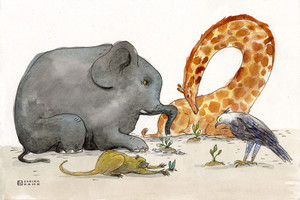
Once all the animals had come into being, the Great Spirit invited them to a sunset meeting on the tropical grassland known as the savannah.
Greetings, my children. I have news to share, but first, I want to make sure all the animals are present.
Elephant, here! Giraffe. Present. Eagle.
At your service. Monkey! That's me! As the Great Spirit went down the list, all the animals dutifully chimed in.
All that is but one. Hyena? Hyena. Where is that bushy-tailed creature?
I thought I delivered the message to everyone. other animals exchanged a look.
They knew full well that the Great Spirit did deliver the message to everyone.
But they weren't surprised to see that Hyena didn't heed the call.
Because Hyena had a notorious reputation for being...
Lazy. Not just lazy, but mean. She spent most of her time laughing at the other animals while loafing and lounging in her den. which is probably what she was doing right now.
The Great Spirit waited another moment, then decided to move on.
Well children, The sun will soon set, so I'll make this quick.
I invited you all here to tell you about my newest creation to add to this vast land.
I call them trees. Trees? That's right, elephant.
They will grow from the earth and provide you with marvelous things.
What kinds of things, Great Spirit? Well, giraffe, they'll give you food for your bellies.
They'll offer shade on a sunny day. And for some of you, They'll even become your homes.
You mean, we can live in them? Absolutely, Eagle.
You can make a burrow in the hollows of their trunks or build nests in their branches.
What about playing, Great Spirit? Can we play in the trees, too?
Of course, Monkey. You'll have endless hours of fun climbing and swinging from branch to branch.
But before any of that can happen, the trees must be planted.
And you... We'll do the planting. First thing tomorrow at sunrise, meet me right here.
I will be waiting with all the different kinds of trees that will grow on the savannah.
One by one, you will choose your tree, then find a place to plant it.
Does that sound good? It sounds wonderful, Great Spirit!
Amazing! We can hardly wait to pick our trees.
And plant them in the earth. Splendid. Now go home and get some sleep, my children.
I'll see you bright and early tomorrow. And then...
Let the planting begin! What do you think will happen when the animals plant their trees?
And will they all show up? Or will a certain someone be missing?
We'll find out after a quick break. Support for Circle Round comes from Indeed.
You just realized that your business needed to hire someone yesterday.
How can you find amazing candidates fast?
Easy. Just use Indeed. There's no need to wait.
You can speed up your hiring with Indeed. and Circle Round listeners will get a $75 sponsored job credit to get your jobs more visibility. at indeed.com slash circle round.
Just go to indeed.com slash circle round right now.
Support the show by saying you heard about Indeed on this podcast.
Indeed.com slash circle round. Terms and conditions apply.
Hiring? Indeed is all you need. mind. The reviews are in, and super fans like you are loving the Circle Round Club. an exciting opportunity to support public radio and get cool stuff. including ad-free episodes and a personalized birthday message from me. is that Rebecca here sends extra messages.
And it supports the show. And there are no odds.
Grown-ups, support public radio and sign up today at wbur.org slash circleroundclub.
Welcome back to Circle Round. I'm Rebecca Shear.
Today, our story is called The Upside Down Tree.
Bye. Before the break, the Great Spirit asked the animals to meet at sunrise so they could each pick a tree and plant it.
And as dawn crept over the horizon, lighting up the sky with swirling reds, oranges, and pinks, The Great Spirit watched with joy as animal after animal assembled on the savanna.
Good morning, my children. You will notice that the trees I brought are still young and small.
They're what we call saplings. So, one by one, I want you to line up and choose which sapling you would like to plant.
The animals went about arranging themselves in a single file.
Leading the charge was Elephant. Elephant, looks like you get the first choice.
Which tree will you pick? I'll plant that one over there, Great Spirit.
Elephant extended his trunk toward a sapling with a leafy crown shaped like an umbrella.
Excellent choice, elephant, excellent. That one is an acacia tree.
I believe you'll find its leaves to be quite delectable, and its wide canopy will protect you from the sun.
Plant it with pride and treat it with love and care.
I will, Great Spirit. Thank you. Next up was Giraffe.
Giraffe, which tree do you pick? Giraffe glanced around and cocked his gangly neck toward a sapling with yellow bark.
I like that one, Great Spirit. Ah, the fever tree.
When it gets bigger, it will sprout brown pods that are so very tasty Nutritious, too.
Splendid choice, giraffe. Thank you, great spirit.
Eagle was next. She chose the sapling known as the bush willow.
Well chosen, Eagle. With its strong branches and large leaves, the bush willow would be the perfect tree for you to nest in.
Thank you, Great Spirit. Behind Eagle was Monkey, who selected the fig tree.
You will love nibbling on its sweet fruits, monkey, and playing in its leafy branches.
Thank you, Great Spirit. On and on it went, with each animal choosing their sapling.
The marula tree, the butterfly tree, the jackalberry. and going off to plant it in the earth.
Plant it with pride and treat it with love and care.
Eventually, all the animals had selected their trees and begun to plant.
Well, all the other animals. What's going on here?
But one. Are you having a party? Why wasn't I invited?
Everyone froze and stared at, you guessed it, Hyena.
Her dark eyes were blazing and her bushy tail hung low.
Um, for your information, Hyena, We are not having a party.
We are planting trees. Like we discussed at last night's meeting.
Didn't you get the Great Spirit's message?
Message? About a meeting? Oh, right. I got the message, but I decided to go to bed early.
I had a feeling it would be a real snooze fest anyway, so I might as well hit the sack.
What did I miss, Great Spirit? Well, Hyena, I told everyone about the new trees I've created and how you all get to plant your own tree In the earth.
Trees? Huh. Okay, in that case, I'm thinking I'll plant the best one then.
The most beautiful, elegant, and graceful.
Just like me. As Hyena collapsed in hysterics, the other animals exchanged an uneasy glance.
Um, Hyena? Here's the thing. We already planted the trees.
You arrived so late today. There's only one tree left.
The animals gestured toward an unusual little sapling with a plump trunk and twisted, gnarled roots.
Just one look and Hyena knew it was not the elegant and graceful tree she'd been expecting.
Oh, come on! You gotta be kidding me! That's the only tree left?
Great spirit, say it isn't so! It is so, Hyena, and it's all yours.
So go ahead, plant the tree. Hyena stared at the Great Spirit.
Then she stared at the sapling. Then her lips curled into a sneer.
So, you want me to plant the tree, do you?
Huh? Then fine. Okay. I'll plant the tree.
Watch this! Hyena lowered her furry head, then took off running toward the last sapling.
She stuck out her muzzle and clamped her teeth around the tree's trunk.
Then, with every ounce of strength she had, And every bit of spite, she whipped her head to the side.
And as she did, she snapped open her jaw so The young tree went flying from her mouth and rocketed toward the sky.
The sapling flipped and tumbled through the air, and when it hit the ground, the other animals could hardly believe their eyes.
Because when the tree landed, its branches hit the ground first and sank down into the earth. which meant the twisted, gnarled roots were sticking up in the air.
So, with the branches at the bottom and the roots at the top, The tree was upside down.
Hyena let out a laugh, then bolted off across the savannah. pleased with her rambunctious prank.
But once she was gone, the Great Spirit did something Hyena never expected.
The supreme creator took that little upside down tree and touched it with magic.
And ever since, the baobab tree has been one of the most precious on the savannah.
Animals have relied on the Baobab for food, shade, and a place to live.
People have used its bark to make rope and baskets.
They've used its roots and leaves to whip up medicines.
They've even taken shelter inside the hollow trunk on the hottest and sunniest of days.
So, while Hyena may have laughed at the little upside down tree, She didn't get the last laugh because All this time later, we now know that the laugh was on her.
. . . Now it's your turn. When Hyena got angry, she found a pretty extreme way to let it out.
So next time you get angry, what are some helpful ways you can deal with your feelings?
Check in with a grown-up and make a list of strategies.
Maybe you'll do jumping jacks or squish up some Play-Doh or clay.
Perhaps you'll write all your feelings down or draw a picture of them, then crumple up the paper and toss it away.
Maybe you'll listen to a calming song or story, or you'll talk about your feelings with someone you love.
After you make your list, remember, anger is natural.
It's normal. just so long as we don't allow our anger to turn things upside down.
Woo-hoo! This week's episode, The Upside Down Tree, was adapted by me, Rebecca Shear.
It was edited by Sophie Codner. Our original music and sound designs by Eric Shimalonis.
Our artist is Sabina Han. Sabina has drawn a black and white picture for all of our Circle Round stories, and you can print them out and color them in.
Grownups, visit our website, wbur.org, and click on Coloring Pages.
Special thanks to this week's actors, Theodore Chin, Joe Hernandez, Erica Rose, Alexia Trainor, Chris Tucci, and Alonzo Bowden.
Comedian Alonzo Bowden is a regular panelist on Wait, Wait, Don't Tell Me, the weekly NPR news quiz.
He's been the grand prize winner on NBC's Last Comic Standing, and you grown-ups can check out his comedy special Heavy Lightweight on Amazon.
And kids, you can check out Alonzo's other Circle Round episode, The Mountain Guardian.
Just visit wbur.org slash Circle Round and click on Archive.
And while you're at WBUR.org slash Circle Round, you can support our public radio podcast by joining the Circle Round. club to show our thanks we'll send you a welcome box with our new circle round club swag plus weekly activity emails, monthly newsletters, and early access to Circle Round events, both live and virtual.
You can also get ad free episodes, bite sized bedtime stories, music education videos, even a personalized birthday message from me.
Visit wbur.org slash circle round and click Circle Round Club.
Our featured instrument this week was the ngoni.
Learn more about this stringed instrument from West Africa and see a photo of Eric Shimalonis playing one on our website.
Once more, that's wbur.org slash circleround.
Grownups, if you enjoy Circle Round, please leave us a five-star review on your favorite podcast app.
It really does help. We also invite you to tell your friends about the show and talk about us on social media.
Our handle on Facebook and Instagram is at CircleRoundPodcast.
Circle Round is a production of WBUR, Austin's NPR news station.
I'm Rebecca Shear. Thanks for circling around with us.
Now that you've made it to the end of this Circle Round episode, we want to know...
What's your favorite Circle Round story?
Thousands of fans just like you have been telling us about the Circle Round stories they like best.
Take a listen. Maybe one of their favorites is one of yours, too.
Hi, my name is Sophia. I live in Montreal.
My favorite Circle Round story is One Wish.
My favorite part is when Talia says, That was my one wish.
Hi, my name is Lydia and I'm from Montreal and my favorite Circle Grand store is a sorcerer's offer and my favorite part is when he asks the questions.
My name is Jasper. I'm from Richmond, North Carolina.
My favorite Circle Run story is The Lion's Whisker.
And my favorite part is when they get the whiskey from the line and I'm four and a half.
My name is Frankie. I live in Pittsburgh and I'm calling from Michigan.
My favorite circle round for me is the one with the...
I like to play with my kids and be with them.
That's the most important thing. My name is Emma and I live in San Mateo, California.
And my favorite story is the most beautiful for it all.
And my favorite part is when the bear pulls off the rabbit's My name is Yara.
I live in Oakland, California. My favorite trick-or-round story is the Golden Eagle My favorite part is when her friend makes the flower tea and then she gets better.
I am Rufus and I live in Pennsylvania. I like look-alike phones and the basilisk because both of them turn into stone.
I love you, Becca Shear. Did someone mention a story you've missed?
Not to worry. Grownups, you can find all of our Circle Round stories plus links to the Circle Round Club, picture books, coloring pages, and oh so much more on our website.
WBUR.org slash Circle Round.