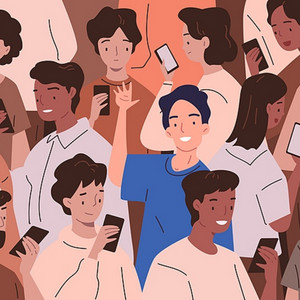
Sometimes the things that are intended to make us feel better actually have the opposite effect. we turn to our phones to unwind and de-stress only to feel worse?
Why is it that our escapes often deepen the void they're meant to fill?
Some new numbers in China have looked at detection rates of internet addiction.
We're going to talk about that definition itself.
We'll have a look at those numbers, too.
This is Roundtable. We are live from Beijing.
I'm Steve. Thank you so much for being with us today.
And for the show, I'm joined by Ngo Hung Lin and Yushin.
First on the program. We've all been there.
Maybe you've been there today or last night.
You hop on social media for a quick scroll and suddenly an hour is gone and then two or three hours are gone. and you find yourself in a bad mood.
After a long day, grabbing your phone feels like the easiest way It's right there, it's on your table, right at your fingertips. but that relaxing scroll can quickly backfire once you get hooked on the rush it gives your brain.
For others, addictive habits can be shopping or overeating or getting lost in a video game for hours on end.
But the question is, is this inconsolable urge on seemingly harmless habits just a mere lack of willpower, something that if we want to change it, we can.
Or is there something deeper about us that's at play?
Yuxuan and Niu Honglin, good afternoon to you both.
I don't think this is new, right? Oh, no.
Right. This is an everyday thing. We've encountered it almost daily all around the world.
At least once in our lives, that doom scrolling, that spending hours on end on our phones.
Yeah, our brains are like undergoing a test of information overload as we casually scroll through hundreds of information, short videos, social media posts or hit like buttons countless times on social media.
So, and that is why we're having that some kind of conditions like insomnia. forgetfulness, trouble focusing, hidden fatigue, feelings of loneliness, et cetera.
Yeah, even crankiness. I think can come, I mean, it's all a spider web, isn't it?
One thing is connected. to another and you're right it's because of the endless amount of content that is out there in the world for us and they're fragmented yeah yeah exactly At the same time, we can see that we have different ways to describe the situation.
We have different content. creating or resulting in these kind of symptoms in our lives.
In the West, there is the term brain rot, especially after it was voted as the Oxford Word of the Year for 2024.
People are using it much, much more often these days.
It is often used in a relatively humorous kind of way saying that, oh, I'm consuming brain rock content.
Actually, recently, I had an interview with a middle school teacher in the UK and he was talking about the favorite content of his students majorly from the age of 12 to around 16, are brain rot content.
Some of them are meaningless, like silly cat. usually generated by artificial intelligence doing silly things.
I was watching just at lunchtime, actually.
I was watching a video. It was a cat, an orange cat. was making an omelet in the backyard, like a seven egg omelet.
And that's exactly what you're talking about.
Yes. Brain rot if you're not. I'm sure you're familiar, but just in case you're not.
This is how it's defined. Over-consuming, trivial, and unchallenging material found on social media and other online platforms.
It seems like the go-to content for people these days.
And if you think about it, it's a smart way to talk about this sad situation because we say it's brain rock content, we can talk about the kind of meaningless content.
I am enjoying or suffering from a little bit brain rot, meaning that I am consuming the content and also the brain rot term itself talks about the phenomenon.
Whereas in China, we have a more, I think, in my opinion, broader way of talking about it or a relatively more umbrella term talking about it.
Yeah, there's a Chinese term for it. We'll get to it in a sec.
It kind of just hit me. I mean, I knew this, right?
And everybody knows this, but it just hit me. today at lunchtime and then in the last few days.
I was thinking about how content used to be consumed, right?
You would have your, if you had a television in your home, That was it, right?
And if you had the basic cable package, you might have 13 channels.
But if you got the deluxe cable package, well, you might have like 120 channels.
And at the time, that was like... Oh my God, you would talk to your friends.
I've got so many channels on my TV now. we have like three billion channels at our fingertips and that's what but people just keep... It's like changing the channel, isn't it?
Yusheng, do you agree with that? It's just...
When you keep scrolling and scrolling, it's like changing the channels on a television.
It's just done in a different way these days. yeah and that is when you are not even realizing that like one or two hours you just spent and Sometimes we call it in a positive way when you're calling as you're getting into a state as we call xing liu or mind flow.
That's the Chinese term we were going to talk about?
No. When you are getting to in a negative way.
It is called like internet addiction or wang yin.
I don't think it can be categorized as a flow or a mind flow.
What do you mean by mind flow? Because when we talk about mind flow, we're talking about a state that you're doing something that you feel like you're in the zone, you're unstoppable. you are reading, you are coming up with a plan that is supposed to be your next year's major project.
You're even playing a video game and you can manipulate the little avatar in the video game so smoothly and it defeats everybody That is a flow.
That is your inner state. That is a very good type of flow.
When you are doing these things, you will not be aware of the time is flowing.
So that is a positive term for sure. as addictive, or in Chinese, wáng yǐn, that wáng stands for the internet, whereas yin stands for addiction or being addicted to, and that is talking about the situation where, again, like Yusheng said, the similarity between these two states is that you are not aware of the environment, you do not know what is happening around you, yet you're Also, you're ignoring the flow of time.
But I think... people would address the negative side or the negative term in the sense that you're also not actively engaging or engaged with the content.
Let's talk about the terms because... Okay, let's start with brain rot, right?
Researchers say that they lack... sufficient data to fully understand the concept of brain rot and what it might lead to.
One expert said there really isn't a coherent science around it.
It's a term. that's been created and thrown out there and thrown around by Internet users to describe a certain type of content.
Addiction. Now, people have... started to use that word very loosely, I think. when we talk about internet addiction, smartphone addiction, I wonder that Chinese term, the negative one.
Is that also an example of a term that's just been It's almost like hyperbole, right?
Meaning like people use it, but it's not being used in the truest definition of the word.
It's just something the internet is saying.
Or maybe it's just an umbrella term talking about all. the situations where someone is not happy with another person's frequency of getting in touch with the internet.
The reason I'm describing it as such is because I can say, oh, I'm addicted to my phone.
I should be stopping. And that is because I feel like I'm spending too much time on my phone.
And a mom can say a kid spending 15 minutes or 30 minutes on a video game is addictive in the sense that the mom is not happy with the situation.
So yes, Steve, I agree. It's been used very loosely.
All right. Well, let's talk about this then a little bit deeper.
The swiping, the endless swiping on your phone, the scrolling nonstop, does it actually count as an addiction or not?
So first of all, addiction, if we're talking about it, like medically, it is. is coined by American society of addiction medicine.
Addiction is treatable chronic medical disease involving complex interactions among brain circuits, genetics and environment, and an individual's life experiences.
People with addiction use substances or engaging behaviors that become compulsive and often continue despite harmful consequences.
And when we're talking about internet addiction or Wang Ying in Chinese context. sometimes it because up the use in a lot of like internet languages it is being used as sometimes a self-mocking term saying that, okay, I am internegative.
I am a like teenager who is internet addictive.
And in that way, it's more like I spend a lot of time on the internet, but not in a case that I have actual condition of addictive? words that you finished that definition with caught my attention you said uh the term addiction coined by the American Society of Addiction Medicine. often continue despite harmful consequences.
Which leads me to this. Does that mean if it's not harmful to us, it can't be considered an addiction?
It depends? I think it depends because Can you say you're addicted to work or to study?
Even if you're spending too much time reading a book, You're not eating.
You're not feeling very well after a long time.
Does it still count? See, it's a complicated question. term.
It's debatable, isn't it? Yeah. So the numbers I mentioned when we got started, there's numbers here from China.
There was a recent... article where they looked at the rate of internet addiction here in the country.
What did those numbers say? This is a 36KR article.
So the detection rate of internet addiction in China ranges from 8.1% to 31%.
That's a big range. Yeah. Various studies conducted among different demographic of people.
So official data announced in around 2018 also shows that globally, the prevalence of internet addiction among teenagers is around 6%, while in China is close to What's your response to that?
I don't know. To start with, if we do not even have a term for addiction or a correct and scientific enough understanding about addiction. and how can we come up already with these numbers?
My best guess would be to send out some questionnaires having the answers, and then call it a result.
That's self-diagnosed. Yeah, that's self-reporting, right?
We know with self-reporting survey results you have to take those results with a grain of salt. salt right because the person answering the question needs to know what the question is truly asking.
So can we rely on those types of surveys? or not um there was a report this is from cbs from from 2023 it talked about a study from reviews.org that found that nearly 57% of people admit to being addicted to their phones. again, this is from the United States, right?
But there's that word again, and people say, yeah.
I'm addicted to my phone 57% but that only scratches the surface of the report.
They found some other findings as well. 75% of the responders said that they were uneasy when they've realized that they left their phone at home. when we think about the number of times that we check our phone per day... right?
They say it's up to 100 times a day. That's about 12 times an hour, which is once every five minutes.
Do you think that that's a reasonable? A reasonable amount?
It's not reasonable, but that's me. I do that.
Oh, nice segue. Because we're going to play a game right now and it's called...
Is this you? Aww. I'm going to share some more statistics from this report. and I'll tell you how we play in just a sec.
But ladies and gentlemen, let's get started. with our game show.
We have our two contestants joining us here in the studio. first up she's a hard-working mom and a dedicated broadcaster ladies and gentlemen say hello to new Hello everybody!
And he is an up and comer in the entertainment industry who loves Ed Sheeran just a little too much.
Ladies and gentlemen. You should. It's not a song.
Oh there's like four people. so your mom whoa thank you everybody your mom and sister in the crowd there This is how we play.
I will give you a statistic. If that statistic applies to you, shout out.
That is me. Understand how we play the game?
Yep. Okay. In that study from the one I just mentioned, it came out that 89% of people check their phones within the first 10 minutes of waking up.
That's me. Me. That's me too. Is it 10 minutes or is it shorter than that?
Shorter. Definitely shorter than that. It's immediate.
Yeah. What are you checking immediately when you open your eyes in the morning?
Oh, I cannot. Instant messages. Yeah, I cannot answer that question because it'll be working messages.
It's so sad. My introduction of you was appropriate.
Exactly your persona. What are you checking in the morning?
I missed your answer. When you open your eyes.
Instant messages. Work message from me. That early.
All right, here's our next question. 75% of Americans say they use their phone in the bathroom.
Oh, definitely. It's also me. Here's an extra question.
I use it when I'm in the shower sometimes.
Oh, I don't. Yeah. Oh, thank you, Steve.
I'm not scrolling while I'm taking a shower.
I'll put my phone just outside the shower and I'll have like a podcast playing or something like that, but that counts.
Oh, I do that too. I thought I dodged that one.
We're off to a good start or a bad start.
I don't know because we're saying we're all in these.
A little segue, I can recommend you a product you can stick it to it's waterproof so it can stick on the wall of your bathroom And it's Bluetooth connected to your phone.
So the sound quality would be even better when you're showering.
Why did you answer no? So after this contest are we gonna like have kind of confirmation that it Which of us is more addicted to internet?
Yeah, exactly. There's only a loser in this game, I think.
Next question. 60% of respondents in the survey said they sleep with their phone directly next to them.
Yeah. I need my phone when I'm sleeping.
Why? I need to listen to some like sleep helper.
Same here. Oh, what kind of sleep helper?
Like ASMR kind of thing. Oh, Podcasts. Podcasts?
You can't go to sleep in silence? No. I listen to podcasts when I go to sleep as well.
I might as well just put the phone directly on my face when I'm sleeping.
I have a pillow that can connect to Bluetooth.
Wait a minute. It can connect to my phone to my pillow.
The pillow has a speaker so I do not disturb others because I'm sleeping on the Put it under your pillow.
Yeah. No, but then the sound would be like.
Yeah. No, no, no. It. that means you didn't you'd never tried it because you're like close enough to her phone it will be really really clear but you can only hear it with one ear.
That's the problem. There are Bluetooth speaker pillows.
I had no idea. Yeah, well, there you go.
That's the end of our quiz and game. show for today oh my gosh we're all we're all see there's that word again though, right?
It was just on the tip of my tongue. So let's compare.
Is this addiction or is it poor? discipline, or is this something that we don't really need to worry about?
I think we need to put things or put people into different categories. because when we talk about addiction, if we're being serious enough, if we are looking at it as a clinical term, then there are maybe not that many people but a group of people who are being bothered by the situation so The thing is, we talked about the scenario in the beginning of our conversation.
We talked about after scrolling down the screen for even hours and you feel worse about yourself.
And if that is only occasionally, it happens once a month or once every, several months, it's relatively fine.
Everybody can have a bad day. But if it is your everyday, then probably there is a mental issue, a more serious issue, issue that you should take. to a doctor.
So that is another scenario that needs professional medical help but also for everybody we definitely are on the spectrum of being a little bit addictive to something. or maybe to the internet content to being quite addictive to it. for especially people under the age of 18, it could be a problem.
That is why in different countries we have different measures, we have different policies. here in China there are so many different types of policies making sure young kids are not getting too much content from the Internet.
You bring up a legitimate point there, because for adults, of course, It can be serious.
It can be problematic. But perhaps it's even... more dangerous for kids because Adults sit around in a room and do podcasts about this type of topic.
We discuss it. We're aware of it. It's on the forefront of our minds, right?
Kids don't think like, I'm not a child expert, but I don't think kids think like that, right?
So a little bit more dangerous for kids, perhaps.
Yeah, pay attention to the words or the scenarios you just listed, Steve.
When we were talking about you use your phone while you are taking a shower.
You use your phone while you're in the bathroom. that is when we are doing something actually it so that is That means that you are still engaged with life.
Yes, your life is functional still. But when you're having an addiction, you are stick to that mobile phone or a computer. without doing anything else that is addiction you forgot to sleep you forgot to eat And that is when you are having That's so-called lemmatical term addiction.
Yeah, and hence the negative consequences.
I think there are – I'll push back just a little tiny bit on that.
It's not our topic for today, but – I think you can still function. and be addicted to certain things.
Um, but yeah, a full, full blown, full, on addiction is probably something you're defining there.
Any difference between, still on the topic of children, Any difference between urban kids and rural kids coming back here to China?
Can we find a difference there? terms of smartphone usage or addiction, or do we see similar results?
Yeah, and there are some... Scenarios when parents work away from home and children often stay behind in their hometowns. sometimes live with their grandparents.
And in that case, These part of demographic of children in rural China, will have us like commonly found more Often in this kind of case, having more addictive to their mobile phones because they probably don't have that much of time with their parents. or supervision supervision with or with their friends or have their huge rich resources of a play time.
And that is why here in the country there are so many different ways and different policies from different uh different fronts talking about how to supervise kids using their phone.
For example, for those who are under the age of eight Technically speaking, they are recommended to use their phone less than 40 minutes a day.
And for those between the age of 8 to 16, that's less than one hour a day And 16 to 18, that's less than two hours a day and this is carried out by the parents in the home by the schools by the teachers in schools and Also, there is a minor mode.
So if the person using the phone is a minor, is under the age of 18, then there are minor modes for almost all the different types of apps on the internet, different websites on the internet.
So the computer as well as the phone, they have minor mode.
So minor mode controls not only the usage time of the app, but also the content.
So the content is supervised as well. And besides that, for different games or for different basically app operators, there are policies helping them making sure that kids For example, the way well, the reason that we're very addicted or at the very beginning, we get addictive to the certain app is because we quote unquote cultivated to suit or to cater to our preferences, our needs. and late night usage of it, or they would feed you only the content you're interested you enjoy the most.
This is a kind of phenomenon that will make you a bit more addictive to it and that function is not allowed during nighttime for kids.
So these different ways are being carried out so that kids would not get easily addicted to the internet content.
They have minor mode. to protect the kids.
Do they have senior mode to protect the elderly because that is another group that here in China is now suffering, they say, from quote-unquote internet addiction.
Yeah, China National Radio reported in 2023 saying that proportion of internet users aged 60 and above has rapidly increased in China in recent years with many seniors spending over four hours online every day. as pointed out by a report. by the China Internet Network Information Center, older adults are spending excessive amounts of time online.
But that is also making sense, right? When they have plenty of time and they...
I think they are also getting into an age of starting to explore how wonderful the internet is. response to that yeah of course there's going to be extreme cases where the cause of that extreme level of internet use is an emotional void or loneliness or something like that.
Of course. Okay. We're going to find cases of that. but also curiosity has to be a major factor. this as well imagine living imagine you're 75 years old you've lived your whole life and all of a sudden you AI cat videos are available to you.
Who's not watching that, right? I mean, I'm just saying, I think you have a great point there. is that the tech now is something that seniors haven't been able to experience up until now.
Sure, I mean, there have been major breakthroughs in the past, but I'm saying this level of tech that we're living in right now.
I know. You know what I'm trying to say?
We can look... We can twist these statistics and look at them any way we want to.
By the way, here in China, because some senior citizens are more... vulnerable to digital or internet fraud.
So there are are policies to that to prevent that from happening.
But I kind of also understand why there is not a senior mode because you can discipline your kids.
But if when I'm 80 and my kids tell me I can only spend three hours on the internet, I would not listen.
So, nah. Yeah. um yeah that's why this topic is so tricky right i mean we can we can look at this um any way that we want to.
I want to kind of finish up with something that I found from Science Focus, an outlet called Science Focus.
This is from 2024. And in that article, this is what they talked about, the common belief that People are addicted to our smartphones is a myth and it's an oversimplification Instead, our phone use is better explained by two different factors.
One, hyper-personalized stimulation. Your phone isn't a single addictive thing.
It's a portal. to countless highly engaging activities social media news games messaging All of those things just mentioned are specifically designed to capture your attention.
You're not addicted to the device itself, but to the information and social connection itself. it provides.
What do you think about that? That is a really good point.
And on top of that, I also think if you are dive into something, it definitely is because of a certain reason.
It can be because that thing can provide you with the kind of happiness that you cannot seek anywhere else.
It can also be because it can provide you with a shelter that you can avoid the problems in your real life and more effective than any other place.
So maybe if we see our friends or ourselves being addicted to the internet, It's because there is a deeper question waiting to be solved.
Thoughts on that one, Yuxuan? We've already passed the discussion on elderly, but I still think about when... why they're like more and more people are getting addictive to internet. especially among the outerlies.
And when we're thinking about they spend most of their lifetime in... an era that they can only use like males. to connect with another one, like probably in another side of the... Send a letter.
Right. So, and when they're getting into the era when they can just click some of the buttons on their phone and they can connect to another people I remember I cannot remember actually how many times my mom said how technology is so good that she can actually see me through a phone.
Yeah, mind blowing, right? You're right.
We take it for granted, don't we? And at that moment, I just realized that, yeah, they are... also like benefiting from all of these technologies and they are realizing and experiencing it even stronger than us as like digital like natives.
So when we're having these kind of conversation, of course, addictive is something that we discussed that is so bad.
But when we're thinking about the center scenario and the environment of people surrounded or I mean around it.
It's another situation and we, as you said, we need to think about the deeper result or deeper reason of this.
I have a problem with the word addiction when we talk about the internet and our smart phone.
The story from Science Focus can say it a lot better than I could.
So let me share again what they had to say.
They talk about the variable reward cycle, and they say that it's a powerful psychological principle.
Constantly check our phones because we might find something rewarding alike. on a post, a message, some interesting news This unpredictability similar to a slot machine in a casino creates a compulsive habit loop.
Not a clinical addiction. It's a bad habit loop.
Framing this as an addiction is incorrect and can be harmful as it implies that we are. are powerless to change it.
And that's why I have a problem with the word addiction when we discuss things like this. because of that implication that we can't do anything about it.
Ngo Hung Linh just checked her phone twice in the last few minutes.
Are you shopping for Bluetooth pillows again during showtime?