Pushkin. This year at Pushkin, we've been able to work with some of the world's biggest brands on bespoke content.
But the ad space is incredibly noisy.
How do we ensure our content reaches the right audience?
That's where LinkedIn ads come in.
You can precisely target professionals by job title, company, and more, making sure your message lands with the right people.
Cut to the noise and reach your ideal audience.
Get a $100 credit on your next campaign at LinkedIn .com slash Malcolm.
Terms and conditions apply.
The most innovative companies are going further with T -Mobile for business.
Trapper Supply trusts 5G solutions from T -Mobile.
Together, they're connecting over 2 ,200 stores with 5G business Internet, empowering AI so team members can match shoppers with the products they need faster.
This is Enriching Customer Experience.
This is Trapper Supply with T -Mobile for business.
Take your business further at teammobile .com slash now.
I'm taking a trip to Texas this November, two quick nights across Dallas and Houston, and then on to Austin for the Texas Book Festival.
And if you too have a trip coming up, you might want to consider hosting your home on Airbnb.
Whether it's for a few short nights or a few weeks, you can host your home for however long it will be sitting empty.
It's an easy and smart way to make some extra money.
Your home might be worth more than you think.
Find out how much at airbnb .com slash host.
Hello, hello, revisionist history listeners.
We are back with a very, very special announcement.
I have a new book coming out.
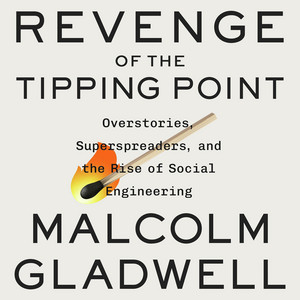
It's called Revenge of the Tipping Point.
It's a sequel to The Tipping Point, my very first book from 25 years ago.
It's like a little silver anniversary present for you, my loyal listeners.
The original Tipping Point was about how the best way to understand ideas and behaviors and social change was to use the model of the epidemic.
This time around, in Revenge of the Tipping Point, I'm taking those ideas and going one big step deeper.
Now I'm interested in the dark side.
I go to Miami and try and figure out why Miami is so strange.
I go to a seemingly perfect little town called Poplar Grove where a tragedy is unfolding.
I have a chapter on the Holocaust that I think will completely surprise you.
Yet another takedown of Harvard University.
I know, I know. I'm a broken record, but I'm inordinately proud of this one.
On and on, a mixture of narrative ingredients baked into a highly entertaining souffle.
Today we're sharing an exclusive preview of chapter one of the audiobook of Revenge of the Tipping Point.
It's all about bank robbers and doctors, and that's all I'm going to tell you because you'll have to listen to find out more.
But that's not all.
Coming up in the next couple of weeks, Unrevision is history.
We have all kinds of goodies related to my book.
We've got a two -part episode on maybe my favorite criminal trial ever.
Something I call the Georgetown Massacre.
Then an episode where I go back and audit the chapter I wrote on crime in the original Tipping Point.
Did I get it right?
And finally we're going to run the conversation I'm having with the editor of The New Yorker, David Remnick, at the 92nd Street Y in New York.
Stay tuned and for now enjoy this preview of Revenge of the Tipping Point.
You can find Revenge of the Tipping Point wherever you get your audiobooks.
Part One Three Puzzles Chapter One Casper and Seedog It was just like wildfire.
Everyone was jumping into the game.
One In the early afternoon of November 29, 1983, the Los Angeles Field Office of the Federal Bureau of Investigation received a call from a Bank of America branch in the Melrose District.
The call was taken by an FBI agent named Linda Webster.
She was the person in the office who fielded what were known as 211s, reports of bank robberies.
There had just been a holdup, she was told.
The suspect was a young white male wearing a New York Yankees baseball cap.
Slender, polite, southern accent, well -dressed.
He said please and thank you.
Webster turned to her colleague, William Rader, who ran the FBI's local bank robbery division.
Bill, it's the Yankee.
The Yankee Bandit had been active in Los Angeles since July of that year.
He had hit one bank after another, slipping away each time with thousands of dollars in a leather suitcase.
Rader was growing frustrated.
Who was this man? All the bureau had to go on was that telltale baseball cap, hence the nickname, the Yankee Bandit.
Half an hour passed.
Webster got another 211.
This one was from a city national bank 16 blocks west in the Fairfax District.
They had been taken for $2 ,349.
The caller gave Webster the details.
She looked at Rader, Bill, it's the Yankee again.
Forty -five minutes after that, the Yankee hit a security Pacific National Bank in Century City.
Then immediately walked one block down the street and held up a first interstate bank for $2 ,505.
Bill, it's the Yankee, twice, back -to -back.
Less than an hour passed.
The phone rang again.
The Yankee had just hit an imperial bank on Wilshire Boulevard.
If you drive from Century City to the imperial bank on Wilshire, you pass right by the FBI's office.
He probably waved at us, Rader told Webster.
They were now on notice.
History was being made.
They waited. Could the Yankee possibly strike again?
At 5 .30, the phone rang.
An unknown white male, slender, southern accent, Yankee cap, had just robbed the first interstate bank in Encino, 15 minutes north on the 405 freeway, for $2 ,413.
Bill, it's the Yankee.
One man, four hours, six banks.
It was a new world's record, Rader would later write in his memoirs, still unbroken.
Two. No criminal has ever held as exalted a position in American culture as the bank robber.
In the years after the Civil War, the country was riveted by the exploits of bands such as the James Younger Gang, who terrorized the Wild West with bank hold -ups and train robbers.
In the Depression, bank robbers became celebrities.
Bonnie and Clyde, pretty boy Floyd, John Dillinger.
Billie, you're brought to Chicago, recaptured after he had escaped from Lamo, Ohio.
Desperate public enemy now rises to fame as an underworld hero.
Here is Clyde Barrow and Bonnie Parker, who died as they lived, by the guns.
But in the years after the Second World War, the crime seemed to be fading.
In 1969, a total of 1 ,318 banks were robbed across the entire United States, a modest number, given the size of the country.
There was speculation that bank robberies were headed toward extinction.
Few major crimes had higher arrest and conviction rates.
Banks felt they had learned how to protect themselves.
A definitive study of bank robbery was entitled Nothing to Lose, meaning that the act seemed so irrational that its perpetrators must have run out of other options.
It seemed like the 20th century equivalent of cattle rustling.
Who does it anymore?
But then came an epidemic.
In a single year, from 1969 to 1970, the number of bank robberies nearly doubled.
Then rose again in 1971, and once more in 1972.
In 1974, 3 ,517 banks were robbed.
Two years later, the number was 4 ,565.
By the beginning of the 1980s, there were five times more bank robberies than there had been at the end of the 1960s.
It was a crime wave without precedent, and it was just getting started.
In 1991, the FBI fielded a 211 call from a bank somewhere in the United States 9 ,388 times.
And the center of this astonishing surge was the city of Los Angeles.
The sprawling city that's home to Hollywood, movie capital of the world, is also the bank robbery capital of the world.
A quarter of all bank robberies in the U .S.
in those years happened in Los Angeles.
There were years when the local FBI office handled as many as 2 ,600 bank robberies.
So many robbers robbing so many banks that Rader and the bureau were forced to give them nicknames to keep them straight.
The man who disguised himself with surgical gauze became the mummy bandit.
The man who wore a single glove became, naturally, the Michael Jackson bandit.
The two -man team who wore fake mustaches were the Marx brothers.
A short, obese robber was Miss Piggy.
A beautiful robber was the Miss America bandit.
A guy who waved a knife was the Benihana bandit.
On and on it went. There were robbers named after Johnny Cash and Robert De Niro.
One group robbed in threes, one dressed as a biker, another as a cop, and the third as a construction worker.
Do you need to ask what they were called?
This was the 1980s.
They were known as the Village People.
It was just like wildfire, remembers Peter Houlihan, one of the unofficial historians of the LA bank robbery surge.
Everybody was jumping into the game.
Ten years into the surge, incredibly, things got much worse.
The first generation of LA robbers were like the Yankee bandit.
They walked up to a teller and they had a gun, scooped up whatever Cash was on hand and fled.
People called them, a bit dismissively, note -passers.
But then came a two -man group called the West Hills Bandits.
The West Hills gang went back to the grand tradition of Jesse James and Bonnie and Clyde.
They came in hot, in wigs and masks, waving assault weapons.
They would force their way into the teller's cage and clean out the entire bank, empty the vault if they could, before executing a meticulously planned escape.
The bandits had a bunker in the San Fernando Valley filled with military grade weapons and 27 ,000 rounds of ammunition to prepare for what their leader believed was an imminent Armageddon, even by the standards of 1990s Los Angeles.
The West Hills gang was a little crazy.
On their fifth robbery, the West Hills gang broke into the vault of a Wells Fargo bank in Tarzana and made off with $437 ,000, more than one million in today's dollars.
And then Wells Fargo made a crucial mistake.
The bank told the press exactly how much the West Hills gang had stolen.
It was like putting a match to kindling.
$437 ,000? Are you kidding me?
One of the first to take notice was an enterprising 23 -year -old named Robert Sheldon Brown.
His street name was Casper.
Casper did the math.
I've robbed. I've done burglaries.
I've done a little bit of everything, he would explain later, but the money couldn't compare to the banks.
You could go into a bank and in two minutes get what on the streets would take you six or seven weeks to get.
John Wiley, one of the prosecutors who eventually brought Casper to justice, remembers him as a standout.
He said Casper was really ripped and really smart.
Here he is. He figured out the problem with robbing banks is going into the bank, so he got somebody else to do that.
You would think, how could you possibly get someone to rob a bank for you?
And that was his particular talent, was recruiting people to rob banks for him.
And he recruited an unbelievable number of folks.
He was kind of a producer in Hollywood terms.
Casper had a partner in crime, Donzel Thompson, also known as Sea Dog.
They would pick a bank they thought was ripe for a hit.
Then they'd find a getaway car known in gang speak as the G -Ride.
In the early 1990s, Los Angeles also experienced an astonishing surge in carjackings, which were treated in the press as another indication of the random mayhem sweeping the streets.
But a good chunk of it was actually just Casper and Sea Dog.
They had a guy they paid to acquire their G -Rides.
If you were doing as many bank robberies as Casper was, you needed a lot of cars.
Then he would pick the crew, prosecute a wily again.
A lot of his robbers were just kids.
I think he probably paid some of them nothing.
He just coerced him into robbing.
He was a big threatening guy.
And, you know, he was a member of the Roland Sixties, which was a very notorious Crips gang.
Wily recalled a particular recruit who was very young, no more than 13 or 14.
I remember he took the kid out of school and said, you know, when can you rob this bank for me?
And the guy said during nutrition break.
So during nutrition break, they picked him up and Brown and Thompson explained how to do it.
You go in, scurvy to death, get the money, get out.
Casper taught his recruits a technique he called go and kamikaze.
His kids would come busting in, waving their machine pistols and assault rifles, firing rounds at the ceiling and screaming obscenities.
On the floor, motherf***er.
They would stuff all the cash they could into pillowcases, grab wallets, and rip rings off women's fingers if they wanted a little extra treasure for the road.
On at least two jobs, Casper borrowed a school bus to ferry his young charges to safety.
Another time, he borrowed a postal service truck.
Casper had imagination.
He would exercise managerial oversight of his operations from a position of safety, parked in a car somewhere far down the block, then follow his hand -picked team as they raced through the streets.
These guys knew if they tried to get away with all the money that have these two Roland Sixties Crips after them, and that would not improve their lives.
The G -Ride would be abandoned.
The whole crew would retreat to Casper's hideout, usually in a motel, where he would pay them a pittance and let them go.
They were kids. Chances are they would get caught, but Casper didn't care.
Here's Wiley describing his general attitude.
I mean, okay, so that wasn't great.
My guys got caught.
Now we have to get new guys.
But we do that all the time.
In just four years, Casper produced 175 robberies, which remains a lifetime bank robbery world record, crushing the Yankee Bandits' previous mark of 72.
Casper and C -Duck even came close to the Yankee Bandits' one -day mark of six heists.
On a single day in August of 1991, they produced five.
A first interstate bank on La Cienega Boulevard, then banks in Eagle Rock, Pasadena, Monterey Park, and Montebello.
And remember, the Yankee Bandit was a one -man show.
Casper was doing something infinitely more difficult, organizing and supervising teams of robbers.
Once Casper showed the world how easy it was to take over a bank, other gangs jumped in.
The eight -tray gangster crypts started putting together crews.
A duo called the Nasty Boys did almost 30 takeovers in under a year, just the two of them.
The Nasty Boys were nasty.
They liked to herd everyone into the bank vault, talk loudly about executions, and fire their guns next to people's ears just for the fun of it.
In retrospect, 1992 turned out to be the peak year for bank robberies.
2 ,641 robberies in one year.
Wylie again. So that averages one bank robbery every 45 minutes for each banking day.
And the worst day was 28 bank robberies in one day.
This drove the FBI completely crazy.
I mean, they were completely exhausted.
Robbing a bank takes minutes.
Investigating a bank robbery takes hours.
As the robberies piled up, the FBI would fall further and further behind.
So if you're having 27 robberies a day, if one team is committing five robberies in one day, I mean, just think physically how you investigate that.
These guys are driving all over town as fast as they can, robbing.
So just keeping up with them in LA traffic is a problem.
You get to the bank, and how many people have witnessed the robbery?
Well, how many people were in the bank?
You know, 20 people?
So you need to get witness statements from 20 witnesses.
This is a big project.
Then, just as you start, what happens?
You're on the scene for five or ten minutes, and there's another bank robbery emergency somewhere across town.
The FBI was being run ragged.
The city of Los Angeles was the bank robbery capital of the world.
Wiley held up a chart of bank robberies in Los Angeles from the 1970s through the 1990s.
There was no reason to think it would crust.
If you look at the trend line, it just seems like it's heading for the moon.
The FBI put 50 agents on the case.
Over the course of many months, they gathered what they could from Casper and Seedog's terrified recruits, sorted through the layers of deception the two used to hide their assets, and tracked them from one address to another across South Los Angeles.
It took forever to get a grand jury to indict Casper and Seedog because what had they done?
Nothing. They didn't rob any banks.
They were just sitting in a car down the street.
All the FBI had was a testimony of terrified teenagers who skipped school between lunch and recess.
Finally, prosecutors thought they had enough evidence.
They found Seedog at his grandmother's house in Carson and arrested Casper as he stepped out of a cab.
With the two of them behind bars, the bank robbery fever that had seized Los Angeles finally broke.
Within roughly a year, the number of robberies in the city dropped 30 percent, then drifted even lower.
Bank robberies didn't head for the moon.
The contagion passed.
When Casper and Seedog got out of federal prison in the summer of 2023, they shopped their story around Hollywood and took meetings with film producers.
Movie executives who heard their story were incredulous.
That happened here?
Yes, it did. If you asked someone to name a genius, virtually everyone would give you the same answer.
Albert Einstein, the genius of all geniuses.
He's most famous for his general and special theories of relativity.
And even children today know his renowned equation, E equals mc squared.
And yet there's one thing that even the great Albert Einstein would have trouble understanding today, mattresses.
Think about it. There are so many styles, so many sizes, so many companies selling them, and so many seemingly good deals this time of year.
It's enough to make your brain hurt.
Fortunately, there's one simple thing you can do to understand everything you need to know about choosing a mattress.
Visit the Saatva blog.
It has entries like how to test a mattress, what makes a luxury mattress, best Cyber Monday deals, and even the best mattress for sex, plus loads of other buying guides.
Whatever question you have about mattresses, you'll find the answer at the Saatva blog.
It is in a word, genius.
Visit the Saatva sleep blog at Saatva .com slash blog.
That's s -a -a -t -v -a slash blog.
For many of us, the holiday season means more travel, more shopping, more time online, and more of your personal information in more places you can't control.
It only takes one innocent mistake, even if it's not your mistake to expose you to identity theft.
Not to worry, LifeLock monitors hundreds of millions of data points every second and alerts you to threats you could miss by yourself, even if you keep an eye on your bank and credit card statements.
If your identity is stolen, your own U .S.-based restoration specialist will fix it, guaranteed.
The last thing you want to do this holiday season is face drained accounts, fraudulent loans, or other financial losses from identity theft all alone.
Gift yourself the peace of mind that comes with LifeLock and spend more time doing more of the holiday things you love.
Visit lifelock .com slash pushkin and save up to 40 % your first year.
That's 40 % off at lifelock .com slash pushkin.
LifeLock, for the threats you can't control.
T -Mobile for Business recently teamed up with Malcolm Gladwell for a new episode of Revisionist History to talk about how 5G is enabling the use of AI to deliver transformative and sometimes life -saving innovation.
Hello, hello. Malcolm Gladwell here.
Today I wanted to share a very special conversation I had recently posted by my good friends at T -Mobile for Business about how AI is changing our world.
Tell us about the problem you're trying to solve.
When we think about emergency events and really the majority of the world, the primary toolset that firefighters use is a radio to communicate their status to the outside operation.
Pretty reasonable to expect that people can become disoriented.
So when I realized that technology was important, was when I realized that many of the most vexing healthcare challenges that we saw in my own family, we realized that there was just significant lack of resources.
From a T -Mobile for Business perspective, how can we take this incredible best -in -the -nation 5G network and how can we harness some very specific capabilities?
Listen to this episode of Revisionist History on the iHeartRadio app.
Available now. 3. I want to begin Revenge of the Tipping Point with a series of puzzles, three interconnected stories that seem at first glance to defy explanation.
The third involves a little town called Poplar Grove.
The second involves the story of a man named Philip S.
Worms And this first chapter involves the exploits of the Yankee Bandit and Casper and Sea Dog.
The Los Angeles bank robbery crisis of the early 1990s was an epidemic.
It fit all the rules.
This was not an outbreak generated inside each robber like a toothache.
It was contagious. A low -grade fever surfaced across the United States at the end of the 1960s.
In the 1980s, the Yankee Bandit caught that bug in Los Angeles.
The West Hills Bandits later picked up that virus and in their hands it mutated into something darker and more violent.
They passed a new strain on to Casper and Sea Dog who reinvented the process, outsourcing the labor and scaling up dramatically like the late 20th century capitalists they were.
And from there the infection went clear across the city to the eight Trey gangsters and the nasty boys and on and on sweeping up hundreds of young men until by the time the bank takeover boom peaked in Los Angeles, the small -time note passing of the Yankee Bandit era seemed like a dim memory.
Social epidemics are propelled by the efforts of an exceptional few.
People who play outsized social roles.
And that was exactly how the LA outbreak unfolded.
This was never a mass participation event like one of those big city marathons where tons of thousands of people sign up.
It was a rain of mayhem driven by a small number of people who robbed over and over and over again.
The Yankee Bandit robbed 64 banks in nine months before the FBI finally grabbed him.
He went to prison for 10 years, got out, then robbed 8 more banks.
The nasty boys did 27 banks.
Casper and Sea Dog masterminded 175.
If you focused only on the Yankee Bandit, Casper and the nasty boys, you would have a pretty complete picture of what happened in Los Angeles in the 1980s and early 1990s, a contagious phenomenon that rose and tipped, fueled by the extraordinary actions of a few.
Casper, while he said, is the super spreader, if you want to talk about epidemics.
Was the context in the 1980s and the early 1990s ripe for a bank robbery explosion?
Yes, it was. Between the 1970s and the end of the 1990s, the number of bank branches in the United States tripled.
Casper and Sea Dog were shooting fish in a barrel.
The fever that swept Los Angeles in the late 1980s and early 1990s makes perfect sense.
Except for one thing.
There's a puzzle. In the early morning of March 9, 1950, Willie Sutton rose and applied a heavy coat of makeup to his face.
The previous evening, he had dyed his hair several shades lighter so that he was almost blonde.
And now he wanted to pair that with an olive complexion.
He applied mascara to his eyebrows to give them some substance.
He stuffed bits of cork inside his nostrils to broaden his nose.
Then he put on a gray suit, tailored and padded in such a way as to alter his silhouette.
Satisfied that he no longer looked like Willie Sutton, Willie Sutton left his house in Staten Island for Sunnyside Queens, to a manufacturer's trust company branch at 44th Street and Queens Boulevard in New York City.
Sutton had spent the previous three weeks standing across the street every morning, learning the routines of the bank's employees.
He liked what he saw.
There was an elevated subway stop across the street, a bus stop and a taxi stand.
The street was busy and Sutton liked crowds.
The bank's guard, a slow -moving man named Weston who lived nearby, arrived every morning at 8 .30, engrossed in his newspaper.
Between 8 .30 and 9, he would let in the bank's other employees, culminating in the bank's manager, Mr.
Hoffman, who arrived like clockwork at 9 .01.
The manufacturer's trust opened to the public at 10 o 'clock, much later than most bank branches.
This, too, made Sutton happy.
He regarded the time between the arrival of the first employee and the arrival of the first customer as his time.
And his time, in this case, would be more than an hour.
At 8 .20, Sutton mingled with the crowd, waiting at the bus stop.
A few minutes later, the custodian Weston turned the corner, lost in his newspaper.
As Weston took out his keys to open the door, Sutton slipped in behind him.
Weston turned in shock.
Sutton looked him in the eye and said, quietly, come inside, I want to talk to you.
Sutton wasn't a fan of guns.
Guns for him were props.
His real weapon was a quiet authority that compelled the attention of others.
He explained to the guard what would happen next.
First, they would let in one of his accomplices.
Then, the remaining employees would be admitted exactly as they were each morning.
As each one entered, Sutton's accomplice would emerge and lead them by the elbow to a row of chairs he'd set up in preparation.
Once you've taken control of the bank, Sutton would write years later in his memoirs.
Sutton was sufficiently famous by that point that he wrote not one, but two sets of memoirs, like a statesman who feels the need to respond to the turns of history.
It doesn't really matter who comes to the door.
A trio of painters once arrived unexpectedly while I was taking a bank in Pennsylvania, and I simply told them to spread out their drop cloths and go to work.
The pay you guys get, the bank can't afford to have you hanging around doing nothing.
They're insured against bank robbers, but nobody would insure them against you robbers.
All during the robbery, I was able to keep up a line of chatter about how I could have retired by now if we bank robbers had as strong a union as they did.
Everyone had a good time, and by the time we walked out the door with the money, they had one of the walls completely painted.
Sutton was terrifyingly charming.
Did the employees of the manufacturer's trust company realize that the famous Willy Sutton was robbing them that morning?
Undoubtedly. They filed into the conference room one by one.
Don't worry, folks, he told them.
It's only money, and it isn't your money.
At 9 .05, four minutes late, Mr.
Hoffman, the manager, arrived.
Sutton sat him down.
If you give me any trouble, I want you to know that some of these here employees of yours will be shot.
I don't want you to have any false illusions about that.
Now, perhaps you don't care about your own safety, but the health of these here employees of yours are your responsibility.
If anything happens to them, the blame will be yours, not mine.
It was a bluff, of course, but it worked every time.
He scooped up the money from the vault, ambled out the door to a waiting getaway car, and vanished into the New York City traffic.
Willie Sutton was the New York version of Casper, although that doesn't quite do Willie Sutton justice.
Nobody knew much about Casper at the time he was orchestrating his bank robbery spree.
Even his trial barely made a dent in the news.
Not so, Willie Sutton.
Willie Sutton, whose capture ends a five -year manhunt, still carrying a big bankroll, the nation's most elusive bank robber is arrested in Brooklyn.
America's most wanted criminal, his arrest brings promotion...
Sutton was a celebrity.
He dated starlets. He was a master of disguise.
He made not one, but two daring escapes from prison.
He was once asked, why do you rob banks?
And he replied, because that's where the money is.
Later he would deny having said that, but it didn't matter.
To this day his quip is known as Sutton's law, and it's used to instruct medical students on the importance of considering the likeliest diagnosis first.
Hollywood made a movie about his life.
A writer turned his story into a biographical novel.
In today's dollars, he claimed to have stolen more than 20 million over the course of his career.
Casper wasn't even in the same tax bracket as Willie Sutton, assuming, of course, that they paid taxes, which neither of them did.
The point is that if anyone were to start a bank robbery epidemic, you'd think it would be Willie Sutton.
You would think that the impressionable criminal classes of New York City would look at Slick Willie effortlessly slipping into bank branches without firing a shot and making off with a king's ransom and say to themselves, I can do that.
In epidemiology, there's a term called the index case, which refers to the person who kicks off an epidemic.
We're going to talk about one of the most fascinating index cases in recent history later in this book.
Willie Sutton should have been the index case, right?
He turned the grubby job of holding up a bank into a work of art.
But Willie Sutton did not start a bank robbery epidemic in New York City, not in the 1940s and 50s in his heyday, nor in the years afterward, as he wrote one memoir after another.
After talking his way out of prison in 1969, claiming ill health, he would live another 11 years, Sutton recreated himself as an expert on prison reform, giving lectures across the country.
He consulted with banks on how to prevent bank robberies.
He even did a TV commercial for a credit card company, pioneering a card with a photo on it.
They call it the face card.
You see it has your face right on it.
Now when I say I'm Willie Sutton, people believe me.
Did that make the world want to be Willie Sutton?
Apparently not. In the days of Casper, New York City suffered only a fraction of the bank robberies that Los Angeles did.
An epidemic, by definition, is a contagious phenomenon that does not respect borders.
When COVID first emerged in China in late 2019, epidemiologists worried that it would spread everywhere, and they were absolutely right.
Yet in the bank case, the fever engulfed Los Angeles, but skipped other cities altogether.
Why? This is the first of the three puzzles.
And the answer involves a famous observation made by a physician named John Winberg.
Five. In 1967, fresh out of his medical training, John Winberg got a job in Vermont as part of a federally funded operation called the Regional Medical Program.
These were the years of the Great Society when the U .S.
government was making a concerted effort to expand the American social safety net.
Winberg's job was to map the quality of care across the state to make sure everyone was getting access to the same standard of medicine.
He was young and idealistic.
He had studied under some of the best minds in medicine at Johns Hopkins University.
Winberg arrived in Vermont, he said later, still believing, quote, in the general paradigm that science was advancing and that it was being translated rationally into effective care, end quote.
Vermont had 251 towns.
Winberg began by dividing up those communities according to where their local residents got their medical care.
That left him with 13 hospital districts across the state.
He then calculated the amount of money that was spent on medical care in each of those districts.
Winberg assumed that what he would see was that in some faraway corner of Vermont where there wasn't much money, spending would be low.
And by the same logic, in wealthier communities such as Burlington, the biggest city in the state, home to the University of Vermont and Champlain College, where the hospitals were the newest and most sophisticated and the doctors more likely to have trained at prestigious medical schools, spending
would be a bit higher.
He was completely wrong.
Yes, they were differences in spending from one hospital district to the next, but the differences weren't small.
They were enormous.
And they didn't follow any apparent logic.
They were, as Winberg put it, without rhyme or reason.
Surgery for removing hemorrhoids, for example, was five times more common in some districts than in others.
Your chances of getting an enlarged prostate surgically removed or your uterus removed in a hysterectomy or your appendix removed after an attack of appendicitis were three times higher in some districts than in others.
Here's Winberg years later, describing his early work in an interview with the Community Health Center's podcast, Conversations on Healthcare.
We first ran across this in Vermont where we looked at a whole bunch of different attributes of the healthcare system.
The one that sticks out in most people's mind is the incredible variation that we saw in tonsil equity rates, where literally by going five miles up the road and entering a new hospital service area, you could jump from about a 20 percent risk of having a tonsil out by age 15 to well over 60 percent.
So that gives you an idea of what the basic variability was.
And this variation simply could not be explained on the basis of differences in the incidence of sore throats or tonsilitis or anything like that, and it was traced pretty much directly back to the medical opinion of the physicians in the different communities.
Winberg saw this firsthand.
He was living at the time midway between the small Vermont towns of Stowe and Waterbury.
His kids went to school in Waterbury, a town where tonsillectomies were rare.
But had Winberg's family been living a hundred yards north, his kids would have gone to school in Stowe, where everyone got their tonsils out.
It made no sense. Stowe and Waterbury were both idyllic small towns full of weathered 19th century buildings.
Nobody seriously thought that one was more worldly or was in the grip of a different medical ideology than the other.
It wasn't that Stowe attracted one kind of person and Waterbury attracted another very different kind of person.
The people were the same.
Except, that is, that the children of Waterbury tended to keep their tonsils and the children of Stowe did not.
Winberg was now deeply confused.
Had he stumbled upon some strange quirk of the small towns of Vermont?
He decided to expand his analysis to other parts of New England.
He compared Middlebury, Vermont versus Randolph, New Hampshire.
These two cities are essentially twins.
But when he looked further at the data, he found that in Randolph the doctors conducted themselves in a kind of over -caffeinated frenzy, spending freely, hospitalizing and operating on everyone in sight.
But Middlebury? Middlebury was a different world.
Winberg called what he had discovered small area variation and he found evidence of it across the entire United States.
And what started as an idiosyncratic observation about the small towns of Vermont has turned into an iron law that half a century after Winberg made his startling discovery, shows no signs of going away.
How your doctor treats you, in many cases, has less to do with where your doctor was trained or how well he or she did in medical school or what kind of personality your doctor has than with where your doctor lives.
Why does place matter so much?
The easiest explanation for small area variation is that doctors are simply doing what patients want.
So, for example, let's pick a relatively simple medical event.
How many times a doctor visits a patient in the last two years of their life?
The national average in 2019 is around 54 visits.
In Minneapolis, by contrast, the average is much lower, 36.
But you know what it is in Los Angeles?
It's 105. You get three times more doctor visits in your dying days in L .A.
than you do in Minneapolis.
That's a huge difference.
Is it because dying Minnesotans behave like stoic Scandinavians whereas the very old of Los Angeles are needy and demanding?
The answer seems to be no.
Winberg and other researchers have found that small area variation does not result from what patients want their doctors to do.
It stems from what doctors want to do to their patients.
So, why do doctors behave so differently from place to place?
Is this just about money?
Maybe more people in Los Angeles have the kind of insurance that rewards doctors for treating their patients aggressively.
The technical term for this is payer mix.
A city with 100 % of its citizens covered by fee -for -service insurance where a doctor gets paid for everything they do is going to have a very different pattern of care than a city where 100 % of its citizens are enrolled in managed care where payments to doctors and hospitals are fixed.
But does Los Angeles have a radically different payer mix than any other big city?
No, it doesn't. Okay, what if this is just random?
After all, doctors are people, and people are all over the map in what they believe.
Maybe Los Angeles is a place where by chance many aggressive doctors happen to practice while Minneapolis is a place where by chance there are very few.
No, random would mean that aggressive doctors would be scattered across the country in patterns that ebb and flow with each passing year.
Random would mean that every hospital would have a different combination of physicians representing a sampling of ideas about how to practice medicine.
There would be a Dr.
Smith who always took out tonsils and a Dr.
Jones who never did, and then a Dr.
McDonald who was somewhere in between.
But that's not what Weinberg identified years ago.
What he found instead were medical clusters where the doctors in one hospital district took on a common identity as if they had all been infected, but the same contagious idea.
Jonathan Skinner, an economist at Dartmouth University, who's one of the heirs to Weinberg's work, said it's a birds of a feather flock together puzzle.
Okay, doctors have different opinions.
People develop opinions about what works.
But the question is, what is it about an area that causes some people to practice in one way on average?
It's something that's kind of in the water.
T -Mobile for Business recently teamed up with Malcolm Gladwell for a new episode of Revisionist History to talk about how 5G is enabling the use of AI to deliver transformative and sometimes life -saving innovation.
Hello, hello. Malcolm Gladwell here.
Today I wanted to share a very special conversation I had recently posted by my good friends at T -Mobile for Business about how AI is changing our world.
Tell us about the problem you're trying to solve.
When we think about emergency events and really at the majority of the world, the primary toolset that firefighters use is a radio to communicate their status to the outside operation.
Pretty reasonable to expect that people can become disoriented.
So when I realized that technology was important, was when I realized that many of the most vexing healthcare challenges that we saw in my own family, we realized that there was just significant lack of resources.
You know, from a T -Mobile for Business perspective, like how can we take this incredible best -in -the -nation 5G network and how can we harness some very specific capabilities?
Listen to this episode of Revisionist History on the iHeartRadio app, available now.
This year at Pushkin we've been able to work with some of the world's biggest brands on creating bespoke content.
Whether it's a custom episode in partnership with a brand or a creative ad campaign, we want to be sure that our content reaches people.
But the ad space is incredibly noisy.
How do we ensure our content reaches the right audience?
That's where LinkedIn ads come in.
With LinkedIn ads, you can precisely reach professionals who are more likely to find your ad relevant, as you will have direct access to a billion members, 130 million decision -makers, and 10 million C -level executives.
You can target your audience by job title, industry, company, and more, ensuring your ads reach the right people for your business.
Start building the right relationships and reach your audience in a respectful environment with LinkedIn ads.
We'll even give you a $100 credit on your next LinkedIn ads campaign.
Go to LinkedIn .com -slash -Malcolm to claim your credit.
That's LinkedIn .com -slash -Malcolm.
Terms and conditions apply.
Hi there, Malcolm Glabble here.
What does it take to become a Master Tea Blender?
I have no idea. But Harney & Sons does.
Founded by John Harney 40 years ago, American family -owned Harney & Sons is run by sons Paul and Mike and third -generationers Emmerich and Alex.
At Harney .com, you'll find over 300 varieties of teas.
From best -seller hot cinnamon spice to single -estate Japanese gyokuro and ali sun oolang.
And don't forget, iced tea, a U .S.
favorite. But while many iced teas are loaded with sugar, with freshly brewed Harney & Sons iced tea, it's the quality and flavor that shine through.
And with flavors like watermelon mint, tropical mango, and raspberry herbal, these teas just might steal the show at your next backyard barbecue.
Discover your favorite teas at Harney .com.
There's even a quiz to help.
Shipping is free on domestic orders with no minimums and the quality is guaranteed.
Find your perfect cup from Harney & Sons today at Harney .com.
Six. Small area variation has subsequently become something of an obsession for medical researchers.
Books are written about it.
Scholars spend their days studying it.
But what's fascinating is how the same inexplicable patterns of variation turn up outside the world of medical care.
Let me give you an example.
The state of California keeps the public database of what percentage of seventh graders at any middle school in the state are up to date with their recommended vaccines.
Chicken pox, measles, mums, rubella, polio, and so on.
If you give the list, and it's a long list, a cursory glance, it seems pretty straightforward.
The overwhelming number of public school kids in California have received all their shots.
So what about private school kids?
Private schools tend to be smaller and quirkier.
Could there be more variation there?
Let's take a look. Here are vaccination rates chosen at random from a selection of private elementary schools in Contra Costa County, east of San Francisco.
St. John the Baptist, 100%.
El Sabrante Christian School, 100%.
Contra Costa Jewish Day School, 100%.
The list goes on. There are a lot of private elementary schools in Contra Costa County, and the parents who live there seem pretty intent on protecting their children from infectious diseases.
St. Perpetua, 100%.
St. Catherine of Siena, 100%.
But wait, there's one school that's very different.
East Bay Waldorf, 42%.
42%. Is this a fluke?
A chance deviation from a consistent pattern?
Let's take a look at private schools in El Dorado County, just down the list alphabetically from Contra Costa.
GHS Academy, 94%. Holy Trinity School, 100%.
And then, wait for it, Cedar Springs Waldorf, 36%.
Let's try Los Angeles.
Most middle schools, like their counterparts around the state, are up in the 90s or at 100%.
But once again, there is an exception, far on the west side of the city, in the exclusive neighborhood of Pacific Palisades.
Westside Waldorf, 22%.
If you've never heard of Waldorf schools, they're a movement started by the Austrian educator Rudolf Steiner in the early 20th century.
Waldorf schools are small and expensive and focus on holistic learning, seeking to develop the creativity and imagination of their students.
There are several thousand Waldorf schools around the world, mostly kindergartens and elementary schools, and about two dozen in California.
And almost without exception, the lowest vaccination rates in any California town that has a Waldorf school are at the Waldorf school.
There are other schools with unvaccinated rates as high as Waldorf, but they're rare.
Here is Sonoma County.
St. Vincent de Paul Elementary School, 100%.
Rincon Valley Christian, 100%.
Sonoma Country Day School, 94%.
St. Eugene Cathedral School, 97%.
St. Rose, 100%. Summerfield Waldorf School, 24%.
California had two measles outbreaks in the mid -2010s.
Right now there are nine confirmed cases of the measles which are tied to Disneyland or Disney's California Adventure.
As health officials try and contain the virus, parents are being urged to vaccinate their children.
The outbreaks led many to say that California was suffering from a problem with vaccine skepticism.
But that's wrong. Look again at those elementary schools with 100 % vaccination rates.
It's actually small pockets of people within this state, such as the parents who sent their kids to a very specific brand of elementary school who have a vaccine problem.
John Wenberg would recognize the pattern in an instant.
Vaccine skepticism is small area variation.
This is the first lesson of social epidemics.
When we look at a contagious event, we assume that there is something fundamentally wild and unruly about the path it takes.
But there is nothing wild and unruly about the LA bank robbery epidemic or the patterns of medical practice in Waterbury versus Stowe or the ideas of Waldorf parents.
Whatever contagious belief unites the people in those instances has the discipline to stop at the borders of their community.
There must be a set of rules buried somewhere below the surface.
Which brings us to puzzle number two.
Thanks for listening to that preview of my new book, Revenge of the Tipping Point.
You can hear the rest on Audible, Apple Books, Barnes & Noble, Spotify, Pushkin .fm, or wherever you like to listen.
Coming up next on Revisionist History, two narrative episodes about my favorite trial of all time and a deep dive on broken windows, a theory that I helped popularize in the tipping point.
Did I get it right?
And what's changed 25 years later?
I would go around and I would talk to people in New York City and they, liberal people, progressive people, would say, oh, well, you know, we've had this miracle in New York.
And some people would say, oh, yeah, Malcolm Gladwell's idea, broken windows.
Revisionist History is produced by Nina Bird Lawrence, Lucy Sullivan, and Ben Nadaff -Haffrey.
Our editor is Karen Schakirgy, and our executive producer is Jacob Smith.
Special thanks to Sarah Nyx.
Revenge of the Tipping Point audio book was executive produced by Kerry Colon, directed by Alexandra Garriton, with help from Louis Mitchell.
Engineered by Nina Bird Lawrence, guitar by Ged Corbin.
It was produced by Alexandra Garriton, and Louis Mitchell.
Nicole Aptenbosch is Pushkin's VP of Operations and Publishing.
Special thanks to Jasmine Faustino, and, of course, El Jefe, Gredicombe.
I'm Malcolm Gladwell.
Has someone been walking around outside your house?
Don't rely on revisionist history from your neighbors.
Try myQ Home Monitoring.
MyQ is a revolutionary approach to home security that goes beyond monitoring.
With myQ, you get safe access control to the most sacred space of all, your home.
Take the myQ Smart Garage Video Keypad.
It lets you create unique pin codes for your kids, dog walkers, family members, and more, offering a safer and easier alternative to keys.
Whether you're home or traveling, myQ keeps your loved ones, belongings, and home safe.
Use code GLADWELL for 10 % off at myq .com.
For many of us, the holiday season means more travel, more shopping, more time online, and more of your personal information in more places you can't control.
It only takes one innocent mistake, even if it's not your mistake to expose you to identity theft.
Not to worry, LifeLock monitors hundreds of millions of data points every second and alerts you to threats you could miss by yourself, even if you keep an eye on your bank and credit card statements.
If your identity is stolen, your own U .S.-based restoration specialist will fix it guaranteed.
The last thing you want to do this holiday season is face drained accounts, fraudulent loans, or other financial losses from identity theft all alone.
Gift yourself the peace of mind that comes with LifeLock and spend more time doing more of the holiday things you love.
Visit lifelock .com slash pushkin and save up to 40 % your first year.
That's 40 % off at lifelock .com slash pushkin.
LifeLock, for the threats you can't control.
The holiday season is back, which means it's a time for giving.
Subaru and its retailers believe in giving back to those who need it most.
For the past 17 years, Subaru has made the act of buying a Subaru during the holiday season an act of love.
When you purchase or lease a new Subaru during the Subaru Share the Love event, Subaru and its retailers donate a minimum of $300 to charity.
By the end of this year's event, Subaru and its retailers will have donated nearly $320 million to national and hometown charities.
To learn more, go to Subaru .com slash share.
Subaru. More than a car company.