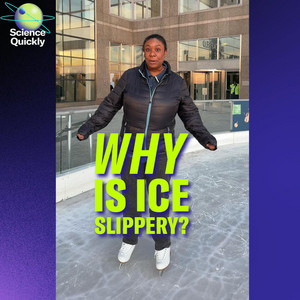
So we're out here today in lower Manhattan ice skating.
There are lots of kids skating around, dudes in hockey skates and I'm here getting my inner Michelle Kwan on.
If you really think about it, ice skating is just controlled slipping on ice.
And whenever I go skating, I can't help but think about the Winter Olympics, like the ones that are happening right now in Italy.
Welcome inside the Cortina Curling Olympic Stadium.
The United States mixed curling duo of Corey Dropkin and Corey TC faces Team Canada in a matchup of unbeaten teams.
And watching the Olympics, I started to realize that, if you really think about it, so many of the Winter Olympic sports are just about controlled slipping on ice like bobsledding, the luge curling, and yet scientists still don't really know why ice is slippery.
Sure, they have theories, like the pressure that we put on the ice maybe melts the ice, creating a thin watery layer, but scientists mostly agree that those theories aren't the full picture.
The slipperiness of ice is actually still a mystery.
It's such a simple question that should have been answered centuries ago, but turns out All the stuff we learned at school.
It's not fully correct.
Like with many, many other things,
So today, we're going to try to get some answers.
For Scientific American Science Quickly, I'm Kendra Pierre-Lewis, in for Rachel Feltman.
There are at least three longstanding scientific theories that try to explain what makes ice slippery.
One of the oldest potential explanations dates back to the mid-1800s.
It comes from a Scottish engineer named James Thomson, the older brother of famous physicist Lord Kelvin.
And it involves the pressure that an object exerts on ice.
We know that the melting temperature It's generally zero degrees Celsius or 32 Fahrenheit.
And above that, we have water.
Below that, we have ice.
But then pressure changes this, changes the properties of water.
That is Polina Rowinska, who we also heard at the top of the episode.
She's a science journalist at Quantum Magazine and she wrote an article in December that dug into the competing theories about why ice is slippery.
One of the hypotheses is that when we step onto the ice, we put pressure on it, possibly lowering the melting point.
It's freezing out there, but we are getting closer to the melting temperature.
So we might be melting like the surface layer of ice.
And then we get kind of a layer of water.
And we all like water is slippery because it's a liquid, not a solid.
Thompson came to this idea that pressure on the ice basically creates a liquid layer by studying glaciers, says Martin Mieser.
Martin is a theoretical physicist in the Department of Material Science at Saarland University.
Glaciers, there is a heavy, heavy load that sits on the points of contact.
And we know that when we are a little below the freezing point and we squeeze on ice, it becomes liquid.
So he argued that ice liquefies because of the pressure.
But there's a problem with the pressure hypothesis a big one, according to Daniel Baum, a professor of physics at the University of Amsterdam.
You would need 10 elephants resting on a single skate in order to get a decent amount of melting due to the pressure.
Given that humans do not weigh as much as 10 elephants and we still manage to slip on ice, pressure alone does not seem to be why ice is slippery.
So another theory emerged, and this one is especially popular among tribologists, scientists who study friction, lubrication and wear between moving surfaces.
Here's Martin again.
When you talk to a tribologist, in particular in the field of ice friction, they would come up with an explanation.
That was proposed by Frank Bowden.
And he made a very neat experiment in the Alps where he put two identical skis.
They had the same way, the same surface finish, the same everything.
But one conducted the heat inside a little better than the other one.
And the one that conducted the heat less well was noticeably faster.
So he said, look, what happens is because you have friction, you get heat.
When the heat, it melts the water.
And the more heat is retained in the contact, the better it is.
What happens is melting by frictional heating.
The idea that Bowden laid out with another physical chemist, T.P.
Hughes, is that as we walk or skate on ice, the friction we create heats and melts the surface.
The concept is called frictional heating.
Daniel's team did experiments where they measured the friction on ice over a very large temperature range, from negative 100 degrees Celsius or minus 148 degrees Fahrenheit to the freezing point of water.
And then all kinds of interesting things happened.
At very low temperatures, you probably don't want to be ice skating anyways at minus 100.
But it's actually impossible to ice skate because the friction is very high.
But then increasing the temperature.
From those very low temperatures the friction decreases extremely rapidly.
Daniel and his colleagues found that the friction decreased until a temperature of roughly negative 7 degrees Celsius, which is about 20 degrees Fahrenheit.
But when they went closer to the melting point of ice, the friction went up again.
And this is something that you've experienced if you do ice skating.
If the ice is too warm, it actually becomes mushy and you leave traces in the ice, which this is what we call plowing friction.
And so we were very happy because we found that there was an optimum temperature for ice skating which is minus seven degrees C.
And so we went to our ice skating rink and they said we've known this for many decades.
These experiments reinforce for Daniel that the answer to what makes ice slippery lies beyond friction.
Sure, frictional heating might be responsible for melting the ice in our wake, that is, melting the ice behind us.
But, as we all know, ice is slippery.
Before you've even stepped on it, before friction has even occurred.
As you know, it's difficult to remain standing on the ice, even at zero speed.
And so we don't think that the sliding itself has something to do with it.
So if it's not pressure or friction, could ice be slippery because there's already a pre-melted layer of water on top.
Paulina says that's what a third hypothesis suggests.
So this has to do with how ice is structured.
So, you know, ice is just water.
So we have water molecules, but they are structured in a very ordered way.
So they form bonds and it's kind of like a nice lattice.
That's why ice is solid.
In a liquid like liquid water the molecules are kind of moving freely and the structure is much looser.
So the idea is that close to the surface of ice, the bonds are much weaker.
So it's kind of like a boundary between two molecules. different materials.
So it's not that the surface of ice is melting, but there is like a pre-melted layer of water on top of ice because of these structural differences between water and ice.
This theory, like the pressure hypothesis, dates back to the 1800s.
It was first proposed by English chemist and physicist Michael Faraday, Martin explains.
He basically saw that from putting two ice cubes together.
And when they were fresh, they would slide.
But if you would wait a bit longer time, they were stuck.
So a single basically interface would form.
And he said, well, they are slippery because there must be a very thin lubricating layer.
And in the last 30, 40 years there was a lot of experimental effort proving the existence of this layer.
But this theory too has holes.
Among them, Martin says, is this layer is relatively thin.
And a very thin layer, even if the viscosity of the liquid is as small as that of water, would still give quite noticeable friction.
So let's recap.
The three longstanding leading hypotheses as to why ice is slippery are one the pressure applied by an object melts the ice, causing us to slip.
Two, friction heats the ice, causing us to slip.
And three, ice has a thin layer of pre-melted water that again causes us to slip.
On the one hand, all of these theories have flaws.
On the other hand, computer simulations run by a group of European scientists a few years ago suggest that it might not be any one of these theories, but all of them together.
You might be asking yourself, why does any of this matter?
We know that ice is slippery.
Does it really matter if we know why?
For Daniel, who is Dutch, it's actually a matter of national pride.
So the most important application for the Dutch is getting gold medals at speed skating.
Yeah, so we're the best speed skaters in the world and we want to keep it that way.
And so we also want to have the fastest ice skating track.
But it also matters if you're not Dutch.
He says it's extremely interesting to think about why things are slippery, because if you can understand what's happening there, you might be able to transfer that knowledge to other systems.
And so things that are extremely slippery are extremely interesting, because friction is responsible for an estimated 25 of the world energy consumption.
Yeah.
And so the Friction on ice is roughly an order of magnitude lower than friction on all other materials.
And so if you could transpose that to all the moving parts in the world, you would save almost 25 of the world's energy consumption.
In other words, ice is slipperier than most other materials.
If scientists could figure out why they might be able to mimic its behavior for use in other applications like train tracks or motorized energy.
This would allow us to lose less energy to friction, cutting energy usage in the process.
But let's come back to the eternal question of why ice is slippery.
So a new hypothesis came out last year in a paper and the idea is it's not really about melting.
It's about almost like a mechanical moving of atoms and molecules on the surface.
So you know how we, when we step on ice, we kind of destroy this structure because there are some almost like electrostatic attraction.
It's not exactly electrostatic, but it's like an attraction between molecules of our shoe and of ice.
But then we keep going, we keep skiing, we kept walking and we kind of keep attaching and disattaching these molecules.
So there is.
They call it like an amorphous layer, so it's a layer that's liquid-like, but it's not really liquid because it's very thin.
So it's not really water, it's not really ice, it's something in between.
And it was Martin's team that published this theory in the journal Physical Review Letters.
He said that to understand the idea, imagine stacking a bunch of egg cartons.
You put them perfectly in parallel, of course they're going to stick.
But ice crystals will never be oriented that well.
They will be misoriented.
And, very much to my surprise, did I see that if I put two misaligned ice crystals in contact, even if I go extremely, extremely close to absolute zero, would I see amorphization right away?
In other words, instead of the crystalline structure one might expect ice to have.
So we saw this very fast amortization at 10 Kelvin.
And then we said, hey, now let's look what happens at minus 10 degrees Celsius.
So in Fahrenheit, I don't know, roughly it's about 10 Fahrenheit or 12 Fahrenheit.
And we did see that the water also liquefied.
To understand what Martin is getting at.
It helps to understand the difference between an ordered and a disordered solid.
An ordered solid is when all of the atoms are arranged in a precise, repeating 3D structure.
Think about a phalanx of Roman soldiers all lined up.
Those structures can handle a lot of stress.
For example, most metals are ordered structures.
A disordered solid, though, is more chaotic.
The structures can be more random, less repeating.
When water becomes ice, the outer layers are disordered.
Their structure looks like an open honeycomb.
When we step on that surface with say, a sneaker or ice gate, we break up that structure, introducing stress into the system.
As the ice works to adjust to that stress, it creates an amorphous layer, something that's not quite liquid and not quite solid.
That causes us to slip.
Or at least that's the latest theory.
Sometimes people ask me if people accept the answer.
And I always say I hope not, because any good non-trivial, correct scientific answer is met by a lot of skepticism.
So the next time you go ice skating or wipe out on an icy sidewalk, you'll at least have a clear idea of why it might have happened.
That's it for today.
Tune in on Monday for our weekly Science News Roundup.
Science Quickly is produced by me, Kendra Peer-Lewis, along with Fonda Mwangi, Sushmita Patek and Jeff DelVisio.
This episode was edited by Alex Sugiera.
Shana poses in Aaron Shattuck's Fact Checker show.
Our theme music was composed by Dominic Smith.
Subscribe to Scientific American for more up-to-date and in-depth science news.
For Scientific American, this is Kendra Pierre-Lewis.
Have a great weekend.