From The New York Times, I'm Michael Barbaro.
This is The Daily on Sunday.
We all knew TV was dead, but thought, why not squeeze in one last development meeting?
This is a video, a kind of comedy sketch, produced by a company in the United Kingdom called Particle 6.
Now, Particle 6 bills itself as the world's leading AI production studio.
So everything in this video the voices you're hearing, the words that they're saying, all of it was generated by artificial intelligence.
And the star of this video is Tilly Norwood, an AI-generated scientist.
Like if a Sunday roast went to drama school and got BAFTA optimized.
But can she cry on Graham Norton?
Of course she can.
And it'll be clipped, subtitled, and monetized on TikTok.
It seemed like a clever one-off.
But a few months later, Particle 6 announced that Ms.
Norwood was close to signing a deal to be represented by a major Hollywood talent agency.
The kind of thing you'd expect from an actual human actress.
And that news caused a sensation in Hollywood.
Good Lord.
We're screwed.
Actors howled in protest.
The arts should be left to human beings.
You're still going to want to have real people.
The head of the largest actors union came out against it.
She, it, is a synthetic creation garnered from ill-gotten data.
Even Whoopi Goldberg weighed in on the view.
What this means is AI in the workplace, not just my workplace, but in every industry.
All of this outcry over Tilly Norwood reflects a real anxiety in Hollywood about the role of AI in TV and movie making.
Because AI is well on its way to remaking an industry we all love and rely upon, which is entertainment.
And you, the viewer, you are not going to be able to escape this.
And neither, for that matter, are the people who work in Hollywood.
So let's try to understand it.
It's Sunday, January 18th.
So let's get to it.
Joining me are two of my colleagues from The Times who think a lot about how AI is impacting Hollywood.
Brooks Barnes. a reporter covering Hollywood for The Times out in Los Angeles.
Hey, Brooks.
Hey there.
And Alyssa Wilkinson, one of our film critics, who is here with me in the studio in New York.
Alyssa, welcome.
Good to have you.
Thanks.
It's good to be here.
So I think we need to establish, Brooks, what we're talking about here.
I think most of us intuitively understand that TV and filmmaking have used elaborate computer-generated imagery for a very long time, right.
I mean, Avatar was a three-hour orgy of CGI.
So what's actually new here?
What are we actually talking about?
So AI is an umbrella term.
What people really mean are two things under that.
One is non-generative AI, tools that assist.
They don't create new content from scratch.
So think about tools that help editors cut movies, tools that help sound designers isolate dialogue on a noisy set digital de-aging.
If you saw Indiana Jones and the Dial of Destiny, Harrison Ford appears to be 30 or 40 for chunks of that film.
He's really in his 80s.
That's all a form of AI.
Fine-tuning, tinkering.
Fine-tuning, and that's under the hood in Hollywood everywhere.
You know, every studio, every network, every streaming service.
The new part and the controversial part is generative AI.
Tools that scrape vast amounts of information and then use that to create new content.
Got it.
So this is not remotely tinkering.
This is whole cloth creation from the vast... generative sea of AI.
Correct.
One example is a biblical show on Amazon called The House of David.
Very popular, 45 million people globally watched part of it, Amazon said.
So they used AI to generate hundreds of scenes that would have been too expensive to film otherwise.
It all began in the days of the Great Rebellion.
For example, there's this sequence at the beginning of one episode about the creation of Goliath, the giant that David kills.
And it's this big, visually impressive montage, a sprawling fantasy landscape.
You've got mountains, you've got angels falling from the sky on fire.
But God punished the angels for their sins.
Banish them into eternal darkness.
All of this was done with AI.
The creator of the show said they were going to do something less impressive because they really didn't have a big budget.
But once they got access to AI, now they can do this big, epic thing.
They are you, my children.
Another place where a lot of people might be seeing this, for instance, is that an AI tool may have been trained on a person's likeness, or maybe even their past performances, in order to generate a completely new performance.
It actually makes me think of Furiosa, the sequel to Mad Max Fury Road.
By the time they did that, an actor from the original had died.
So they used AI to help recreate his performances.
Yes, that is a way that we have seen this happen.
So the distinction you guys are drawing here and this is important is we are used to seeing things that are created relying upon computers, but we're not really used to those creations being created by computers.
Correct.
Even in contrast to what you might see if you go to see, for instance, Avatar right now, which is an actor's performance that's painted over with a digital effect.
That's the classic.
That's the classic.
This is fully created by an AI tool.
Another place where people are seeing this is social media.
You know, Instagram is awash in videos that are completely created by AI.
And sometimes you don't even notice it.
My husband has a master's degree in art history.
And the other day he came to me and said, isn't this little old lady cute?
What's your take on men who bring you flowers?
Flowers die, honey.
My Chanel bag is forever.
Know the difference.
I said, you realize that's an AI video, right?
Yes.
Had no idea.
And don't forget, there's all these commercials we're seeing all over TV where you might have seen perhaps like animation in the past, or you might have seen human actors.
And now you're seeing AI created commercials.
You know, Coca-Cola kind of kicked up a little bit of a firestorm on social media over that this past holiday season.
What was the ad?
Just, you know, Coke always does these little embrace and celebrate the holiday ads.
And this one, they used AI.
And there's...
People were not thrilled about this.
It was AI coke trucks driving by what were supposed to be adorable AI penguins and adorable AI rabbits.
But people really saw it as soulless.
And you know, digital slop was what the critics said, which is sort of the opposite of what they were going for, which was emotional warmth.
Okay.
So now that I think we can all agree that we are in fact awash in AI generative content in Hollywood, I want to back up for just a second and talk about how AI came to the world of film and television and has gained a foothold there.
Because this story, as I recall it, begins with lots of creative types being vocally opposed to the idea, pushing for it to be banned, trying to put restrictions on its use into union contracts.
And yet, here we are.
Clearly, this invasion has begun.
So help us understand how that happened.
So just a couple of years ago, AI was the absolute villain in Hollywood.
It's kind of amazing the degree to which Hollywood as an entity has turned around on it, even though that artists have said publicly how much they despise this.
In my reporting, it shows that they're curious people.
They're interested in tinkering with it.
In particular, directors are really interested in what this kind of technology can do.
And so they've started to experiment more.
I think there's also something that's true of Hollywood, and always has been, which is that it's an art form that is married to technology.
That every change that's happened in the movies for a century has been driven by the development of some new technology, whether it's lighter cameras or it's color, or it's film technology changing to digital or anything like that.
And so there is a reticence among many filmmakers, who often are kind of gearheads themselves, to say well, we're just going to never use this technology at all.
They want to think about, well, where can we use this?
How can we use this?
And while there's also the flip side of this, which is that it's a serious labor issue for a lot of people.
Well, talk about that.
Why it's a serious labor issue for people specifically.
Yeah.
So you know, one thing that is true about Hollywood that a lot of people don't think about is that the vast majority of people who work in Hollywood are, you know, middle class or below.
They're just making a kind of a normal living working in parts of the industry that...
You know, they're doing the visual effects that you see.
They're background actors.
They're doing commercials.
You know, that's how they're making a living.
That's how they're getting their union card so they can have health care.
What happens with something like AI is that you know the studio executives see it and see that this is a way to cut some of that labor out and save money.
Right.
But for the people who perform that labor, the jobs go away.
And that also means that the funnel into the industry goes away.
So there's any number of people who you have heard of who came up through the industry through those routes.
But, you know, now those routes get cut off.
You're saying Leonardo DiCaprio was once a background actor.
Well, I don't know if Leo was, but I read recently that half of the Screen Actors Guild members have done background work in their career.
So those kinds of jobs start to go away.
And that means that there's fewer and fewer ways for people to come into the industry, which means that you just have fewer and fewer interesting voices getting involved in the industry.
But that could fundamentally change the way that an already struggling industry operates.
Absolutely.
There are whole categories of jobs that are under direct threat.
For example, the dubbing business.
You've got technology now that for YouTube shows, for example, they press a button and the actor who performed in English that voice is instantly now speaking Portuguese or Russian or French.
And that is just the start of what's going to come to, you know, streaming services.
These are global platforms.
And so when you start cutting out entire professions, it starts getting really scary for people.
Right.
So we're talking a lot about people who work in Hollywood.
But selfishly, let's talk about me.
The viewer here.
And I want to talk about the contract that TV makers and filmmakers have with the audience, the understanding we all have about what the rules of the road are.
And Alyssa, helpfully.
You've thought a lot about the way AI is being used in documentaries and how that might be changing and challenging the way we think about what is in a documentary and what is a historical artifact of.
Yeah, that's right.
So you know, documentaries are a little different from a scripted movie or TV show in that we assume, when we watch a documentary, that the things we're looking at actually happens and existed in the world.
Right.
And if we're looking at archival video, for instance, which is just video of old stuff, we assume that the old stuff happened.
I do.
That's what makes a documentary a documentary. that is essential for documentary.
So one thing that has happened, that I have heard of happening, is the speed at which particularly streaming platforms need to turn out documentaries to kind of feed the content pipeline has led to producers being asked to create quote unquote generated archival footage, for instance.
So then you, the viewer, are actually watching something that's you know, it looks like something that could be real.
And it wasn't real.
And this has many different ways that it could be a problem.
But one of them is that, you know, in the future we may end up with a world where we have a bunch of little clips of videos that we can't discern which ones were real and which ones weren't.
And do the documentarians who do this work?
Do they disclose this or they just don't think it's actually all that meaningful to the audience?
So the filmmakers that I've talked to hate this.
Like they think this is very frustrating and bad.
And so the push in the documentary world is to, whenever you use generative AI to disclose it on screen so that the audience, You know, the viewer knows.
So one example that does pop up a lot and people may have seen is sometimes the subject of a documentary, for instance, may be deceased and you can generate their voice.
This happened with Anthony Bourdain.
This happened with Anthony Bourdain.
There's been a number of other documentaries where this has been used.
And, you know, there may be instances in which people do use generated visual material as well.
But the idea is we want to make sure that the audience can trust what they're seeing on screen.
You can imagine that will get kind of awkward.
Like the following documentary contains fake versions of deceased actors' voices.
Yes.
Enjoy.
It's true.
But you know what?
I think this is a place where a lot of people's kind of rubber meets the road.
You start to understand how AI generated material could create a real problem for things as lofty as truth and fiction, and you know misinformation and things like that.
And on the fictional side, does the audience have the right to know that AI was used to juice up a performance?
Does the viewer have the right to know that Adrian Brody's accent in The Brutalist was enhanced?
Right.
And does he then deserve the...
Academy Award.
The Academy Award.
He won Best Actor for that performance.
Best Actor for most of his own acting.
Speaking.
Yes.
Yes.
You know, this was a big controversy in Hollywood last year during our Oscar season.
In fact so much that the Academy then clarified its rules and said Using AI in this sense does not exclude a performance.
Right.
But one thing that you do see a lot in films these days, if you stay to the end of the credits which I know only sickos like me do, but is you'll see something at the end where people will say No generative AI was used in the making of this film.
And I do wonder if we will see more often kind of almost like a certified organic label placed on films so that people know that nothing was used.
Or maybe we won't.
Maybe we'll just start assuming that everything has AI in it, the way that we assume that everything has extra sugar.
Everything or everything was shot with a green screen or whatever, you know.
Okay, well, we're going to take a break.
And when we return you, Debbie Downers, are going to have to reckon with the fact that it's not all that bad in the world of AI in Hollywood.
There are some bright spots on the horizon.
There are some serious creative potentials.
And we're going to explore those in just a moment.
That's what you think.
I want to talk about the creative possibilities that AI presents.
And I want to begin with a mega deal that was announced just a couple of weeks ago between a major movie studio Disney, and the biggest AI company, OpenAI.
They're wrapping their arms around each other.
And it's Disney clearly saying that the future of their brands, which are many is, are going to have to live in the world of user-generated artificial intelligence.
And I wonder how much that means that regular people like me and my two kids get to start playing with this suite of Disney characters, that Elsa is no longer some distant figure on screen but someone that we can literally help us do the dishes.
You're right.
This was a watershed deal, a moment.
It hasn't gone into effect yet.
They said, early this year, which I would take to mean by the end of April, people are going to be able to use Sora, which is OpenAI's video creation tool, to make their own 30-second movies, shorts using 200 Disney characters Yoda Cinderella, Iron Man.
Darth Vader Elsa, all of these classic characters that until now have been only available in carefully controlled stories by professional artists or in the black market of AI.
Disney is one of the most obviously controlling companies of its copyright.
There are all sorts of examples.
Such as?
Well, the famous one was they told a stonemason that he couldn't engrave Winnie the Pooh on a child's gravestone.
That created quite a firestorm of criticism of Disney.
So to have this company that has so aggressively policed its copyrights do a deal with open AI is groundbreaking.
It went from adversarial to cooperative.
Well, what does it tell you?
That Disney, being as protective of its intellectual property, realized that this was the right direction.
It tells you that they feel like they have no choice.
You know, if you go on VO, which is Google's AI video generator, you can create a clip using a Disney character.
I did it yesterday.
I typed in Buzz Lightyear riding a bicycle.
A few seconds later, there's a clip of Buzz Lightyear riding a bicycle.
So it's not like this isn't happening without a deal in place.
So they might as well be compensated for it.
They might as well be compensated for it.
And no company is more concerned with how to keep up with what kids want, the children of the future.
How do we entertain them?
And they really have conceded that.
Young people like to remix things, want to be involved with their entertainment in a different way.
They don't just want to sit there and watch what Hollywood has created.
So, you know, they're going to do it anyway.
We might as well be involved and get paid for it and try to do it with some what they call guardrails.
Right, they can control it.
No sex, no drugs.
You can't have, you know, Cinderella doing things that... Are pornographic.
We should probably not discuss.
Right.
Albus, do you view the Disney Open AI deal through...
The prism that I'm somewhat provocatively putting out here, which is the democratization of filmmaking, short video production and the ability of lots of regular people to play with these brands and use them without being sued by Disney.
I mean, I think that I've always felt that Disney should be open to people remixing their intellectual property because it's so beloved.
So in a way, great.
Like, that seems great.
On the other hand, you know, I really wish that...
They had stood up for something a little bit.
I wish that... What do you mean?
I feel like they had the opportunity as the largest entertainment company in the world, which they are.
They still own well over half the box office to say, actually we don't want to see this incursion on our own craftspeople's work.
On the animators, on the drawers.
Certainly.
So if your children, who I'm sure are wonderful, creative people, but if they can make 30-second videos with Elsa, then the people who made Elsa suddenly their work is.
You know, it's not the same right.
And the future of Disney movies, I don't think is going to be the same either.
I mean, one part of this deal was that some of I don't understand how this is going to work, but some of this fan creative material will end up on Disney, which could be cool.
But are those people going to be compensated for their work?
I don't know.
But I'm sure they won't be compensated at whatever rate the people who created the originals would be.
So there's just something going on here that feels smushy to me in a way that I don't love.
And I think that Disney had the opportunity to set a pace for the entertainment industry that they kind of just decided not to take.
Well, isn't the pace perhaps that they've set one where...
A company like Disney makes sure that they are going to be compensated at all for this stuff, rather than it being just a vast dark web of pirated use.
I think what they've basically said is we believe that what we create is content, not art.
And to me, that seems like the end point of all of this.
And, you know, as a person who cares deeply about this—
That doesn't mean that the audience can't then remix and create their own art out of it.
But it just feels like they're indicating the way that they're thinking about their intellectual property going into the next century.
The Writers Guild of America, the Animation Guild, they're right there with you.
I would point out.
At the same time, Disney was careful in that, in timing the announcement of the deal, they also sent cease and desist letters to Google to take down copyright-infringing videos from YouTube.
So they're trying to send a message at the same time like, calm down, we get it, but we kind of had no choice.
It's like the drug dealer defense.
You know, it's like we didn't create this demand, but they're going to do it somehow, so they might as well get it from us.
Right.
We might as well control this situation.
Alyssa, speaking of AI's creative potential...
I want to talk about something that you experienced in Las Vegas recently.
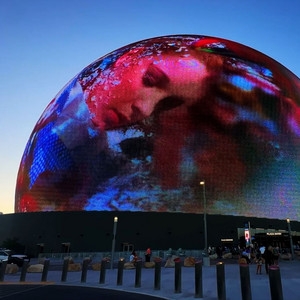
Arguably one of the biggest entertainment events happening right now in the world, which is the Wizard of Oz at Spheres.
By the way, it's not the sphere.
Not the sphere.
Sphere.
Just sphere.
In Vegas.
Just describe what this is and the unique way in which AI has come to play a role in it.
Well, so Sphere, for people who are not familiar, is kind of what it sounds like.
It's a huge sphere that you sit inside.
It's an entertainment venue.
It's been used for concerts and things of that sort.
And this is the first big movie event inside of it.
And When you sit inside Sphere you are kind of enveloped by a screen that comes up around you and behind you.
So it's sort of like the largest IMAX screen you could ever imagine.
And it fills your peripheral vision.
It's basically a planetarium in the middle of Vegas.
Yeah, but like way bigger than a planetarium.
It feels like, you know, a ride.
It snows on you at one point.
You're inside a tornado.
They hurl apples, foam apples at you and things like that.
So it's an experience.
It's the Wizard of Oz experience.
The movie was adapted, I would say, for the space, heavily using AI.
So it was upscaled.
Munchkins were added because, of course, the movie got much, much wider.
It's a lot of screen to fill.
It's a lot of screen to fill.
So, of course, everyone who played a munchkin in The Wizard of Oz, I assume, is no longer with us.
But performances were created for them.
Legs were added to Dorothy for some of the shots because...
Yes.
I mean, we all really needed to know what Judy Garland's legs looked like in that scene.
And it's not just the legs.
It's arms legs torsos, the whole.
It's a whole character that AI is putting into a scene where you didn't see it before.
So in some scenes where you know a character is present, but in the original version because of the camera ratio is not on screen, that character is added in.
So like the Cowardly Lion is now seen or the Tin Man or Uncle Henry early on the farm was recreated.
So they didn't create new characters, but the poppy field goes on and on and on and on now.
Well, let's bring this all together.
I mean, as critic, did you notice it?
Did you like it?
Did it detract?
Did you feel like the contract was being honored or violated between you and the original makers of?
I actually went in to see it expecting to hate it entirely, because I hated the idea of taking AI and throwing it at the Wizard of Oz.
And I came out with very mixed feelings actually, because while I didn't like the Wizard of Oz manipulated by AI, I felt like it actually felt like the AI tools themselves did not pull off what they were hoping for.
Interesting.
For instance, the munchkins look kind of dead-eyed and scary that they generated.
All that warmth was just... It just doesn't work.
It wasn't what I was expecting for kind of how it was played up to me.
On the other hand, sitting in there thinking about what I was experiencing, I could see how an AI tool could be used to take a movie with the creator involved and make a really cool experience out of it and really help people understand how great the cinematic experience is, especially when you're in a room with other people who are experiencing wonder.
I could understand that.
I happened to be seated next to a kid who was probably about 10 who was having the time of his life.
But he also kept asking his father questions, and you know why does the room feel like this and why is the shot like this?
This is why you hated the experience.
You sounded like a 10-year-old.
No, no, no, no.
I love sitting next to a kid in the movies.
It's the best experience.
I think that there's potential there.
But in the future are movies just going to again be content that studios can grab and take AI and just like remix and you know, with with no kind of respect for what they originally were or what the director's original intentions were?
Right.
Because literally, the director of that movie created a border, an edge, and these folks at Sphere literally just like pulled it in entirely new directions.
Yeah, Alyssa, you said something really important, which was with the creator involved.
Like can you imagine taking ET or Jaws or you know a Steven Spielberg movie and saying well, you won't be involved, Mr Spielberg?
We're going to change everything.
Right.
You know, every shot in those films is created through an artistic, you know, sensibility.
And so that was really part of the reason that purists and a lot of people in Hollywood did not like the.
You know what Sphere decided to do here.
For reasons I don't really understand, it went from like 100 minutes to 70-ish minutes.
Well, you understand that.
It's the vacationing masses need to get back to the gambling tables.
So, as we conclude this conversation, I can't help thinking about a modern parallel to what we're talking about here, which is the Internet.
Internet comes along.
Everyone's initially... filled with as much dread as enthusiasm.
And the internet obliterates entire segments of every industry.
You know, classifieds, poof.
But then comes Craigslist.
And yes, and I'm going to be very newspaper-centric for a moment, you know entire newspapers go away.
Other online...
News organizations adapt and thrive, and eventually an equilibrium of a certain kind takes hold.
And isn't that inevitably the story of AI and Hollywood?
I mean, it's definitely one way to think about it.
I think that the metaphor is imperfect in some ways, though, because AI is not a platform, right?
It's a tool.
It's a tool to accomplish certain kinds of tasks.
And the idea there is to cut out labor and to cut people out of the industry.
So really, ultimately, the idea is to take the human out of an art form, right?
And to take human out of an art form, I think, is inevitably going to shrink the art form.
It is true, we keep talking about the democratization of the art form, and I definitely think that it will make it possible for more people to make things.
But I also think that it will make it less possible for people to have those things be seen.
And that has always been true every time we talk about democratization in things like filmmaking.
So that's tough.
And then the other thing that's inherent to AI tools, at least as they stand right now, is that they are trained on existing stuff.
And when we talk about Hollywood, we're talking about an industry that's already profoundly risk averse when it comes to what they put out in the world.
Right.
And AI tools make it more possible, not less possible, to continue to only turn out the same material, slightly remixed, over and over again, because there's less risk in that.
But when we think about a movie like, for instance Sinners, which finishes in the top 10 last year, it's not the kind of movie that makes sense on paper, right?
You need a human to dream up that kind of a film.
And it's that friction, it's that weirdness that humans bring to art that AI just hasn't got to it.
It can do some interesting stuff.
It can help people think.
But in a profit investor driven industry like Hollywood, the inclination is always going to be to run to the safest, most kind of risk averse edge.
And AI makes that very easy.
Brooks, I'm going to give you the final word.
Don't laugh, but one of the positive ways that companies spin this is that the studios, that if AI reduces costs, makes it easier, cheaper for us to make these movies, we can justify taking bolder creative risks if it's not so expensive.
It's a little rich to hear studio executives talk like that, right?
Like, okay, I believe you.
But there is something in it that if the cost of a movie goes down, they are more willing to let it be a little more unusual.
Not all the time, but sometimes.
Right.
And so that is a possibility here if we're looking for rays of sunlight.
Right.
If you cast Tilly Norwood enough, then you will get sinners.
If that happens, I will be the happiest person in the world.
But it is hard for me to believe that that's where we're going.
All right.
We're going to take a quick break and we'll be right back.
So, Brooks and Alyssa, we've been talking a whole lot about AI today in Hollywood.
But to end this conversation, let's talk about human filmmakers for just a moment.
We're here at the beginning of 2026.
You are both movie aficionados.
Can each of you briefly tell me about the film you're most looking forward to?
This year, 20 Choice Experts.
Oh, make the non-critic go first.
Sure.
So well to keep it a little bit thematically appropriate.
One movie that I'm really interested in seeing is Toy Story 5.
Don't roll your eyes, Alyssa.
I'm not.
I love the Toy Story movies.
Well, anything that has five after it.
No, no, they're allowed in my book.
Bonnie, there's a package for you.
Hi.
But the reason that I'm really interested in that is that this idea is Woody and Buzz and all of the old-fashioned toys they're not being played with anymore because the kids all they want to do is play with electronics.
Oh, very appropriate.
An iPad-like device.
And so it's about how the old-fashioned toys battle back into the creative play life of kids.
And I love that idea as an oldster.
Perfect.
Alyssa?
The one I've been saying for well over a year now, actually, is The Bride.
Okay, which is slated to come out in March.
Finally, stars Jesse Buckley, who people now should know from Hamnet, and Christian Bale.
Was I just the same before the accident?
And one of the reasons I'm excited is just Jessie Buckley.
Generally, I'll watch anything she's in.
So winning.
She's always great.
But also, if you've seen the trailer for this, it is bananas.
It's like one of the most bananas trailers I've ever seen.
It's like... Quick summary.
Okay.
The movie is about the bride of Frankenstein, which is great actually, in this conversation as well, because the whole Frankenstein narrative has come to be something about AI.
It's punk.
It looks punk.
I think we're going to have a great time watching it.
And, you know, in some ways, this is an IP story, but done with a real interesting eye.
I haven't seen it yet.
The IP being Frankenstein.
Yeah.
I mean, that's an old, old intellectual property, if you want to call it that.
But it's been reinvented so many different and interesting ways.
I think it really shows you how creativity can be re-infused into the same story.
Monstrous.
Well, to both of you, Brooks and Alyssa, thank you very much.
We appreciate it.
Thank you.
This was fun.
Thank you.
If you liked this episode, and I hope you did, I have some great news for you.
Me and my two daily co-hosts, Rachel Abrams and Natalie Kitchoff, are going to be hosting The Daily on Sundays from here on out.
Today's episode was produced by Alex Barron, with Tina Antolini and Luke Vanderplug.
It was edited by Wendy Doerr, with help from Paige Cowan, and was engineered by Rowan Emisto.
It contains original music by Dan Powell, Marion Lozano, Diane Wong, and Alicia Baitu.
Special thanks to Ben Calhoun.
That's it for The Daily on Sunday.
I'm Michael Barbaro.
See you on Tuesday after the holiday.