This is Planet Money from NPR.
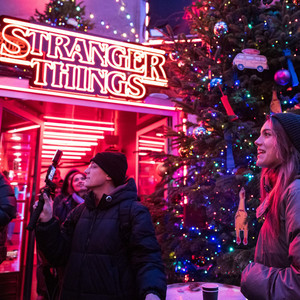
Hey, it's Kenny Malone, and this episode is coming out on December 24th, and so we here at Planet Money, we would love to wish all of you who celebrate a very, very merry night before Stranger Things.
Tomorrow is Christmas and Netflix is about to shovel like four hours of Stranger Things down our chimneys.
Now I had hoped that for this final season, Netflix might consider taking each of these highly anticipated episodes that cost like 50 million a piece on average and then release them episode by episode, week by week.
But nope, Netflix is avalanching these directly onto the holidays forever four episodes onto Thanksgiving, three onto Christmas and a two-hour final episode on New Year's Eve.
And so that is why I hope they're not listening to this.
I will be sneaking away in the middle of my in-laws' Christmas festivities to binge watch from what I've read like three hours and 52 minutes of Demogorgons and whatnot, because if I wait I may get spoiled.
This is the world Netflix has created.
And it seems to be going great for them.
You know, the little startup that used to lend us DVDs in the mail is now so big and powerful.
It is maybe going to buy Warner Brothers and own Bugs Bunny and Tony Soprano and the Harry Potter movies.
And the strategy of binge dropping entire seasons of television has arguably built that Netflix business.
Waylon Wong.
Hello.
What was the last show that you binge-watched?
Technically, it was... Oh, actually, I remember.
It was Industry.
It was Industry.
HBO drama.
Yes, about young people working at an investment bank.
This is very on-brand for Planet Money Indicator host.
I know.
Now listeners.
You may know Waylon Wong as co-host of Planet Money's Indicator, but she is also our staff secret pop culture weapon.
And for an episode about the economics of streaming, about the decisions that have led us to this modern streaming world, and about the critically important question to binge or not to binge, we needed Waylon Wong.
Well Waylon, I have brought you here because it is this binge model that, I contend, built Netflix into what it is.
Yeah.
And I think that the history is a story that can be told in four specific chapters.
Each is their own television show.
Oh.
Intrigued?
Yes.
I'm not going to tell you the television shows, but I'm going to read a quote from each show as we go and see if you can guess.
I'm not going to play it for you because it'll give too much away.
I'm going to read it and see how you do.
Is this a game show?
Is this a show within a show within multiple shows?
Game show within with a show.
Yes, that's right.
Are you in?
Yeah, let's make a deal.
Okay, let's go.
Hello and welcome to Planet Money.
I'm Kenny Malone.
I'm Waylon Wong.
Today on the show, putting all of your episodes out at the same time.
The greatest decision in the history of television or ruining our lives.
Did we, viewers, want this all along or did the companies want us to want this all along?
Plus...
What does the academic research say about whether it is better to binge drop or not?
We have some data now.
Nice.
And Waylon, you're here for a fun, bingey, television-infused ride.
I'm strapped in.
I have my snacks.
I have my water.
This message comes from Superhuman, the AI productivity suite that gives you superpowers everywhere you work.
With Grammarly Mail and Coda coming together, you get proactive help across your workflow so you can outsmart the chaos.
Experience AI that proactively helps you go from to-do to done faster.
Unleash your superhuman potential today.
Learn more at superhuman.com slash podcast.
That's superhuman.com slash podcast.
All right.
Due to the nature of this episode, we're going to end up naming all kinds of real big tech companies.
And so we should say right here, Apple and Amazon are NPR funders.
And with that said, Waylon, we're going to start with a little history.
You ready?
Mm-hmm.
Okay.
So the year is 2007.
Oh, seven.
What was going on in 07?
So Netflix debuts a feature called Watch Now.
Oh.
Oh.
The company which was sending people DVDs.
They had like 70000 DVD titles that they would mail you.
I mean, I got those DVDs.
Yeah, yeah.
It's how I first watched Itu Mama Tambien.
That's how I first watched Infernal Affairs.
See?
And they debuted a streaming option for around 1,000 titles.
Okay.
So very few.
Do you want to see what it looked like?
I do.
Like I have some screen grabs of it.
Okay, let me share my screen here.
Take me back.
It is all very GeoCities looking.
Yes.
Angel fiery looking site.
Okay.
For sure.
And here are some of the titles available if you want to look.
12 Angry Men, classic.
Wow.
Ben-Hur.
It's pretty good.
They launched with good titles.
Casablanca, like Stone Cold classic.
Run, Lola, Run.
That's a fun one.
And with your DVD subscription, you could stream six hours of these with your plan, which was 599 at the time.
Well, also six hours, that's maybe three movies, right?
That's actually not a lot.
And did I say Ben-Hur on the list?
Yeah, Ben-Hur's on the list.
You only get six hours and you watch Ben-Hur.
That's basically all you're doing.
Now how Waylon, do we go from a company that is now on the verge of not just including Casablanca in their streaming offerings, but owning the movie studio that made Casablanca?
That, I will argue, all comes down to just a few key moments and a few key television shows in the history of Netflix.
You ready for chapter one?
Ready for your quote?
Can you guess this TV show?
Yeah, hit me.
Just because you shot Jesse James, don't make you Jesse James.
You're on the clock, Waylon.
Is it House of Cards?
You're ahead of the story.
We are going there, but not yet.
Breaking Bad?
It's Breaking Bad.
Breaking Bad premiered in 2008 on AMC.
And sort of famously the story of Breaking Bad is that no one watched Breaking Bad for the first season, the second season, the third season.
There's some caveats here, like viewership went up a little bit.
But what changed the game was in 2011...
Netflix picked up Breaking Bad and people started discovering Breaking Bad.
They would watch tons of it.
Now that you're telling me the story, I am trying to remember how I started watching it.
And I wish I could remember because I'm like, was I on the Vanguard?
Did I watch it when it was on AMC?
Or was I someone who discovered it on Netflix?
And I can't remember now.
So ahead, and here is the single statistic that I think maybe changes television history.
Are you ready for this?
Yeah.
Okay.
So the night before season five of Breaking Bad premiered the final season.
According to Netflix executives, they saw 50000 people watch the entire fourth season ahead of the premiere.
All in one day?
All in one day.
Whoa.
I hope they got up for breaks.
No.
I would need lots of breaks.
You're not made for this life, Waylon.
I know.
And I will say that show creator Vince Gilligan, when he won one of his Emmy Awards, was talking to reporters afterwards.
And he said, quote, I think Netflix kept us on the air.
Not only are we standing up here with the Emmy, I don't think our show would have even lasted forever.
Really?
Wow.
Yes, the word was out that Netflix was changing things, which brings us to, if you are prepared, key television show number two.
Are you ready?
Yeah.
Money is the McMansion in Sarasota that starts falling apart after 10 years.
Power is the old stone building that stands for centuries.
I cannot respect someone who doesn't see the difference.
Pass the cards.
Yeah, that was an easy one.
All right, what do you know about House of Cards?
Is Mahershala Ali in it?
Yeah, I believe so, yes.
I think that was my introduction to Mahershala Ali.
Me too.
Because I remember thinking, like, wow, who is this guy, you know?
Now, in 2012, Netflix launches its first original program.
It's called Lilyhammer.
It's about a New York mobster moving to Norway.
But this is not the show that really changes television forever.
The next year, in 2013, House of Cards was going to be, for Netflix, the big one.
This was expensive.
This was top-end talent.
But, Waylon, how to release it?
You got to make a splash.
Yes.
Well, Netflix had experimented with binge dropping all of its episodes with Lilyhammer.
But like, look, it had also seen that users like to binge old thrillers.
I mean, we know that statistic with Breaking Bad, right?
Like that 50,000 people had watched an entire season of Breaking Bad ahead of the final season.
Like how many hours is that?
Yeah, that would be, I mean, it's what it's like.
Is it like 16 hours?
Nine hours and 20 minutes-ish, apparently.
Wow.
So Netflix is like, well, let's go ahead and release all of House of Cards at once.
And, you know, it is easy to take this for granted now.
But this was so abnormal.
And it is very fun to go back and listen to coverage of House of Cards back then.
Yeah, it's very fun.
Good morning.
And Netflix puts a new twist on its business model with a new political drama.
It's releasing today all 13 episodes at once.
Not just the pilot, but all 13 episodes of the show's first season.
All 13 episodes today.
Okay, here's a little... Stevie Nitzke is interviewing someone who's written a book about Netflix.
And that person says All of those episodes are going to be put up at once so viewers can watch them really in any order.
Although this also means, doesn't it, there's not going to be appointment viewing.
I'm not going to be eagerly waiting for the next episode of this and talking with people about the next episode of this.
No, but I think that really works in Netflix's favor.
The thing about the end of appointment viewing is kind of prescient.
The thing about you can watch these in any order is really strange.
You could watch them in any order.
It's a country but like do whatever you want but even the interface suggests that you go chronologically like it's not a choose your own adventure you know it's not supposed to be some like formal experiment like television easy to dunk on this all now and then here's the best one I think this is a marketplace piece Instead of releasing a new episode every week, the streaming service is giving subscribers the entire season of House of Cards all at once.
Yoris Evers is a spokesman at Netflix and he says CEO Reed Hastings believes the traditional TV model doesn't reflect modern viewing habits.
As Reed Hastings wrote, imagine if books were always released one chapter per week.
But suddenly somebody flips a switch and you can read the whole book at your own pace.
That's the future of television.
And that's what we call Internet TV.
Internet TV is so funny.
It's so quaint.
It's going to eat our whole world, though.
Internet TV.
It's easy to forget that dumping all the episodes at once was a huge deal.
I mean Reed Hastings, what compared it to going from serialized Dickens to having entire books like the Gutenberg Bible.
I don't know.
I think I'm getting my chronology wrong.
I like the idea that the Bible might have been serialized at one point.
Oh, I can't wait for the rest of Matthew to come out.
You're waiting for each commandment to be etched into the tablets.
What's the next one going to be?
Uh, okay.
So honestly, to some extent, the rest is history.
The streaming wars kickoff, uh, binge watch. enters the Oxford English Dictionary.
Everyone who has a streaming service has at least dabbled in binge-dropping entire seasons of very expensive new shows, and we're all in a place where some of us are so annoyed about Stranger Things Christmas Binge that they're doing an entire episode of Planet Money about it.
Let's not name names, it's all fine.
But what if, though, Waylon, what if it did not have to be this way?
What if there were data saying it should not be this way?
Which brings us to our penultimate show and quote
Are you ready for the quote?
Yeah.
But I'm too young to be the Pope.
The young Pope?
Yeah.
All right.
I got to admit, I made that one up because I've never seen a lick of the young Pope.
But I assume he says that at some point.
We'll explain all of this after the break.
All right, Waylon.
We have arrived with great anticipation, I'm sure. at HBO's The Young Pope.
We have white smoke.
Yes.
A third of our four television shows here.
But before we get to how this factors into the history of binge watching, I would like to introduce you to a professor at Carnegie Mellon named Pedro Ferreira.
Yeah, professor of information systems in engineering and public policy.
One of the things Pedro studies is how the information we interact with and the businesses we interact with affect us and how we affect them.
And He had noticed that there had been a decent amount of research already on how binge-dropping and binge-watching episodes affected the consumers specifically.
Noting, for example, that spending too much time in front of the screen could be psychologically or mentally hurt the consumers.
It doesn't feel great.
I've done a few binges in my day.
I don't feel great the next morning.
I don't know about you, Professor.
Have you binged anything ever?
I have binged many shows years ago.
Name some names.
What have you binged?
Breaking Bad, The Wire, for example.
One of the last ones that I actually binged a couple weeks ago was The Severance.
So he was like, look, we've seen a number of studies from the consumer standpoint.
But let's look at this from a firm standpoint.
Like if you are a company making TV shows, what is the best way to drop this stuff?
And so he got a chance to study data from a company whose name he was not allowed to name.
Though I did ask him if it rhymed with flat nicks.
And he can't say.
But I don't – my guess is it's not.
It's not.
Okay.
But this first study that Pedro conducted was specifically focused on the bingers.
Like what happens to the bingers when you drop entire seasons of content?
And what we found in the end of the day is that binge watchers consume content at a pace never seen before in the industry.
They exhaust the content.
They're binging it.
They're binging it, yes, yes.
Inside, that's exactly what's happening.
And so they exhaust the content of interest to them rather quickly, canceling their subscriptions until new content becomes available.
And they're like, I'm done.
I've finished your streaming service.
Exactly.
And so keeping binge watches from churning requires a pace of content production that the industry has a hard time coping with.
Churning, the ultimate nightmare for streamers.
Where you should say churning is like subscribers quitting right they join, they quit and like that turnover, that churn.
No, i think it's also.
Churn is one of these industry terms that comes up in all of the earnings calls.
I think the idea is that you want to hang on to people because it's quite expensive to get them back.
You then have to send them i don't know all the promos and all the marketing and it's expensive to do that But yeah, so like churn is the whole ballgame.
And what Pedro had been finding in that first study was that bingers are high churners.
Like once they run out of stuff to watch, they're like, I'm out.
I quit.
And so, if that's true, I asked him though, like well then wouldn't, wouldn't it matter which company you were studying?
So like if we're talking about a Netflix versus a smaller company that has fewer offerings.
Yeah, so that's a very good question.
I can tell you that our experiments over the years run on different catalog sizes, exactly to solve that.
And in confidence.
I have some of the larger providers streaming that rhyme with all those words that you mentioned, telling us that we also find exactly the same result.
So if you're catering to bingers, this is maybe backfiring.
Like they check out, they churn.
And here's the thing.
Those hardcore bingers Pedro realized were a very small part of the audience, like maybe five to 10.
Well, I mean way back when you shared that stat about 50000 households or 50000 accounts who watched a whole season of Breaking Bad in one day.
And that is a small number, right?
It's not like a huge number was enough for Netflix to really pay attention.
But it's still a small number, right?
So I would imagine that kind of extrapolates to a relatively small percentage of super users.
That seems to be generally true.
Okay.
So he and his regular co-author, Miguel Godinho de Matus, and Samir Mamadoucine, wanted to know what about the rest of us?
How do we react to different drop strategies?
So Pedro and company partnered with an international telecom company.
That I believe is different from the first study, although he again cannot tell me which one it is.
I can't, sorry.
Even if I ask nicely, or should I not even try?
It's not one of the ones that you're thinking about.
Okay, okay.
Okay.
But the bonkers thing about this company is they were willing to let him mess around with the release schedule of some pretty big deal shows.
We were allowed to release these shows, with a random number of episodes, to different random sets of consumers.
So some restrictions, but allows us to randomize the number of episodes.
This has got to be really exciting as a researcher.
Like this is a pretty wild opportunity to get to play streaming God with people's release schedules.
That is true.
This is an experiment that we have tried to run for a good alpha decade before we actually were able to do it.
Of course, I would prefer to do it with 40 titles instead of just four.
But this gives us a window into results that I think make sense.
So ultimately, they were allowed to kind of manipulate the release schedules of four shows.
And those shows were, Waylon, number one, Big Little Lies.
Uh-huh.
Watched it.
The Muppets.
A show called Unforgettable.
I have forgotten this one.
I definitely forgot that show too.
I'm sorry.
I'm sure it's great.
And then finally, finally, of course, The Young Pope.
Ah, The Young Pope.
Professor, do you remember the plot of the young pope at all?
No, no.
The young pope I have not seen.
There's a lot of memes about young pope.
I don't know if you knew.
There's like a funny picture of Jude Law as the young pope sitting in a lawn chair smoking a cigarette.
This goes on the internet all the time.
I don't know if you ever see this.
I saw that picture.
And one of the things that we tried to do was although I didn't watch a couple of these shows we wanted the shows to be representative of what people like.
Because if we were running an experiment with shows that no one cares, the results would not just be informative, right?
A few really key things about the four shows that were chosen here.
They were all first seasons.
So you weren't going to get an effect of like, let's say, one show had a more highly anticipated second season.
Like that wasn't going to be a factor.
Also, these shows had already launched in the US, but Pedro and his fellow researchers had surveyed the international audience they were about to serve these shows to.
And found that, like, people didn't really know about them.
Even something like Big Little Lies, which I would have assumed kind of had a following, didn't seem to be the case.
So they're all kind of starting from square one.
That seems smart.
Okay.
Now, the terminology I had not heard is that we are testing a drop model like Binge Drop all the episodes at once, versus a drip model, weekly model.
This is the paradigm.
I like this language.
I had never heard this before.
Do you like drop versus drip, Waylon?
Yeah, I do.
Very succinct.
So the game here is like, can churn be minimized?
Which model is minimizing churn the most, drip or drop?
And so Pedro and co-authors wait like three to four months And here is what they find.
So first of all, as we know, there are people who only want to binge content and that's it.
The like true hardcore bingers.
And guess what?
When those people were randomly assigned stuff weekly, they were not happy.
First, as we would expect at this point in time, there are some people that when the content is released on one episode per week or two episodes per week, they don't simply engage.
Those are your extreme binge watchers that just don't care.
That's not their pace.
They show up and they're like, there's only one episode of Big Little Lies?
What am I wasting my time for?
Exactly.
Pedro's point is that when people who only like to binge were randomly served their episodes week by week, they basically hated it and didn't watch it.
Well, it makes total sense.
Yeah, seems pretty obvious.
But Waylon, where this got really interesting for me was when they looked at the data for everybody else, like the people who are not hardcore bingers.
What they found was that people who were randomly given their episodes in a weekly drip instead of a binge drop had way, way lower churn rates.
Like they stuck around much longer.
What we found was that the people in this segment were subscribing the product 50 more than everybody else.
50% more.
50% more than everybody else.
So, meaning they would continue the subscription at a rate that was 50% higher than everyone else.
Than everyone else, being the people that were given all episodes of the shows at the same time.
Which is a big, which is an extremely big difference.
Okay, okay.
So they hung on to more customers who were getting them dripped.
Yes.
Drip was better than drop.
And that is because, of course, people had to stay subscribed if they wanted more of the show that they were watching.
But also, Pedro says, that resulted in people discovering other shows on their own.
As people repeatedly come to the platform, they need to repeat their visits every week.
And there's only one or two episodes available.
They find themselves with some time on their hands.
They go in search for other things.
Now that you've produced this study that says like hey, the drip might be better in many many, many cases.
Have you been hearing from other streamers And what have they been telling you?
They have been telling me something that we just talked about, which is the world is very dynamic.
In the end of the day, it's a matching problem.
I need to do the drop for the binge watchers and I need to do the drip for everybody else.
So I need to know who's who.
I don't think that drip can be done, just drip, and drop cannot be done just drop, because not everybody is a binge watcher, and vice versa.
So are we drip dropping?
Are we not drip dropping?
What are we doing?
Well, okay.
Pedro's finding is that drip was better than drop.
Like, weekly releases reduced churn compared to binge drops.
But there's a bunch of caveats here.
So we're talking about specific kinds of shows.
This is an international audience.
And the average age, I should probably say, is like 49.
Mm-hmm.
And so you know, instead of saying always drip, Pedro says there might be some kind of other optimal solution where you find out which kinds of shows work better as a drip versus a drop.
And then who are the targeted audiences?
Are they drippers?
Are they droppers?
And then a streamer might want to customize releases based on that stuff.
You know what I mean?
Now, has Pedro watched The Summer I Turned Pretty?
I did not ask.
However, it is bizarre that you're mentioning this, because are you aware that The Summer I Turned Pretty is the show that gets mentioned as a case study of thinking outside of drip versus drop paradigm?
No, I brought it up because I thought it was like a glorious return to the drip model.
Okay.
All right.
So, well, it is in fact our final chapter.
Oh!
Since you already mentioned it, do you want to do the quote?
Yes.
I had one.
Okay, go ahead.
Can I look it up so I... Yeah.
I evict you from my heart.
Oh, it's almost talking about the binge model.
We're going to get back to Netflix in a second because why are they still doing this?
But do you want to talk about Summer I Turned Pretty?
I will admit I have not watched it.
Really?
I missed the phenomenon.
Yeah.
You should watch the show.
I know people are on different teams.
Team Jeremiah versus Team Conrad.
All right, and is there a right answer?
Yes, and the right answer is Team Conrad.
Is the right answer?
Okay, all right.
But I mean, you know, people will come.
Definitely write in if you disagree with Ellen.
Oh, they will.
And send it directly to wwang at npr.org.
But okay, we really went right in on this.
So let's back up for a second.
Waylon, do you want to tell the people who missed Summer I Turned Pretty about this?
I would love to.
It is based on this YA romance that was super popular by the author, Jenny Han, who also, I believe, is the showrunner.
It's on Amazon.
And they released it week by week and created some huge social media appointment tv kind of viral collective shared experiences that i certainly participated in.
My daughter got really into the show and we would make a point of watching it together and we'd like scream and cry and throw up at the tv together.
And then i say throw up at the tv.
Well, you know, like that whole phrase, like screaming crying, throwing up, like That's like the kind of emotions that this show elicited.
It was so dramatic.
But I found that really interesting because I had a friend who would go to a bar in LA where everyone was watching the show together and the kind of fandom it elicited and the way they did it week by week.
That felt really old-fashioned and kind of brought us back to this collective experience when we haven't had that kind of experience in a long time.
Aha.
Well, the reason it was on my radar was because it was not always that kind of week by week experience.
Oh, really?
It's been so long.
No, I don't remember.
Was the first season binge-dropped?
It was binge-dropped.
Wow.
So the Summer I Turn Pretty is held up as a case study of this sort of hybrid release model that has been getting more and more popular.
I mean, Amazon in particular is credited with doing this where they will binge drop the first season of a show, like they did with Summer I Turn Pretty.
Right.
And then if it breaks through right and it gets that audience, and then that means that they will have the liberty in following seasons to do something more like your classic appointment TV drip model, because then they can eventize it right.
Make those pop culture moments that go viral.
Yes, exactly.
But I will say, like, we've started seeing some really interesting hybrid models.
Like, maybe you will get the first two episodes of a season that come out together, and that's what happened with Breaking Bad creator Vince Gilligan's new show on Apple TV, and then it went weekly.
You know, another interesting example is the latest season of Andor.
Andor.
Yeah, Andor, exactly.
But it was packaged into mini arcs, right, of, like, three episodes each.
Yep, exactly.
And, uh...
Actually, Waylon, this is not a scheduled final chapter, so let's call this epilogue.
But may I do one final quote for you that I think will be somewhat obvious?
Okay.
All right.
We have a lot of rules in our party, but the most important thing is that friends don't lie.
Never, ever, no matter what.
Aw.
It almost makes me cry every time I hear it.
So good.
Stranger Things.
Yeah.
So I don't feel like we're kind of back where we started, because the release schedule for the final season of Stranger Things this kind of thing that I have been complaining about now for roughly 28 minutes of an episode at this point, you could argue looks a lot like one of these hybrid models.
You've got a batch of episodes on Thanksgiving, a batch on Christmas and then one long finale on New Year's Eve.
But I don't see it that way.
Because to me, Stranger Things has earned its place to be the kind of show that is like The Summer I Turned Pretty.
Like, it has the following.
If ever there were a show that could get away with going weekly and maintain its viewership, this is it.
And yet, Waylon.
No.
No.
Netflix won't do it.
So I suppose you could argue Stranger Things shows that Netflix is willing to fiddle with release strategy.
But to me, it looks like they are just as committed to binge dropping as ever.
And I don't know what to say.
Any thoughts?
Well, I think that you're going to have a really fun Christmas and New Year's Eve.
Why?
Why? are they doing this?
Maybe they have internal data.
They're famously private about it.
And we reached out to Netflix.
They're obviously in the middle of much bigger news.
Yes, other stuff going on.
And so we did not get an on-the-record response from them.
However, we did a sort of dragnet of everything they've ever said publicly about this, or at least as much as we could find.
And I would say that stuff boils down to Binge drops give consumers choice.
It is what consumers want, which, okay, fine.
But when I asked Pedro Ferreira why he thinks Netflix might still be hanging on to this drop strategy, even when other streamers seem to be moving away and even when he has data that says maybe that's not the best strategy, Pedro says well, it's possible that Netflix is playing a longer game here.
Offering the possibility to binge to everyone also has probably this goal of converting more and more of us into bingers.
And it takes time.
But if every one of us becomes a binger and you're the platform that is providing binge, then guess where people are going to go right.
If we are all retrained to become binge watchers Yeah, then we know that.
The existing problem is you need to have enough content to keep our eyes.
And will there only be one company with enough content to keep us all subscribed?
I'm going to go back to listening to fireside chats on my radio.
We're all going to gather around the radio and we're going to listen to the radio.
You think that's going to fix it?
You're done with internet TV?
I'm done with internet TV.
You can support our work and NPR by joining NPR+.
You also will get regular bonus episodes from Planet Money and other cool perks.
Just go to plus.npr.org.
And if you're already signed up, thank you so much.
But it doesn't mean that you can't sign other people up, I think, or convince them to.
NPR is the gift that keeps on giving.
That's what I'm saying.
This episode was produced by Willa Rubin and edited by Meg Kramer.
It was fact-checked by Daniel Suleiman and engineered by Maggie Luthar.
Alex Goldmark is our executive producer.
I'm Waylon Wong.
And I'm Kenny Malone.
This is NPR.
Friends don't lie.
Goonies never die.