This podcast is supported by Signify Business Cash by Wells Fargo.
As a business owner, you wear a lot of hats.
One minute you're ordering today's inventory, and the next you're planning tomorrow's expansion.
It's complicated, but your business credit card should be simple.
With the Signify Business Cash card by Wells Fargo, you earn unlimited 2 % cash rewards on purchases for your business with no caps or categories to track.
Signify Business Cash, the deliberately simple business credit card.
Learn more at wellsfargo .com slash signify.
Terms apply. From The New York Times, I'm Michael Bavaro.
This is The Daily. Today, the mayor, the president, and the alleged quid pro quo that has plunged the Justice Department, and now New York's political world, into chaos.
My colleague, Nick Fandos, walks us through the saga.
It's Thursday, February 20th.
Nick, nice to have you in the studio.
Thank you for coming.
It's always good to be back.
So if you live in New York City long enough, and you almost qualify for this, you come to know the famous phrase from Cindy Adams, the legendary tabloid columnist, only in New York, kids, only in New York.
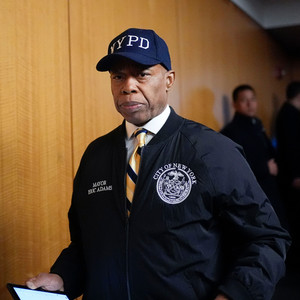
And that seems to apply to the events of the past week or so, when our Democratic mayor, indicted on sweeping federal corruption charges that would seem to spell the end of his career suddenly wins a reprieve from the Republican president of the United States.
But then as the terms of this reprieve become public, it creates this extraordinary blowback that extends far beyond our fair city.
That's where you pick up.
Yeah. Well, as usual, Ms.
Adams, I think is correct.
But Mr. Adams, that is Mayor Eric Adams, I want to make the argument while I'm here today that his case is much bigger than New York City.
Because what has happened over the last couple of weeks, as the Justice Department has taken up and intervened and now moved to dismiss his case, it set off two different crises at once.
I think one of them is for the Justice Department, because in moving to dismiss this case, they have set off a series of resignations and really a very large -scale conflict over the kind of traditional role of the department versus what President Trump wants to do with it, to use it to advance his agenda in all
kinds of different realms.
And at the same time, for Mayor Adams back here in New York City, it set off a real crisis of confidence about is the guy in charge of our city running it in the best interest of the citizens or is he now beholden to President Trump in Washington?
And right now, there's a whole lot of people trying to figure out what to do about that.
I think we should take these crises one at a time, starting with the crisis that this has triggered inside the Department of Justice, where, as you said, the story has been resignation.
So take us in that crisis and why this has felt like a crisis to folks inside the Department of Justice.
Yeah, well, I think to explain that, I want to step back just slightly and remind listeners that last September, the Department of Justice and the United States attorney in Manhattan brought federal charges on bribery and corruption against Eric Adams.
And the charges essentially allege that he was taking bribes and kickbacks from Turkey in exchange for official favors.
The nation of Turkey.
The nation of Turkey.
And the indictment laid out pretty strong evidence.
They had text messages, other communications, testimony from people around the mayor, making a pretty strong case that this behavior had occurred.
But Eric Adams has insisted throughout that he's innocent.
And last fall, he recognized something important was happening.
Donald Trump was marching back to the White House.
And given Trump's own aggrieved view of the justice system, that he was targeted for political reasons, Adams begins to kind of curry favor with Trump.
Right, as suggests that they are kindred spirits in their journey with the justice system.
That's right. And the president seems to pick up and agree on this.
They meet down in Florida for lunch.
Adams attends Trump's inauguration.
There's a developing kind of rapport between them.
And so in the first days that Trump is in office, the mayor's lawyers write to the president and ask for a pardon.
They want these charges to just completely go away.
They don't get a pardon.
But what they got last week was a letter from the Justice Department to prosecutors here in New York saying it's time for you to dismiss these charges.
Mm -hmm. Basically, the mothership of the Justice Department is saying to the New York City wing of the Justice Department, this is over.
Drop the case. Right.
And there's two things that's interesting about this.
One is who's running that mothership right now.
It's none other than one of President Trump's former personal lawyers, Emile Bovet.
And the second thing is what he pens in this letter.
Rather than making this decision based on the evidence of the case, saying, oh, we don't actually think this is worthy of such grave charges or we don't think that you can prove it.
He says, no, no, no, we're not commenting on all of that.
The reason for us to act is that this case is impeding Mayor Adams from helping implement the president's immigration agenda, from helping the president deport undocumented immigrants who have committed crimes or otherwise threatening Americans.
That's a pretty shocking thing to read in an official Justice Department memo because the tradition in the Justice Department is that you make decisions based on the evidence, not on— And the law.
And the law, not on political aims like that.
The other thing about this letter is that Beauvais makes clear these charges may not actually go away.
They say the Justice Department is going to dismiss them without prejudice, which means they could bring them back at a later date.
And the kind of easy logical conclusion is we'll bring them back if you don't help out with this explicit immigration agenda that we're saying we need your help with.
What some would clearly see as a quid pro quo.
And that right there, Michael, is what lays the foundation for the crisis that's now unfolding at the Justice Department.
OK. So take us inside that crisis.
Beauvais' letter is a call to action for the prosecutors in New York to actually dismiss these charges.
So he needs the people who have built this case, who are overseeing that office, who are career prosecutors not appointed by President Trump, to go along with this plan.
Charges don't just drop themselves.
Exactly. And to put it simply, they refuse.
The acting U .S. attorney in Manhattan, who is a conservative lawyer named Danielle Sassoon, says that I will resign before I carry out this order.
And in this extraordinary letter to the attorney general, she says, I was sitting in the room when the mayor's lawyers and the Justice Department were working out this deal.
And basically, the mayor was offering assistance for something in exchange for these charges being dropped.
That, in my view, is a quid pro quo.
There's no way that I'm going to be a party to it.
She finishes the letter saying, I remain baffled by the rushed and superficial process by which this decision was reached.
She's resigning in protest.
Yeah, and she's not the only one.
This sets off basically a set of dominoes because Emile Bovee still needs somebody to sign this dismissal paperwork.
And he starts hunting around the Justice Department for someone who will.
He goes to the Public Integrity Unit in Washington, D .C., which oversees political corruption cases all over the country, and says, you guys sign it.
The two men who are the acting heads of that department, they go with Sassoon and they say, we're not signing that.
We quit. Back in New York, the prosecutor who was overseeing the case preemptively says, nobody's asked me yet, but I'm not doing it either.
I quit. And he writes another pretty extraordinary letter.
This is a guy named Hagen Scotton who had built the case against Adams.
He said, any assistant U .S.
attorney would know that our laws and traditions do not allow using the prosecutorial power to influence other citizens, much less elected officials in this way.
If no lawyer within earshot of the president is willing to give him that advice, then I expect you will eventually find someone who is enough of a fool or enough of a coward to file your motion.
But it was never going to be me.
So he, just assuming his phone is going to soon ring, writes that letter of resignation saying, I refuse to even be in this seat where I might be asked because I'm so disgusted by what you're undertaking here.
And a lot of people at the Justice Department clearly share this opinion.
At the most recent count, eight people have resigned over the Adams case and this dispute.
But Beauvais, he's been undeterred.
He shot back a letter to Sassoon flatly denying that there was any quid pro quo.
He's maintained that everything that was done here is legal.
And by the end of last week, he basically said, enough is enough.
He gets a bunch of lawyers from the Public Integrity Unit onto a call and threatens them and says, somebody's got to sign this thing.
This is incredibly dramatic.
Yeah. And so, ultimately, a senior member of that department, our reporting shows, decided to put his name on it because the bleeding had to stop somewhere.
Basically, he was willing to take one for the team, figured somebody is going to sign this.
But not everybody should have to leave over this fight.
So, he decides to sign it.
Not because he agrees with it, but because the bloodletting, the resignations have to stop.
That's understanding, yes.
And in the end, Emile Bovet actually puts his name on it as well, and it's filed with a judge here in New York to try and dismiss these charges.
So all these resignations, all this drama does not get in the way of what he wants.
But at the same time, it has pretty significantly changed the public understanding of what's going on here and potentially the legal understanding too.
Explain that. So by going public with their resignations and writing these letters, which so eloquently basically amount to a statement of values, these former prosecutors have set up a situation where it looks like the Trump Justice Department is the one that is kind of smashing apart norms that have governed
the Justice Department under Republicans and Democrats for a very long time.
And in doing that, they've also impacted the way that a judge is potentially going to see this case, because though the Justice Department and the mayor both agree that the case should be dismissed, the judge is going to have a say in whether he ratifies that or not.
And he's now armed with a lot of new and very pointed information.
Right, from the people who built this case themselves.
And as we saw Wednesday afternoon, when the judge had his first hearing on this, he takes this set of issues very seriously.
Now, judges are not afforded a lot of leeway in our legal system to stand in the way of dismissals like this.
Especially when both of the constituencies in the courtroom want a case dismissed.
Exactly. But there is a very narrow lane.
If he feels that this deal is subverting the public interest, he could try to intervene and stop it.
And we may not know for days or weeks to come as the legal system reaches an answer on this case.
But back in New York, The mayor, Eric Adams, is facing that second crisis in a very immediate way because Democrats in his home city have been watching all this play out in the Justice Department.
And now they have to answer a question.
What do we do about a mayor who doesn't seem to be accountable to the citizens of New York City, but to Donald Trump?
We'll be right back.
So, Nick, what has this second crisis, this political crisis inside the New York Democratic world looked like over the past week or so?
It's starting to look like it was a profound misjudgment by the mayor.
He thought that getting these charges dismissed was going to give him new political life.
Let him reassert his control over the city and get ready for reelection this year.
Instead, the opposite has happened.
The bottom has basically dropped out from his political support.
When you voted for mayor, did you vote for corruption?
No! Did you vote for a backroom deal between Trump and Eric Adams?
No! We're talking about members of the city council who work with him to run the city.
Right now is the time for the mayor to step down.
Many of them, in fact, have called for him to resign.
It is the intention of the Trump administration to keep the current mayor on a short leash.
We're talking about prominent members of Congress from New York.
My feeling is that the fate of the city, people have been shaken and there needs to be a resolve.
Even longtime allies, Black leaders like Al Sharpton, who have stood by the mayor and said he had the right to defend himself, are now basically saying, unless you can prove your independence, I don't see a future for you anymore.
This is not acceptable.
This is not about a friendship.
I'm going to stand up for what I believe.
This is about what is right and what's going to be oppressive.
They are reading these letters coming out from the Justice Department, and their conclusion is that you are no longer the mayor of New York City's 8 million residents.
You appear to be the mayor of Donald Trump's agenda, or at least his immigration agenda.
And you're putting your own interests ahead of all of ours.
In some ways, it's kind of the worst nightmare for a lot of these Democrats.
At the very moment that President Trump is exerting control of the federal government, that he's upending international affairs, they fear that he has reached his hand back into his hometown, New York City, and is now basically running the show and will implement a bunch of policies that they don't
agree with. And what evidence, just to play devil's advocate, do these Democrats have that that's actually the situation?
Well, one pretty clear piece of evidence that they watch playing out in real time is that even as he insists he is not beholden to the Trump administration, the mayor has a very high -profile meeting with Trump's boarders are, Tom Homan.
How'd it go? Well, Mayor Adams and Tom Homan join us right now.
Guys, great to see you.
And then they go on TV together, including on Fox News.
that's what's good about what we're doing right now what uh tom the border czars has done i've said it over and over again we need to control our borders and basically stands next to him buddy buddy and says we're going to work together i came to new york city i wasn't going to leave nothing and i told
him i'm not leaving until i got something and we got it was where homan makes pretty clear if you don't do what i want if he doesn't come through i'll be back in new york city, and we won't be sitting on the couch up in his office up his butt saying, where the hell is the agreement we came to?
I'm going to be up your butt.
That's an actual quote.
So, exactly at the moment where the mayor is being accused of becoming a bedfellow of the president on issues of immigration as part of this deal to have the charges dropped, the mayor goes on TV with the president's borders are, and seems to allow him to say, you now answer to me.
That's exactly right.
And you can imagine if you're a Democratic lawmaker in the city or you're the governor of New York and you're watching this, you're like, wait a second, maybe this is all true.
Like he's not even, this is the moment where he should be defending himself.
And like instead he's giving more evidence that he's handed himself over to the Trump administration.
However, my sense is that Adams tells all these Democrats politely, I'm not resigning.
So what do they do next?
Not only does he say, I'm not resigning, but he says, you've got this all wrong.
I just believe in these policies.
I'm doing these things because they are right for New Yorkers because undocumented immigrants who have committed crimes have no place in our city.
Give me a chance to prove myself.
Well, obviously, the people who want him to resign are not happy.
There's a lot of people in his administration who are not happy.
And so by Monday, four of the most senior members of the Adams administration, the deputy mayors and other officials who are responsible for running large swaths of the city resign in protest.
And of course, this immediately makes you think back to the resignations over at the Department of Justice.
And so these two crises are now seeming to kind of collide.
Right. There's kind of an echo going on between the two of them on parallel tracks.
These are people who were trusted even by those who didn't trust atoms to ruin the city.
And for those who have already started to lack confidence in the mayor, this really exaggerates that.
And as a result, we see what had been slow growing calls for an even more drastic step start to explode this week.
And that is calls for Governor Kathy Hochul, the Democratic head of the state, to use a little invoked and pretty extraordinary power in the New York state constitution to unilaterally remove the mayor from office.
Just explain that power, how it would work, and whether there's any possibility that New York's governor would even entertain this idea.
Yeah, so some states have recalls, other cities have impeachment processes.
New York does not. But what it does do in the state constitution and the New York City charter is explicitly give the governor the authority to remove officers across the state if she thinks there are charges that warranted.
Single -handedly. Single -handedly.
Now, this is such an extraordinary power that it really has never been used to completion against a mayor.
And the only time it was attempted was by Franklin Roosevelt when he was governor of New York.
So there is very little precedent for how this might work and huge political and legal questions around it.
So as alarmed Democrats across the city begin to come to the conclusion that this power may be the last best chance to deal with Eric Adams before the end of his term.
Pressure has grown in a tremendous way on Governor Hochul.
And Hochul, who frankly has been an ally of the mayor in the past, she puts out a statement that I think really underlines the gravity of the predicament that she is in and the choice that's in front of her.
She says that overturning the will of the voters is a serious step that should not be taken lightly.
That said, the alleged conduct at City Hall that has been reported over the past two weeks is troubling and cannot be ignored.
So she's thinking about it.
She's thinking about it.
And by Tuesday, we find her clearing her schedule, holing up in her Manhattan office and calling in a series of elected officials, civic leaders to basically game out, like, what are my options here?
Should I go down this path?
Should I not? I mean, we should just observe the enormity of what it would mean for the governor of New York to essentially take out the mayor of New York City, as she herself puts it, without an election, in some sense undermining what voters did when they elected Eric Adams.
I think that that weighs particularly heavily on her, especially because there is an election coming up in New York.
I think she's very worried about the precedent that it might set.
I mean, at the same time that her constituents are very concerned about President Trump and the Justice Department blasting apart norms and traditions in Washington, you know, would this put her in the same position to do that?
And on the other hand, if she really does believe that the mayor is captive to Washington, well, I don't know.
How could she not? So she's really in a tight position here.
And I don't think we know yet how she's going to try to get out of it.
Right, and that's more or less where things stand at the time we're now taping with you.
On Wednesday, the governor is still weighing this.
She's indicated serious interest in possibly pursuing this.
But ultimately, she may decide to just leave this in the hands of the voters and take no action.
And so I want to just put this all together now and ask what you think are the larger lessons of these two crises now that they very much have kind of conjoined.
Yeah, it's such an important question, Michael.
And it's one that I've been wrestling with a lot over the last several weeks as we've been watching this play out.
I'm glad to hear that.
It's your job. Now, obviously, both of these crises are open -ended.
We don't know the end yet.
But I've been thinking about the first Trump administration.
I was based down in Washington then.
And I wrote a lot about the special counsel's investigation and the aftermath of President Trump firing Jim Comey as FBI director.
All of these moments that then felt like break glass moments where he was challenging the norms of the Justice Department.
Right. And here in just the first few weeks of his administration, I think that he's made those tests look quaint.
Other presidents and attorney generals have been held back in the past by the threats of resignation, by a fear about what might happen if they go just outside the bounds.
Well, I think Trump is ready to attest, will anything happen?
If I just blow through this and I really want to do it, can anyone stop me?
The mayor of the nation's largest city is now, whether there was a quid pro quo or not, rowing in the same direction as the president on immigration policy.
he's getting assistance in doing something that he wanted, where many other mayors might be putting up a fight.
And it raises the question down the line, could a Justice Department use prosecutorial power to try and extract other benefits from cities or states by threatening lawsuits, by indicting people, by pulling them back?
That is potentially a very potent tool.
This may not be where it ends.
This may be a story that unfolds in Chicago or LA in some permutation down the line and just gives Trump basically another arrow in his quiver, and they don't have a lot of ability to stop it right now.
Right. And just to make very clear what you're saying, because it sounds very important, and I haven't thought about it this way, once the president decides that the threat of prosecution or taking prosecution away becomes a policymaking tool, then there's no reason not to expect that it's going to
be deployed all over the place on all kinds of issues.
The Justice Department may now see the idea of justice as a way of getting policy done.
Exactly, Michael. We have always wondered what it might look like for a president to use the justice system to advance his own ends and his own interests.
Now we're seeing this administration do that explicitly.
And I think for people like Danielle Sassoon, the conservative lawyer, prosecutor who resigned in protest, and for the Democrats in New York City who have been watching this unfold, The most concerning thing right now is that it seems to have worked.
Well, Nick, thank you very much.
Thanks, Michael. On Wednesday evening, Emile Beauvais, the Justice Department official who ordered that charges against Mayor Adams be dropped, issued a stark warning to the department's remaining prosecutors.
In a statement, Beauvais told them that they could either work with him to advance Trump's agenda on issues like immigration, or they could resign.
We'll be right back.
here's what else you need to know today in a series of barbed back and forth Ukrainian President Volodymyr Zelensky accused President Trump of buying into Russian disinformation and Trump accused Zelensky of being a dictator the war of words demonstrated just how quickly the alliance between the US
and Ukraine is deteriorating because of Trump's decision to embrace Russia and cut Zelensky out of talks to end the war between Russia and Ukraine.
And the Trump administration says that it plans to revoke federal approval for New York City's new congestion pricing system, which tolls drivers who enter Manhattan's busiest streets in order to lower traffic and fund mass transit.
The White House said it wants to end the program to save working -class drivers the toll's $9 fee.
But it's unclear whether the president has the authority to shut it down.
I don't care if you love congestion pricing or hate it.
This is an attack on our sovereign identity, our independence from Washington.
We are not subservient to a king or anyone else out of Washington.
New York officials said they would fight to preserve the tolls, which so far appear to be succeeding in reducing traffic.
Today's episode was produced by Olivia Natt, Will Reed, and Diana Wynn.
It was edited by Lexi Diao, contains original music by Dan Powell and Alishiba Itoub, and was engineered by Chris Wood.
Our theme music is by Jim Brunberg and Ben Landmark of Wonderland.
That's it for The Daily.
I'm Michael Bilbaro.
See you tomorrow. The next time you fly, upgrade your comfort to Emirates' premium economy.
sink into soft leather seats with raised leg rests and adjustable headrests elevate your dinner plans with delicious regional dining all served with complimentary premium drinks enjoy endless entertainment with up to 6500 channels including live sports there's no other premium economy like it fly emirates
fly better