This is Planet Money from NPR.
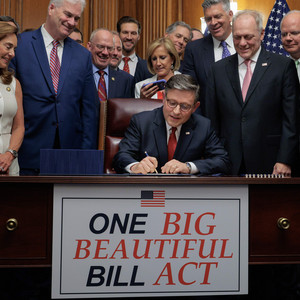
The bill formerly known as the one big beautiful bill has officially passed.
Both the Senate, Being equally divided, the vice president votes in the affirmative and the amendment is agreed to.
And the House, The motion is adopted.
And it will be signed, or may have already been signed by the president, depending on when you're listening to this, meeting President Trump's July 4th deadline.
This is a huge bill, soon to be law, with huge economic implications.
And as is the custom here at Planet Money… Hey there, how are you?
Well, Kelsey Snell, here we are again.
Here we are. We called our dear colleague, Kelsey Snell, to talk about this big new law.
Kelsey is NPR's congressional editor and tends to take on the masochistic task of reading every single word of these huge bills.
This bill is north of 800 pages.
Kelsey, of course, has read it.
Actually, I've read a couple different versions of it.
And at this point, do you have a kind of ritual?
Do you crack open a pack of pecan sandies and a cup of tea?
No, what you need, though, you need one of two things.
Either two screens right next to each other, or you need a printer.
Kelsey confesses to printing this one single -sided.
Please tell our audience that you recycled it when you were done.
Oh, of course. Now, okay, so the headline stuff here.
This is a massive piece of domestic policy, a tax and spending bill that, at its core, takes some of the huge tax cuts from the first Trump administration and makes those permanent and then on a much smaller scale, dollar -wise at least, adds a bunch of spending on things like immigration enforcement and defense and then reduces spending on things like Medicaid, Medicaid food stamps, green energy to try and balance out the tax cuts and the new spending.
Kelsey pulls up the bill to show what this means in practice.
Why don't you scroll over in Section 70501 through 70514?
These are the big cuts to things that were meant to encourage green energy investment.
Tax credits for efficient home energy and for clean commercial vehicles going away, for example.
Republicans have said that they want to undo a lot of these kinds of green incentives that were part of, remember when Democrats talked about the Green New Deal?
Yes. These are provisions that Democrats got passed under President Biden that would have provided a lot of incentives and tax credits for people who are investing in energy efficiency.
So that stuff is gone now.
And then there are the cuts to SNAP, the Supplemental Nutrition Assistance Program, also known as food stamps.
The bill has new eligibility requirements that Republicans say will get rid of waste and fraud in the program and the Democrats say simply drops people from the program to save money.
Kelsey wants to show us something in that section.
Control F for the word non -contiguous.
OK, non -contiguous.
This takes us to a list of exceptions to the new tighter food stamp eligibility.
So the new stricter requirements do not apply to children, to parents who are taking care of a child under 14 years old.
people who are pregnant.
But then if you keep scrolling, there is an exception for people living in non -contiguous states with an employment rate that is at or above one and a half times the national unemployment rate.
So what does that mean?
That means Alaska and Hawaii.
Right. So this is a carve out that says that, you know, these cuts to food stamps don't apply to people in Hawaii and in Alaska, largely because they needed to find ways to convince Lisa Murkowski to vote for this.
Senator Lisa Murkowski, Republican from Alaska, got a few different carve -outs in this bill, actually.
For example, Kelsey takes us to a section of the bill, 7 -0, titled Adjustment of Charitable Deduction for Certain Expenses Incurred in Support of Native Alaskan Subsistence Whaling.
So that is a tax break for whalers in Alaska.
So this is kind of preserving a lifestyle of an indigenous Alaskan community.
That's right. I see.
OK. And again, that is something that Lisa Murkowski really wanted to see get into this bill.
There are so many ways to study and process a bill like this.
You can read it like a kind of legislative forensic investigator looking at the evidence of who got carve outs that got the bill passed.
You can look at the historic political pendulum, the policies put in place by one administration being shredded by a new administration.
Or there is a very simple way to understand this because at the end of the day, it arguably all comes back to this simple math.
This is a bill that makes a big chunk of the Trump tax cuts permanent and tries to balance that out with spending cuts.
And Kelsey says it does not require hundreds and hundreds of pages of reading to get an understanding of that.
So, am I permitted to not read all 800 pages and just think of this as basic arithmetic, where it's like big tax cuts are going to require big spending cuts, and does it balance out?
Spoiler. It does not.
I don't think it's close to balancing out, correct?
No, it's not. Hello, and welcome to Planet Money.
I'm Kenny Malone. And I'm Sally Helm.
And today on the show, the simple arithmetic with profound ramifications.
Tax cuts, slashed spending, and the deficit it will add to.
Today on the show, we walk through that simple arithmetic.
We're going to look under the hood at how all of this gets calculated and how the cuts will actually happen.
And then we will look at how bigger government debt means changes for all of us as little economic beings out there in the world.
This message comes from NPR sponsor, U .S. Bank.
With U .S. Bank Business Essentials, you get more than just a bank.
You get a dedicated partner that provides you a powerful combo of checking and card payment processing with quick access to the money you've earned, proving that there is nothing as powerful as the power of us.
Visit usbank .com today to learn more.
Member FDIC. Copyright 2025 U .S. Bank.
This message comes from NPR sponsor Holiday Inn by IHG.
It's a new day for a new stay at Holiday Inn for business travelers.
With modern spaces for meeting and working, plus delicious dining from breakfast to happy hour and dinner, you have everything you need to get work done.
Give your everyday business travel an upgrade.
Book your next business trip at Holiday Inn by IHG.
Visit HolidayInn .com to book your stay.
Okay, so we are looking at the simple math problem of the big bill.
Tax cuts require spending cuts, which may or may not, in this case do not, balance out in the end.
So let's start with the tax cuts.
What are they and how much revenue will go away when those taxes go away?
I called up two people to help me figure this out.
Valerie Ramey, senior fellow at the Hoover Institution, was an econ professor at UC San Diego for 36 years.
I used to teach 500 students principles of macro, so I try to be clear.
And Howard Gleckman, also a senior fellow at the Urban Brookings Tax Policy Center, loves talking about taxes.
It's actually fun. It's like figuring out a puzzle.
So, first piece of the puzzle, what exactly are these tax cuts?
The biggest one permanently lowers marginal tax rates basically across the board. These were tax cuts that were in President Trump's 2017 tax law, but were set to expire at the end of this year.
Other tax cuts from that law got extended, too.
The majority of the tax cuts in this bill are for individuals, but there are also some in there for businesses.
There's a group of new tax cuts that are versions of things Trump talked about on the campaign trail, like no taxes on overtime, no taxes on tips.
And if you take the tax cuts as a whole, Howard told me, on average, low -income people do get a small break.
But the households that do the best in this law, by our analysis, are households that make between $460 ,000 and $1 .1 million.
So not the super rich, not the Bill Gates's and the Elon Musk of the world, but very wealthy partners in big tax firms or doctors or small business owners, people like that.
So, next piece of the puzzle, taken together, all these different tax cuts, how much do they add up to?
Now, you'd think there would be just one answer to that question.
But when the official scorekeepers assess these kinds of tax cuts for the budget, there are two ways that they can look at things.
And the difference gets into actually one of the key things about what taxes essentially are.
Okay, so the first way to score a tax cut like this, kind of the traditional way, it's called static scoring.
Static scoring calculates how much tax revenue will change given the change in tax rates and deductions, but assuming no effect of that tax change on the path of GDP and income.
So it's kind of a simple one in a way.
It's like if everything stays the same, then this is just like if we cut taxes, we lose money.
Exactly. Exactly. I mean, why is that not where we stop?
Like what is even the other option?
Okay. The other option is to recognize that changes in taxes have incentives effects and they will lead to changes in GDP and income and work behavior, all kinds of things.
That second option is called dynamic scoring.
It thinks about whether tax cuts will spur growth in the economy.
Because if they do, then the tax base gets bigger.
So even if the government cuts tax rates, they're overall taxing more money because the economy has grown.
This is the classic idea that the pie can get bigger.
A lot of times you hear about this when it comes to business taxes.
So, cutting taxes typically induces firms to invest more, both in factories and in what we call intangibles, such as research and development, to come up with new products or better ways of doing things.
There's very good evidence that there are these sorts of effects.
And there's actually a similar argument when it comes to individual taxes.
taxes. So let's say that you're somebody who is only working a part -time job.
You're only working 30 hours a week instead of 40 hours a week.
And the tax rate's very high.
And your boss comes to you and says, Sally, you know, we'd like you to work another 10 hours a week.
And you say, you know, I kind of add up what taxes I'm going to pay on that extra 10 hours a week.
And you know, it's not worth it to me.
I'd rather stay home and walk my dog or read a book.
It's really not worth And that's worth it to me to go to work.
But say Congress cuts my tax rate.
Then maybe I feel different.
You say, you know, I did the math and the take -home pay now is pretty sweet.
And I love my dog and everything, but, you know, it's kind of worth it to me to work that extra 10 hours.
Maybe I even hire a dog walker.
Maybe you even hire a dog walker and that grows the economy even more.
I worked more hours and I created a job.
That is growth. growth.
And this behavior change aspect of taxes, it's important in economics.
Like, on the one hand, taxes are a thing to raise money.
That is key. And if the government cuts taxes, they lose revenue.
But taxes can also change the choices that people make about how much they work, how much money they spend, whether they start a business.
And those choices, taken together can affect the economy in good and bad ways.
The idea with dynamic scoring is include these effects in your calculation.
And if you look at the tax cuts through that lens, well, some of the cuts in the bill will lead to growth, but others don't do much for growth at all.
They just amount to new deductions for certain people.
So where do we land?
How does this big tax cut affect growth?
The official congressional scorekeepers say that it has a very modest effect.
At the Tax Policy Center, we've done an analysis, which has essentially come to the same conclusion, that in the short run, you get a little bit of a boost in economic growth.
The economic growth offsets maybe 10 % of the cost of the tax cut.
There are other analysts who look at added and say, you know, it doesn't even do that.
You know, rough justice here is to say the economic effect is going to be very small.
Whether it's very small positive, very small negative, don't know, but it's going to be very small.
Now, of course, there is just the argument we want to cut taxes because we don't like taxes, whether or not cutting them spurs growth.
But if we are thinking about this possible small growth effect, well, there is no world in which it covers these these tax cuts.
Overall, the net effect of the tax cuts is huge.
They'll cost about $4 .5 trillion over the next 10 years.
So even if growth offset about 10 % of that, we'd still be more than $4 trillion in the red.
So if we're looking at our simple big bill arithmetic to balance these big tax cuts, growth alone won't do it.
So next, let's go look at the big spending cuts.
In the the last six months or so, President Trump has said in no uncertain terms these cuts would not come from Medicaid.
In fact, in the bill that just passed, one of the biggest spending cuts is indeed coming from Medicaid, the program that pays for or partially pays for health insurance for poor and disabled and some elderly Americans.
Kenny Malone is back with his magnifying glass and his jeweler's loop to examine the fine print of these Medicaid cuts.
Yes. Very small, fine print.
Very worth reading.
We're going to go deep here is what we're going to do.
So I am seeing that cuts to Medicaid will end up saving something on the order of $900 billion.
But my understanding is that it's kind of more complicated than just simply cutting lots of people from Medicaid.
Well, yes and no. I mean, to some degree, there is one chunk of the bill that essentially does cut people off of Medicaid by tightening the eligibility requirements.
Now, most notably, the bill has a work requirement that you may have heard of, which means that federal eligibility isn't just tied to income anymore.
Now people are going to have to work or volunteer or whatever some minimum number of hours to also qualify.
So practically speaking, like for the bill math, this is a stricter requirement and people will lose Medicaid or not qualify in the future.
And estimates are that about 8 million people will lose their Medicaid eligibility by the year 2034.
for and obviously i mean that is just a devastating thing for the people who will lose that health and catastrophic stuff yes i mean the math does seem like brutally straightforward though it's like okay fewer people on medicaid cheaper for the federal government yeah so that is you know one big category of medicaid cut but the other a slightly smaller one that i do think is really worth unpacking is a little mushier and has to do with something that i think people are going to to hear a lot about soon, called the provider tax.
Have you heard this term, Sally?
I have. And I got to imagine provider in this case means like healthcare provider, like doctor.
Yes. Hospitals, nursing homes, like that kind of stuff.
And do you mind if we go like deep, deep in the weeds on this?
Because I think it's good.
Kenny, I do not mind.
What else are we here for?
Get your bug spray.
We're going to do tick repellent.
I'm so scared of ticks.
This deep into of the weeds.
You're okay with that?
Yeah, let's go. Okay, so let us begin with this fact.
The way Medicaid money works in each state is that each state spends money on its Medicaid patients, and then the federal government matches that spending at some rate.
It differs state by state, and so, like, Maryland, for example, has a conveniently simple match. For every $1 they spend on their Medicaid population, the federal government also contributes $1.
Okay, so half of the money from the state, half from the federal government.
Yeah. And that's actually the lowest matching rate.
The state with the highest match is Mississippi because its population has the lowest per capita income of any state.
And in Mississippi, for every $1 they spend, the federal government contributes $3 .33.
Okay. So state by state matching system set by some formula.
I got it. Okay. And here's where it gets interesting.
In 1989, the governor of New Hampshire realized a way to game this system, he found out about a way to make it look on paper like his state was spending more on Medicaid than it really was.
And he did that by taxing providers, you know, like taking money from hospitals and such, and then basically promising to give that money back to them by re -spending it as Medicaid spending.
Ah, because if you re -spend it, then it gets matched by the federal government.
That's the gambit. That's the play.
And so in New Hampshire, for example, they have something like a 5 % provider tax on hospitals.
And really what's happening is New Hampshire spends, you know, like $100 on Medicaid at a hospital, gets that $100 matched by the feds.
But then New Hampshire takes back its provider tax chunk, 5 % of that money, and re -spends a ton of it, which gets more matching money from the federal government and so forth and so forth.
I mean, it's a good scheme.
It's very clever. And it is not a secret anymore.
Every single state, except Alaska, does a version of this because the provider tax lets states shift even a little bit more of the Medicaid burden back onto the federal government.
It is generally, by both parties, considered a messy, suboptimal way to fund a national health insurance program.
But it is now the way Medicaid works.
And the federal government has essentially said, fine, do this, but don't go nuts.
And they have placed an effective cap of six percent on the provider taxes that states are allowed to put in place.
OK, I am with you. We are deep into the weeds.
But I do I sense, Kenny, that the big bill might now be coming into our sights.
Yes. Well, OK. So the Trump administration has specifically pointed to the provider tax as an example of, quote, waste, fraud and abuse in Medicaid, Which, by the way, some Republicans say is the rationale behind all of the changes to Medicaid.
But specifically with regards to the provider tax, the bill that just passed does change that tax.
It lowers the provider tax cap.
This is essentially saying that like even that 6 percent tax is too much states should rein it in.
And specifically, this is going to apply to the 40 states that have expanded Medicaid under the Affordable Care Act.
And this bill moves that provider tax cap for those states down from 6 percent to 5 .5 percent and then eventually all the way down to 3 .5 percent in the year 2032.
All right. So meaning, I'm getting this, that those states will still be able to game the system, but just like less and less, like squeezing less and less federal matching money out of the federal government.
Yep, that's it. And the spending cut here, if you want to think of it this way, with regards to the provider tax specifically, really boils down to the federal government not sending as much money to states for Medicaid, somewhere around $200 billion less over the 10 -year window of this bill.
So does that mean that states will then drop people from Medicaid?
That is where it gets a little complicated and a little mushier, honestly, because it's not really a state decision who qualifies for Medicaid and who does not.
That is federal law.
So states will still have the same number of Medicaid patients, but they will have less federal money, and they're going to have to figure it out.
Do they raise taxes to make up the difference?
Do they cut spending elsewhere to make up the difference?
Unlike the federal government, states consider it off limits to run a deficit and borrow money to make up for that.
All right. Kenny Malone, thank you very much for this trip through the weeds.
You're welcome. Thanks for going there.
Do your tick check.
You know, the weeds are fun.
Be in the weeds, everybody.
All right. Checking in on the simple math of the big bill.
These cuts to Medicaid are the biggest spending cuts in the bill.
They come out to almost a trillion dollars.
There are also cuts to food benefits like Snap, and remember there were cuts to green energy tax credits, but they don't come close to covering the tax cuts, which come out to about $4 .5 trillion over the next 10 years.
And because the tax cuts disproportionately benefit the wealthy, and a lot of these spending cuts are to programs for low -income people, this does boil down to a wealth transfer.
The bill also does something else.
We're cutting a lot of taxes and not cutting as much spending.
So we're going to have to borrow money, which will increase the national debt.
What does that mean for you and me?
That's after the break.
This message comes from a ritual.
What makes Ritual Vitamins different?
Ritual Vitamins are made with bioavailable, clinically studied key ingredients, as well as the essence of mint.
Get 25 % off your first purchase when you visit ritual .com slash NPR.
So, if taxes are cut by what comes out to a net of $4 .5 trillion, and the spending cuts on Medicaid and other things are estimated to be about $1 trillion, then where does the rest of the money come from?
It's debt. Of course it's debt.
It's always debt. Mary Childs, we merely just imply the existence of debt markets and you just apparate into the studio.
Thank you. Yes. I'm ready to go.
Are you ready? I'm ready.
Let's go. Okay. So as you know, the government has basically two ways to pay its bills, through tax revenue or through bonds, debt.
And the government has been doing this for a long time already.
The U .S. has spent more money than it takes in.
It has run a fiscal deficit for the last 20 -plus years.
Yes. And over time, that adds up.
The federal debt, how much we collectively owe, already stands at $36 trillion total.
And this bill is expected to add at least $3 trillion to the debt over 10 years.
So you are here to tell us, is this bad?
Like, I mean, will it mean that we just pay for all this some other way?
Like, will it tank the economy?
We just did a whole show for what it's worth asking if we can outgrow the debt so people can go back in the feed to listen to that theory.
Mary. But spoiler alert, we can't.
Well, Mary. All right.
So today you have been trying to find out how this specific bill and even bigger and faster growing debt would affect us, like as little individual economic actors going about our everyday lives.
Yes, exactly. The Richard Scarry version.
I wanted to know how this affects me personally.
So I found someone who worked on economic policies up close and professional within in the very government itself.
Karen Dynan. I am a professor of the practice at Harvard University.
What is the practice?
The practice? The practice of economic policy.
Okay. Okay. So for real economics.
Karen worked at the Treasury Department from 2014 to 2017, putting economic theory into real world practice.
And she told me the deficit can affect our normal people lives lives in kind of two big phases, what I will call the government phase and the private sector phase.
I'm really sorry, but those are the best and only names that I was able to come up with for these two phases.
You can email me if you have better ideas.
I like them. They're descriptive.
They're clear. Don't overcomplicate it.
Thank you, Sally. And they're true, which is important.
So first, the government phase.
Okay. Government phase.
So this is the deficit affecting affecting the government and then eventually us?
That's right. Okay.
So when a government does all this borrowing, someone out there has to lend it that money.
So that's citizens and banks and other countries, central banks.
And generally, when a government needs to borrow more and more, the lenders demand higher interest rates to keep lending.
So interest rates generally go up on new debt.
Now, what really matters with interest is the stock of your debt.
The stock, meaning the the total amount we have borrowed, all the debt that we will have to eventually pay back.
Because you pay interest on the entire stock, right?
If you have a credit card, you're paying interest on the entire balance.
Okay, so for the U .S., that is the $36 trillion that we currently owe, plus whatever trillions this bill will add.
That's right. And for a long time, this was not that big of a problem.
We borrowed and borrowed and borrowed, but interest rates were low and for so long did not go up.
so it was kind of not that expensive to keep borrowing.
But then starting in about 2021, but then really in 2022, interest rates started to go up and up.
So when we borrowed more new debt or just refinancing old debt as it matured, we paid more and paid more for it on more and more and more debt.
I can see how many mores there are in that sentence and how that might add up.
And so one of the particular problems we're facing right now is that interest payments have become a really large share of the spending that we're doing.
Sally, I actually have this chart that I want you to look at with me.
Mary, charts on the radio is my favorite thing that we do.
I thought you might like it.
Okay, I'm clicking it.
Tell me. Okay, I'm looking at a chart that says federal government current expenditures colon interest payments.
Okay, OK, so this is a chart of what the government is paying in interest on its debt.
And Mary, I'm not loving this chart.
I got to say, just it fills me with a certain fear because it's one of those up, up, up kind of graphs.
And I got to say, it's a graph that goes up, kind of really going up kind.
And I got to say, it goes sharply up after 2020.
It's like up, up, up starting in the 70s, up, up, up 2020.
It's like zoop. That's right, Sally.
You have hit the nail on the head.
This chart shows you the growth of how much the government is spending on interest every year.
And it is now so much more than ever.
So that is money that it's not spending on other stuff that might be more productive or useful.
Like Karen has a very practical place where this would show up.
Every place I've lived my entire life has been along I -95.
Oh, that's a good one.
So when people ask me where I'm from, sometimes I say I -95.
I, too, am on Interstate 95.
It's one of the ones that runs along the Northeast Corridor.
And Karen says if the government is busy paying substantially higher interest rates.
My beloved I -95, there would be more potholes.
We'd be more likely to see problems with bridges.
And if we're closing lanes and roads or can't repair the infrastructure the way we need to, that's going to be more hours sitting in traffic.
That'd be a real headache for a lot of people in a way that seriously hurt their lifestyle pretty immediately.
Really? And you know what else a government provides in services?
What? Bailouts. Like if there's a pandemic or a financial crisis, if you, a government, have already issued boatloads of debt and it's become expensive for you to issue more debt, you just have less room to issue more debt for things like bailouts.
All right, Mary, I feel like that's the government phase and I want to hear about the next phase, which in my recollection is called the private sector phase.
Yeah. Sorry again about the names.
I love it. Yes, the private sector phase.
Because it is not just about the government providing less in services.
We would also feel the effects in the private sector.
Businesses would feel it, and so would people like you and me.
When the government goes out and borrows, it's actually competing with other people who want to use that money.
Private firms who want to use that money for something else.
So a small business trying to get a loan so it can expand to build a new warehouse or a factory or whatever.
The lender is choosing between lending to that business or to the government.
And of course, they're going to ask this risky little business to pay more than the big, safe government that always pays its bills.
That'll bid up the interest rate that people are paying.
So it will raise interest rates all around.
So it'll raise the cost of a mortgage for someone buying a house.
It's going to raise the interest rate that people are facing on their credit card. The size of the interest payments every month matters.
I mean, I own a home now.
But if I were going into the market to buy a house, I would buy a smaller house if interest rates were higher.
So that's going to have really— very real effects.
When interest rates are really high, it changes people's behavior.
They buy less house and less car.
car. They buy less of the things that they finance with loans.
But also, when people spend more of their money on the interest on their houses or their cars, they have less money for other things.
Okay, so money for fun things, things we just want, things we love.
That's right. So for our everyday purchases, things that we don't necessarily buy with loans, dinner at a restaurant, a new TV, a vacation, God forbid, potato chips.
Higher rates become a drag on the economy as a whole.
They just start soaking up money, money that could have been used for something more fun.
Economists talk about this idea of crowding out, and that's what they're talking about.
And the longer we run a deficit, the more we add to the debt, the more crowded it gets.
So with this bill, we are going to get at least $3 trillion more crowded.
Mary, thank you so much. Love to talk debt with you at any time.
I'll take you up on that.
Watch out. This increase in the deficit and the increasing amount of money that we have to spend on interest. This is the final and very important part of the overall math of this bill.
Howard Gleckman walked me through where that leaves us.
So you have the tax cut and you have the economic effects of that, but you also have the economic effects of not paying for those tax cuts.
And when you don't pay for the tax cuts, you increase the deficit.
it. The government has to borrow more.
It means there's less money available for businesses to borrow more.
That means businesses have to pay a higher interest rate on what they do borrow.
And that makes them less productive.
And that slows the economy.
When you net out the effect because of the fact the tax cut's not being paid for, and you look at what happens to interest rates, you may not get much. High interest rates hurt businesses.
And as we've discussed, They also mean that the government is paying so much interest on its debt.
To give you some sense of it, a quarter of the taxes that you pay in 2034, 2035 are going to go to pay for interest on the debt.
To really understand the math of this bill, you got to look outside the bill itself to the world that it is entering.
And the world now? It's really different from the way it was in 2017, when a lot of these tax cuts initially passed.
Interest rates now are way higher.
That context changes the math here.
For the worse. A reminder that Planet Money Summer School kicks off next week.
Planet Money Plus supporters will get early access to episodes of Summer School all summer long.
They also get a discount on a live taping that's coming up.
Plus, they always get bonus episodes, sponsor -free listing, all of that.
Thank you so much to listeners who have already signed up for Planet Money Plus.
It is the best way to support our journalism and tell our bosses that you value it.
If you want to join, sign up at plus .npr .org slash planet money.
This episode was produced by Sam Yellow Horse Kessler with help from Cooper Katz McKim and edited by Jess Chang and our executive producer, Alex Goldmark.
It was engineered by Sina Lofredo and fact -checked by Sierra Juarez.
A very special thanks to Jared Walczak at the Tax Foundation for teaching me so much about the provider tax.
I'm Kenny Malone. And I'm Mary Childs.
And I'm Sally Helm.
This is NPR. Thanks for listening.