You're listening to Roundtable.
I'm Steve Hatherly, together today with Yushun and Yunqi.
Coming up, you're the go-to for homework help and the first call after a doctor's appointment.
You're in the middle, the crucial crumbling center of the sandwich generation.
It's a role of constant motion where love and logistics collide every single day.
This is for everyone holding it together and sometimes barely holding on.
We'll chat about it.
After that, it's the end of the week and everybody wants to feel a little tingle of happiness.
We have Roundtable's Happy Place on the way.
And teaser, we have a podcast recommendation for you.
Our podcast listeners, that is you, can find us at Roundtable China on Apple Podcasts.
Don't forget, we love hearing your voice, so you can send us a voice note our way with your thoughts on any of the issues that we discuss on the show.
Here's how you do it. roundtablepodcast.qq.com Once again, roundtablepodcast.qq.com And now...
Stretched thin across the responsibilities of two generations, a growing segment of the population finds itself in an increasingly difficult and emotionally complex situation caring for aging parents while still supporting their own children.
This is called the sandwich generation, and that generation is caught in a silent squeeze, bearing the weight of medical appointments, financial planning and emotional support for the older generation and emotional support for their kids, simultaneously navigating the demands of school activities, formative care for the younger ones.
And it brings about this question.
In a society that often celebrates individual achievement, how can we better recognize and support the silent pillars holding entire families together?
It's a topic worthy of discussion for sure.
So let's start with the big picture, Yunqi.
Who exactly are we talking about when we say the sandwich generation, and why is this a growing phenomenon?
I think that word really paints a very vivid picture of this conundrum or this problem for them.
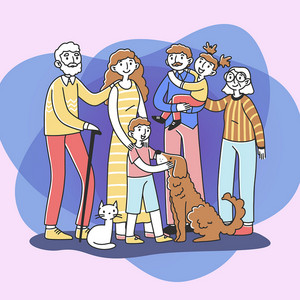
So the term sandwich generation describes adults, and usually in their 40s and 50s, who are simultaneously caring for their parents and their own children.
So if you are someone between that age period, then just picture yourself as the chicken or ham or beef or fish, whatever meat you prefer to be.
In the sandwich.
In the middle, yeah.
And then your parents and your children as the bread that are pressuring and squeezing you in the middle.
So it's a literal representation of being sandwiched between two generations that depend on you.
So the reasons behind this problem is that, First of all, we are having a population that is living longer.
So older people are living for longer years.
And we are also going through a society change that we are waiting longer to have children.
So when we have both of these patterns taking place at the same time.
So this overlapping period of time is a significant demographic shift.
So currently there are over 20 of the US population now that actually fall into this category of sandwich generation.
Yeah, it's a growing segment of society.
Yeah, and people, you know, as they got older into their later years.
In the past they would, they would pass before um a particular age, but now people are living longer than they did before and that means that children it's not.
It's not uncommon for for people in their 50s and 60s to have living parents while having their own kids at the same time.
Perhaps grandkids if you're a 50 or 60 year old.
That's another group, yeah.
And then the flip side of that coin is where people are waiting longer to have children for various reasons.
Higher education, establishing careers, financial stability, whatever personal choice.
You know, now it's common for people to have their kids perhaps in their late 30s, early to mid 40s.
So that's how this situation has come to be.
But all in all, we're just demonstrating a kind of fact that is happening globally.
It's not like we're creating fear for that kind of people who are trying to like having children.
I kind of think is what I was hearing.
Of course, that's quite vivid.
It's a vivid description.
And using the word problem.
Well, it's not necessarily... It's a pattern, yeah.
It's not necessarily a problem.
In fact, you could look at this as an absolutely beautiful thing.
You know, especially if you've got... That's a happy thing, to be honest.
If you've got great grandparents for your kids to be able to enjoy time with you, know this can be a wonderful thing.
But the whole issue of our conversation here is more about the fact that it yes, it can be wonderful, but it's also very very, very difficult for a number of different reasons, and and one of those reasons of course, there's the emotional toll.
But it's impacting people's financial lives too.
Yeah, when we're Seeing a lot of these things the dual financial burden.
Members of the sandwich generation are often financially responsible for both their children's needs, like education extracurriculars, and their parents' needs, which can include medical bills, housing and long-term care.
And this creates immense financial pressure, with about 22 of adults in the US now financially supporting an aging parent.
Then there's the financial fears, right?
And those are legit, and they're very personal.
There's a legal expert who specializes in aging parents.
And, according to that expert, the top financial fears of this particular sandwich generation include the fear of not being able to afford care for their parent and the fear of a parent outliving their money.
Now that sounds like a very cold thing to say, but the fear only speaking about the financial aspect of things, then that is a legitimate stress.
And that kind of stress will stay with you from the moment you open your eyes in the morning until the moment you close your eyes when you go to sleep at night.
Yeah, it is a changing societal pattern that we need to find a new way for how we are going to adapt and change our maybe financial spending and our own lifestyle to adapt to this societal change.
And currently there are people that are in this position of being a sandwich generation, that are finding it nearly impossible to save money adequately for their own retirement.
And their study found that, these caregivers being the sandwich generation, they are spending an average of about 10000 per year out of their own pockets on care-related costs.
And we already went through that financial... responsibility to some extent.
But on top of that, there's actually something that's been neglected.
It's the emotional energy that you have to contribute, because the group also spends approximately 1350 hours on their parents and children combined per year.
And that will convert into 168 days.
That's roughly half a year.
Like a full-time job.
You have to dedicate yourself into the caregiving of your parents and your children.
So typically, children will require more money and capital intensive care, while your parents, your aging adults, will need more time and labor intensive care.
Yeah, it's almost like there's not enough hours in the day to share with everyone and take care of yourself.
And then we mentioned it already, right?
There's the concept of of the sandwich turning into a double sandwich or a triple decker or whatever.
Grandkids.
Yeah, it's called the great grandparent club, where you have an extra layer of responsibility, where you've got the parents and the kids, but then sometimes the kids can have kids.
Because it wouldn't be the other way around, right?
It wouldn't be the parents still with us, but it would be your kids having children and you being a grandparent yourself.
It's exhausting even talking about it, never mind living it, right?
So what about the emotional weight of the caregiving there, Yushin?
That has to be really significant.
Of course.
Of course.
Yeah, and this new reality also comes with a significant emotional toll, right?
Like juggling the needs of three or even more generations can lead to the burnout of the caregivers and stress, and also sometimes guilt, when you're thinking you are not giving enough to them.
And as individuals feel pulled into many directions without adequate time for their own needs, And it can be a kind of lonely and also isolating experience, as they feel they are the only ones managing this burden, because they are kind of the pillar of the house.
Holding everything together.
Yeah.
The statistics we gave were from the United States, but it's not just America.
It's a lot of different countries around.
Global phenomenon.
It's a global thing.
Are we see I can only imagine we're seeing something similar here in China.
Yeah, I think, just like there are some heavy sides to this phenomenon, but at the same time, just like Yusheng earlier said, we can look at this from a little more positive angle, which should be actually a happy thing, because one side of the reason that's leading this phenomenon is that people are living longer, and i was looking into the lifespan of people over the over time and it looks like from over 100 years ago.
In 1900, people were only living an average of 32 years, and then 50 years later, around the time when the people's republic of china was established, people extended their lifespan to 46 years old, and then another 50 years to 2000, the year 2067 years old, and now, in 2021, people are living an average of 73 years.
So now, with people living longer, we actually have that.
It's actually quite a common cultural thing in China that we call a si shi tong tang, where you have four generations of people living under the same roof.
That's just what we talked about, right?
The great grandparent club.
Yeah, yeah.
So there will be some financial responsibility.
As the caregiver, as the sandwich generation, you have to contribute.
But at the same time, if you look at it from a positive angle, you can have the great-grandparents share their time and spend time with their great grandkids, which is actually quite, a very accepted and accepted culture in here in China accepted, expected And not just expected.
And a welcome.
There's a legal responsibility, Yuxin.
And this is a difference between China and the West, I think.
Yeah, first of all, we kind of have or we do have similar situations here in China.
And unlike in some Western contexts, where maybe filial responsibility is seen more as a moral or emotional duty, in China adult children actually have a legal obligation to support their parents.
One example is Article 26 of the Civil Code.
Uh clearly stipulates that adult children have the obligation to support, assist and protect their parents and the responsibilities are including uh, but not limit to living expenses and unnecessary medical costs and something like that.
So culturally the expectation is deeply rooted in cultural traditions as well, reflecting in the old thing like or raise children to be cared for in old age.
So the responsibility of medical bills you mentioned that.
That's the overlapping part, pardon me, with the united states and in the states there's no legal, generally no legal requirement for adult children to provide care for their aging parents.
But some states do have, and I didn't know about this, what they call filial responsibility laws.
And that may impose financial responsibility on adult children under very specific circumstances.
And that could include being required to provide food or housing or medical attention.
And it's also where an adult child could be financially responsible for the parents' unpaid health care costs.
But I don't think that's nationwide.
As far as I know, there are a number of states maybe 29 or 30 states that have filial responsibility laws, but I don't think it's all the states.
When we are having a conversation like this and we know that this is kind of a global phenomenon, right?
But the question still is in my mind, because This is still like sandwich generations, still kind of an imported idea, right?
But the common impression of Westerners is that once you turn 18, or at least you finish your universities, you are expected to live independently.
So why does this phenomenon still occur in some way, when you still have the responsibility to take care of your family like adult children?
Yeah, that Western concept of like the kid leaves the house at 18 years old.
That's not as true perhaps, as it used to be.
That comes from.
You know, when you go out of the house after high school and you move to university, because oftentimes your university will not be located within the same town or the same city.
So you have to move out.
But it doesn't mean you can never come back.
And it also doesn't mean you know a lot of my friends.
I went to school in Halifax, Nova Scotia, the capital city, and some of my classmates were from Halifax.
They lived at home.
So it just depends on the context of the situation.
Just very quickly, we're going to have to wrap this up with this question.
But in China, are there policies in place to support sandwich generation parents, I wonder?
The comprehensive improvements in elderly care and children's health care services indirectly benefit this demographic by providing more support and accessible resources for their dependents.
Yeah um, we do welcome for the caregivers to spend more time with their parents, give care and as well as their children, but at the same time, we also look exploring the solutions to face this societal change of people living longer and having the responsibility responsibility to care for children.
So in So, currently there are over 6000 general hospitals at or above the secondary level in China that they have set up geriatric departments.
That accounts for about 85 of all the general hospitals that they now have a department that's dedicated to elderly care.
And, at the same time, By the end of 2024, the number of practicing pediatricians had reached over 200000.
So that's almost a 50% increase compared to the number in 2002.
Oh, that's good.
That means we have more...
2020, sorry, yeah, the figure.
So over the period of four years, the number of pediatricians had increased 50%.
So that means we are having more care services for the elderly and as well as for the young kids.
More support available.
And, of course, companies can do their help to support as well, with more flexible schedules and access to resources and employees, employee assistance programs and financial planning tools.
All of those things together.
Because when we recognize the situation that sandwich generation individuals find themselves in, the more support the better.
That is for sure.
Stay with us.
You're listening to Roundtable.
And after a brief break, we have a podcast recommendation for you.
Delivery.
Delivery.
Delivery!
Delivery!
What is it?
Happy Meals from Round Table Time for Roundtable's Happy Place.
I'm Steve with Yu Shun and Yun Qi.
And today it's a little bit different because we have a podcast recommendation for you that we are excited about.
Because if you are into myths and legends, you should check out Chinese Folk Tales.
The new season takes you all the way to Xinjiang.
It's in the far northwest part of China.
And this is the podcast where stories come to life.
And you might even hear some familiar voices, because Yushun and Yushan from Roundtable got to be a part of the program.
And Yushun... played a pretty important character in the new season, I think.
So, before we talk about it any further, let's hear the promo for the new season of Chinese Folk Tales.
Chinese Folk Tales new series brings you exciting tales from beautiful Xinjiang in the far northwest of China.
It's known as a land of lively music and stories so wild you think they were made up.
Like a mirage emerging on the hot road, a man in a long robe showed up on a donkey.
Tales of greed and sweet revenge.
Seventy eighty ninety, i want more time's running out.
Get out of my shade or pay me for it.
Stories carved from millennia of myths and legends that woman is a devil.
I can feel her evil energy.
Come out, you demons, and face your doom.
Timeless tales of love and loss.
I bring you gifts and once we are married, you shall live in a fine palace Encased in a swirling mist of music and dance.
The tree is singing.
It's singing.
I found a singing tree.
Chinese Folk Tales.
Now available on your favorite podcast platforms.
How much of the story is true?
That we shall never know.
That's fun.
Did you have fun?
We heard your voice in the ocean.
You were playing the role of Afanti.
And Afanti is a character I learned about very recently.
So tell our audience, if you don't mind, who Afanti is.
So he's a very very interesting and smart man and I tried to play really smart way to act him.
But honestly, I don't think I sound very smart myself.
The process is quite fun, I would say.
Afanti is a famous character in Chinese folktales, yes?
Yeah.
It's not only a household sage in Xinjiang, but also a shared cultural symbol among the peoples of many countries in Central and Western Asia.
His stories transcend languages and borders everywhere, serving as a vivid testament to people-to-people bonds, to mutual learning of civilizations along the Silk Road.
And, of course, the series is not only about the stories of Afanti.
There are also many other stories or folktales originated from Xinjiang.
And this program is very interesting to watch, listen to and also watch to, because you can also watch some of the episodes In the format of videos.
Oh, very cool.
So it's a collection of the folktales from Xinjiang, So more than just Afanti.
Yeah, Afanti sounds very Chinese, But at the same time, Afanti sounds very exotic.
Yeah, and before we re-enacted this show, I actually almost forgot that as a kid I grew up watching a lot of cartoons.
Oh cool Yeah, it's actually a very popular cartoon in China The folktales of Afanti.
It's a part of China that's famous for culture and food and music and folktales.
Check it out.
The new season of Chinese folktales.
And that will do it for today's roundtable.
Thank you so much for giving us your time today.
We certainly appreciate that.
Thank you to Yushun and Yunqi.
My name is Steve, and we certainly hope to see you again next time.