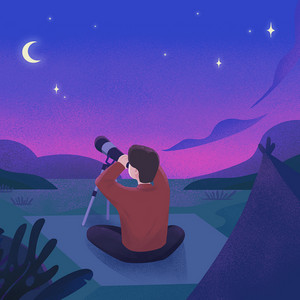
Forget the guidebooks.
The new travel itinerary is written in the stars.
It's called Stargazing Tourism, and it's booming.
But why?
We'll explore why travelers are now chasing celestial events and weather phenomenon.
We're live from Beijing.
This is Roundtable.
I'm Steve.
Thank you so much for being with us today.
And for the show, I'm joined by Yushun and Jingyu.
First on the program.
Stargazing has always carried a touch of romance, has it not?
Ancient poets wrote about the Milky Way stretching endlessly above them.
And today, people living in crowded, neon-lit cities are rediscovering that same longing the desire to look up and see the stars.
Across China.
Stargazing tourism is gaining momentum, blending astronomical science, leisure and culture into a fresh kind today, of travel experience.
So why are people doing this?
Why are more people planning their trips around the sky and around the weather?
We're going to touch on that as well.
And what does this say about tourism as a whole?
Xingyuan, Yuxuan, good afternoon to you both.
Let's get into it.
Yuxuan, you talked about this.
You've done this, have you not?
Stargazing tourism.
Yeah, kind of actually.
I did it last year.
And I was trying to chase that meteor shower and I failed, unfortunately, because of the weather.
But anyway, I can totally see it is getting so much more popular in recent years.
And, you know, growing tourism sector centered around experiencing and maybe monetizing the night sky right.
It goes beyond simply just watch stars because...
It blends, as you said astronomy education photography, art and outdoor leisure activities into that kind of themed travel experience.
Like when you're going for a trip, for a stargazing absolutely you're going to eat, you're going to live, maybe somewhere, right.
So it is actually linked up with a whole industry.
Yeah, you're right.
It's much more than simply looking up, because there are so many more things involved that, And it's kind of like stargazing plus, I guess, isn't it?
Xinyu, there's a couple of models involved here.
One of them is education, yes?
Yes.
Actually, I've looked up this Shenzhen's Xichong Dark Sky Planetarium.
It was...
Aside from this observatory and also this dark sky planetarium, there's also this international dark sky community, established in Shenzhen Xichong.
And it's recognized as China's first international dark sky community which is certified by Dark Sky International.
Oh, that's an international community too.
Yes, and this place collaborates with schools and also the public to host lectures on celestial events and also hands-on telescope sessions.
Oh, cool.
Yeah, and also they invite tourists and residents living there living nearby the location to have this on-site live stargazing activities and also popular science lectures.
Over the past five years.
That's cool.
So the people living in the area can take advantage of the facilities there for a little bit of fun and a little bit of education.
But it's more than just that for the local communities yes, and also this location.
It's located just six kilometers away from the urban city, so that means the environment there is pretty good and also, since 2021, they have been improving the overall environment as well as to reduce the light pollution around this site.
You can't put one of these things in a downtown area of one of the biggest cities in the world.
It just won't work because of all the all the light pollution.
But yeah, as I was saying, they have it for the people who live in the community, but there are also specialized trips.
And these involve professional tours where they'll bring in enthusiasts, people who are really into this kind of thing as a hobby.
And these are designed around these observation conditions or these observatories.
I've never visited one myself.
I've always wanted to.
Me neither.
Yeah.
I've never looked through a telescope before, as a matter of fact.
And that makes me feel like I've been missing out on a lot.
Oh, that actually reminds me.
I didn't do that as well.
It feels like it's something so normal that you can see through that.
But not a lot of us can have that chance to experience that.
And that is why I think in recent years, a lot of parents are taking their children to this kind of educational tour focusing on like science outreach through these lectures or observatory activities.
And even they are like the stargazing have merged with, let's say, camping and outdoor festivals, even music festivals and events, creating that kind of, as you mentioned, stargazing plus format.
Yeah, so it is gaining more popularity here in the country and the numbers, they prove that too.
Yes.
If we look at the data during last year's Perseid meteor shower season, that meteor shower actually is visible every year, primarily in August.
So during that period, searches for media shower on China's travel platforms increased by over 200 month on month.
And some of China's cities, like Zhongwei.
It's known for its large desert area, which is located in Ningxia Hui Autonomous Region, and also Inner Mongolia's Ulan Chab and also Heilongjiang's Mohe.
It's located in the northernmost part of China.
I haven't been to any of those places, but I've seen images of Inner Mongolia, which looks like an absolutely beautiful part of the planet.
And this is how I would describe it, kind of like big sky country.
The sky just looks bigger there than it does when you're standing in the middle of a city or something like that.
Yeah, so obviously those would be some of the best places to go.
But what are some of the other reasons that this is becoming popular?
I feel that celestial events, they always have this cultural connections, cultural connotations in China.
Apart from the ancient mythology that people have created based on these phenomena, but also modern days, it's pretty much linked to romance.
Like we even have TV dramas named after media shower, right?
It's centered around high school romance.
So it's a widespread belief that when you see a shooting star, you have to close your eyes and you make a wish, and then the wish can come true.
That's a Western concept as well.
That's a worldwide thing, I guess.
Yes.
Yeah.
So they have the locations that you can go to.
You touched on a few, but they also have and I thought this was kind of interesting stargazing hotels.
And those hotels had a 47% increase in reservations compared to a month before.
And a lot of those destinations were fully booked.
A stargazing hotel, how does that, do you know how it differs from a regular hotel?
Basically, they are just hotels in popular stargazing areas, and some of them then may have special designs for stargazing.
Let's say, it's like, have you ever seen that kind of pictures of Bubbles Hotel?
Yeah, like a little dome.
Yes, and you can see through the ceiling in your hotel room and the whole night, the whole sky is yours.
It might be a little hot in the morning.
That's what I always thought when I saw pictures of those things.
Some of them can be very, very luxurious and they will have very good condition for you and you will experience that very fancy kind of thing.
Yeah, I think I was looking at a travel website, just browsing for fun, and maybe Iceland or Norway or Denmark or up in that part of the world they have these kind of bubble hotels and they're just kind of like.
Out in the middle of nowhere.
It feels like that when you're looking at the images, of course, I'm not sure.
But yeah, they don't seem to have curtains on the roof.
So I always thought oh, it must be when the sun comes up in the morning.
You're going to, you're going to wake up as soon as that sun comes up, for sure.
So there's a lot of factors going into the popularity of this.
What would you say?
Some of those factors are social media is absolutely one of the push in this sense.
You know, viral photos of the starry nights, media showers and also red moons circulate widely and a lot of people will just post them on social media and some people like me, will follow them and then they will like, recommend you specific places and when you go into that places, it will give you a sense of adventurous, um way that you go to that place with somebody, maybe with some romantic, um connotation, in this way when like, you're chasing the star together.
Yeah, that kind of thing.
So it's not, it's like we have that foundation of like, cultural background or basement going to that specific place.
It also, like the tourism part is also a very attractive thing.
Is that how you found it last year?
By social media?
Yes, that's where you got the idea from.
Yeah yeah, you said you didn't get to, you didn't get to see the shooting star because the weather didn't cooperate, but i'm guessing that part of the fun is the chasing yes exactly, the uncertainty of whether you will see it or not.
Yeah i, i didn't succeed uh, chasing the stars but uh, the process is really enjoyable.
And we didn't, we did like we did not go to that place only for chasing stars.
Right, we went to that grassland we we, we like get on the horseback and uh, you know really yeah yeah because um, that's like like, we can experience.
So, Even though we didn't get to see the meteor shower, but we still enjoyed that.
Yeah, of course.
Yeah, because it's not just about the star itself or the stars themselves.
It's about, you know, all the activities that you're doing around it.
I would say lifestyle would have perhaps a bit of an influence here as well.
Maybe a lot of people live in big cities and concrete jungles.
Do you think that has something to do with it?
Yeah, definitely.
I feel like when you are dealing with this busy city life, sometimes you just want to want an escape or just to get away from all of this urban life and to go to a remote place and just look up the sky and enjoy the view.
But I'm not the person to do that at the time.
I remember a while ago, there was this total lunar eclipse, and I didn't observe the moon.
The next morning, when I scrolled through the WeChat moments, the pictures of the moons are everywhere.
And that was good enough for you, seeing it on WeChat.
I observed it for the whole process.
Oh, did you really?
And it was really fascinating.
WeChat moments and social media, where other people will take their pictures or videos and put them up for you to see, but also tech support in the sense that these observatories are accessible now and people are aware of them.
Exactly.
Some of these apps, like astronomy apps now can help users easily locate, like planets and track of moonrise times, and also simulate constellations in real time and, like you can like turn on your camera, you can totally see that the map of the stars.
So other technologies also help travelers gain better experiences.
I actually use some of these apps.
When I was doing stargazing and the app said it's gonna be like a lot of clouds that day, so we didn't like fully expect that we're going to see it.
So I think that also helps us to have a better experience.
How do the apps work?
So you open it up and then it just provides you with information.
Or if the sky was clear, you would point the camera at the sky and it would identify things for you.
That varies.
Some of the apps like give you that kind of immersive experience.
That's one type of app and another are basically like information apps that they'll tell you uh, what the weather is gonna be and how the cloud is gonna go and how everything is gonna be in like few hours or few days.
So that's um, i think they're cooperating with some meteorological bureaus or something so You can get the like up-to-date information on your phone.
When looking up information for our chat on this topic today, I came across an article from the Smithsonian and it had a list of the 10 best places For stargazing around the world.
Now obviously, a list like that is going to be subjective, right?
There's more than 10 great places around the world.
But as I was scrolling down the list I found I was pleasantly surprised because Nova Scotia Canada, was listed in the top 10 places for stargazing.
And I'm from Nova Scotia.
Yeah, I'm from Nova Scotia, Canada.
And you do a lot of stargazing.
Yeah.
Yeah, we do.
I mean, my parents have a very small place in front of the water at a beach in Nova Scotia.
And it's in the middle of nowhere.
The closest town is maybe a 25 minute drive away.
The closest store is like a 15 minute drive away.
So what that means is at night.
There's no light pollution at all.
There's no pollution in the air.
So what we do in the summertime is we'll build a little campfire on the beach on the sand and then just eat some marshmallows and some food.
And then when the fire gets close to going out, you know, we stay up late.
It's party time, summertime.
Around 2 or 3 a.m., put the fire out and then just stare up at the sky.
But here's the thing.
We don't call it stargazing.
No.
What do you call it?
Just looking up at the stars because it's just there for us all the time.
But Canadians will travel for it.
I think there's places where you can see, oh, what are they called?
The Northern Lights, right?
The Northern Lights, Aurora.
Yeah, the Aurora Borealis, I think.
Yeah, that's in a different part of Canada, though.
But still, I was pretty proud to see my home on that list.
So, OK, we talked about the good things and obviously the benefits.
Are there any challenges that come with this sector?
One I would have to imagine would be the dependence on the weather, because people book their tickets.
And you were OK with it, Yuxin, but a lot of people might be disappointed by that.
Yeah, actually we went to that place with the whole group of people and some of them are disappointed because of the weather.
So clear skies are not guaranteed right, when we're going to that place.
Remote destinations often lack the infrastructure for like, smooth visitor experiences and nobody can guarantee that you are going to see that star going through the sky.
So, And also infrastructure accommodation, transport and dining are often or sometimes underdeveloped in remote starting sites, because when you go into these places, because you need to get into that open area with people, low um light pollution yeah, and those probably aren't the places for you know, three or four or five star hotels, because there's just usually not enough foot traffic there or tourists right yeah, and also, i think there's still a gap in awareness.
When We think about traveling, we usually think about where you can spend your time during the daytime, not the night.
Yeah, that's a good point.
Yeah, you think about where you can go to enjoy the beautiful nature, or you can visit the cultural sites, but not the night sky, I mean.
So I think for most of the tourists, it's not an option for them when it comes to public holidays.
And also, some of these celestial events, they don't happen during public holidays.
They can be some random events happening throughout the year.
They often don't cooperate with the calendar, do they?
That's a fair point.
I was thinking.
When you go to a movie, you pay for your movie ticket.
You know you're going to see the movie.
If you go to the beach, if you fly to a beach location, you know the ocean is going to be there.
But with this, there's no guarantee that it's going to happen.
And a lot of money might go into your vacation, right?
You have to get to the place.
You're going to eat.
You're going to have beverages, maybe a little bit of shopping, depending on where you're going.
So that would be a huge disappointment, I think, for people.
You need a bit of luck.
Yeah.
And your timing is limited, too, when you're on vacation.
Also, I was thinking about this when you go to see something like that, a lot of people wouldn't have a full education about what they were looking at.
If i look up at the sky i don't, i don't know i can maybe find the north star and that's about it uh, so maybe having people who know about the topic would there be a shortage?
There would be.
There be enough people for those positions.
Definitely we need more professionals and some of the trained guides for these tours.
Definitely and I think especially when school students they are involved or some of the enthusiasts they want to learn more about these celestial events and also the whole astronomical events.
Definitely there's room for more people trained guys or professionals joining in the tours to help us understand.
If you bring the kids on a school trip, you're going to have teachers there or somebody there to teach the kids about what's going on.
But if you do it through a travel agency, they might not have those qualified professionals.
That is why for a long time, only hardcore enthusiasts will do that and go to that specific place on specific days to Like chase that specific star to go through the sky.
So we know that these are fascinating, these celestial events, but there is a lot more to offer for travelers.
There are clouds and lightning displays.
There's seasonal frost and rare climate effects.
Nature, i often feel, is moody and emotional, and you never know what you're going to get, but that's part of the beauty of it and that's why there's something called meteorological tourism as well.
What's that about?
Yeah, people will chase to not only stars, but also a lot of other climate phenomenons, so like weather, landscape resources, just as clouds Like different shapes of clouds.
Or sea of clouds over the mountains.
And maybe different forms of rings even.
Snow and light and rare astronomical phenomena.
There's a mountain region in China.
And I don't know where it is.
I believe it's in the southern part of the country.
Where you have the clouds that kind of hang lower.
Or it feels like they're hanging lower.
Ah um, in the mountains, maybe in the valleys a little bit.
Um, i know that that's a really popular tourist destination and those pictures make it look absolutely stunning.
It's not often that humans get close enough to touch a cloud yeah, or be inside of a cloud, if you will, yeah.
When i visited uh, snow mountains in sichuan and yunnan provinces um many tourists.
They go there to watch this phenomenon, called in chinese, called it means sunlight over the snow-capped mountains, and it happens only during sunrises and sunsets and the snow cap will turn golden.
Yeah, turn golden, turn gold, and it's, It feels, like the mountain is made of gold.
And then you definitely need a lot of luck maybe to actually witness that phenomenon, because it doesn't happen every day and it needs the air to be really clear.
And then when the sun hits, the peak, peak of the mountain um, and then the the peak just turned into gold and it lasts for just a few minutes.
So um, i can see that a lot of people they go to the mountains to see this um view, but sometimes they just um, they have to return with disappointment.
With that disappointment because it's because it's a gamble on that one as well.
You mentioned what did you say before?
You said cloud sea.
What's the cloud sea?
A sea of clouds?
Sea of clouds?
Yeah like, I think it's pretty much the same to what you just mentioned Steve, especially in places like Huangshan.
It's in eastern part of China's Anhui province.
Some of the mountains, especially its pine trees, and sometimes the clouds will linger around the mountains.
See, I didn't know it was called Cloud Sea or Sea of Clouds.
I knew what it was.
Yeah.
Yeah.
So there's that.
And those would be perhaps sometimes for maybe not the clouds, but you know the the warmer temperatures would be times when people would go stargazing or to have a look at the weather.
But it happens in the wintertime, too.
Yes, of course.
When, in the wintertime, some specific places like northeastern China will have some phenomenons like frost rhyme or rhyme frost phenomenon.
It's actually in our textbook in my primary school.
Oh, really?
Yeah, like teachers will teach us.
And they beautifully described how it was.
Like they were saying that the trees looked as if they were dressed in silver shimmering clothes.
Oh, see, for me, it looks like the trees are covered in diamonds.
Yes.
So this is like it frequently forms along riversides in urban areas and visually like rime, looks like white and feathery ice crystals or spikes, often found on like tree branches and power lines and fences in winter.
So some people even visit northeastern China during winters into specific places just to see that massive image of that frost rhyme.
It's very picturesque and it's something that i've seen in nova scotia a lot as well.
Yeah, but i didn't look at it positively because it's like minus 25 and you're freezing cold outside, but yeah, it's absolutely stunning.
For sure.
There's something else that people will travel for too.
It's called a solar halo.
Um, what's a solar halo?
These striking meteorological events, especially like common in winter, attracts visitors to like northern China, like Xinjiang and Inner Mongolia.
Again, Inner Mongolia.
Many tourists even take road trips across grasslands and wetlands, chasing solar halos on the horizon.
It's like it's around the sun.
It creates...
A halo.
Like a circle.
Yeah, a circle or a light circle.
And when you're looking at it, it feels sacred.
Yeah, to me.
I've never seen that before.
Have you seen that before?
No, I've seen any movies and like TV series, but never in person.
Never before, huh?
The tourism meteorological tourism is growing continuously here in China in recent years, along with weather-related tourism and stargazing.
Both of these will maintain a pretty rapid growth trend in the coming years, it seems.
There was a report on meteorological tourism development.
It came out from the China Meteorological Tourism Development Institute, and the service industry is predicted to exceed 300 billion yuan, that's about 42 billion dollars, by the end of this year.
So obviously it is extremely popular, be it the help of social media or other things.
The industry is expected to grow.
So, looking ahead um, with the expected growth, what can we expect?
Um, in terms of measures?
Perhaps that would help to boost the tourism?
Yeah, on one hand, I think many travel companies.
They are working to upgrade their infrastructure and also put more fun into these whole tours, including hot springs or cultural experiences or music events.
And also to make it more sustainable, to not to put so too much damage to the environment.
Over tourism.
Yes, over tourism and to... reduce the pollution as well.
And I think they are also diversifying their offerings from these meteorological landscapes to educational programs and also science-based experiences.
So I think there's a lot of room for improvements for the future.
Yeah, I agree.
These are just gifts from the nature and people are chasing them just because they are rare to see.
And I think They are rare for a reason, and we need to pay attention to protect that environment that we can go.
I couldn't have put it better myself.